Example ELA 8th Grade Course
Course Overview
The Grade 8 Core ELA course completes the middle school arc by turning the lens toward Systems — the structures, institutions, and forces that shape both individual lives and collective experience. Students develop the tools to see past the surface of any text or situation and ask: who built this, for whom, and at what cost?
This course prepares students for the analytical demands of high school ELA, with a heavy emphasis on evidence-based argument, research, and the kind of critical reading that resists easy answers.
Key Focus
The key focus of this course is structural analysis and argument. Students learn to read texts not just for what they say but for the assumptions they encode — about power, access, and value. They practice identifying how systems operate invisibly and making those operations legible.
Writing in 8th grade is research-anchored and argument-driven. Students complete an extended research project that asks them to investigate a systemic question of genuine consequence.
Arcs of inquiry
The 8th grade year is organized around three arcs of inquiry:
Arc 1: How do systems shape us? — Students examine the visible and invisible structures that constrain or enable individual action, drawing on historical case studies and contemporary texts.
Arc 2: Who holds power — and how? — Students analyze how authority is constructed, challenged, and maintained, reading across texts that explore resistance, reform, and revolution.
Arc 3: What can one person do? — Students investigate the role of individual agency within systemic constraints, developing an argument about change and presenting it in a final research-based project.
Unit 1: Roots & Remembrance — The Way of Kings
Knowledge-Building Topic
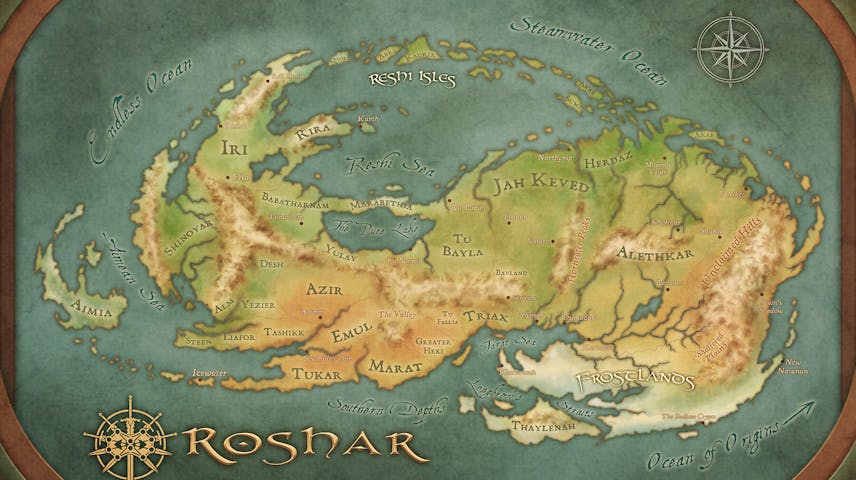
This unit examines how communities construct and maintain shared historical memory through The Way of Kings, the first volume of Sanderson's Stormlight Archive. Dalinar Kholin, Highprince of War, is haunted by visions of ancient Roshar — the age of the Knights Radiant, the Desolations, the Oathpact — and must persuade a fractious assembly of Alethi highprinces that the past is not merely history but urgent instruction. Meanwhile, Kaladin Stormblessed, condemned to Bridge Four and the suicidal work of carrying bridges across the Shattered Plains, discovers that his ability to lead — and to demand accountability from a system designed to kill his crew — is itself a form of civic memory: recovering who he was before the system stripped that from him.
Essential Questions
What does Dalinar's struggle with his forgotten past — his memory of the Rift erased by the Nightwatcher — reveal about the relationship between personal and civic accountability?
How do communities decide which histories to honor and which to forget, and what does the Alethi highprince system reveal about what happens when civic memory is weaponized?

Unit 2: Power, Propaganda, and the Art of Persuasion — Words of Radiance
Knowledge-Building Topic
This unit examines how power uses language, image, and narrative to shape belief and behavior through Words of Radiance, the second Stormlight Archive volume. Sadeas, Highprince of Information, has built his power on the careful management of what the Alethi highprinces believe and who they believe it about. Shallan Davar, a Lightweaver whose Surge of Illumination allows her to create convincing illusions, must navigate the Ghostbloods — a secret society — using fabricated identities that require understanding how people want to be deceived. And Kaladin, elevated from slave to bodyguard of the man he blames for his enslavement, must distinguish between the propaganda that made darkeyes enemies and the reality of individual people in front of him. Students analyze the techniques of propaganda and persuasion that Sanderson dramatizes across these three storylines.
Essential Questions
How does Sadeas's manipulation of Alethi politics — his willingness to sacrifice Bridge Four to gain gemhearts — demonstrate the difference between persuasion and manipulation?
What does Shallan's infiltration of the Ghostbloods, using her Lightweaver abilities to become Veil, reveal about how propaganda requires an audience willing to be deceived?

Unit 3: Recovery & Reciprocity — Oathbringer
Knowledge-Building Topic
This research unit examines humanity's relationship with the natural world through the ecological lens that Oathbringer, the third Stormlight Archive volume, provides. Sanderson's Roshar is a world shaped by its ecology at every level: highstorms deposit crem that builds the geology; spren are fragments of Honor and Cultivation that embody natural forces; the Listeners (Parshendi) bond with spren to take different forms in a deep reciprocal relationship with the rhythms of the land. When the Everstorm arrives — a counter-storm that the Fused have summoned — it does not merely disrupt weather; it destabilizes the entire ecological and spiritual system that Roshar depends on. Students investigate how Sanderson uses this planetary-scale disruption to make arguments about reciprocity, recovery, and what it means to be responsible for the systems that sustain life.
Essential Questions
What does the ecology of Shadesmar — where the physical world's geography is inverted and every object becomes a bead of glass in a vast ocean — reveal about the relationship between the human world and the world that sustains it?
How does Navani Kholin's project of restoring Urithiru — a living tower whose Sibling spren was nearly killed — function as a model of ecological reciprocity: tending the system that tends you?
Unit 4: Stories for the Future — Rhythm of War
Knowledge-Building Topic
This culminating unit examines the relationship between storytelling, knowledge preservation, and cultural survival through Rhythm of War, the fourth Stormlight Archive volume. Navani Kholin, queen and scholar, works within an occupied Urithiru to recover the lost science of ancient Surgebinding — the fabrial knowledge the original Knights Radiant used, hidden in the Sibling's own memory. Meanwhile, the Fused occupy the tower specifically because of what it contains: the preserved knowledge of Rosharan history, including the Singer history that was suppressed when humans arrived. Students investigate how Sanderson uses the parallel projects of Navani's knowledge recovery and the Fused's cultural reclamation to make an argument about what stories are worth preserving, who gets to decide, and what it costs to be the one who carries them.
Essential Questions
What does Navani's project of recovering ancient fabrial science — including the lost knowledge of the Dawnsingers — reveal about the relationship between technological knowledge and cultural memory?
How do communities pass on what matters across time — and what does Rhythm of War say about what happens to a people when the Fused occupy their ancient seat of knowledge (Urithiru) and attempt to erase their capacity to remember?