Loading course navigation
Loading lesson
50 min
Student Lesson
Lesson 16: The Lightning Thief, Chapter 9 and "The Oracle of Delphi"
Content
Students will determine the central idea of The Oracle of Delphi and compare how the informational text and Chapter 9 present the Oracle.
Language
Students will explain what the prophecy states and implies using evidence, cause-and-effect language, and symbolism frames.
Foundational Skills
Students will break words into prefix, root, and suffix to determine meaning and spelling.
Why do cultures tell stories about gods, monsters, journeys, and transformations?
Knowledge-Building:
Students continue building knowledge about Greek mythology by studying the Oracle as both a historical religious figure and a fictionalized guide in Percy’s world.
Enduring Understanding:
Myths help cultures explain danger, uncertainty, and human choices, and modern authors reinterpret those ideas for a new generation of readers.
Future Lessons:
In Lesson 17, Percy will begin making high-stakes choices on the quest, so students need today’s understanding of prophecy, fate, and structural turning points as a guide.
Unit Performance Task:
Students will need to compare a fictional scene with an informational source and explain how each text presents a mythic figure differently.
| Lesson Flow | Purpose of Learning Experience |
|---|---|
Launch5 Minutes | Activate thinking about prophecy and fate, and connect Lesson 15’s work on mythic trials to Percy’s official move into quest mode. |
Literacy Lab10 Minutes | Explicitly teach how morphemes and word parts help readers unlock meaning in key words connected to prophecy and history. |
Learning in Action30 Minutes | Part A: The Historical and Fictional Oracles (RI.6.2, RI.6.9) Students will determine the central idea of the article and compare the article’s presentation of the Oracle to Riordan’s version in Chapter 9. Part B: Comparing the Prophecy’s Message (RL.6.5) Students will analyze Percy’s reaction to the prophecy and explain how symbolic language and implied meaning make fate seem unavoidable and launch the quest. |
Material List
Unit 4 Lesson 16 Student Edition
Venn Diagram graphic organizer
Routines
Turn and Talk
Partner Reading & Discussion
Quick Write
Say these Directions: Turn and talk with a partner to discuss your response to the question.
Ask: Why might a prophecy matter before anything has even happened?
An early prophecy matters because it changes how readers and characters see every next event. Even before Percy starts the quest, the warning makes his future feel more serious and more dangerous.
Say: Today, we will read the Oracle scene as both a story moment and a mythic idea, then compare Riordan’s version with a factual source about the historical Oracle at Delphi.
Today’s word study supports students’ understanding of the prophecy’s warning language.
Target words: betrayed
Display and read aloud the prophecy line from Chapter 9.
“You shall be betrayed by one who calls you a friend.” (p. 141)
Say: When a text gives us a powerful word like betrayed or an academic word like historical, we do not have to guess at its meaning. We can break the word into meaningful parts, use what we learn to build a definition, and then check that definition against the text to see if it fits. This strategy will help us to read both Percy’s story and the informational article more accurately.
Say: I see the word betrayed and notice the base betray and the ending -ed. Betray is an action word which tells me that a person’s action is a part of the prophecy.
Guide students to record:
betrayed = betray + -ed
Build a definition: Prompt students to work with a partner to determine the meaning of the word betrayed within the context of the story. Encourage students to use word parts as well as context to infer the word’s meaning.
Verify Meaning: Prompt students to use a dictionary or other reference material to confirm the meaning they constructed.
Say These Directions: Check your definition using a dictionary or other reference material. Does the definition match what you figured out? Revise your definition as needed.
The Encoding Requirement
1. Erase/hide the displayed word.
2. Write betrayed from memory in your Personal Dictionary.
3. Check: Display the word again.
4. Check your spelling and fix anything you need to fix.
5. Underline the root or base word and circle the prefix or suffix you notice.
Ask: Which word part helped you remember how to spell the word?
The ending -ed helped me remember betrayed.
Say: Now that we have practiced unlocking meaning with word parts, we are ready to read the article and compare its factual description of the Oracle with Riordan’s fictional version.
Teacher Tip |
|---|
Before students read the Oracle scene closely, preview that Chapter 9 includes eerie fantasy imagery and a prophecy about Percy’s future. Also remind students that the Oracle comes from ancient Greek religious tradition, which we are studying as literature and history; students do not need to share the beliefs in the text in order to analyze it thoughtfully. |
Check for Understanding |
|---|
List the word betrayed in your Personal Dictionary. Underline the base or root word and circle each prefix and suffix. After the word, write (1) the definition of the word and (2) the definition of each focus morpheme. |
In this part of the lesson, students move between the article and Chapter 9 to compare how each text presents the Oracle. The goal is for them to identify a central idea in each source and to notice key details that support that idea. The partner routine helps them gather focused notes before shifting into deeper comparison work.
Pair students strategically. Direct partners to move between the article and Chapter 9 while locating key moments or ideas in each text.
Say these Directions: Read to identify key details in each text that describe the Oracle. First, reread the Oracle room scene in Chapter 9, paying close attention to the moment when Percy enters the attic and hears the prophecy. Then read The Oracle of Delphi, focusing on the opening paragraph that explains who the Oracle was and the sections that explain how and why people consulted her. As you read, use a Venn Diagram graphic organizer to collect one central idea from the article, one from the story, and one idea that they both share.
Say: When I compare a story scene with an informational article, I follow a few steps. First, I ask, “What is the article mostly teaching me?” Then I ask, “What ideas are emphasized in the novel?” If both texts mention the Oracle but for different purposes, that difference helps me explain how Riordan modernizes myth rather than simply copying history. This is the kind of comparison you’ll need for the performance task.
Ask: What is a central idea of The Oracle of Delphi?
A central idea is that the Oracle of Delphi was an important figure in ancient Greece who people believed could deliver prophecies and guide major decisions.
Ask: What central idea or theme is conveyed through the Oracle in Chapter 9?
The Oracle scene develops the theme that prophecy creates pressure and doubt, forcing Percy to confront who he is and what kind of hero he will become—even before the quest truly begins.
Ask: What is one important difference between the ideas in the article and Chapter 9?
The article presents the Oracle as a historical religious figure in ancient Greek culture, while Riordan presents the Oracle as a mysterious and active character in Percy’s quest. Both texts connect the Oracle to prophecy, but the novel emphasizes suspense and storytelling, while the article focuses on explanation.
Pulse Check |
|---|
Which statement best compares the article and the novel? A. Both texts mainly try to frighten readers with strange details about the Oracle.
B. The article explains the Oracle’s historical role in ancient Greece, while the novel turns the Oracle into a dramatic force that pushes Percy onto his quest.
C. The article and the novel both argue that prophecies should always be trusted.
D. The novel gives facts about Delphi, while the article focuses only on Percy’s feelings.
|
In this part of the lesson, students revisit three key moments—the prophecy itself, Percy’s reaction, and the moment the quest becomes official—to help them see how fate and choice start to intersect. The Think‑Pair‑Write‑Share routine gives them time to process the literal message of the prophecy and its deeper implications before writing a short explanation.
Keep students anchored in three key moments: when Percy hears the prophecy, when he reacts to it, and when the quest becomes official.
Say these Directions: Go back to the moment the Oracle speaks, Percy’s immediate reaction, and the scene where the prophecy becomes Percy’s quest. First, think silently, then talk with your partner. After that, write a short response that explains what the prophecy says directly and what it suggests about Percy’s future.
In your written response, use one of these words: suggests, implies, or symbolizes. Also include one sentence that explains how Percy’s reaction helps turn the prophecy into the start of the quest.
The prophecy says Percy will go on a quest to return something that was stolen and that someone he trusts will betray him. It also says he won’t be able to save what matters most. This suggests his journey will be dangerous and kind of sad, and it implies he will have to make hard choices. Percy is confused and a little scared when he hears it, but he still agrees to go on the quest, which helps turn the prophecy into the start of his journey.
Say: A prophecy works on two levels. One level is literal—the words name events or people Percy may meet. The other level is symbolic—the words hint at danger, betrayal, and choices before Percy fully understands them. When Percy reacts with confusion but still has to move forward, the prophecy becomes a pivotal moment: it ends his camp-only life and opens the official hero’s quest. That is how fate begins to feel unavoidable in the story.
Say these Directions: Respond in writing to the following prompt:
How do the novel and the article present the Oracle differently? Use at least two specific details—one from Percy’s prophecy scene and one from The Oracle of Delphi.
Ask: SAMPLE RESPONSE: The article presents the Oracle as a historical priestess whose messages mattered in ancient Greek life. In contrast, Riordan turns the Oracle into a spooky story figure whose prophecy launches Percy’s quest. The warning about betrayal makes fate feel unavoidable because Percy hears about future danger before he can choose his path, so the quest feels planned for him even as he has to live it.
Performance Task Bridge
Say: Today you practiced a skill you will need for the performance task: comparing a fictional scene with an informational source. When you explain how Riordan adapts a traditional myth idea, you are practicing the same kind of thinking you will use in the final unit task. Keep noticing not just what stays the same across texts, but why an author changes it for modern readers.
Ask: Which phrase helped you most today when you had to move from evidence to explanation?
The phrase that helped me most was “suggests that” because it pushed me to explain the meaning of the prophecy instead of just repeating it.
Have students access their copy of The Lightning Thief. Instruct students to:
Read the summary of Chapter 10, pp. 149–157.
Read and annotate The Lightning Thief, Chapter 10, pp. 158–167, looking for Percy’s first major decisions as the quest begins.
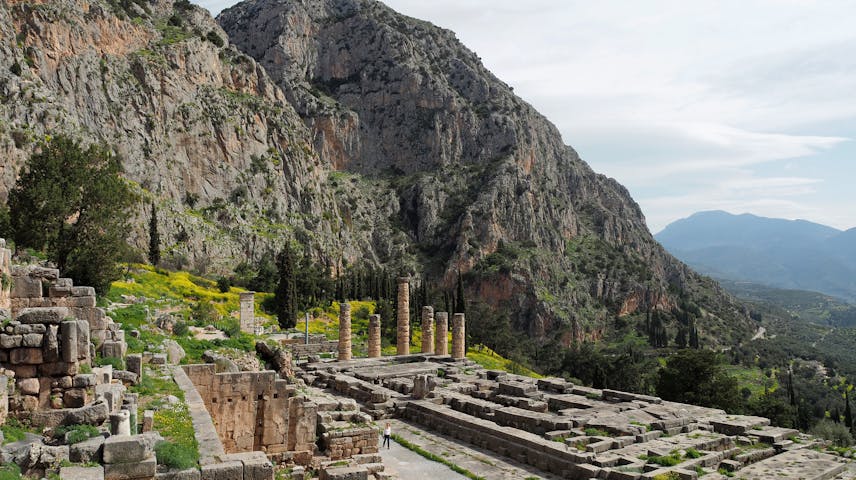
The Oracle of Delphi
Standard News Bureau