Loading course navigation
Loading lesson
50 min
Student Lesson
Lesson 29: The Lightning Thief, Comparison Writing, Part 3
Content
Students will compare Riordan’s and Virgil’s Underworlds and draft an informative introduction that explains how each text portrays the danger of death.
Language
Students will use comparative transitions, abstract nouns, and nuance verbs to write a cohesive introductory comparison.
Foundational Skills
Students will maintain consistent pronoun number and person when attributing ideas across two texts.
How do stories from different cultures explore danger, courage, or the unknown?
Knowledge-Building:
Students compare an ancient Roman Underworld scene and Riordan’s modern version to deepen their understanding of how myths explain death, danger, and the unknown.
Enduring Understanding:
Cultures use myths to explore fear, uncertainty, and what lies beyond ordinary life, and modern authors reshape these stories for new audiences.
Future Lessons:
In Lesson 30, students will use today’s comparison work as they read Percy’s meeting with Hades and analyze a more complex version of danger and power in the Underworld.
Unit Performance Task:
Students are practicing the comparison work they will need for Shared Stories, Shared Lessons, especially introducing two texts and explaining how a modern author transforms an older mythic pattern.
| Lesson Flow | Purpose of Learning Experience |
|---|---|
Launch5 Minutes | Students will activate prior learning from Lesson 28 and frame today’s comparison as preparation for informative writing. |
Literacy Lab10 Minutes | Students will read the Aeneid excerpt and learn how to build a strong comparative topic sentence using abstract nouns, cohesive compare/contrast language, and consistent pronouns. |
Learning in Action30 Minutes | Part A: Build the Comparative Blueprint (RL.6.9) Students will organize Underworld details from Riordan and Virgil and draft a transformation claim. Part B: Draft the Introduction (W.6.2.a, W.6.9.a) Students will draft an informative introductory paragraph that names both texts, previews the comparison, and explains how Riordan updates the older myth. |
Material List
The Lightning Thief by Rick Riordan
Unit 4 Lesson 29 Student Edition
Venn Diagram graphic organizer
Routines
Think-Pair-Share
Language Study
Modeled Writing
Quick Write
This opening helps students reconnect to their recent reading of the Underworld in The Lightning Thief while preparing to compare it with an older mythic version. Students should activate specific details from the DOA scene and begin considering how authors create different kinds of danger through setting and structure. Encourage students to ground their predictions in evidence rather than general impressions, pressing them to explain how the scene creates a particular mood. This moment frames the lesson as a shift from noticing details to analyzing how those details build meaning across texts.
Say these Directions: Think about your response to the question first, and then share and refine your answers with a partner.
Ask: Based on the DOA lobby scene, what kind of danger does Riordan create in his Underworld, and how might an older version of the Underworld be different?
Riordan creates a feeling of danger with crowds, confusion, and control by a cold system. An older version might feel more ancient, eerie, and final, so the danger could come from the dark setting, the endless waiting, and the power controlling who can cross.
Connection to Today’s Learning
Say: We are now ready to move from noticing story details to naming the larger idea those details create.
Teacher Tip |
|---|
Today’s texts portray the land of the dead and the danger of crossing into the Underworld. Before reading, remind students that Greek and Roman stories about the Underworld come from ancient religious traditions and are being studied here as literature; students do not need to adopt these beliefs in order to analyze the texts. Keep discussion grounded in author choices, mood, and comparison rather than students’ personal beliefs about death or the afterlife. |
Teacher Tip |
The Aeneid excerpt may feel dense for sixth graders because the syntax and vocabulary are unfamiliar. Students do not need to read all of Book 6 or understand every line of epic poetry. An excerpt has been provided. Briefly summarize the scene before reading, gloss a few key words, and keep the comparison anchored in four concrete landmarks—the dark river, the crowd of waiting souls, Charon the ferryman, and the rule that controls who can cross. |
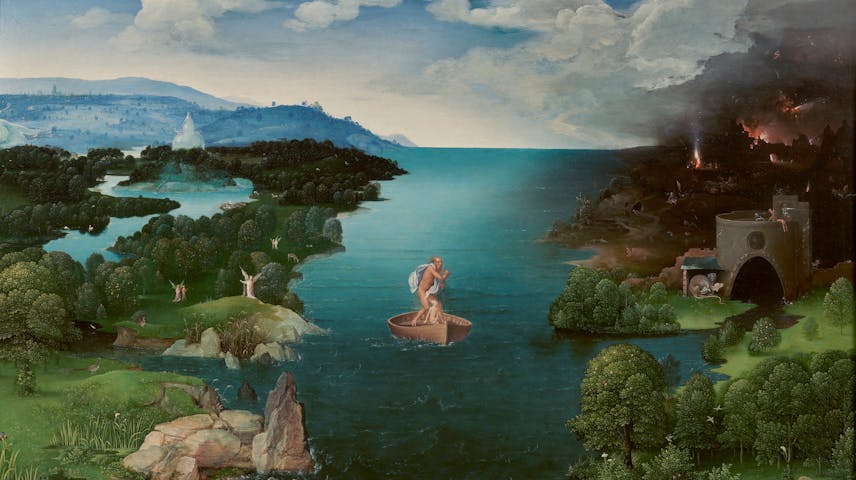
In this scene, Aeneas reaches the edge of the Underworld and sees a dark river filled with souls waiting to cross. A ferryman named Charon controls the crossing, and the priestess explains that some souls must wait a very long time before they are allowed to enter. As we listen, we will focus on how Virgil makes this place feel dangerous.
Say these directions: We will read the Aeneid excerpt aloud. Before reading, look for the phrases and landmarks listed below.
Display and briefly explain these words and phrases before reading:
dreary: dark, gloomy, and sad
ferryman: a person who carries people across water by boat
multitudinous: very many; crowded
passage across: the crossing from one side to the other
Display the following phrases and moments in the text:
The Riverbank: Look for lines describing “Acheron’s wave,” “the dreary pool,” and the muddy river. This helps students notice that Virgil’s Underworld feels ancient, natural, and dangerous.
The Waiting Crowd: Look for the lines comparing the souls to falling leaves or flocks of birds. This helps students notice the feeling of endless waiting and eternity.
Charon: Look for the description of “Charon, the dread ferryman.” This helps students understand who controls movement and who is allowed to cross.
The Rule for Crossing: Look for the explanation of why some souls must wait before crossing. This helps students understand how the Underworld is controlled.
Say these directions: As the excerpt from Virgil’s Aeneid is read, look for the river, the waiting crowd, the ferryman, and the rule that controls who can cross. We will use these details to understand what kind of danger this Underworld creates.
Ask: Before we start comparing it to Riordan’s version, what is happening in this scene?
Aeneas reaches the Underworld river, where many souls are waiting to cross. Charon controls the boat, and some souls have to wait because they are not allowed to cross yet.
Use this mini-lesson to bridge comparison reading into comparison writing. Emphasize that strong introductions do more than list differences; they name the deeper idea, such as despair, authority, or passage.
Display and read the definitions of despair, authority, and passage.
despair: complete loss of hope
authority: the power to give orders and enforce obedience
passage: the act or process of moving from one place or condition to another
Say: Notice that the danger in this scene is not just the river. The danger also comes from waiting and from not being allowed to cross. This creates a system where some souls are stuck for a long time.
Say: Effective comparison writing has to do three things fast: name both texts, use a clear comparison word, and connect details to a bigger idea. In this excerpt, details such as the endless crowd and the rule about burial suggest themes of despair, authority, and passage. We also need consistent pronouns so our reader always knows who or what each pronoun refers to. Let’s use a sentence from Virgil to practice.
Target Sentence Block:
“Hither all crowded, and rushed streaming to the bank… multitudinous as leaves fall dropping… or birds swarm…”
—Virgil’s Aeneid, Book 6, teacher excerpt
Display the following comparative sentence for analysis and read it aloud. Then explain the meaning and function of each section of the sentence, as shown in the chart.
Comparative Sentence:
Whereas Virgil portrays death as an endless passage into eternity, Riordan reveals an Underworld shaped by modern authority and crowded confusion.
Chunk | Meaning | Function |
|---|---|---|
Whereas Virgil portrays death | Virgil shows what death feels like. | Introduces the first text and sets up comparison |
as an endless passage into eternity, | Death seems permanent and never-ending. | Uses abstract nouns to move from description to theme |
Riordan reveals an Underworld | Riordan shows his own version of the setting. | Shifts to the second text |
shaped by modern authority and crowded confusion. | The danger comes from rules, systems, and pressure. | Explains how Riordan modernizes the old myth |
Say: To avoid simply listing, I start with a comparison word, such as whereas or unlike. Then I name the first author’s idea and the second author’s idea.
Say: If I write, “Virgil shows the souls and they are waiting and you can see it is scary,” my pronouns get messy because they and you are unclear.
Say: A clearer sentence is “Virgil shows souls waiting at the river, and this endless crowd creates despair.” Now the pronouns stay consistent, and the sentence sounds more formal.
Ask: Which abstract noun best fits Virgil’s Underworld in this excerpt: despair, authority, or passage? Which detail supports your answer?
Despair fits best because the souls are crowded together at the river and seem stuck waiting. That detail makes the Underworld feel hopeless and endless.
Ask: What rule controls who is allowed to cross the river?
Only souls who have been properly buried are allowed to cross, while others must wait for many years.
Say: Revise this sentence so it keeps pronouns consistent and sounds more informative: “Virgil shows many souls at the river, and you can tell they are trapped because we see them waiting forever.”
Virgil depicts many souls at the river, and the endless waiting suggests they are trapped in a hopeless passage toward death.
Connection to Today’s Learning
Say: We will now use these language moves to organize evidence from both Underworld scenes before drafting an introduction.
This section focuses on building a clear comparison before students begin writing, ensuring that their ideas are grounded in evidence from both texts. Students should first identify shared features of the Underworld, such as the river, ferryman, and waiting souls, and then analyze how each author develops those features differently. Guide students to move beyond listing similarities and differences by explaining how those differences shape the mood and meaning of death in each version. The goal is to develop a transformation claim that captures both what stays the same and what changes.
Students should have both texts open to the Underworld entrance passages. Keep the comparison concrete first, then guide students toward tone and thematic meaning.
Say these directions: We are going to build the comparison before we draft. In the Venn diagram, place details that appear in both texts in the middle and details unique to each version in the outer circles. Then use those notes to write one transformation claim that explains how Riordan modernizes Virgil’s mood of death and danger.
Say: A strong comparison does not just say, “These are the same” or “These are different.” It notes the shared archetype first, like the ferryman or the river crossing, and then explains how the author transforms it. If Virgil uses the river, the crowd, and the rule about burial to create despair and endless waiting, Riordan can keep those ideas but change them into a modern system with lines, rules, and authority. That claim becomes the backbone of the introduction.
Ask: Which details belong in the center of your Venn diagram, and what do those shared details suggest about death as a passage?
In the center, I would put the dark river, the ferryman, and the crowd of dead waiting to cross. Those shared details suggest that death is a passage into another world, and crossing over is serious and dangerous in both texts.
Ask: Choose one shared detail, and explain how Riordan transforms it to create a different mood from Virgil.
Both texts have a ferryman, but Virgil’s ferryman controls a natural and ancient crossing, which creates despair and fear. Riordan’s Charon feels more like a worker in a system, so the danger comes from rules, waiting, and authority.
Ask: Draft a one-sentence transformation claim for your notes.
Although both Virgil and Riordan portray the Underworld as a dangerous passage guarded by a ferryman, Riordan transforms Virgil’s ancient despair into a modern mood of authority, waiting, and confusion.
By the end of this section, students should have organized notes and a clear claim that will serve as the foundation for their introduction.
This section supports students in turning their comparison-based thinking into a structured, coherent introductory paragraph. Students should use their notes to select key details and organize them into a logical sequence that introduces both texts and previews the comparison. Emphasize that a strong introduction not only names similarities but also clearly explains how one text transforms the other. Encourage students to use precise academic language, including comparative transitions and abstract nouns, to communicate their ideas effectively.
Display the following writing model if needed for support and guidance:
In both The Lightning Thief and Virgil’s Aeneid, a hero reaches the edge of the Underworld and faces a dangerous crossing. Both texts include a dark river, a ferryman, and crowds of dead souls waiting to pass, which shows that death is a serious and controlled passage with no easy return. However, Virgil creates a mood of despair and endless waiting through an ancient, shadowy landscape, whereas Riordan reveals a modern Underworld controlled by lines, rules, and cold authority. By updating the old myth in this way, Riordan keeps the archetype of the Underworld crossing but changes how readers experience the danger and threat of death.
Say these directions: Now you will turn your blueprint into an introduction. Your introduction should name both texts, preview one or two shared details, and end with a clear transformation claim that explains how Riordan updates Virgil’s version. As you draft, keep your pronouns consistent and use at least one comparison transition. Reread each sentence to ensure pronouns clearly refer to specific nouns.
Say: An introduction is like a map for your reader. First, I name the two texts and the topic they share. Next, I preview the key comparison details, and then I end with the claim that explains the most important difference. If I only say, “They are both scary,” my reader does not know how the comparison works, so I need specific details and a clear idea about tone.
Ask: Before you draft, what are the three jobs your introduction needs to do?
My introduction needs to name both texts, preview the shared Underworld details, and explain how Riordan changes the older myth.
Ask: Draft your three- to four-sentence introductory paragraph comparing Riordan’s Underworld and Virgil’s.
In both The Lightning Thief and Virgil’s Aeneid, the hero reaches the Underworld by coming to a dark river filled with waiting souls. Both texts also include a ferryman who controls the crossing, which makes death feel like a serious passage. Unlike Virgil, who creates despair through endless waiting in a harsh natural setting, Riordan reveals a modern Underworld shaped by lines, rules, and authority. This change keeps the old myth alive but gives modern readers a new way to feel the danger of death.
By the end of this section, students should produce an introduction that clearly presents a comparison and prepares the reader for deeper analysis.
Teacher Tip |
|---|
After drafting, pause for a structured self-assessment. Have students rate their introduction using key criteria (e.g., transformation claim, use of shared details, comparison transitions) and record their ratings in a simple visual tracker (stars, bars, or color scale). Then guide students to set one specific revision goal (e.g., “I will revise my claim to better explain how Riordan transforms the original myth”). For multilingual learners, highlight one language focus (e.g., use of comparison transitions or precise academic nouns) and have students track their use of that move. This supports students in monitoring both writing development and language growth over time. |
Checklist (W.6.4) |
|---|
As you write, ask yourself the following:
|
Lesson 29 Writing Rubric: Explanatory Paragraph — Two Underworlds
Writing prompt: Draft an introductory paragraph comparing how Riordan and Virgil each depict the Underworld to reveal different ideas about power and authority. Your introduction must establish context for both depictions and present a focused thesis about what each author’s Underworld reveals about divine power.
Criteria | 1 — Beginning | 2 — Developing | 3 — Proficient |
|---|---|---|---|
Thesis & Topic Sentence (W.6.2.a) Name the Shared Idea | The topic sentence does not identify a shared idea across both underworld descriptions or names only one text. There is no comparative framing. | The topic sentence identifies the underworld as the topic, but the shared idea about power or authority is vague. The comparative framing is present but not focused. | The topic sentence clearly names a shared idea about power, authority, or the afterlife across both underworld descriptions and frames the comparison: Both The Lightning Thief and [myth] depict the underworld as a place where [shared idea], revealing [what this shows about the cultures' values]. |
Appositive Phrases (L.6.3.a) Appositives for Precision | The paragraph does not use appositive phrases, or appositives are used incorrectly (e.g., without commas). | The paragraph uses at least one appositive phrase, but punctuation or placement is incorrect. | The paragraph uses at least one correctly punctuated appositive phrase to add precision — for example, naming a character, place, or concept: 'Hades, the god of the underworld, rules...' or 'The Elysian Fields, a paradise for heroes,...' |
By the end of this lesson, students should understand how comparing two versions of an Underworld scene reveals both shared mythic patterns and meaningful differences in how authors present danger. Students should be able to explain how specific details from each text contribute to a larger idea about death, such as despair or authority. This reflection reinforces the importance of organizing ideas clearly before writing and using precise language to communicate comparisons. Ensure students can articulate both a shared feature and a transformed element in their explanation. This prepares them to continue developing comparison-based writing in the next lesson.
Say these directions: Use two specific details, one from Virgil and one from Riordan, to explain how your introduction compares the danger of death in the two texts. Make sure you name the detail and explain what idea or mood it supports.
Ask: Which detail from Virgil and which detail from Riordan did you use or plan to use in your introduction, and how do those details help you compare the danger of death?
From Virgil, I used the detail about the huge crowd of souls waiting at the dark river because it creates despair and eternity. From Riordan, I used the DOA check-in line and Charon acting like a worker in a system, because that makes death feel cold and controlled. Together, those details help me explain that both texts show death as a dangerous passage, but Riordan modernizes the danger.
Have students access their copies of The Lightning Thief. Instruct students to do the following:
Read pp. 300–319 of The Lightning Thief. Annotate for details that show how Percy’s deeper journey through the Underworld adds to the danger of death, especially in the sections where he sees the dead, the gates, and Hades’s realm.
Teacher Tip |
|---|
Homework tonight includes pp. 300–319 of The Lightning Thief, which contain references to the dead, torture, and graphic Underworld imagery. Preview this before dismissal, remind students that they may annotate privately rather than sharing personal reactions aloud, and offer a brief written check-in option in the next lesson if students need space to process the reading. |
The Lightning Thief (Percy Jackson and the Olympians, Book 1)
Rick Riordan
Virgil’s Aeneid Book 6 Excerpt
Virgil