Loading course navigation
Loading lesson
50 min
Student Lesson
Lesson 18: The Lightning Thief, Comparison Writing, Part 4
Content
Students will compare a traditional Medusa retelling and Riordan’s Chapter 11 scene to explain how a modern retelling changes the portrayal of Medusa and shifts ideas about power, responsibility, and monsters.
Language
Students will use compare-contrast transitions and attribution frames to write an explanatory paragraph about how two texts develop a shared myth differently.
Foundational Skills
Students will use intensive pronouns and clear noun naming to avoid unclear pronoun references when comparing two versions of a myth.
Why do cultures tell stories about gods, monsters, journeys, and transformations?
Knowledge-Building:
Students deepen Investigation 2 by comparing Percy’s Medusa encounter with a traditional Perseus/Medusa retelling.
Enduring Understanding:
Myths explain danger, power, and responsibility, and modern authors reinterpret those ideas for a new generation of readers.
Future Lessons:
This lesson prepares students for Lesson 19’s seminar, where they will synthesize ideas about heroism, power, and responsibility across myths.
Unit Performance Task:
Students practice comparing a modern retelling with a traditional myth and explain what that shift reveals.
| Lesson Flow | Purpose of Learning Experience |
|---|---|
Launch5 Minutes | Activate prior learning from Lesson 17 and frame today’s question about how retellings can change the reader’s point of view about blame and monsters. |
Literacy Lab10 Minutes | Students will learn how to use attribution frames and intensive pronouns to keep comparison writing clear and precise. |
Learning in Action30 Minutes | Part A: Comparing Medusa Stories (RL.6.9) Students will compare selected Baldwin and Riordan excerpts to identify what stays the same and what changes in each Medusa portrayal. Part B: Writing to Compare Texts (W.6.2.d) Students will draft an explanatory paragraph explaining how Riordan honors and reframes the traditional myth. |
Material List
The Lightning Thief
Unit 4 Lesson 18 Student Edition
Venn Diagram graphic organizer
Routines
Think-Pair-Share
Language Study
Partner Reading & Discussion
Modeled Writing
Use this routine to connect Lesson 17’s focus on Percy’s choices under pressure to today’s more complex question about whether a “monster” can also be someone who was harmed at an earlier point in their lives.
Have students turn to a partner with Chapter 11 open.
Say these Directions: Think about your response to the question first, and then share and refine your answers with a partner.
Ask: Why might an author retell a familiar myth from the perspective of a monster?
An author might do that so readers stop seeing the monster as only evil and start asking who had power and who got blamed. That kind of retelling can make the story feel more modern and complex because it shows that responsibility is not always simple or one-sided.
Connection to Today's Learning
Say: To make comparisons effectively, it helps to have an understanding of attribution and pronoun use before you begin to draft.
This mini-lesson teaches students how to keep comparison writing clear by using attribution frames and intensive pronouns to track characters across two versions of a myth.
Say: When we compare two versions of a myth, we must name the source and the character before using pronouns. This helps the reader track who is being described in each version.
In this example, this sentence is confusing because we do not know who she or he refers to or which version is being discussed.
Display Unclear Sentence:
She blames Athena, but he is the hero in the other version.
Display Revised Sentence:
In Riordan’s retelling, Medusa herself blames Athena, but in Baldwin’s retelling, Perseus is presented as the hero.
Ask: What information is added at the beginning of each part of the sentence?
the source of the retelling
Ask: Why is naming the source important?
It tells which version the idea comes from.
Ask: Who is clearly named in the first part of the sentence?
Medusa
Ask: What does the word herself add?
It emphasizes that Medusa is the one making the claim.
Ask: Why is the sentence clearer than the original?
It names both the version and the character, so the reader is not confused.
Say: To write clear comparisons, we:
name the source first (“In Riordan’s retelling . . .”)
name the character before using a pronoun
use intensive pronouns like herself or himself for emphasis
use comparison language such as but or in contrast to connect ideas
This helps the reader follow both versions without confusion.
Say these Directions: Revise the unclear sentence so it clearly compares both versions:
Riordan’s Medusa is a modern monster who uses charm to trap him, while Baldwin’s Medusa story focuses on the suffering and injustice that shaped it.
Riordan’s Medusa is a modern monster who uses charm to trap Percy and his friends, while Baldwin’s version focuses on Medusa’s suffering and the injustice that shaped her.
Connection to Today’s Learning
Say: In this lesson, you practiced using attribution and precise pronouns to keep comparisons clear. Next, you will use these same structures to write an explanatory paragraph showing how two texts develop the same myth differently.
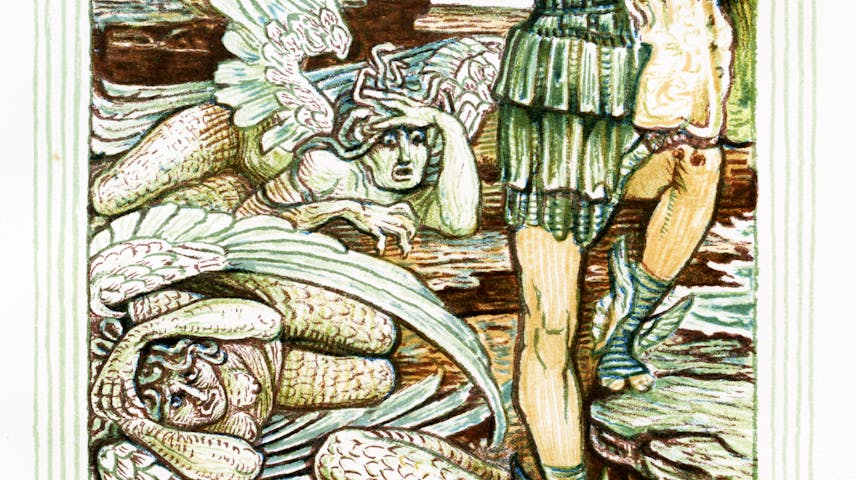
Students will compare Baldwin’s and Riordan’s versions of Medusa, focusing on what each keeps and what changes. This sets them up to use the Venn Diagram with a partner.
Say these Directions: With your partner, reread the selected Baldwin excerpts and the Aunty Em scene from Chapter 11. Consider how both texts portray Medusa. On the Venn Diagram to record the details and ideas that both versions share in the middle and details and ideas that show how they differ in the outside part of the circles.
Ask: In Baldwin’s retelling, who sets Perseus on the task, and how does that shape the reader’s first view of Medusa?
In Baldwin’s retelling, the king pushes Perseus into the task by demanding Medusa’s head. This frames Medusa as a dangerous obstacle in the hero’s mission, so readers first see her as something Perseus must defeat rather than as a character with her own perspective.
Ask: What important myth element stays the same in both texts, and what major idea changes in Riordan’s version?
In both texts, the hero survives by using a reflective surface instead of looking at Medusa directly. However, Riordan gives Medusa a voice, which makes readers question responsibility, power, and whether Medusa is only a monster.
Pulse Check (RL.6.9) |
|---|
Which statement best explains how Riordan’s Medusa compares to Baldwin’s version?
|
In this part of the lesson, students shift from comparing details to shaping those ideas into a clear explanatory paragraph. The modeled writing helps them see how to connect a shared myth element with Riordan’s changes, use evidence from both texts, and explain how those changes affect the reader’s view of Medusa. This prepares them to draft their own explanatory paragraph with precise language and clear attribution.
[FLAG: non-standard routine — tagging inferred]
Display the following writing model if needed for support and guidance:
In both texts, the hero defeats Medusa by using reflection instead of looking at her directly, so Riordan keeps an important part of the old myth. However, Riordan modernizes the story by changing how readers view Medusa. In Baldwin’s retelling, Medusa is mostly an obstacle in the hero’s task, and the gods help Perseus complete that mission. In Chapter 11, Medusa speaks for herself, which makes readers question who holds power and whether Medusa is only a monster. Percy still sees that she is dangerous because she tricks travelers and tries to turn people into statues. This shift in portrayal suggests that Riordan honors the traditional myth while reframing it so responsibility and power feel more complicated.
Say: To build an explanatory paragraph that compares, you must first write a topic sentence that names something both versions share and something they do not. Next, choose one piece of evidence from Baldwin and one from Riordan that connect to the same big idea. Then use attribution frames so your reader always knows which version you mean. Finally, explain how Riordan’s reframing shapes the reader’s impressions of Medusa.
Say these Directions: Use your Venn diagram notes to draft an explanatory paragraph answering this question:
How does each text’s portrayal of the Medusa myth impact the reader’s understanding of Medusa? Include evidence from both texts to support your response.
Lesson 18 Writing Rubric: Explanatory Paragraph — Riordan's Transformation of the Medusa Myth
Writing prompt: Write an explanatory paragraph explaining how Riordan transforms the Medusa myth in The Lightning Thief. Focus on the specific language choices he makes and what they reveal about how modern retellings adapt ancient myths for new audiences.
Criteria | 1 — Beginning | 2 — Developing | 3 — Proficient |
|---|---|---|---|
Precise Language & Style (W.6.2.d) Language Choices + Effect | The paragraph does not discuss specific language choices. General observations about the retelling are made without reference to precise word choice or its effect. | The paragraph mentions Riordan's language choices, but the analysis of what those choices reveal is vague or incomplete. | The paragraph identifies specific language choices in Riordan's retelling and explains what they reveal about how the modern version adapts the ancient myth — what is kept, what changes, and what the changes reveal about the intended audience or theme. |
Gerunds & Verbals (L.6.1.b) Gerunds in Explanatory Writing | The paragraph does not use gerunds or verbals, or gerunds are used incorrectly as finite verbs. | The paragraph includes at least one gerund or verbal, but it is used awkwardly or does not add precision to a sentence. | The paragraph uses at least one gerund or verbal correctly and purposefully to add precision to a sentence about Riordan's craft or the effect of his language choices (e.g., 'By transforming Medusa into a tourist attraction, Riordan...'). |
Reflection |
|---|
Reflect on your writing ability using the Reflection routine.
|
Say these Directions: Take two minutes to look back at your draft and the question we started with. Then, turn and talk with a partner to discuss your response.
Ask: How does each text’s portrayal of the Medusa myth impact the reader’s understanding of Medusa? Include evidence from both texts to support your response.
In Baldwin’s retelling, Medusa is mainly a monster Perseus must defeat, so the focus stays on the hero’s task. In Chapter 11, Medusa speaks for herself, which makes readers question her role and the gods’ power, even though Percy still sees her as dangerous.
Have students access their copy of The Lightning Thief. Instruct students to:
Read and annotate The Lightning Thief Chapter 12.
Review annotations from the myths covered in Investigation 1 and Chapters 1–12 of The Lightning Thief to prepare for discussion.
The Quest of Medusa’s Head
James Baldwin, Old Greek Stories