Loading course navigation
Loading lesson
50 min
Student Lesson
Lesson 2: Jim Crow Laws: A Dark Chapter in American History
Content
Students will analyze how text features organize ideas in an informational text.
Language
Students will explain inequity using causal and contrastive language in discussion and a short paragraph.
Foundational Skills
Students will use context clues to determine the meaning of domain-specific words in an informational text.
How do curiosity, evidence, and collaboration lead to discovery?
How can research help us uncover lesser-known contributions and tell a more complete story?
Knowledge-Building:
In Lesson 1, students learned why the Space Race required many experts. This lesson adds historical context about segregation and discrimination that shaped who had access to education, training, and scientific careers. After the Civil War, Black Americans briefly gained new rights during the Reconstruction era. In the following decades, many states created Jim Crow laws and policies that enforced racial segregation and limited opportunities.
Enduring Understanding:
Scientific discovery depends on people, but historical conditions have not always given all contributors equal access to education, careers, or recognition.
Future Lessons:
Students will next explore how some innovators of major scientific breakthroughs such as space flight were hidden, overlooked, or underrecognized because of discrimination and segregation, such as the women in Hidden Figures.
Unit Performance Task:
Background on segregation and exclusion will help students explain the obstacles hidden innovators faced and why their work deserves recognition.
| Lesson Flow | Purpose of Learning Experience |
|---|---|
Launch15 Minutes | Students will build background knowledge about Jim Crow segregation and connect it to the previous lesson’s exploration of who had access to opportunity and discovery in the fields of math and science. |
Learning in Action30 Minutes | Part A: Explore How the Article Is Organized (RI.6.5.a) Students will analyze how “Jim Crow Laws: A Dark Chapter in American History” uses title, headings, bold terms, and other text features to organize information and help readers understand exclusion and barriers. Part B: Explain Barriers to Opportunity (RI.6.5.a) Students analyze how the author organizes information and uses text features to explain how Jim Crow laws created barriers to opportunity. They discuss how these text structures help readers understand segregation and its impact on daily life. |
Look Back5 Minutes | Reflect in writing on how the article’s structure deepened understanding of exclusion and why that matters for the unit. |
Material List
Unit 3 Lesson 2 Student Edition
3-Column Chart graphic organizer
Structure and Purpose graphic organizer
Routines
Think-Pair-Share
Quick Write
Say: In Lesson 1, we learned that NASA needed mathematicians, engineers, and other experts during the Space Race. Today, we examine a harder truth: unfair Jim Crow laws shaped who could access those opportunities. These laws enforced segregation and treated Black Americans as second-class citizens, denying them equal rights and opportunities. Understanding these barriers helps us make hidden stories visible and recognize why many talented people were excluded.
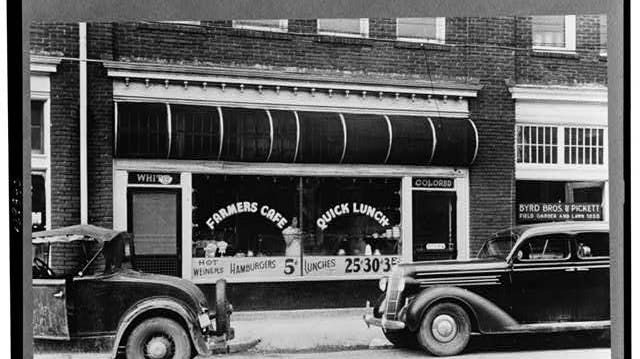
Display the historical image of segregation signage to establish context for the lesson.
Teacher Tip |
|---|
This lesson introduces racist laws and exclusion. Use direct, age-appropriate language: Jim Crow laws were unfair laws and rules that separated Black and white people and treated Black people as less worthy. Remind students that we study this history to understand the harm clearly and to honor the people who continued learning, working, and contributing despite these barriers. |
Place students in pairs. Give them a few silent moments to observe the image and skim the article before they speak.
Say these Directions: Take a few silent moments to observe the image and skim the article before discussing the questions with a partner.
Ask: What details do you notice in this image, and how might rules like these affect who gets opportunities to learn, work, or use public spaces?
I notice that the signs above the cafe entrances separate people by race. Rules like this could block people from getting good schools, jobs, or access to places where learning and work happen. That would make opportunities unfair before someone even got a chance to show their skills.
Ask: If a country says it needs the best problem-solvers but its laws treat some people unfairly, what problem does that create?
It creates a contradiction because the country says talent matters, but the laws stop some talented people from getting equal chances. Segregation could limit who gets to learn, practice skills, or join important work. That means discoveries and innovations could be slowed down because not everyone is allowed to participate fully.
Say: Now you will explore how an informational article teaches readers about this history through its structure, not just through its facts.
Students will use the article itself as the gallery text. Direct students to stop and study the title and opening, the section headings, bolded vocabulary, and image captions included in the article. Prompt students to label the 3-Column chart with the following headings: Text Feature, Observations, How It Works
Say these Directions: We will study how the article’s structure conveys information about how Jim Crow laws created barriers to opportunity. As you read, pause to notice the structure and organization of the text. In the 3-column chart, record each type of text feature you come across in the article, your observations and the purpose it serves. Then answer the questions below.
Say: When I first look at an article, I don’t start reading right away. I pay attention to how the text is organized because features like titles, headings, subheadings, bolded terms, and captions act as a map showing how the author presents information. For example, the title “Jim Crow Laws: A Dark Chapter in American History” previews the topic, and the phrase “dark chapter” signals that it will cover a difficult period. The sections use question-style headings such as “What Were Jim Crow Laws?” which tell me exactly what each part will explain. Bolded words like segregation highlight important vocabulary and provide definitions. The text also includes images with captions that describe the visuals and add helpful details. Paying attention to these structural elements helps me better understand the information being presented.
Completed 3-Column Chart
Text Feature | Observations | How it works |
|---|---|---|
title | The phrase “dark chapter” shows the topic is unjust and harmful. | The title previews the topic. |
heading titles | The heading tells me that the question will be answered in this section. | The heading tells me exactly what I’ll learn about in each section. |
bolded words | The word must be important for understanding the text | The bolded words connect to key ideas in the text. |
image or caption | The caption describes the image and gives even more information about the topic. | The caption makes a connection between the image the ideas in the text. |
Ask: What text feature first grabbed your attention, and what did it help you predict or understand?
The title grabbed my attention first because the words “dark chapter” made me predict that the article would explain a harmful period in history. It also suggested the author’s perspective before I even read the first section.
Ask: How does one heading or section in the article help organize the information for readers?
A heading like “What Were Jim Crow Laws?” helps by grouping similar information together, like laws about schools, transportation, or public spaces. That structure makes the article easier to follow because I can see that segregation affected many parts of life, not just one place.
Ask: What context clues in the article help you understand a word like segregation or discrimination?
The article gives examples like “Black Americans had to use separate water fountains, restrooms, and waiting areas labeled ‘Colored’ while white Americans used ones labeled ‘Whites Only.’" Those examples act like context clues. They helped me figure out that segregation means forced separation by race and that discrimination means people were treated unfairly because of who they were.
Ask: Based on the article, how could Jim Crow laws limit the opportunities of Black women who wanted to work in math, engineering, or science?
The article states, “Hotels, restaurants, movie theaters, schools, hospitals, and even churches were segregated . . .” which means that Black people could only work in segregated jobs. Because of this, Black women could be blocked from equal schools, training, and job opportunities. Although they were highly skilled, unfair laws and social barriers could still keep them from being hired, promoted, or fully included.
Pulse Check (RI.6.5.a) |
|---|
Which statement best explains how the article’s text features help develop its ideas? A. They mostly make the article longer by adding extra information that is not important.
B. They help to group ideas, signal importance, and help readers follow how the topic develops.
C. They mainly entertain the reader with dramatic details instead of teaching information.
D. They prove that every reader must agree with the author’s opinion.
|
After students complete the Gallery Walk and the 3-Column Chart organizer, guide a discussion to help them synthesize how the article's structure and text features help explain barriers to opportunities.
Say these Directions: You explored several text features in the article such as the title, headings, bold words, images and captions. Now, we will look more closely at how the author organized information and how those choices help readers understand the topic.
In the Structure column of your graphic organizer, record a specific structure the author uses. This could be:
a heading
a section of text
a paragraph
a bold vocabulary word
an image or caption
In the Purpose column, explain why the author included that structure and how it helps readers understand the history of Jim Crow.
Say: When I analyze an informational article, I look closely at how sections of the text develop ideas. For example, in the section that describes how Black Americans had to use separate schools, transportation, and public spaces, the author groups several examples in one place. By having all of these details in the same section, the author helps the reader understand that segregation affected many parts of daily life, not just one situation. This structure helps me see the larger idea that Jim Crow laws created barriers to opportunity in education, work, and travel.
Structure and Purpose Entries
Structure | Purpose |
|---|---|
Title: “Jim Crow Laws: A Dark Chapter in American History” | The title introduces the topic and signals that the article will explain an important period when laws enforced segregation. It prepares readers to learn about unfair rules that limited opportunities for Black Americans. |
Bold vocabulary word: segregation | The bold word draws attention to an important term and helps readers recognize a key concept in the article by highlighting the word. The author helps readers understand that segregation is central to understanding the laws being discussed. |
Ask: Which structure in the article helped you understand the topic most clearly?
The section titled “What Were Jim Crow Laws?” helps explain the main idea because it defines the laws and gives examples of how they affected everyday life.
Ask: How do headings and sections help organize the information in this article?
The headings divide the article into different parts such as the background after the Civil War, examples of segregation, and how people resisted the laws. This organization helps people understand the topic step by step.
Ask: How does a photograph or caption contribute to the article’s message?
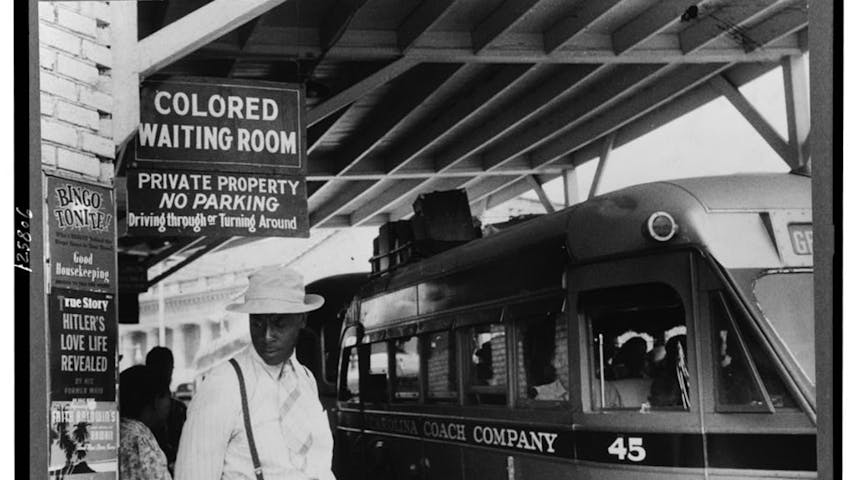
The photograph of the segregated waiting room shows a real example of how the laws affected people. It helps readers picture what segregation looked like in daily life.
Provide students with a confidence continuum (i.e., 1–5). As needed, model how to demonstrate a level of confidence using the continuum.
Reflection (RI.6.5.a) |
|---|
Reflect on your understanding of text features using the Reflection routine. How confident do you feel about identifying text features and explaining how they help readers understand an informational article? |
Say these Directions: In three to four sentences, explain how the article’s structure and text features helped you understand the barriers created by Jim Crow laws. Use key details and specific examples from the article to support your response.
The article’s structure helped me understand exclusion because it broke the topic into clear sections about different kinds of laws and public spaces. In the title and opening, I could tell this history was serious and harmful, and in the section about separate schools I learned that segregation limited equal education from the start. In another part about public spaces, the article showed how laws controlled where Black people could go and how they were treated. Although Black women had the skills to contribute, these barriers made it harder for them to be included and recognized.
Optional Sentence Starter:
The article’s structure and text features helped me understand ______. An example of this is _____ which shows me that_____.
Jim Crow Laws: A Dark Chapter in American History
Library of Congress, adapted by Newsela