Loading course navigation
Loading lesson
50 min
Student Lesson
Lesson 3: What Is a "Hidden Figure"?: Seeing the Work Behind the Work
Content
Students will determine the author’s purpose in the prologue of Hidden Figures and define the concept of a “hidden figure” using text evidence.
Language
Students will use domain specific language to define the concept of “hidden figure” and describe the author’s purpose for writing the text.
Foundational Skills
Students will use introductory evidence clauses and correct comma placement to integrate evidence from the prologue of a text.
How do curiosity, evidence, and collaboration lead to discovery?
How can research help us uncover lesser-known contributions and tell a more complete story?
Knowledge-Building:
Students synthesize what they learned about NASA’s urgency in the Space Race and segregation to understand why some contributors were essential but unseen.
Enduring Understanding:
Scientific discovery grows through questions, evidence, and collaboration, and history does not always give equal visibility to every contributor.
Future Lessons:
Students will continue reading Hidden Figures and track how the author develops purpose and point of view as she introduces specific women whose work shaped NASA.
Unit Performance Task:
Students are preparing to research a hidden innovator by learning how to notice overlooked contributions and explain why recognition matters.
| Lesson Flow | Purpose of Learning Experience |
|---|---|
Launch15 Minutes | Students will discuss the idea of unseen contributors and connect the previous two lessons to the unit’s second essential question. |
Learning in Action30 Minutes | Part A: Annotate for Author’s Purpose (RI.6.6) Students will explore how the prologue of Hidden Figures introduces important but overlooked contributors and begin annotating for the author’s purpose. Part B: Explain author’s purpose and Hidden Figures (RI.6.6) Students will discuss evidence in the prologue to identify the author’s purpose and develop a definition for “hidden figure.” |
Look Back5 Minutes | Use key details to describe how the author uses the prologue to define “hidden figures” and to state her purpose for writing the text. |
Material List
Student copies of Hidden Figures (Young Readers’ Edition) by Margot Lee Shetterly
Unit 3 Lesson 3 Student Edition
Routines
Think-Pair-Share
Annotation Spot-Check
Quick Write
Place students in pairs before beginning the opening conversation. Display the historical photograph of women mathematicians/computers working at NASA or NACA.
Say: In the last two lessons, we learned that NASA needed many kinds of expertise and that segregation kept many people from getting equal access to opportunity. Today we are putting those ideas together by asking who did essential work but did not get equal recognition. This matters because, later in the unit, you will research an innovator whose story deserves to be seen clearly.
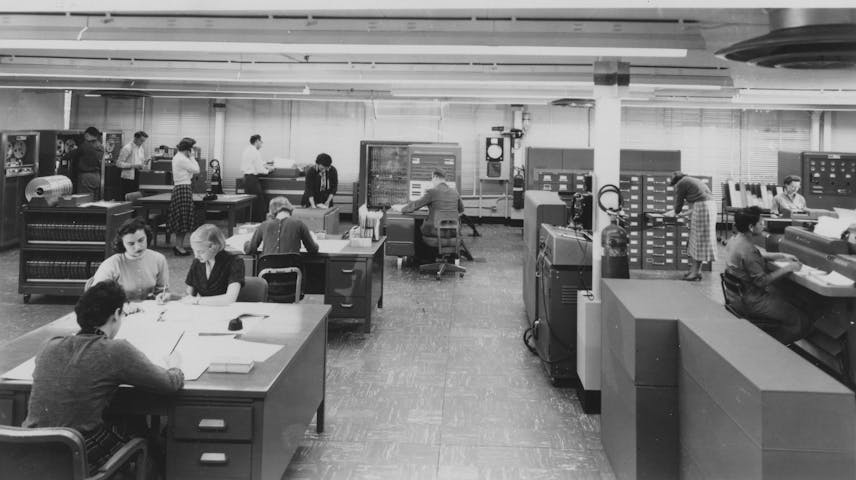
Say these Directions: Take a moment to study the photograph closely before you respond. Look carefully at the desks, papers, calculation tools, and the number of workers in the room, and think about what those details show about the kind of work being done.
Ask: What do you notice about the people who are doing the work in this image, and why might some of these people be less remembered than astronauts or presidents?
I notice that the people in the image are doing serious math and office work, not standing in front of a rocket or giving a speech. Some of them might be less remembered because the public usually hears about the astronaut or the leader, not the team working behind the scenes. This connects to our earlier learning that discovery depends on collaboration, not just one famous person.
Ask: Based on what we learned about the Space Race and segregation, why might an important contributor become “hidden” in history?
An important contributor might become hidden if their job happened behind the scenes or if prejudice kept people from giving them credit. In this unit, we have already seen that NASA needed many experts, but segregation and discrimination affected who got noticed and who did not.
Connection to Today’s Learning
Say: You have started to explore the big idea of unseen contributors. Next, you will think about this concept as you read the prologue and begin gathering evidence that identifies the author’s purpose.
Instruct students to begin annotating the prologue of Hidden Figures. Keep the focus narrow and remind students that they should look specifically for evidence of the author’s purpose and details that help define the idea of a hidden figure.
Say: When I read the prologue, I think about what the author is saying and why she chose to say it this way. She begins by describing her childhood in Hampton, Virginia, where many Black Americans worked in science, math, and engineering. She mentions her Sunday school teacher who worked at NASA as a “computer,” doing complex math for engineers. She then explains that hundreds of women—many of them Black—worked as mathematicians at NASA during segregation. These details show the author’s purpose: she wants readers to understand that many people helped make space exploration possible, but their work was not always recognized. In my notes, I might write: “purpose: show that Black women mathematicians made important contributions that history often overlooked.” From this, I can define a hidden figure as someone who makes an essential contribution to a major achievement but does not receive equal recognition.
Say these Directions: As you read, mark text that connects to the author’s purpose. As we read the opening of the prologue, look for places where the author points our attention to people whose work was necessary but not widely recognized. Mark H next to a detail that helps define the idea of hidden figure, mark P next to words and phrases that reveal the author’s purpose, then mark E to identify evidence the author uses to support her ideas.
In your notes, use an evidence frame such as “According to the prologue ____” to start your thinking. Identify any annotations you want to share with a partner and be prepared to explain why you marked that spot in the text.
Ask: Which idea from the prologue gives you the strongest clue that this book will focus on overlooked contributors to the Space Race?
The part of the prologue where the author explains that “…hundreds of women, many of them black, worked as mathematicians at NASA” shows that the story will focus on contributors whose work was important but not widely recognized.
Ask: Based on your annotations, how would you complete this sentence: A hidden figure is someone who ___, but ___?
A hidden figure is someone who makes an important contribution to a major goal but does not get equal visibility or recognition for that work. In the prologue, the author says, “The contributions made by these African American women have never been heralded, but they deserve to be remembered…”
Reflection (RI.6.2) |
|---|
Reflect on your ability to identify key details in an informational text. Choose a number between 1 and 5, with 1 being the least confident and 5 being the most confident, to rate your confidence level. Then write a sentence or two describing how confident you are identifying key details in an informational text. |
Say these Directions: Now that you’ve gathered evidence through annotation, you’ll use that evidence to explain the author’s purpose and the meaning of “hidden figure.” With your partner, share one annotation that helps explain the concept of a hidden figure and another that reveals the author’s purpose. Explain why you marked that part of the text and describe the idea that it helps you understand. In your discussion try to use examples of the domain specific vocabulary, including those for this lesson: expertise, evidence, data, or aeronautics. After both of you have shared, decide together which annotations give the clearest clues about the meaning of “hidden figures” and the author’s purpose.
Ask: What seems to be the author’s purpose for beginning the book by describing overlooked contributors? Use examples from the text to support your response.
I think the author’s purpose is to help readers notice that space achievements depended on many people with expertise, not just the most visible people. By describing these contributors first, she shows that collaboration and technical work were essential to the success of the Space Race. The author states that these contributors “...are an important part of American history.”
Ask: Based on the prologue, how would you explain the idea of a hidden figure? Use details from the text to support your response.
A hidden figure is someone who makes an important contribution to a major achievement but does not receive a lot, if any, recognition. The prologue shows that many mathematicians and engineers helped make space exploration possible even though most people do not know their names.
Pulse Check (RI.6.6) |
|---|
In the prologue of Hidden Figures, the author shifts attention from “in front of the camera” achievements to the people who worked behind the scenes. Which choice best explains her purpose? A. To show that space missions depended only on brave astronauts Incorrect: This answer repeats the most visible part of space history, but it ignores the author’s attention to mathematicians, engineers, and other workers. B. To explain only how rockets and machines were built Incorrect: This choice is too narrow because the prologue is not only about machines; it is also about people whose work and expertise were overlooked. C. To show that major discoveries depend on many experts whose contributions were often unseen Correct: This choice matches the author’s emphasis on collaboration, expertise, and recognition in the prologue. D. To argue that government leaders deserve most of the credit for space exploration Incorrect: This answer goes against the author’s purpose because the prologue expands credit beyond public leaders and famous figures. |
Instruct students to keep the writing brief and focused. Students should synthesize today’s conversation, not retell the entire prologue.
Say these Directions: In 2–3 sentences, explain how the author uses the prologue to define “hidden figures” and identify her purpose for writing the text. Use key details from the prologue in your explanation.
According to the prologue, many major space achievements depended on workers whose names were not widely known. The author points readers to experts doing mathematical and technical work behind the scenes, so a hidden figure is someone who makes an essential contribution but does not receive equal recognition. I think her purpose is to use evidence to make those careers and that expertise visible to readers.
Instruct students to reread the prologue and read Chapter 1 of Hidden Figures. Remind students to take notes in their Journal to respond to the following prompt:
As you read, keep annotating for the author’s purpose. Mark places where the author shows why these contributors mattered, why they may have been overlooked, and what evidence reveals the real story behind the work. Be sure that at least some of your annotations point directly to evidence about the author’s purpose for writing.
Hidden Figures (Young Readers' Edition)
Margot Lee Shetterly