Loading course navigation
Loading lesson
50 min
Student Lesson
Lesson 1: Racing to the Moon
Content
Students will cite textual evidence to explain the scientific and mathematical challenges NASA aimed to solve and evaluate reasons supporting the push for the moon mission.
Language
Students will explain historical and scientific context using cause-effect transitions and domain-specific vocabulary in discussion and brief summary writing.
How do curiosity, evidence, and collaboration lead to discovery?
How can research help us uncover lesser-known contributions and tell a more complete story?
Knowledge-Building:
Students begin the unit by building historical context about the Cold War, the Space Race, and NASA’s urgent scientific mission.
Enduring Understanding:
Scientific discovery grows through questions, evidence, and collaboration, and history becomes fuller when we study the people behind major achievements.
Future Lessons:
Students will examine barriers in STEM and consider why some contributors to the Space Race were overlooked.
Unit Performance Task:
Students will draw on this context as they develop an understanding and then explain the contributions of the hidden innovators in NASA’s space program.
| Lesson Flow | Purpose of Learning Experience |
|---|---|
Launch15 Minutes | Students will engage in Think-Pair-Share to preview texts and images about the Space Race and build initial understanding of why space exploration became a high-stakes national goal. |
Learning in Action30 Minutes | Part A: Jigsaw Resources (RI.6.1) Students will engage in a Jigsaw Reading of three articles about the historical Space Race between the United States and Russia. Part B: Jigsaw Deep Dive (RI.6.8, SL.6.1) Students will complete their Jigsaw analysis by teaching their group what they learned and integrating the new ideas shared by their classmates. Students will also participate in group discussions about the articles. |
Look Back5 Minutes | Students will synthesize the day’s learning in a brief evidence-based summary using cause-effect language and domain-specific vocabulary. |
Material List
Unit 3 Lesson 1 Student Edition
Jigsaw Worksheet
Routines
Think-Pair-Share
Jigsaw Reading
Turn-and-Talk
Quick Write
Place students in pairs. Give students a few seconds to silently study the image and skim the article before talking.
Say these Directions: In this unit, we will explore the Space Race. This was the Cold War competition between the United States and the Soviet Union, a country that included Russia and 14 other republics, to be the first to land on the moon. During this time, success in space became a symbol of scientific strength and global leadership. Today, we will investigate why this mission felt so urgent and what problems scientists needed to solve.
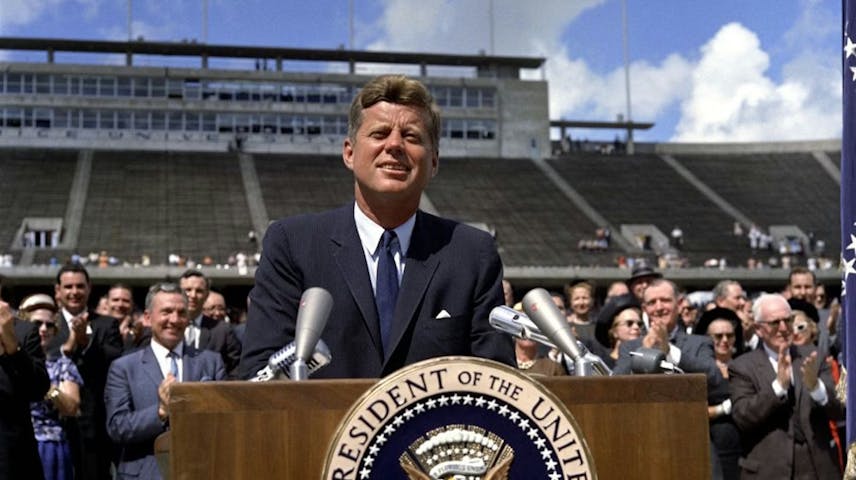
Display an image of President John F. Kennedy speaking at Rice University. Explain that this image shows President John F. Kennedy speaking at Rice University in 1962, when he challenged the nation to send astronauts to the moon before the decade ended.
Say: When I look at this image, I notice how large the audience is and how serious the event seems. That makes me think the country might be facing a big challenge that affects everyone. Engage in Think-Pair-Share as you discuss the following questions with a partner:
Ask: What are your observations, impressions and questions regarding the image?
I notice a huge crowd listening closely to the president, which makes the speech seem important and urgent. I wonder why going to space mattered so much that a president would speak about it like a national challenge.
Ask: Why might a country spend a lot of money, time, and talent on space exploration during an international rivalry?
A country might do that because success in space can show power, technology, and intelligence. If another country gets ahead first, people might think it is stronger.
Say these Directions: When historians and scientists explain big events, they often turn action words into idea words or abstract nouns. For example, if I start with the verb innovate, I can change it to the noun innovation, which helps me use academic language to talk about the whole idea instead of just one action. I can also change collaborate to collaboration, which is an effective word to use in academic discussions and writing. If I want to describe unfair treatment as a system, I can turn discriminate into discrimination. Today, these noun forms can help us explain why NASA depended on innovation and collaboration to solve problems—and later in the unit, how discrimination often determined who received recognition.
Ask: Which abstract noun above best completes this sentence? The Space Race inspired scientific ______ across the United States.
The best word is innovation because the sentence is about new ideas and inventions that grew during the Space Race.
Say: Students, you have reviewed the image and noticed the enthusiasm and sense of urgency behind the space race. Next, you will investigate the specific problems NASA was trying to solve and how innovation helped solve these problems.
Teacher Tip |
|---|
Sixth graders may confuse the Cold War with direct fighting on a battlefield. Clarify that this was a political and technological rivalry between the United States and the Soviet Union, and that success in space missions became a symbol of national strength. It may also be helpful to clarify that the Soviet Union was a communist state that existed from 1922 to 1991, and while Russia was its largest member, it included 14 other republics that are now independent nations. |
Transition students into groups of three. Within each group, prompt students to assign each of the following resources to a member of the group.
Student 1: “The 1960s: From Dream to Reality in 10 Years”
Student 2: “John F. Kennedy’s We Choose to Go to the Moon” speech transcript
Student 3: “The Space Race: America Reaches for the Moon”
Next, form expert groups so that each group reads one of the three texts. After expert discussion, students return to mixed home groups to share what they learned.
Say these Directions: Each expert group will read one short text and will respond to questions together that will help you understand more about the Space Race. Use the Jigsaw Worksheet to record key ideas and details about the text. Remember, when you return to your home group, you will teach everyone about your text by sharing the most important ideas. Once everyone in the group has shared their text, work with group members to see how the ideas in each of the texts connect. Use the Jigsaw Worksheet to record short notes about your text and the connections during the discussion with your expert group.
“The 1960s: From Dream to Reality in 10 Years” | John F. Kennedy’s “We Choose to Go to the Moon” speech transcript | “The Space Race: America Reaches for the Moon” |
|---|---|---|
NASA needed to build rockets and space craft powerful enough to reach the moon. Because Kennedy set a goal to reach the moon before the decade ended, NASA had to move quickly. As a result, engineers, astronauts, and technicians built launch centers, tested rockets, and prepared astronauts for space missions. Kennedy’s dream became a reality because “By decade’s end, the Apollo Program had completed two successful moon landings, and Kennedy Space Center was the launch capital of the world.” | The United States needed to send astronauts to the moon and bring them home safely. Because the United States was competing with other nations in the race to space, the country wanted to lead. As Kennedy said, “We mean to be a part of it — we mean to lead it.” As a result, scientists, engineers, and mathematicians had to develop new technology and solve complex space travel problems. | The United States wanted to land astronauts on the moon and return them safely. Because the Soviet Union launched Sputnik first, Americans worried “that the United States was falling behind the Soviet Union in science and technology.” As a result, scientists and engineers had to design rockets, guide spacecraft, and calculate safe paths to space. |
Reflection (RI.6.1, RI.6.8) |
|---|
Reflection: Reflect on your confidence level with identifying and explaining problems, text evidence, and reasoning across texts. Choose a number between 1 and 5, with 1 being the least confident and 5 being the most confident, to rate your confidence level. Then write a sentence or two describing how confident you are in explaining problems and identifying evidence and reasoning. Modeling: Say: I would give my confidence level a 2 because I can usually identify problems and reasoning in the text but finding supportive evidence is a little trickier for me. For example, I know that beating the Soviet Union to the moon was important because the United States didn’t want to be behind Russia in science and technology but finding the evidence to show this is hard for me. |
Say these Directions: Twith your expert group to discuss the questions. Use this discussion to identify each text’s claim, reasons, and evidence about why the Space Race mattered. Ask thoughtful questions, respond with relevant evidence, and listen closely to your classmates while building on the ideas they share. Take notes on the Jigsaw Worksheet.
Ask: What claim does your text make about why the Space Race mattered? What reason or evidence supports that claim?
“The 1960s: From Dream to Reality in 10 Years” suggests that the Space Race mattered because it pushed the United States to achieve rapid scientific progress. The text supports this claim by explaining that there were “...six successful launches of solo astronauts aboard Redstone and Atlas rockets” in just two years.
In Kennedy’s speech, the claim is that the moon mission was necessary to demonstrate national leadership and progress. Kennedy supports this claim when he says, “But it will be done. And it will be done before the end of this decade.”
“The Space Race: America Reaches for the Moon” suggests that the Space Race mattered because the United States feared falling behind the Soviet Union. The text supports this claim by explaining that Americans worried the Soviets might use space technology to launch nuclear weapons.
Ask: What evidence shows why mathematicians, engineers, or human computers were necessary to solve NASA’s problems?
The text “The 1960s: From Dream to Reality in 10 Years” shows that space travel depended on exact calculations, planning, and testing, which meant NASA needed people who could solve math problems and improve designs.
In Kennedy’s speech, Kennedy’s statement that the mission would use the nation’s “best energies and skills” shows that many experts had to work together, not just astronauts.
In “The Space Race: America Reaches for the Moon,” the need to guide spacecraft safely suggests that trajectory and orbit calculations were important, so human computers and engineers were necessary.
Ask: What reason or evidence does your text give to show that the Space Race was part of the Cold War competition, not just a “science project”?
The text “The 1960s: From Dream to Reality in 10 Years” connects space success to national pride, which shows the mission was about how the United States looked compared with the Soviet Union. The text claims, “The goal—fueled by competition with the Soviet Union dubbed the ‘space race’—took what was to become Kennedy Space Center from a testing ground for new rockets to a center successful at launching humans to the moon.”
Kennedy presents the moon mission as something the country must do to prove leadership and strength, not just to learn about space. He stated in his speech, “...our leadership in science and in industry, our hopes for peace and security, what we owe to ourselves and others, all require us to make this effort.”
The article about the Space Race explains the race between nations, so the science and the politics are connected. The text states, “People were worried that the United States was falling behind the Soviet Union in science and technology.”
After expert groups finish, have students move into home groups.
Say these Directions: Return to your home group. Each speaker has one minute to teach the claim from their text, one reason that supports it, and one strong piece of evidence. As you listen, add at least one new idea from each text to your Jigsaw Worksheet.
After each member shares, prompt students to discuss the following questions with their group members.
Ask: Across the three texts, what central idea do you notice about why the Space Race mattered so much?
Across the three texts, the central idea is that the Space Race mattered because it was both a scientific challenge and a political competition. The United States wanted to solve hard engineering problems and also show that it could lead the world in innovation.
Ask: Which reason in Kennedy’s speech do you think most strongly supports his claim that the moon mission was necessary?
One strong reason is that the mission would organize and measure the nation’s best energies and skills. That supports his claim because it shows the mission could push the country to work together and make scientific progress.
Ask: What makes that reason convincing?
It is convincing because Kennedy connects the moon mission to the nation’s skills, leadership, and progress. He is not just saying the mission is exciting; he explains why it matters.
Pulse Check (RI.6.8) |
|---|
Which statement best evaluates how the texts support the idea that the Space Race had high stakes? A. The Space Race mainly mattered because people wanted more entertainment and television coverage.
B. The Space Race mattered because success in space could demonstrate national strength and push the country to solve difficult scientific problems.
C. The Space Race mattered only to astronauts because they were the only people directly involved in the missions.
D. The Space Race was mostly a peaceful hobby for scientists with no connection to politics.
|
Say: Using cause-effect transition words helps us to move between ideas in our writing. Some examples of cause-effect language include: because, since, due to, as a result of, and for this reason.
Say: Domain‑specific words are special vocabulary that belong to a certain subject or topic. They are the words experts use when they talk about science, history, math, or any other field. You can find domain specific vocabulary in each of the texts you explored in this lesson. Some examples include: astronauts, engineers, technology, launch, blast, and mission.
Say these Directions: In 2–3 sentences, explain the strongest reason the Space Race felt urgent and support your explanation with evidence from at least two texts. Use at least two specific details from two different texts, include at least one cause-effect transition, and at least one domain-specific word.
The Space Race felt urgent because the United States was competing with the Soviet Union during the Cold War. In Kennedy’s speech, he argues that the moon mission would organize the nation’s best energies and skills, and in The Space Race: America Reaches for the Moon, the mission depends on exact calculations to guide spacecraft safely. As a result, NASA needed mathematicians, engineers, and human computers to solve problems involving trajectory and orbit.
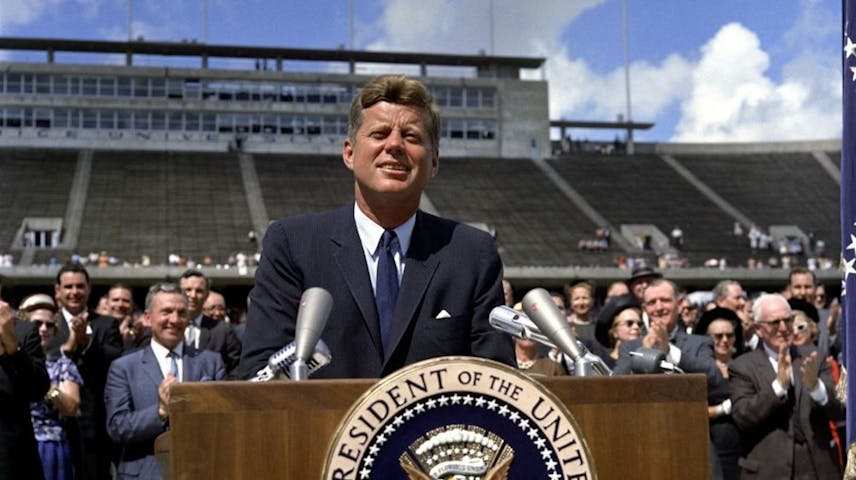
John F. Kennedy’s Speech: “We Choose to Go to the Moon”
Original speech from the public domain, adapted by Newsela staff
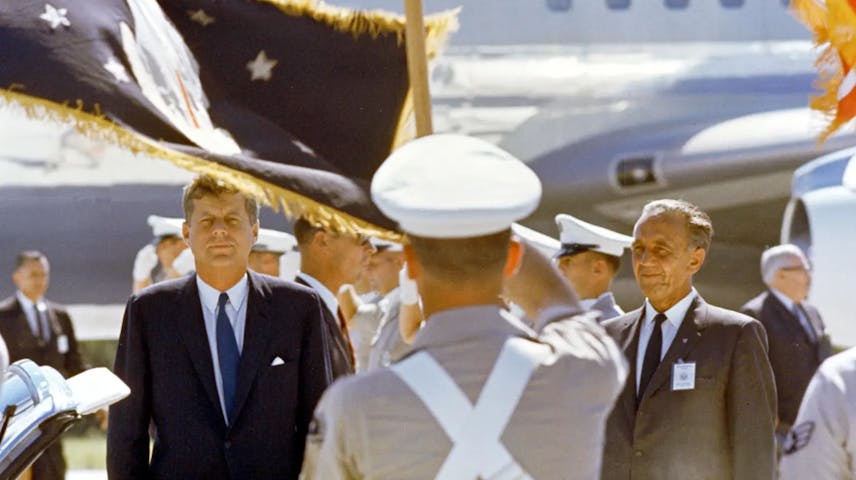
The 1960s: From Dream to Reality in 10 Years
Cheryl L. Mansfield, NASA Kennedy Space Center
The Space Race: America Reaches for the Moon
NASA and the National Park Service, adapted by Newsela