Loading course navigation
Loading lesson
50 min
Student Lesson
Lesson 14: Hidden Figures, Chapter 16 and "Sputnik"
Content
Students will integrate information presented in Chapter 16, the Sputnik text, and historical visuals to explain Langley’s reaction to Sputnik.
Language
Students will synthesize information using comparison frames, and precise scientific vocabulary in a short evidence-based explanation.
Foundational Skills
Students respond orally and in writing to information presented in a variety of formats.
How do curiosity, evidence, and collaboration lead to discovery?
Knowledge-Building:
Students build on earlier lessons about technological change, adaptation, and teamwork at Langley by examining how Sputnik created a new scientific challenge.
Enduring Understanding:
Scientific discovery grows through questions, evidence, and collaboration, especially when people respond to urgent new problems.
Future Lessons:
Students will carry today’s source-integration work into reading Chapter 17 and later research lessons where they will synthesize across multiple sources.
Unit Performance Task:
Students practice combining information from different sources to explain key ideas, a skill they will need in their Hidden Innovators research article.
| Lesson Flow | Purpose of Learning Experience |
|---|---|
Launch5 Minutes | Build interest in the text Sputnik by having students discuss their first impressions of the images and the term “Space Race.” |
Literacy Lab10 Minutes | Build precise scientific domain-specific vocabulary that students can draw on as they explain Sputnik and Langley’s entry into the Space Race. |
Learning in Action30 Minutes | Part A: Analyzing Sources (RI.6.7, SL.6.2) Students will analyze information from Chapter 16, the Sputnik text, and a historical image to identify what each source contributes. Part B: Synthesizing Sources (RI.6.7) Students will synthesize across sources in a short written explanation of Langley’s urgent response to Sputnik. |
Material List
Hidden Figures (Young Readers’ Edition) by Margot Lee Shetterly
Unit 3 Lesson 14 Student Edition
3-Column Chart graphic organizer
Routines
Turn and Talk
Quick Write
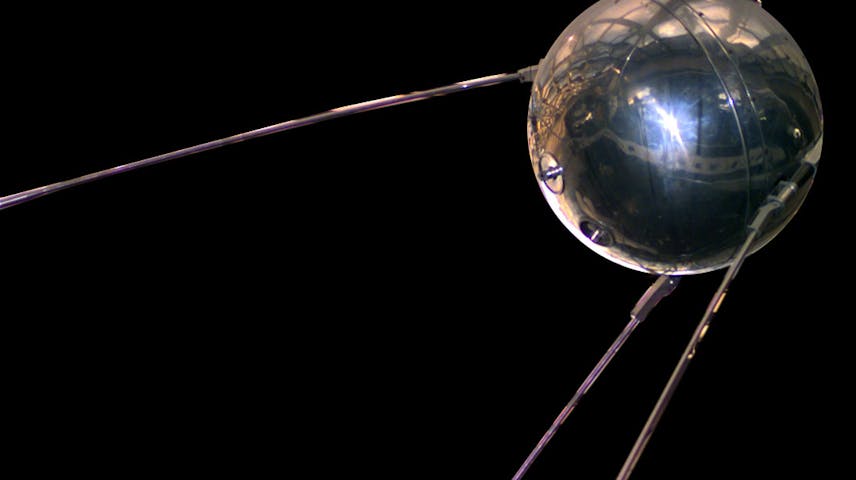
Display the image at the beginning of the Sputnik text so students can enter the lesson through observation before returning to Chapter 16.
Say These Directions: Turn and talk with a partner to discuss your response to the following question.
Ask: What are your first impressions of the title: “The Space Race Begins: The Story of Sputnik?” What do you think about the term “Space Race?”
The term “Space Race” makes me think that this is a competition. A space event could create a sense of urgency on Earth because people might realize another country has reached an important goal first.
Connection to Today's Learning
Say: Now we will explore the academic and domain specific vocabulary that scientists use to explain space missions such as Sputnik.
Target Words: satellite, acceleration
Say These Directions: We’re learning about the scientific words satellite and acceleration. Let’s explore these words more closely.
Introduce the Word: Present the word satellite to students and pronounce it.
Ask: Have you seen the word satellite before? Where?
Identify the Root: Bold the root satell in satellite. Explain that satell comes from Latin satelles, meaning “attendant” or “companion.”
Ask: Do you know any other words that connect to this idea of something staying close to something else? (satellite TV, satellite city)Language Connection: Connect to the idea of something that stays near or follows something else.
Identify Affixes: Circle -ite in satellite. Explain that -ite is a suffix often used in nouns.
Ask: What do you notice about words that end in -ite? (They are often names of things or objects.)
Language Connection: Connect to Spanish satélite, which has a similar meaning.
Determine Meaning:
Ask: Using what we know about satell and -ite, what do you think satellite means? (something that follows or orbits around a larger object, like the moon or a machine in space)
Say: Work with a partner to locate a verified definition for each word using a print or digital dictionary or other reference material. Note the part of speech and pronunciation for each word as well. Once you have found the definition, you can use the context of the sentence or passage to confirm that the definition fits the way the word is being used.
Repeat the routine with acceleration.
Introduce the Word: Present the word acceleration to students and pronounce it.
Ask: Have you seen the word acceleration before? Where?
Identify the Root: Underline the root celer in acceleration. Explain that celer comes from Latin and means “fast” or “quick.”
Ask: Do you know any other words connected to celer? (accelerate, decelerate) Language Connection: Connect to Spanish aceleración, which has a similar meaning.
Identify Affixes: Circle ac- and -ation in acceleration. Explain that ac- can mean “toward” or “to,” and -ation means “the act or process of.”
Ask: What do you think the suffix -ation might mean based on words you know? (the act or process of)
Language Connection: Connect to other words with -ation like education or celebration.
Determine Meaning:
Ask: Using what we know about ac-, celer, and -ation, what do you think acceleration means? (the process of speeding up or becoming faster)
Say: Work with a partner to locate a verified definition for each word using a print or digital dictionary or other reference material. Note the part of speech and pronunciation for each word as well. Once you have found the definition, you can use the context of the sentence or passage to confirm that the definition fits the way the word is being used.
Connection to Today's Learning
Say: We can use these words to help us understand scientific ideas connected to the Sputnik space mission.
Check for Understanding |
|---|
List the words satellite and acceleration in your Personal Dictionary. Underline the base or root word in each and circle each prefix and suffix. After each word, write (1) the definition of each word part (morpheme) and (2) the definition of the word |
Teacher Tip |
|---|
Sixth graders may use NASA as a shorthand for all U.S. space work. Briefly clarify that Chapter 16 captures Langley’s reaction in the period when NACA was shifting toward NASA after Sputnik. Students do not need the full agency timeline; they do need to understand that Sputnik increased urgency and changed the scientific questions people were asking. |
Students will work with a partner to integrate information across multiple formats (narrative, informational, and visual) to build a more complete understanding of a topic. Rather than evaluating sources, students identify what each source contributes and how the sources work together to clarify ideas.
Say: We are going to compare how different types of sources—such as narrative texts, informational articles, and images—can provide information about the same topic. Each source presents information in a different way and from a different perspective. As readers and researchers, we must determine how each source helps us understand and explain the topic we are researching.
Say These Directions: Using the 3-Column Chart, label each column with the source type:
Column 1: Chapter 16 (Narrative)
Column 2: Sputnik Text (Informational)
Column 3: Historical Image (Visual)
Say These Directions: For each type of source, write:
An important detail from that source (what it shows, explains, or reveals).
What this detail helps you understand about the topic.
Be sure to use information directly from each source.
Column 1 (Chapter 16): “With beating the Russians now a national priority, engineers felt pressure to find the quickest, surest way into space..” This helps me understand the tension and stress the scientists and mathematicians felt as they were competing in the “Space Race.”.
Column 2 (Sputnik Text): “The U.S. had been planning to launch a satellite, but it weighed only 3.5 pounds, while Sputnik weighed nearly 200 pounds.” This helps me understand how the U.S. was behind Russia in the Space Race. Our satellite was tiny and Russia’s was huge!
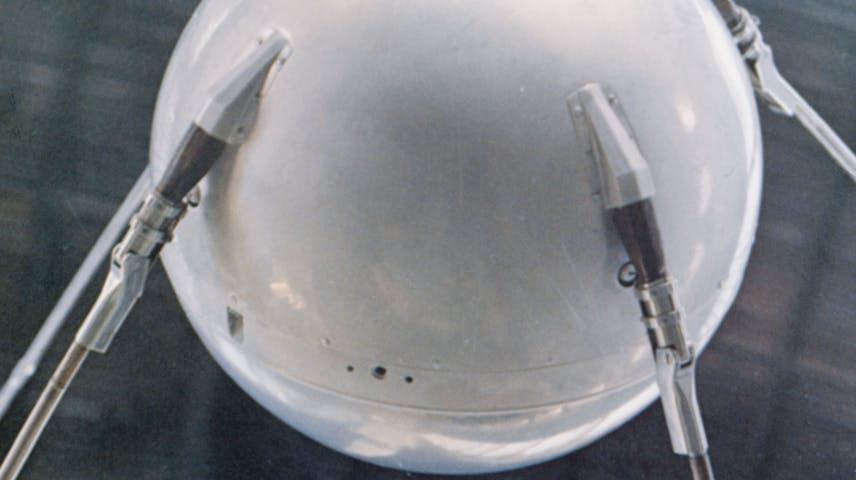
Column 3 (Image): The image shows a metal sphere with four long antennae. This helps me picture the real object that scientists were working with and helps me understand the challenges of getting this object far into space.
Say: When I integrate sources, I think about what each one does best. The narrative helps me understand people’s reactions and feelings. The informational text helps me understand facts and explanations. The image helps me understand what something actually looks like. Then I ask myself: What do I understand better when I combine these sources?
Pulse Check (RI.6.7) |
|---|
Which statement best integrates information from Chapter 16, the Sputnik text, and the image?
|
Students will draft an explanation and then share it with a partner.
Teach: Turning Notes into Synthesis Writing
Say: As I write about the information from each source, I do not want to write three separate mini-summaries. Instead, I start with the idea I want to develop: Sputnik created a new, urgent challenge at Langley. Then I carefully choose a detail from Chapter 16 that shows the human reaction, a detail from the informational text that adds scientific data and facts, and a detail from the image that provides visual clues. I can connect these details with comparison language such as while or on the other hand and a synthesis phrase like “together, these sources show.” My goal is to write a short explanation that sounds clear, connected, and evidence-based.
Say These Directions: Draw on the details and explanations in your 3-Column Chart as you write to respond to the following questions.
Ask: How does Chapter 16 describe Langley’s reaction to Sputnik? How does the additional information from the Sputnik article and image deepen your understanding of this reaction? Use evidence from the text to support your response.
The details in Chapter 16 help me to understand the tension and stress the scientists and mathematicians felt as they were competing with Russia in the “Space Race.” The Sputnik text showed how the U.S. was behind Russia because we had sent a tiny satellite to space and Sputnik was huge! The image helps me picture the real object that scientists were working with and this helps me see the challenges of getting this object far into space.
Reflection |
|---|
Reflect on your ability to synthesize information from multiple sources using the Reflection routine.
|
Say These Directions: Write to respond to the following question:
Ask: How did using multiple sources—such as the narrative text, informational article, and image—help you understand Langley’s response to Sputnik? Use details from the sources to support your response.
Using multiple sources helped me understand how Sputnik impacted the Space Race from different perspectives. Chapter 16 shows that Langley felt urgency after learning Russia had launched a satellite. The Sputnik article adds context about American competition and explains the complicated science behind launching a satellite. The image helps me visualize how unusual and impressive Sputnik was.
Optional Sentence Starter:
Using more than one source helped me understand __________ because __________.
Have students read Chapter 17 of Hidden Figures. Instruct students to take notes in their Journal on the following prompt:
As you read, annotate the text for the following:
Places where Katherine Goble or her colleagues use evidence, math, or teamwork to respond to a problem
Hidden Figures (Young Readers' Edition)
Margot Lee Shetterly
Sputnik
NASA, adapted by Newsela