A Brilliant Beginning
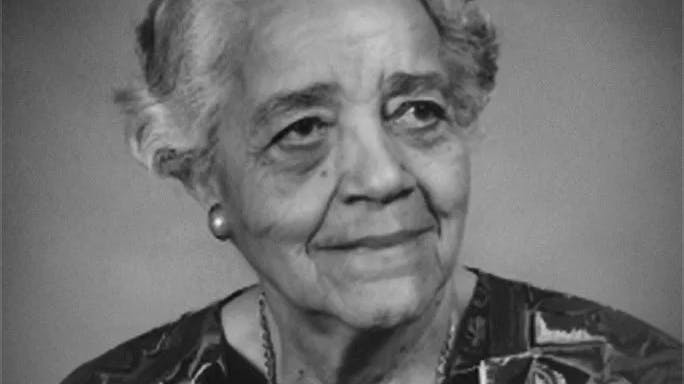
Picture this: a rocket roars off a launch pad, but before it left the ground, someone had to do the math to make it possible—mountains of math—with a pencil, a slide rule and a sharp mind. For nearly 30 years, that someone was Dorothy Vaughan.
Vaughan was born in Kansas City, Missouri, in 1910, but her family soon moved to Morgantown, West Virginia. On a full-tuition scholarship and at just 19 years of age, she finished her math degree at Wilberforce University, a historically Black college in Ohio. After graduation, she became a mathematics teacher at a Black high school in Farmville, Virginia. In 1932, she married, and the couple went on to have six children.
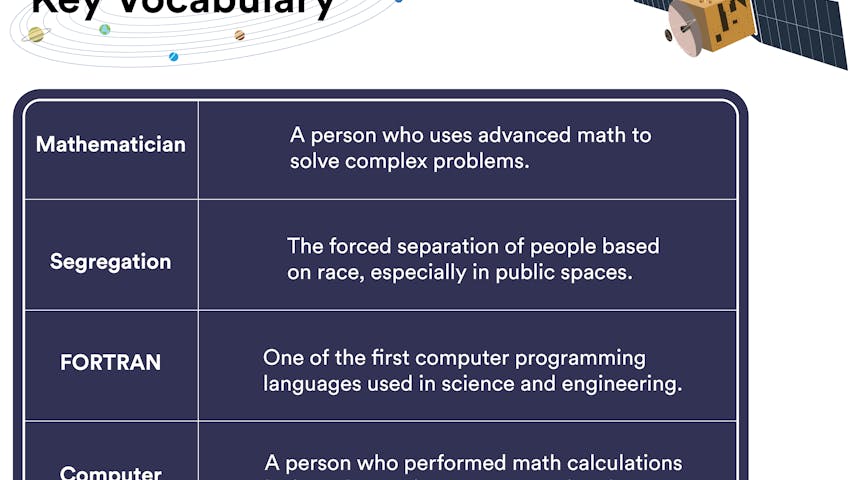
Then World War II changed everything. The country needed math experts, and Vaughan answered the call. In 1943, she applied for a job as a human “computer”—that was a job title for a person at that time—at the NACA Langley Memorial Aeronautical Laboratory. NACA is the organization that became what we now know as NASA (National Aeronautics and Space Administration).
Breaking Barriers
In 1941, President Roosevelt signed Executive Order 8802, prohibiting racial, religious and ethnic discrimination in the country’s defense industry and opening previously closed doors to Black Americans. Two years later, the NACA began hiring Black women to meet the skyrocketing demand for analyzing aircraft flight data. Armed with slide rules, mechanical calculators and strips of film from wind-tunnel cameras, these human computers turned raw data into the answers engineers needed to figure out how planes fly—and how to make them fly better.
As a new human computer, Dorothy Vaughan was assigned to the segregated West Area Computing unit, an all-Black group of female mathematicians. Engineers needed answers quickly, and the lab hummed around the clock. But despite Roosevelt’s Order, Jim Crow laws still required these Black mathematicians to work separately from their white counterparts. They even used separate dining and bathroom facilities.
Over time, though, the West Computers distinguished themselves with their contributions. The group’s first two section heads were white, but in 1949, Vaughan was promoted to lead the West Area Computers, making her the NACA’s first Black supervisor and one of its few female supervisors.
Vaughan was often specifically requested by the engineers to calculate particularly challenging computations. She collaborated with computers Vera Huckel and Sara Bullock to compile a handbook for the calculating machines used by the group. She was also a steadfast advocate for all computers, regardless of race, who deserved promotions or pay raises.
Her Legacy
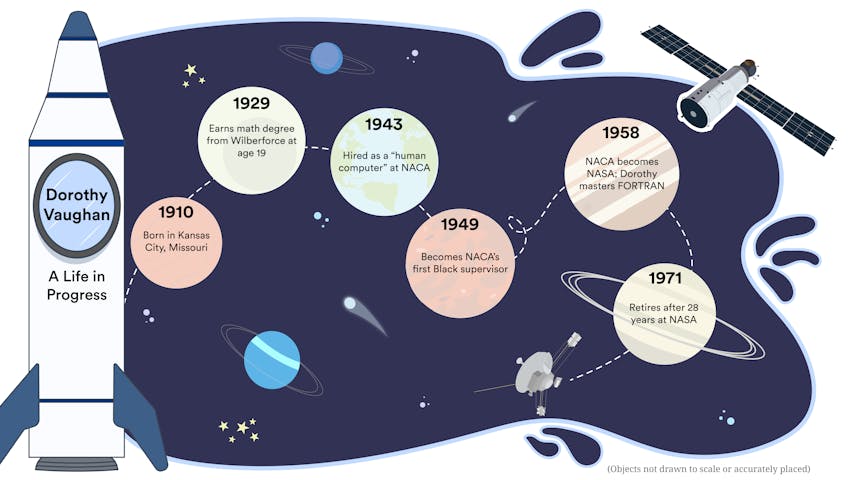
Dorothy Vaughan managed West Computing for nearly a decade. In 1958, when the NACA made the transition to NASA, segregated facilities, including the West Computing office, were abolished. Dorothy Vaughan and many of the former West Computers joined the new Analysis and Computation Division (ACD), a racially and gender-integrated group on the frontier of electronic computing. The new machines didn’t use pencils or slide rules. Instead, they spoke in code, so Dorothy taught herself FORTRAN, one of the first computer programming languages. She became an expert, she made sure the women on her team learned it, and she used her expertise to contribute to the Scout Launch Vehicle Program.
Vaughan continuously challenged herself to learn new technology so that NASA would have the very latest in computing for its research applications. Her countless calculations supported NACA and NASA accomplishments and helped to achieve the nation’s goals from the early days of World War II through the beginnings of the Space Age.
Dorothy Vaughan retired from NASA in 1971. Throughout her 28-year tenure at the NACA and NASA, she encouraged and supported all “computers” in advancing their careers and contributing to the goals of the American aerospace program. She persevered in service to her country during a time when society barred her progress because of both her race and gender. After her retirement, when asked about working within the constraints of segregation and gender she remarked, “I changed what I could, and what I couldn’t, I endured” (“Dorothy J. Vaughan”).
Dorothy Vaughan passed away on November 10, 2008, in Hampton, Virginia, at the age of 98. Her legacy lives on in the successful careers of notable West Computing alumni, including Mary Jackson, Katherine Johnson, Eunice Smith and Kathryn Peddrew, and the achievements of aeronautical engineers like Christine Darden.