Loading course navigation
Loading lesson
50 min
Student Lesson
Lesson 42: Becoming the Apprentice, Revising and Finalizing
Content
Students will revise and strengthen explanatory essays and process documents through structured peer review, planning, editing, and rewriting using digital tools.
Language
Students will engage in collaborative discussions by preparing with a draft and evidence, using that evidence in conversation, following discussion norms, building on others’ ideas, and using sequencing transitions and academic language to present ideas clearly.
Language
Students will use technology to revise and publish writing, demonstrating appropriate formatting, editing, and keyboarding skills.
What does it take to learn something difficult?
How does art connect people to their history and community?
Knowledge-Building:
Students learn the speaking and listening skills necessary to give and view presentations. Students use peer feedback to improve and revise their writing.
Enduring Understanding:
Through practice and mentorship, people turn skill into voice and work into art.
Future Lessons:
In the next lesson, students prepare to present their explanatory essays and process documents during a Gallery of Learning activity.
Unit Performance Task:
Students prepare for their unit presentations and revise their writing to create a final explanatory essay and process document.
| Lesson Flow | Purpose of Learning Experience |
|---|---|
Launch5 Minutes |
|
Literacy Lab10 Minutes | Students will evaluate a presentation using a Speaking & Listening Checklist. |
Learning in Action30 Minutes | Part A: Peer Review (W.6.5, SL.6.1) Students will participate in a peer review to give and receive feedback about their explanatory essays and process documents. Part B: Revise and Finalize (W.6.5, W.6.6) Students will use peer feedback to revise and finalize their explanatory essays and process documents. |
Not available for this lesson
Not available for this lesson
Material List
A Single Shard by Linda Sue Park
Unit 2 Lesson 42 Student Edition
Performance Task Handout
Routines
Think-Pair-Share
Turn and Talk
Display the Performance Task Handout. Explain to students that you will use this handout and rubric to grade their final explanatory essays and process documents. They will also use this rubric to help guide the revision process during class today.
Say these Directions: Take time to review the Performance Task Handout. Then, use the Think-Pair-Share routine to discuss the following prompt:
Ask: Using this rubric, reflect on the drafts of your explanatory essay and process document. Which parts of your essay and process document do you feel good about? Which parts do you feel you need support with?
I feel good about having a strong thesis statement and all four paragraphs of my essay. I also feel good about the use of temporal connectors and images in my process document. I feel like I need support with my grammar and punctuation in both my essay and my process document.
Invite 2–3 students to share their responses with the class.
Say: Today, you’ll work on revising your explanatory essays and process documents. As you work through the peer review, keep in mind what you discussed during the Think-Pair-Share to provide your partner with meaningful feedback about how to revise their work into a final draft.
Display the Speaking & Listening Checklist. Explain to students that they will present their explanatory essays and process documents to a small group of their classmates during a Gallery of Learning activity.
Speaking & Listening Checklist
Successful speakers. . .
Face the audience
Make eye contact when possible
Speak loudly and clearly
Use an appropriate rate—not too fast, not too slow
Active listeners. . .
Face the speaker
Sit still and avoid distractions
Wait until the speaker is done speaking to comment or ask questions
Use thoughtful, respectful language to ask questions and make comments
Say these Directions: Review the sample process document used in Lesson 34. Use the Speaking and Listening Checklist above to listen to give feedback on the presentation and the process according to the checklist.
How to Make Pottery
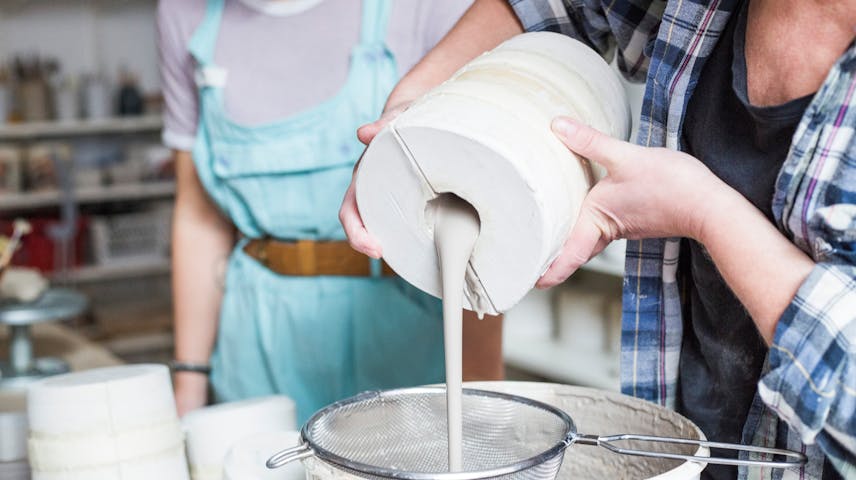
Prepare the Clay: First, the clay is gathered and purified by mixing it with water then draining it through sieves one or more times.
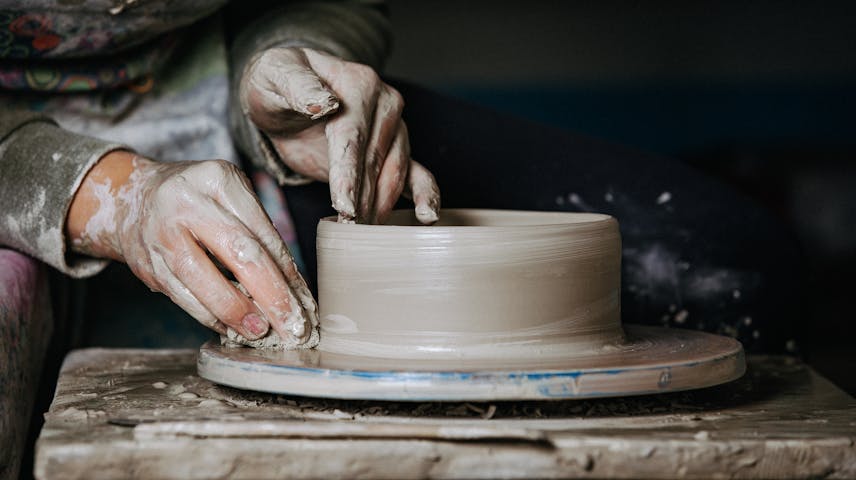
Shape the Clay: Second, the clay is sculpted using simple tools or a pottery wheel. The minerals in the clay allow it to hold its shape.
Dry and Fire the Clay: Next, the clay is left out to dry before being fired in the kiln to drive off any remaining moisture.
Glaze the Pottery: Lastly, the fired pottery is covered with different glazes with metal oxides that create different colors once it is fired again in an electric, soda, or raku kiln.

Say: I’m going to model two different presentations to show the importance of speaking and presenting skills. Listen to the two presentations and observe the differences. Be ready to provide feedback using the Speaking & Listening Checklist. Deliver a presentation of the process document that intentionally ignores the guidelines for successful speakers. For example, turn away from the audience, mumble or speak too quickly, and avoid making eye contact.
Ask: Using the Speaking & Listening Checklist, how could I improve my presentation? Remember to use thoughtful and respectful language to deliver your feedback.
Try to speak more clearly instead of mumbling so you are easier to hear and understand. Try to turn your body toward the audience to help you seem more confident.
Next, deliver a presentation of the process document using feedback provided by the class. This presentation should be an exemplar for how students will present their explanatory essays and process documents during the next lesson.
Ask: What did you notice about the second presentation? How was it different from the first presentation?
During the second presentation, you faced the audience and used eye contact. You spoke clearly. You used a rate of speaking that was easy to understand.
Reflection |
|---|
Self-reflect on the qualities of a successful speaker from the Speaking & Listening Checklist using the Reflection routine.
|
Connection to Today’s Learning
Say: During the next lesson, you will use the Speaking & Listening Checklist to share your final explanatory essays and process documents in small groups. You can use the Speaking & Listening Checklist to practice delivering your presentation after you’ve finished finalizing your writing today.
Tell students that they are going to engage in a peer review to provide feedback on a partner’s explanatory essay and process document. Let students know that they have 15 minutes for this activity.
Say these Directions: Today, you will participate in a peer review to provide feedback on your partner’s explanatory essay and process document using the Performance Task Handout. During the peer review, you will:
Trade work with the partner
Read each other’s work
Correct any capitalization, spelling, grammar, and punctuation mistakes you see
Give advice on how to improve based on the Performance Task Handout
Model how to provide feedback using the rubric.
Say: After reading my partner’s explanatory essay, I’ll look at the Performance Task Handout. Some feedback I might give could be: “Your essay includes a clear thesis statement and has an introduction paragraph, two body paragraphs, and a conclusion paragraph. These criteria are all in the first row, 3 – Proficient. I noticed that you only include evidence from the novel A Single Shard, which is the second row, 2 – Developing. What evidence did you gather from a second source about craftsmanship, learning, or mentorship?”
Show students an example of what was mentioned in the “Say” section of modeling the peer review.
Teacher Tip |
|---|
Have students engage in a peer review with the same partner they worked with during the Launch activity. Prompt students to keep in mind the parts of the explanatory essay or process document that their partner wanted support with. |
Checklist |
|---|
You will turn in your peer review for feedback. A strong draft should: ☐ Refer to the Peer Review Checklist to evaluate your partner’s work. ☐ Identify and correct errors in capitalization, spelling, punctuation, and grammar. ☐ Provide respectful, constructive, and relevant feedback. |
Say these Directions: Implement the feedback from the peer review to revise and finalize your explanatory essay and process document. Your final explanatory essay or process document should either be neatly handwritten or typed and printed. Review the Performance Task Handout again and make sure your revisions adhere to the project expectations.
Criterion | 1 – Developing | 2 – Approaching | 3 – Meets |
|---|---|---|---|
W.6.5 — Student strengthens writing by planning, revising, editing, rewriting, or trying a new approach. | Writing shows little evidence of planning or revision. | Writing shows some revision or editing, but improvements are limited or inconsistent. | Writing shows purposeful planning and revision that improves clarity, organization, or effectiveness. |
W.6.6 — Student uses technology to produce and publish writing, collaborate with others, and demonstrate sufficient keyboarding skills. | Writing shows limited use of technology; collaboration is minimal. | Writing uses technology for basic production or collaboration, but skills are inconsistent. | Writing uses technology effectively to produce and publish writing, collaborating with others during the process. |
Say these Directions: Use the Turn and Talk routine to discuss the revision process with your peer review partner. Respond to the following prompts:
Ask: What advice did you find most helpful?
I found the advice about how to use transitions to better connect my ideas most helpful.
Ask: How did you use feedback from your partner to revise or improve your work?
I used the feedback to improve my work by including more evidence to support the thesis statement.
Ask: Did you find any parts of the peer review difficult or challenging? If so, why?
Sometimes it was difficult to hear feedback about what areas of my work needed improvement.
Invite partners to share their responses with the class.
Have students finish revising and finalizing their explanatory essays and process documents for homework. Instruct students to use the Speaking & Listening Checklist to practice for their presentations during the next class.
After you finalize your explanatory essay and process document, use the Speaking & Listening Checklist to practice presenting your work. In your Reflection Journal, respond to the following prompt:
Evaluate your practice presentation. How well did you follow the characteristics of a successful speaker? How can you improve upon your presentation?
A Single Shard
Linda Sue Park