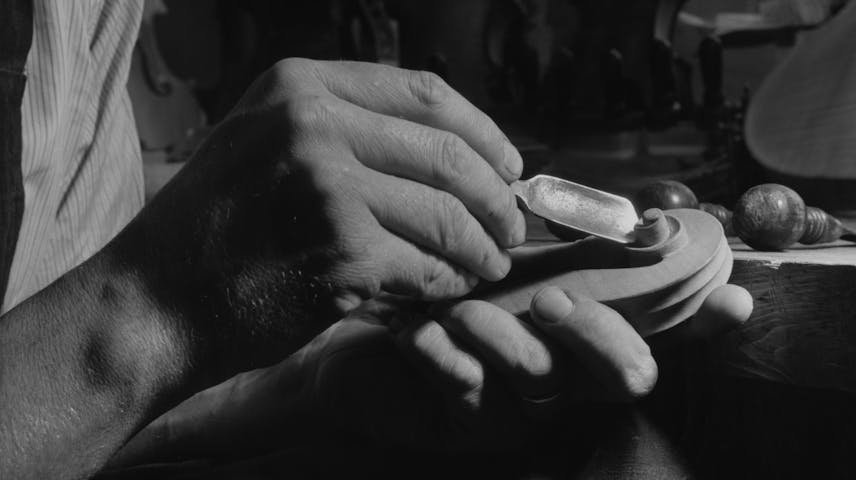
Luthier At Work. A close-up view of British-German luthier Paul Voight using a violin-maker's knife to shape the scroll, the curled embellishment at the top of the neck, at the Voight workshop in Soho, London, England, circa 1955. Photo by Pictorial Press/Archive Photos/Getty Images
Say these Directions: Use the Turn and Talk routine to discuss your Quick Write responses from the previous lesson.
Which source do you think will be the strongest or most helpful to use when writing your explanatory essay? What makes you say that?
Prompt students to cite specific evidence to support their responses. Then ask the following questions.
Ask: Which themes (learning, craftsmanship, or mentorship) does this source show?
The article "Hands That Remember: Artists Who Make Things by Hand" includes all three themes. For example, Esther Mahlangu learned Ndebele mural painting through years of watching her mother and grandmother, which shows both the craft skill she developed and the mentorship that made it possible. The article also shows how she passed that knowledge on to the next generation by opening her own art school.
Ask: What additional article or source might also help you write your explanatory essay, and why?
The short video about Goryeo celadon pottery might also help with my explanatory essay because it shows that the potter took many decades to master his craft and how he learned through trying, failing, and refining.
Connection to Today’s Learning
Say: Today, you will select at least one additional source to gather evidence from to include in your explanatory essay.
Identifying and Using Unit Vocabulary
Have students take out their Personal Dictionaries and Unit Vocabulary graphic organizers.
Say: Throughout the unit, we have learned a variety of vocabulary words related to themes and processes in A Single Shard. We’ve used these words in class, small-group, and partner discussions. We’ve also used them in our writing, including in graphic organizers, Quick Writes, and on-demand writing.
Remind students that for the Showcase Performance Task, they will write an explanatory essay that shows how a learner grows from a beginner to a skilled creator through mentorship and practice. They will also create a process document that shows the steps of learning or making a craft.
Say these Directions: Work with a partner to highlight vocabulary words that you think will help write your explanatory essay. Then circle any vocabulary words that you think will help create your process document.
Invite volunteers to share the vocabulary they identified with the class and why these words will be useful in writing their essays and process documents. Keep a running list of the words on the board or in a place where students can easily reference them.
process document: kiln, glazed, fired, sieve, slip, incising
🎯PURPOSE
Help students select and purposefully use Unit 2 vocabulary by explaining why a word fits an explanatory essay vs. a process document, using comparative connectors and analysis verbs.
Validate that students may bring in community/family craft vocabulary (e.g., cooking, sewing, building) if it supports precision and audience clarity.
🗣️SAY / ASK
Name the two writing purposes explicitly: explain (essay) vs. describe steps (process document).
Require students to justify each vocabulary choice using a comparison frame: “This word fits the essay/process document because ...”
Model one “same word, different job” example (e.g., “apprenticeship” supports explanation; “kiln” supports process clarity).
Press for comparison: “Both words relate to learning; however, ___ is more precise for describing ___.”
“However, ___ is more specific for describing the process step ___.”
“Whereas ___ names a theme, ___ names a tool/action.”
👁️WATCH FOR / SUPPORT IF NEEDED
Upgrade: “I picked it” → “This term is relevant because it emphasizes . . .”
If students only list words → Prompt: “Add one sentence explaining how the word will be used in writing.”
If students mix essay vs. process vocab with no rationale → Prompt: “Label each word E (essay) or P (process), and justify with ‘because.’”
Students use at least one comparative connector correctly (similarly/however/whereas).
Students use at least one analysis verb (illustrates/emphasizes).
Students can explain why a selected word fits the essay vs. process.
Situation
Try this
Struggling with: Using relevant vocabulary
Provide students with brief prompts to help them explain how this word connects to the Showcase Performance Task: “What does this word mean?” “How is it connected to the stages of learning?” “How is it connected to mentorship?” “Does this word help show a process?”
Ready for extension: Using relevant vocabulary
Have students select five vocabulary words from the list they created and write an original sentence using each word. As an added challenge, have students use two vocabulary words in the same sentence.
Check for Understanding
Which vocabulary word from the unit do you think will be most relevant or useful to use in your explanatory essay? Choose at least three target vocabulary words from Unit 2, and rank the relevance of each word on a scale of 1–3, with 1 being the least relevant and 3 being the most relevant. Explain the target vocabulary word you ranked as most useful to use in your explanatory essay and how it is connected to themes of learning and mentorship.
Modeling: Begin by focusing on one target vocabulary word and explaining its connection to the explanatory essay. Have students select a second target vocabulary word and place it on either side of the first word to begin ranking their relevance or usefulness.
Connection to Today’s Learning
Say: As you gather evidence from sources, think about ways to incorporate target vocabulary words into your notes.
Part A: Gathering Evidence from Additional Sources (W.6.5, W.6.9) (20 minutes)
Have students take out their Stages of Learning graphic organizers and the Gathering Evidence graphic organizers they completed in Lesson 36.
Say: Now that you’ve gathered evidence about the stages of learning and mentorship in A Single Shard, the next step is to find examples and evidence from an additional text that explores similar themes of learning, craftsmanship, or mentorship.
Distribute copies of the Paired Text Analysis graphic organizer. Then display the following prompt:
How do these articles explore themes of learning, craftsmanship, and/or mentorship? How do they support the evidence you have gathered from A Single Shard about these themes?
Say: Select two sources that clearly show at least one stage of learning (observing, trying, failing, refining, or creating). These should be sources you plan to use in your explanatory essay. These sources may be the ones you identified during the Lesson 36 Quick Write and today’s Launch.
Model writing the prompt in the top box of the graphic organizer, next to “Question for both texts.” Then model writing sources next to Text 1 and Text 2.
Say: Use the Paired Text Analysis graphic organizer to find evidence from two sources (articles or videos) that answer the prompt. Then answer the questions using details from both sources.
Students may work independently or with a partner who is using the same texts to gather evidence and complete the paired text analysis.
Question for both texts: How do these articles explore themes of learning, craftsmanship, and/or mentorship? How do they support the evidence you have gathered from A Single Shard about these themes?
Text 1: "Hands That Remember: Artists Who Make Things by Hand"
Text 2: “The Youngsters Keeping Traditional Trades Alive”
Add details from the text that help you answer the question below:
Esther Mahlangu learned Ndebele mural painting by watching her mother and grandmother very closely, studying how they held their feathers, mixed their colors, and made choices about pattern and proportion. She later expanded the tradition to canvas and international audiences, and now runs her own art school to pass the craft to the next generation.
The article shows how each artist developed technical skill through years of practice and observation, while also making creative choices that made their work their own.
Add details from the text that help you answer the question below:
Young people in Great Britain are learning trades such as leatherworking, globe making, papermaking, wheel making, and clog making.
They use the stages of learning to acquire and develop their skills from masters who have practiced their crafts for a long time.
Answer the question based on details from both texts:
Both articles show how learning, craftsmanship, and mentorship are closely related. Young people learn skills and knowledge from older mentors who help them become skilled craftspeople, and many go on to become mentors themselves.
Teacher Tip
Encourage students to refer back to their Stages of Learning and Gathering Evidence graphic organizers to help them make connections between the evidence they have already found and details from additional sources that will support their writing.
Set the expectation that all students will gather evidence that clearly supports an idea, not just collect details. This skill develops across grade levels as students move from identifying relevant evidence to comparing multiple sources, evaluating the strength of evidence, and using it to build more complex explanations and arguments.
Invite volunteers to share their findings with the class. Then briefly discuss the following questions.
Ask: Did you find the evidence you were looking for in the two articles? Why or why not?
Yes, I found details about learning, craftsmanship, and mentorship in both articles.
Ask: Was one article more helpful for your research than the other? If so, why?
The first article I chose, "Hands That Remember: Artists Who Make Things by Hand," was more helpful to my research because it included detailed examples about eight different craftspeople and artists from around the world. There was less information in the second article, "The Youngsters Keeping Traditional Trades Alive."
Checklist
As you revise your briefs, check if you:
Work independently or collaboratively with a partner.
Use the Paired Text Analysis graphic organizer to analyze two texts.
Add the question to the graphic organizer.
Use relevant quotes and paraphrases from two sources to answer questions.
Cite page numbers.
Determine how both sources answer the questions.
🎯PURPOSE
Support students in drawing clear cross-text inferences by comparing how two sources develop the same idea (learning/craftsmanship/mentorship), using comparative connectors and analysis verbs.
🗣️SAY / ASK
Encourage students to choose sources that match their interests (pottery, boot making, weaving, poems) to increase engagement while maintaining academic precision.
Require students to write one comparison sentence per source pair before drafting the “Answer the question” box.
Make the comparison target explicit: choose one shared idea (e.g., mentorship, practice over time, observing a master).
Require students to label each evidence note with: idea + evidence + what it illustrates/emphasizes.
Press for inference: “What can we conclude about apprenticeship from both?”
“Text 1 illustrates ___ by ___.”
“Text 2 emphasizes ___ through ___.”
“Similarly, both texts show ___.”
“However, the difference is ___.”
“Whereas Text 1 focuses on ___, Text 2 focuses on ___.”
👁️WATCH FOR / SUPPORT IF NEEDED
Revoice vague connections: “Both are about learning” → “Both sources illustrate learning as a staged process; however, Text 1 emphasizes ___, whereas Text 2 emphasizes ___.”
If students summarize each text separately with no comparison → Prompt: “Add one sentence that starts with ‘Similarly’ and one that starts with ‘However.’”
If evidence is too general → Prompt: “Add one concrete detail (name, craft, step, or action), and explain what it illustrates.”
Students include at least one similarity and one difference using comparative connectors.
Students use “illustrates”/”emphasizes” accurately to explain evidence.
Students state a conclusion about how the shared idea connects to stages of learning.
Situation
Try this
Struggling with: Finding relevant evidence
Provide students with a three-point checklist with brief prompts to help them find relevant evidence in their chosen articles. Learning: What are some examples of learning in this article? What are people learning? Craftsmanship: Does this article show craftsmanship? What are some examples? Mentorship: Who is the mentor? Who is the mentee? What is the purpose of their mentorship?
Ready for extension: Using additional sources
Have students incorporate a third source (text or video) from the unit to include in their explanatory essay.
Part B: Read Through an Exemplar Essay (W.6.5, W.6.9) (10 minutes)
Display the prompt and exemplar explanatory essay. Give students a few moments to read them over, or invite volunteers to read the text aloud.
Prompt: Write an explanatory essay that shows how a learner grows from beginner to skilled creator through mentorship and practice. In your explanatory essay, you will describe each stage of learning, from observing a master to trying, failing, refining, and finally creating something of your own. Use examples and evidence from A Single Shard and at least one additional text that explores similar themes of learning, craftsmanship, and/or mentorship.
Exemplar Essay: A Single Shard
What does it take to learn something difficult? In the novel A Single Shard, Tree-ear, a young boy living in twelfth-century Korea, seeks to learn how to make pottery, a craft that is traditionally passed down from father to son in his village of Ch'ulp'o. Meanwhile, real-life artist Esther Mahlangu set out to master a different tradition: Ndebele mural painting, a craft she began learning from her mother and grandmother when she was about nine years old in Mpumalanga, South Africa. For both Tree-ear and Mahlangu, the answer to this question is simple: learning something difficult takes time, effort, and mentorship. The novel A Single Shard and the article "Hands That Remember: Artists Who Make Things by Hand" show how the stages of learning and mentorship help learners develop into skilled craftspeople.
The stages of learning and mentorship are an important part of the plot of A Single Shard. The main character, Tree-ear, learns the trade of pottery by first observing masters and other skilled craftspeople, then trying new skills and sometimes failing at them, and finally refining his learning to the point where he is ready to create something on his own. One example of this is how Tree-ear learns to gather clay and then purify it so it can be used. First, Tree-ear watches other potters gather the clay from the riverbank. In Chapter 3, he uses a spade given to him by Min to try to cut large slabs, but he gets his spade stuck and has to claw the clay away. After many attempts, Tree-ear becomes skilled at quickly cutting large slabs of clay. After gathering the clay, Tree-ear learns how to pass the clay through various sieves until it is pure enough to be used. In Chapter 7, after months of watching Min and practicing on his own, he refines his own ability to know when the clay is ready to be used by rubbing it between his fingers. Tree-ear also uses the stages of learning to eventually create his own work. After months of watching Min, trying, failing, and refining, in Chapter 9, he is able to mold clever objects, such as a monkey he gives to his friend Crane-man. Through this process, Tree-ear receives mentorship from Min, a master potter in his village. Although Min is not a perfect mentor, his knowledge and skills are very important to Tree-ear's evolution from beginner to skilled creator.
"Hands That Remember: Artists Who Make Things by Hand" offers another perspective on the important connection between learning and mentorship. Artist Esther Mahlangu learned Ndebele mural painting by first watching her mother and grandmother work. As a young girl, she studied how they held their feathers, mixed their colors, and made choices about pattern and proportion. She was so drawn to the craft that she tried to paint every afternoon while the adults napped, getting into trouble every day. Only through years of careful watching and many early attempts did her hand grow steady. Eventually, Mahlangu not only mastered the technical skills of Ndebele painting but also made the tradition her own. She took the wall-painting style and put it on canvas, painted a BMW car, and showed her work in museums around the world. She has said that although her artworks are based on traditional Ndebele designs, "they are still very modern and current." Like Tree-ear, Mahlangu progressed through the stages of learning, including observing, trying, failing, refining, and creating, to develop into a skilled artist. And like Min, she has become a mentor in her own right, running an art school in her backyard to teach young people the same skills her grandmother once passed to her.
Learning a new skill is not always easy, especially without the knowledge and guidance of someone with more experience. For Tree-ear and artist Esther Mahlangu, the process of developing from a learner to a skilled craftsperson was made possible by mentors. In A Single Shard, Tree-ear progressed through the stages of learning, including observing, trying, failing, refining, and creating, to learn and carry on the proud tradition of pottery from Min. Mahlangu went through her own learning process to master Ndebele mural painting, eventually expanding the tradition to new audiences and becoming a mentor in her own right. Together, these texts show that through mentorship and practice, anyone can grow from a beginner to a skilled creator.
Discuss how the exemplar fits the prompt.
Ask: How does this explanatory essay fit the prompt for the assignment?
The essay discusses the stages of learning. It uses information from A Single Shard and another source. It makes connections between the stages of learning, mentorship, and craftsmanship to show how a learner grows from a beginner to a skilled creator.
Share the Performance Task Handout.
Discuss how the exemplar fits the rubric.
Ask: Let’s focus on the rubric. Pick a characteristic from this row, and explain how you know this explanatory essay fits it.
One characteristic is that it has four paragraphs: an introduction paragraph, two body paragraphs, and a conclusion paragraph. I can see that the first paragraph explains what the essay is about, the two middle paragraphs share evidence from the text, and the last paragraph ends the essay.
Say: Think about this exemplar and the ways it fits the prompt and rubric as you begin drafting your own explanatory essays over the next few lessons.
Provide students with a confidence continuum (i.e., 1–5). Model how to demonstrate a level of confidence using the continuum.
Modeling: Students can demonstrate their confidence by choosing one characteristic from the rubric and explaining how it is reflected in the exemplar text. Encourage students to ask questions to determine if they understand how to use the rubric.
Reflection
Reflect on your understanding of the rubric using the Reflection routine.
How confident are you in your ability to use the rubric to determine what to include in your response?
Then write a sentence or two describing how to use a rubric to determine what should be included in your response.
Criterion
1 – Developing
2 – Approaching
3 – Meets
W.6.5 — Student strengthens writing by planning, revising, editing, rewriting, or trying a new approach.
Writing shows little evidence of planning or revision.
Writing shows some revision or editing, but improvements are limited or inconsistent.
Writing shows purposeful planning and revision that improves clarity, organization, or effectiveness.
W.6.9 — Student draws evidence from literary or informational texts to support analysis, reflection, or research.
Writing includes little or no evidence from the text, or evidence is unrelated.
Writing includes some relevant evidence but support is uneven or only partially explained.
Writing uses clear, relevant evidence from the text to support analysis, reflection, or research.
🎯PURPOSE
Help students analyze how an exemplar meets the rubric by naming what the writer does and how it works, using comparative connectors and analysis verbs.
Normalize different valid approaches: students can meet the rubric with different topic choices and different source pairings as long as comparisons are explicit and evidence-based.
🗣️SAY / ASK
Require students to cite one sentence from the exemplar and identify what it illustrates (structure, evidence integration, transitions, formal style).
Require one comparison statement: how the exemplar handles Text 1 vs. Text 2.
Push cross-text comparison: “Similarly, the essay connects both texts by . . .”
Clarify structure terms: introduction, body paragraph, conclusion, thesis.
“This introduction illustrates ___ because ___.”
“Similarly, the writer uses ___ in both body paragraphs to ___.”
“However, the second body paragraph differs because ___.”
“Whereas paragraph 2 focuses on the novel, paragraph 3 focuses on the article.”
👁️WATCH FOR / SUPPORT IF NEEDED
Provide a “rubric-to-text” routine: (1) name the rubric feature → (2) point to where it appears → (3) explain the effect.
If students identify a feature without evidence → Prompt: “Quote 3–6 words that prove it.”
If students struggle to name the feature → Prompt: “Is this structure, evidence, transition, or formal style?”
Students name a rubric criterion and point to a specific location in the exemplar.
Students use comparative connector + analysis verb at least once.
Students explain one takeaway about what to imitate in their own draft.
Quick Write
Say these Directions: Respond to the following Quick Write prompt in one or two sentences.
Ask: What questions do you have about the Showcase Performance Task so far? Are there any challenges or obstacles you have experienced?
One question I have is, how many pieces of evidence do we need to include in our essay? One challenge I have experienced is making a connection between the novel and the sources I chose.
Students read their independent reading book for 20 minutes and complete a reading log entry.
Read your independent reading book for 20 minutes. In your reading log, record the date and pages you read, write 1–2 sentences about what happened or what you learned, and respond to this week’s prompt using evidence from the text.