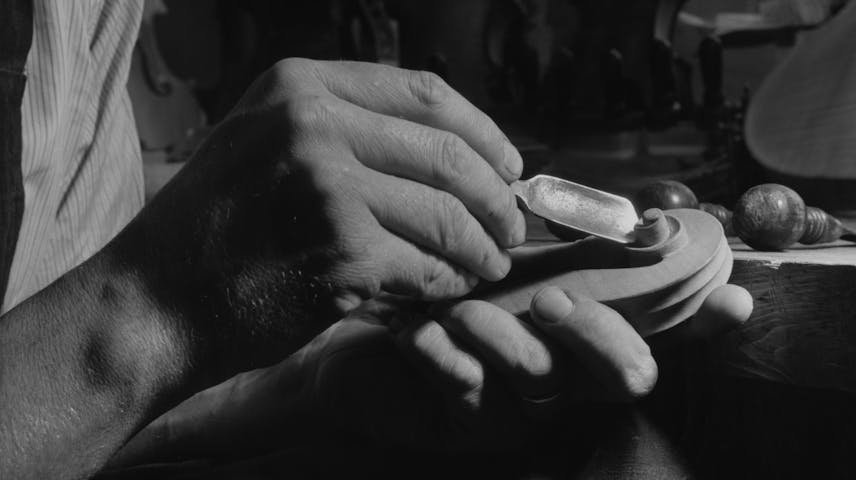
Luthier At Work. A close-up view of British-German luthier Paul Voight using a violin-maker's knife to shape the scroll, the curled embellishment at the top of the neck, at the Voight workshop in Soho, London, England, circa 1955. Photo by Pictorial Press/Archive Photos/Getty Images
Say these Directions: Use the Retell and Paraphrase Partner Check routine to discuss the first half of Chapter 8 from the first sentence, “Min began work on another set of inlaid vases,” to “He did not even know if he could say the word.“
The first partner will orally retell and paraphrase the first half of Chapter 8 of A Single Shard while the second partner checks for accuracy. Then the second partner will orally retell and paraphrase the text while the first partner checks for accuracy.
As students retell and paraphrase the text, move around the room to listen for gist and accuracy. Bring the class together to briefly discuss major events, plot points, and themes.
Ask: What important events happen in the first half of Chapter 8? Use details from the text to support your response.
The emissary returns and gives Kang a limited commission for his new pottery technique. The emissary says he prefers Min’s work and invites him to come up with something innovative to bring to Songdo. Min declines because he is too old to make the trip, but Tree-ear offers to go in his place. Min’s wife agrees to let Tree-ear go on two conditions: that he return safely and that he call her “Ajima.”
Say: The quality of Min’s work captures the attention of the royal emissary in the first half of Chapter 8. Today, you will read two poems about artisans who, like Min, take pride in what they create.
Word Associations
Target Word: craftsman
Introduce the Word: Write craftsman on the board and pronounce it.
Ask: Have you seen the word craftsman before? Where?
Define the Word: Explain that a craftsman is a person who works at a skilled trade or craft.
Language Connection: In Spanish, artesano means “artisan,” which is another word for craftsman. In French, the word is also artisan.
Say: An association is a connection or link between ideas, words, or things that come to your mind when you think about something.
Discussion: Ask students to discuss with a partner the associations that come to them for the vocabulary word, craftsman, then have them share their responses in a whole-group discussion. Encourage students to explain the connection they’re making.
Prompt Student Thinking:
Ask: When you hear the word craftsman, what images come to mind?
a person working with tools; crafts such as pottery, woodworking, or leatherworking; a person making something functional or beautiful
Ask: Which types of crafts, trades, or arts might a craftsman do?
Ask: What words come to mind that have a similar meaning or are related to craftsman?
craftswoman, craftsperson, artist, maker, master
Prompt students to add craftsman to their Unit Vocabulary graphic organizers.
Check for Understanding
List the word craftsman in your Personal Dictionary. After the word, write the definition and any related words.
Situation
Try this
Struggling with: Using the language
Briefly re-model the meaning using concrete language. Ex. “A craftsman is a person who works at a skilled trade or craft, such as pottery, woodworking, or metalworking.”
Ready for extension: Using the language
Ask: How might a craftsman learn their trade? A craftsman might learn their trade through an apprenticeship.
🎯PURPOSE
Help students define and elaborate on the concept of craftsman using expanded noun phrases and academic adjectives that will later support comparison across poems.
🗣️SAY / ASK
Expanded noun phrases (a highly skilled artisan, a patient master craftsman)
General academic adjectives (dedicated, meticulous, disciplined, innovative)
Definitional frames
A craftsman is a ___ (adjective) ___ (noun) who ___.
One quality of a true craftsman is ___.
A craftsman develops skill through ___.
👁️WATCH FOR / SUPPORT IF NEEDED
If definition is too simple (“a person who makes things”) → Prompt: Add how or why: makes things with skill, makes useful and beautiful objects.
If response lacks adjectives → Prompt: Add one describing word before craftsman.
Students define craftsman using an expanded noun phrase.
Students use at least one academic adjective.
Students connect the word to learning or mentorship.
Connection to Today’s Learning
Say: Today, you will read two poems featuring the target vocabulary word: “Craftsmen” and “The Craftsman.” As you read the poems, think about how the poems define, explain, or elaborate upon the meaning of this word.
Part A: Reading “Craftsmen” and “The Craftsman” (RL.6.2) (15 minutes)
Preview the poems “Craftsmen” by V. Sackville-West and “The Craftsman” by Marcus B. Christian.
Say These Directions: Today, you will read two poems: “Craftsmen” by V. Sackville-West and “The Craftsman” by Marcus B. Christian. Vita Sackville-West was a poet and novelist who wrote about her life in the English countryside during the early 1900s. Marcus B. Christian was a Black writer, poet, librarian, and educator from Louisiana who wrote about the African American experience in the United States. The poets approach the same topic—craftsmen—in different ways. As you read these texts, think about the big ideas or themes that each poet develops.
Say: You will read the poems silently for 5–7 minutes. As you read, annotate important ideas, details, connections, or quotes that support themes connected to “craftsman.” I will give a two-minute warning before time is up. When you finish, show a thumbs-up.
Then, in your groups, you will have 10 minutes to share your annotations and complete the web chart, focusing on how the texts connect to the theme of craftsmen. I will keep time and give a five-minute warning.
Give students 5–7 minutes to read the poems independently, annotating important ideas, details, connections, or quotes that support the theme of “craftsman.” Then, place students in groups of three or four to share their annotations using the structured group work process. Finally, have groups complete the Web Chart graphic organizer, recording key ideas, details, connections, or quotes for each poem.
After students finish reading the poems, invite groups to share some of the ideas they recorded in their Web Chart graphic organizers.
Teacher Tip
Both “Craftsmen” and “The Craftsman” develop rhyme schemes to create meaning and rhythm. “Craftsmen” follows an irregular rhyming pattern that changes throughout the poem. For example, the first six lines follow an ABABCDCD rhyme scheme, and the next six lines follow an EEFGGF rhyme scheme. “The Craftsman” is a Shakespearean sonnet consisting of 14 lines, with 10 syllables per line. The rhyme scheme is ABAB CDCD EFEF GG.
🎯PURPOSE
Support students in identifying central ideas in each poem and expressing perspective using comparative language and expanded noun phrases.
🗣️SAY / ASK
Comparative connectors (similarly, however, in contrast)
Expanded noun phrases to describe tone and perspective (a reflective third-person narrator, a passionate first-person voice)
In “ Craftsmen,” the poet emphasizes ___, whereas in “ The Craftsman,” the speaker ___.
Both poems highlight ___; however, they differ in ___.
The poem portrays a ___ (adjective) ___ (noun), which suggests ___.
👁️WATCH FOR / SUPPORT IF NEEDED
If students only summarize → Prompt: What does that show about craftsmen?
If comparisons are unclear → Prompt: Use a connector like however or similarly.
Students identify at least one theme.
Students use one comparative connector correctly.
Students expand one noun phrase describing perspective.
Situation
Try this
Struggling with: Identifying main ideas
Provide students with brief prompts to identify main ideas in the poems. Ex. “What words or phrases does the poet repeat?” Ex. “What points does the poet make about craftsmen?” Ex. “What ideas seem the most important, and why?”
Ready for extension: Descriptive and figurative language
Ask: What descriptive or figurative language do you notice in the poems? How does this influence the poem’s meaning? The poem “Craftsmen” describes tools as having “crotchets.” This is an example of personification that makes the tools seem like characters in the poem. It influences the meaning by showing how craftsmen work very closely with their tools to make things.
Check for Understanding
Provide students with a confidence continuum (i.e., 1–5). As needed, model how to demonstrate a level of confidence using the continuum.
Reflection
Reflection: How confident are you in your understanding of these poems and how they illustrate the theme of craftsmen across all texts?
Choose a number between 1 and 5, with 1 being the least confident and 5 being the most confident, to rate your confidence level. Then write a few sentences that show your understanding of the poems and their shared themes.
Modeling:
Say: I really liked the poems and feel pretty confident about my understanding of them. I would give myself a 4. It was interesting to see how the poems show two different views of craftsmanship. Both poems connect to themes about legacy and how skills are passed down through generations. This also connects to A Single Shard.
Part B: Comparing Texts (RL.6.2, RL.6.9) (15 minutes)
Comparing “Craftsmen” and “The Craftsman”
Introduce the activity by briefly discussing how to compare and contrast texts.
Model comparing and contrasting by reviewing an example with students before they begin the activity.
Check for understanding using a thumbs-up/thumbs-down system: thumbs-up if students understand, thumbs in the middle if they need more support, and thumbs-down if they do not understand.
Note which students need support and provide additional clarification, while those ready to proceed begin the activity.
Say these Directions: When we compare and contrast texts, we look at the similarities and differences between them, including their topics, what each speaker says about the topic, main ideas or themes, structures, and their use of language and punctuation. You just read two poems, “Craftsmen” and “The Craftsman.” While both poems talk about the same topic, the poets develop ideas about these topics in different ways. Together, we will compare and contrast the poems.
As a class, compare and contrast the two portrayals of craftsmen in the poems. Have students record their responses in a Venn diagram: characteristics of “Craftsmen” on one side, characteristics of “The Craftsman” on the other, and shared traits in the overlapping section. Use the prompts to guide students as they complete the activity.
Ask: What are some characteristics only found in “Craftsmen”? Use evidence from the poem to support your response.
The poem is told by a third-person narrator. It discusses sharing knowledge. It explains how craftsmen make things “out of need” but still create art in the process. It explains the close relationship between craftsmen and their tools. The text is free-flowing; each line is different. There are no stanzas.
Ask: What are some characteristics only found in “The Craftsman”? Use evidence from the poem to support your response.
The poem is told by a first-person narrator, from the perspective of a craftsman. It describes the passion of the craftsman. The poem has a rhyming pattern and the rhythm is predictable.
Ask: What are some characteristics shared by both poems? Use evidence from both poems in your comparison.
Both poems emphasize perfection. They both talk about the beauty of the items created. They both talk about time and imply the enduring nature of the craft, through either passing down knowledge or leaving behind objects for others to see.
[sample responses are above]
After students complete their comparisons, lead students in a brief discussion connecting the poems to A Single Shard.
Ask: According to the poems, what qualities define a true craftsman? Which of these qualities do you see in Tree-ear’s apprenticeship so far, and what does this reveal about how difficult learning happens? Use evidence from both the poems and story in your response.
Qualities that define true craftsmen are the pursuit of perfection (even if it means rejecting work or trying the same thing again and again), the transfer or knowledge, the enduring quality of the things they create, and a passion for their work. So far, Tree-ear has seen Min strive for perfection. Tree-ear has also had to repeat the same tasks over and over to learn how to do them well. Min and other mentors have transferred knowledge to Tree-ear. This reveals that difficult learning happens through repetition, through failure, and with guidance from others.
Ask: Does Min fit into these descriptions of craftsmen? Why or why not? Use evidence from the story to support your response.
Min fits the descriptions of craftsmen because he strives for perfection. In the novel, Min rejects multiple pots before accepting one as good enough to go into the kiln. When the glaze on the pottery has brown spots, Min breaks the pots into shards instead of showing his work to the emissary.
🎯PURPOSE
Support students in articulating similarities and differences across poems and connecting those perspectives to A Single Shard using structured comparison language.
🗣️SAY / ASK
Comparative structures (both, whereas, unlike)
Expanded noun phrases with comparative adjectives (a more reflective portrayal, a stronger emphasis on perfection)
Cause– effect connectors (because, therefore)
Both poems value ___, but they differ in ___.
Unlike the speaker in ___, the narrator in ___ focuses on ___.
This reveals a ___ (comparative adjective) ___ (noun) because ___.
👁️WATCH FOR / SUPPORT IF NEEDED
If comparisons are one-sided → Prompt: Add one detail from the other poem.
If ideas are vague (“they are different”) → Prompt: Different in what way? Tone? Structure? Message?
Students compare both poems explicitly.
Students connect poems to Tree-ear or Min.
Students use at least one expanded noun phrase in speech.
Situation
Try this
Struggling with: Making comparisons
Provide students with brief prompts to help them compare the two poems. Ex. “Who is the speaker in each poem? How can you tell?” Ex. “What is similar or different about the structure of each poem?” Ex. “What are common ideas you notice?” Ex. “Are there any ideas that are only featured in ‘Craftsmen’/‘The Craftsman’?”
Ready for extension: Writing an original poem
Prompt students to write their own original poem about craftsmen, using themes from the poems they read and from A Single Shard. Then have students compare and contrast their poem with the texts they read in class.
Pulse Check (RL.6.9)
Which idea about craftsmen is found in both poems?
They make useful items.
Incorrect: “Craftsmen” explains how craftsmen make items out of necessity. “The Craftsman” focuses on the beautiful objects the speaker makes.
They strive for perfection.
Correct: Both poems focus on perfection.
They can live forever.
Incorrect: This idea is in the “The Craftsman” only.
They like working with tools.
Incorrect: Only “Craftsmen” discusses tools.
Quick Write
Say These Directions: Show your understanding of what you learned today by responding to the prompt:
Ask: How are the views of the craftsmen in the poems and A Single Chard similar? How are they different? What did you learn about craftsmen from each text?
Both texts describe craftsmen thinking about their legacy, or what they leave behind. In A Single Shard, we’ve talked a lot about passing on knowledge through mentorship. I learned about how legacy and mentorship are connected.
Instruct students to finish reading Chapter 8 of A Single Shard and then respond in their Journal to the following prompt:
What do Min, Crane-man, and Ajima teach Tree-ear about? What do the characters do or say to teach Tree-Ear? How does this reflect the theme of the text? Use evidence to support your response.