Loading course navigation
Loading lesson
50 min
Student Lesson
Lesson 2: Artisans in Tree-ear's World
Content
Students will watch a video and explore images of Goryeo celadon pottery to help visualize what makes Tree-ear curious.
Language
Students will describe and interpret skilled actions shown in visual media using action verbs, and interpretive phrases (e.g., this shows . . . , this conveys . . .) to explain how curiosity connects to craft and tradition.
What does it take to learn something difficult?
How does art connect people to their history and community?
Knowledge-Building:
Art expresses cultural identity.
Enduring Understanding:
Through practice and mentorship, people turn skill into voice and work into art.
Future Lessons:
In Lesson 3, students will be introduced to the Essential Questions and engage with an article and video about mentorship and apprenticeship.
Unit Performance Task:
This lesson explores curiosity, ingenuity, and innovation.
| Lesson Flow | Purpose of Learning Experience |
|---|---|
Launch15 Minutes | Students engage in a turn and talk discussion about their own definitions of curiosity and then work with the whole class to develop an agreed-upon definition of the word. |
Learning in Action30 Minutes | Part A: Introducing Korean Pottery (RI.6.7, L.6.6) Students watch a video about Goryeo celadon pottery and complete an I See, I Think, I Wonder graphic organizer. Part B: Examining Goryeo Pottery (RI.6.7, L.6.6) Students observe images of Goryeo celadon pottery before engaging in the Graffiti / Table Talk protocol to identify and summarize patterns. |
Look Back5 Minutes | Students respond to a Quick Write prompt explaining what they found most interesting in the video. |
Not available for this lesson
Material List
Student copies of A Single Shard by Linda Sue Park
Unit 2 Lesson 2 Student Edition
I See, I Think, I Wonder graphic organizer
Chart paper or Jamboard
Markers
Routines
Turn and Talk
Graffiti/Table Talk
Quick Write
Say these Directions: Use the Turn and Talk routine to discuss the definition and examples of curiosity you recorded in your Journal for Lesson 1 homework.
Invite two to three students to share their responses before developing a class definition for curiosity.
Ask: What are some characteristics of curious people?
asking a lot of questions, being interested in new topics, eagerness to explore new ideas, interest in other people or ideas
Ask: What piques your curiosity?
Responses will vary
Say: Work together to combine your responses into a single definition of curiosity.
Curiosity is wondering about something, asking questions, and being interested in something new.
Say: In A Single Shard, one of the main characters is Tree-ear, and his curiosity plays an important role in the plot and in his own journey learning about the arts and traditions of Korean culture.
Display the words tradition and celadon. Discuss the definition of these words as a class, providing additional context and connection as it pertains to the unit.
tradition: the beliefs and customs of a culture that are handed down from one generation to the next
Connection: Pottery is an important craft and tradition practiced in Tree-ear's village of Ch’ulp’o. Craftspeople pass down their knowledge of how to make pottery from one generation to the next.
celadon: a type of pottery known for its smooth surface and pale green glaze
Connection: In the novel, Tree-ear becomes curious about how to make celadon pottery, which is specific to Korea’s Goryeo dynasty.
Say: Today, you will watch a video about Korean pottery. As you watch the video, consider why Tree-ear might be curious about the craft and tradition of making pottery.
Tell students that they will be watching a short video about the history and making of Goryeo celadon pottery. This video shows a variety of pottery tools, as well as “throwing,” or shaping, a clay object using a pottery wheel.
Say: As you watch “Korean Pottery: A Story of a Thousand Years,” note what you notice, think, and wonder about the materials, shapes, tools, and how the potters work. Use specific action words from the video to describe the skills you observe.
Say these Directions: Record your observations about the pottery video using the I See, I Think, I Wonder graphic organizer.
I See . . . | I Think . . . | I Wonder . . . |
|---|---|---|
I see kinds of celadon vases with detailed designs. I see a potter throwing clay on a pottery wheel and carving designs with special tools. I see wet clay and clay that has been baked at a high temperature. | I think the potter shows lots of skill and talent as well as patience. I think mastering pottery must take a very long time. | I wonder who the potter learned how to make pottery from. I wonder how long it takes to create a pot. I wonder how glazing the pots makes the celadon green color. |
Have students share their responses on the I Think, I See, I Wonder graphic organizer with a partner. Invite two to three partners to share their responses with the class. Then, have students engage in a turn and talk discussion to answer the prompt.
Say these Directions: Use the Turn and Talk routine to discuss the prompt:
Ask: Based on the video, why might Tree-ear be curious about making pottery?
The pottery is very beautiful. It uses interesting tools and requires lots of skill.
Pulse Check |
|---|
How do the video and informational texts from the last lesson deepen your understanding of the importance of pottery in Korea during the Goryeo period? A. They show that pottery was unimportant to Korean history and was only a minor craft compared to other technologies. Incorrect. Both the video and the texts emphasize pottery as a major artistic and historical achievement, especially during the Goryeo dynasty. B. They show that pottery traditions stopped once new dynasties began and were not connected to earlier periods. Incorrect. The video traces pottery across multiple historical periods, and the texts connect Goryeo pottery to broader Korean history, showing continuity rather than disappearance. C. They show that pottery developed over time as people adapted to Korea’s geography and resources, becoming an important cultural art that reflected community traditions and identity. Correct. The video explains how Korean potters adapted to mountainous geography by mixing clays and developing unique celadon, while the texts describe geography, trade, and Goryeo artistic achievements—together showing pottery as a cultural tradition shaped by environment, history, and community life. D. They show that pottery was mainly produced because Korea had large plains with perfect clay that made pottery easy to create. Incorrect. The video and texts explain that Korea lacked large plains with ideal clay and instead required creative adaptation to available materials. |
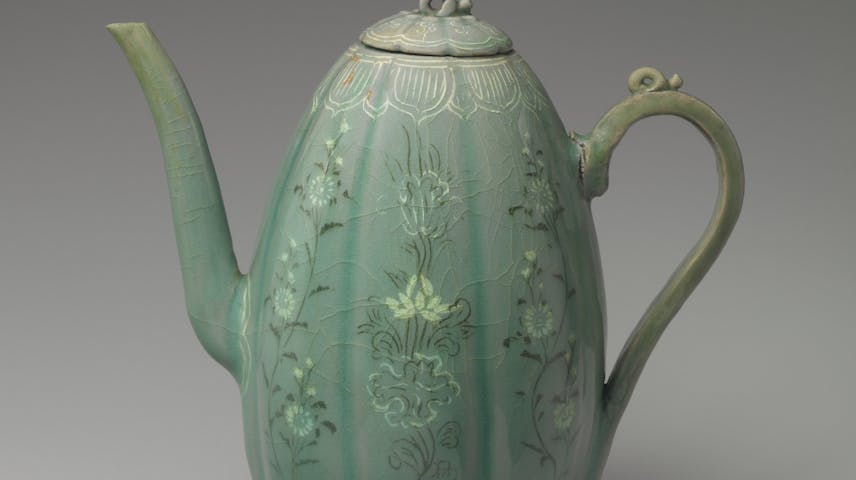
Have students work in small groups to read and examine the images in the article “Korean Ceramics of the Goryeo Period”.
Say these Directions: Work with your group to read and examine each of the images in the article “Korean Ceramics of the Goryeo Period”.
Say: As you examine each image, think about the shapes, designs, and colors of each object. Notice your first impressions as well as any questions or reactions that arise.
After students have studied the images, share the following prompt:
Ask: What did you notice about the Goryeo pottery from the images in the text?
Many of the pieces of pottery were shades gray, or green. The pottery takes many different shapes, including familiar shapes (like bowls and teapots) and more unusual shapes (like vases). Some of the pottery has carvings or designs.
Have groups silently write their ideas on shared charts or digital boards for about two to three minutes.
Ask: What patterns do you see across the responses? What new ideas resulted from reviewing your classmates' observations?
Prompt groups to summarize the patterns they notice and discuss how they might connect to the story before inviting them to share their responses with the class.
Lead students in a brief discussion about the video and images. Encourage them to use specific action words as well as interpretive phrases (e.g., this shows . . . , this conveys . . .) to connect their ideas to supporting details from the video and photo gallery.
Say: Discuss the following questions with your classmates. Be sure to include details from the video and images to support your ideas. Use phrases such as this shows or this example highlights to link details to your ideas.
Ask: Based on the ideas and images in the video and article, what do you think makes Goryeo celadon pottery unique? Support your response with specific details from the media (video and images).
The video explains that the craft is unique to Korea because of the type of clay and materials available to make it. This shows how Goryeo celadon pottery is distinct from Chinese celadon due to its color, designs, and techniques. The images in the article show how Goryeo celadon pottery uses traditional designs.
Ask: What evidence from the video and article most conveys the skill, effort, and tradition behind this art form? Support your response with specific details from the media.
The video explains that the master potter has been working for decades to learn and perfect his craft, including spending as many as 10 years on one piece of pottery. The images in the article show how detailed the pottery is, including intricate designs, carvings, and shaping.
Ask: How might the video and images connect to the story, A Single Shard?
The story might connect to Goryeo celadon pottery and highlight its importance in Korean culture. We can draw on this background knowledge as we read the story.
Teacher Tip |
|---|
Remind students of the observations they made about A Single Shard, including any pottery or shapes they may have noted on the cover. Note that the cover features a prunus vase, a type of ceramic vessel that has a small base, a wide top, and a small mouth that is traditionally used to hold the branches of a plum tree. |
Reflection |
|---|
Reflection: How confident do you feel identifying and summarizing patterns using the Graffiti / Table Talk protocol? Choose a number between 1 and 5, with 1 being the least confident and 5 being the most confident, to rate your confidence level. Then write a few sentences that show how you go about identifying and summarizing patterns using the Graffiti / Table Talk protocol. Modeling: Say: I would rate myself a 4 because I feel mostly confident identifying patterns, but I still need to double-check that I am not missing important ideas. During the Graffiti / Table Talk protocol, I look for repeated ideas, similar words, and connections that show up across different groups’ notes. Then I group those ideas together and write a summary statement that explains the overall pattern in a clear and concise way. |
Have students use the Quick Write routine to respond to the prompts below:
Ask: How do the articles, images, and video help develop your understanding of the significance of celadon pottery in Korea during the Goryeo period? After reviewing these sources, what sparks your curiosity? What questions do you have about A Single Shard, particularly about Tree-ear’s life and his community?
These sources show that celadon pottery was an important part of life in Korea during the Goryeo period. Korea’s geography and history helped shape these traditions. The video explains how potters used special techniques to make the blue-green glaze, and the images show how detailed and beautiful the pottery was. This helps me understand why pottery mattered to villages and to someone like Tree-ear. I’m curious about how he will learn these skills and what challenges he might face.
Students read their independent reading book for 20 minutes and complete a reading log entry.
Read your independent reading book for 20 minutes. In your reading log, record the date and pages you read, write 1–2 sentences about what happened or what you learned, and respond to this week’s prompt using evidence from the text.
A Single Shard
Linda Sue Park

Korean Ceramics of the Goryeo Period
Standard News Bureau