Loading course navigation
Loading lesson
50 min
Student Lesson
Lesson 22: Flex Research: When Sources Disagree
Content
Students will compare one visual source and one informational source on the same narrow topic in order to corroborate information about Korean pottery, ceramic traditions, or firing clay.
Language
Students will explain agreements, differences, and likely reasons for those differences using comparative and causal language. Research: Students will use precise search terms and source information to locate and record a relevant second source.
How does art connect people to their history and community?
Knowledge-Building:
Students build from the previous lesson by treating a visual source as one part of a larger source set about Goryeo celadon and artisan traditions.
Enduring Understanding:
Through careful observation and comparison, researchers learn how craft knowledge is preserved, explained, and valued across sources.
Future Lessons:
Students will use corroborated notes to strengthen later explanatory writing and discussion about apprenticeship, art, and heritage.
Unit Performance Task:
Today’s organizer helps students gather stronger evidence for explaining how skill develops through practice, mentorship, and artistic tradition.
| Lesson Flow | Purpose of Learning Experience |
|---|---|
Launch5 Minutes | Students reactivate the visual source note from the previous lesson and identify what a second source still needs to explain. |
Literacy Lab: Corroboration and Search Strategies10 Minutes | Students learn the corroboration routine and basic search strategies for finding a second source on the same narrow topic. |
Learning in Action30 Minutes | Part A: Find a Second Source (W.6.7, W.6.8) Students use precise search terms and a source bank to choose a relevant second source and begin the Comparing Multiple Sources organizer. Learning in Action B: Corroborate and Explain Differences (RI.6.9) Students identify agreements and differences across two sources and explain how purpose, audience, or time period may shape what each source emphasizes. |
Material List
A Single Shard by Linda Sue Park
Students’ visual source note from the previous lesson
Unit 2, Lesson 22 Student Edition
Comparing Multiple Sources graphic organizer
Teacher-provided short source bank on Korean pottery, Goryeo celadon, or firing clay
Teacher-selected short informational source on ceramic firing or Korean pottery traditions
Routines
Turn-and-Talk
Think-Pair-Share
Quickwrite
Have students take out their visual source note and place it beside their journal paper.
Say: Previously, we treated images as sources and noticed how visual choices shape what we learn. Today, we are taking that same source and putting it next to a second source on the same topic so we can test what stays the same and what changes. This helps us answer our unit question because art connects to history more clearly when we study it from more than one point of view.
Say these Directions: Turn and talk to respond to the following question.
Ask: What did your visual source make clear, and what still needs a second source to explain?
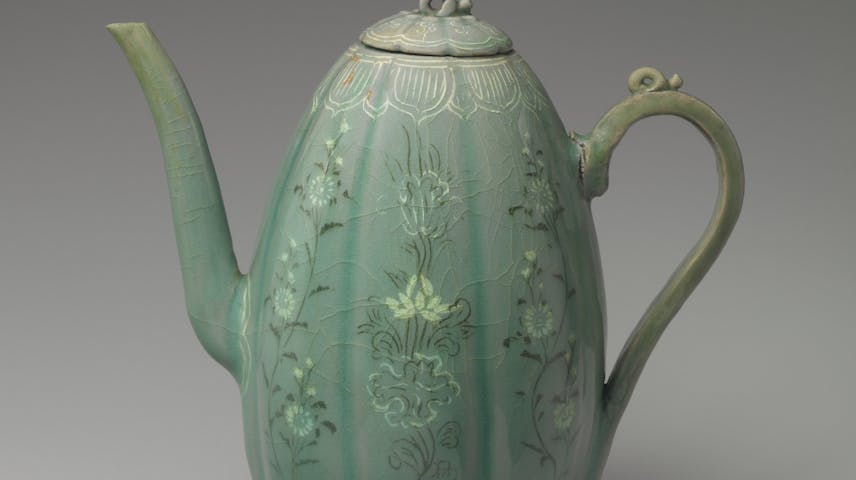
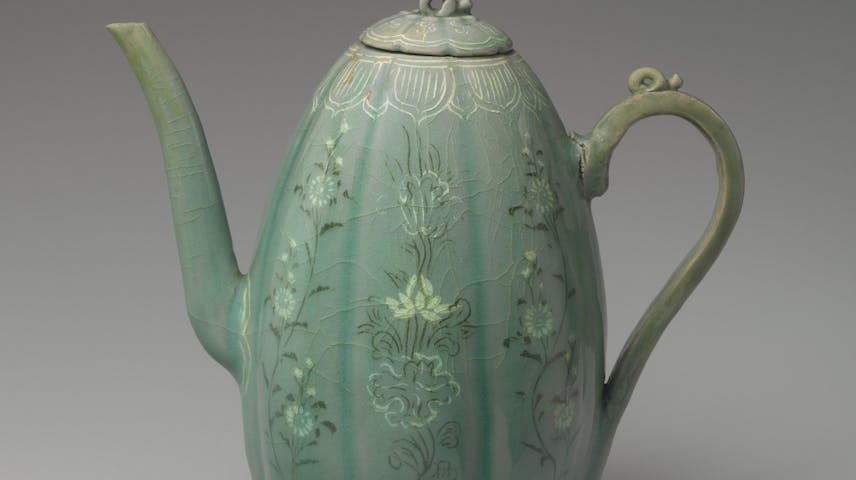
The visual source made clear that celadon pottery was detailed and carefully made because the pitcher has a delicate handle and carefully designed flowers on it. A second source still needs to explain how artisans got that green color or what happened during firing.
Connection to Today’s Learning
Say: Researchers do not stop with a strong first source. We will learn how to find a second source with text that matches the same narrow topic and how to compare a visual and a written source responsibly.
Say: When two sources address the same topic, good researchers compare them instead of choosing one right away. Today we are learning three moves: find a close match, notice agreement, and explain differences.
Display a brief teacher model using the shared class topic: How do images communicate the value of Korean celadon craft?
I begin by conducting a search on the narrowest part of my topic, so I use Goryeo celadon glaze firing instead of a broad phrase, such as “Korean art.” Then I check who made the second source and what it seems intended to do before I read deeply. If both sources suggest celadon required skill, that is an agreement. If one source focuses on beauty while the other focuses on firing, that difference may come from purpose or audience, not because one source is automatically wrong. My job is to explain that reason clearly.
Display the following model notes:
First source: museum photo and caption of a celadon vase from “Korean Ceramics of the Goryeo Period”
Search terms: Goryeo celadon glaze firing
Second source: teacher-selected short informational section from an article on Korean pottery found during keyword search
Agreement: Both sources present celadon as carefully made and highly valued.
Difference: The museum source emphasizes the finished object; the informational source explains the process of firing.
Likely reason: The image source is made for viewers studying an object, while the informational source is made for learners who want explanation.
Check for Understanding (RI.6.9, W.6.8) |
|---|
Make a list of keywords you could use to find a second source for your visual note. Then write one sentence predicting how that source might agree with or differ from your first source. |
Connection to Today’s Learning
Say: We are ready to use precise search terms, locate a second source, and begin comparing what each source adds.
Teacher Tip |
|---|
Students are comparing sources about a specific historical Korean ceramic tradition. Remind them that these sources help us learn about one art form, one set of making practices, and one historical context; they should not be used to make broad claims about all Korean culture or modern Korea. |
Students work in pairs with their visual source note and the teacher-provided source bank.
I do not choose the first source that uses the word pottery. I choose the source that matches the same narrow topic as my first source note. If my image is about celadon glaze, then a source about firing or celadon technique is a closer match than a source about all Korean history.
Say These Directions: Use your visual source note and circle two or three key words from that note, scan the source bank for a close match, and choose a second source on the same narrow topic. Then begin the Comparing Multiple Sources organizer by recording information about both sources before you read closely.
🎯 PURPOSE Support students in explaining why a source is relevant to a research question or source note using precise topic language. |
|---|
🗣️ SAY/ASK Teacher Guidance: Prompt students to use narrow labels, such as “celadon glaze” or “clay firing,” instead of broad labels, like “pottery.” Ask students to justify their choice using a because explanation: “I chose this source because it matches ___.” Language Amplification Moves: You said, “It kind of matches” — we can explain that by saying: “This source is relevant because it focuses on the same process.” You said, “Mine is about pottery too” — we can explain that by saying: “Both sources address celadon pottery, but this second source is a closer match because it explains firing.” Generative Oral/Language Supports: I chose this source because it focuses on ___. This source is a close match to my first source because ___. A broader source would be ___, but my topic is really ___. Strategic Asset-Based Support: Encourage students to say their topic in everyday language first and then revise it into a more academic phrase together. Honor students’ prior visual observations as valid research knowledge to build from. |
👁️ WATCH FOR/SUPPORT IF NEEDED If/Then Contingent Supports: If students choose a source that is too broad → Prompt: “Which exact words from your first source note appear in this source title or heading?” If students struggle to explain relevance → Prompt: “Finish this sentence: This source helps me learn more about ___, not just about pottery in general.” Formative Look-Fors: Student selects a second source that matches the same narrow topic as the first source. Student records source information and explains its relevance with a because statement. |
Learning in Action B: Corroborate and Explain Differences (RI.6.9) (15 minutes)
Students finish their organizer and then rehearse one oral comparison before sharing with the class.
Say These Directions: Now use both sources together. Finish your organizer by naming at least one agreement, one difference, and one likely reason for that difference. In your talk, use words like both, while, however, and because.
🎯 PURPOSE Support students in combining evidence from two sources into one clear explanation of agreement, difference, and cause. |
|---|
🗣️ SAY/ASK Push students to name exact source locations, such as “in the caption under the vase image” or “in the section explaining firing.” Encourage students to explain why the difference matters for their understanding, not just to list it. You said, “They both show it takes work” — we can explain that by saying: “Both sources suggest that celadon required careful skill and planning.” You said, “This one talks more about science” — we can explain that by saying: “The second source broadens the topic by explaining the firing process.” Both sources agree that ___. While Source 1 focuses on ___, Source 2 adds ___. This difference may be explained by ___ because ___. Strategic Asset-Based Support: Let students rehearse in pairs before whole-class sharing so they can test sentence structure safely. Validate observations from visual detail as evidence, not just written sentences. |
👁️ WATCH FOR/SUPPORT IF NEEDED If students quote or retell without explaining → Prompt: “What does that detail help you conclude about the two sources together?” If students confuse topic difference with source disagreement → Prompt: “Are the sources contradicting each other, or is one simply adding a different kind of information?” Student uses one sentence to compare both sources instead of reporting each source separately. Student explains a likely reason for difference, with vocabulary such as purpose, audience, or time period. |
Source 1 | Source 2 | Agreement | Difference | Conclusion |
|---|---|---|---|---|
Museum photo and caption of a celadon vase from “Korean Ceramics of the Goryeo Period” | Informational section on firing from teacher-selected source | Both show celadon as carefully made and important | Source 1 emphasizes beauty and shape; Source 2 explains glaze and kiln process. | The museum source is for viewers studying an object, while the informational source is for readers learning how the process works. |
Ask: How does corroborating these sources strengthen the research you are building for this unit?
Corroborating strengthens my research because now I have more than one kind of evidence. The image helped me notice what artisans created, and the second source helped me explain how that work connects to skill, process, and tradition.
Pulse Check (RI.6.9) |
|---|
Why might two reliable sources about Goryeo celadon include different details about the same pottery? A. One source must be incorrect because reliable sources always say the same thing.
B. One source may be created for viewers studying a piece of art, while another may be written for readers learning about process or science.
C. A visual source always provides more reliable details than a written source.
D. Sources about art often only include opinions, not facts.
|
Say These Directions: Use your organizer to answer both reflection questions in 2–4 sentences. Name what you learned from comparing sources, and identify one new inquiry question or next step for your research.
What new information did you learn by corroborating two sources today? What new inquiry question or next step do you have?
By corroborating two sources, I learned that celadon pottery was not only beautiful but also depended on careful firing and glaze decisions. My new inquiry question is how artisans controlled kiln heat so precisely. My next step is to look for a source that explains the kiln process in more detail.
Connection to Future Learning
In the next lesson, students can use today’s corroborated notes to make stronger explanatory claims about craft, process, and heritage across sources.
Review your Comparing Multiple Sources organizer. In your Journal, write one sentence using while or however to explain a difference between your two sources.
A Single Shard
Linda Sue Park
Korean Ceramics of the Goryeo Period
Standard News Bureau