Loading course navigation
Loading lesson
50 min
Student Lesson
Lesson 27: “I Have a Dream,” Part 1
Content
Students will analyze how Martin Luther King Jr. uses an extended financial metaphor to develop a claim about justice and opportunity and to shape the audience’s understanding and response.
Language
Students will attribute a source using author, title, date, and medium, explain figurative meaning using precise academic language, and evaluate a source’s usefulness for research.
How can understanding the experiences of others help us think critically about fairness and opportunity?
Knowledge-Building:
Students move from Hansberry’s portrayal of dreams blocked by housing discrimination to a historical speech arguing that America has broken its promise of equal opportunity.
Enduring Understanding:
Systems can shape whether people’s opportunities are fulfilled or denied, and analyzing how those systems operate helps us understand fairness and inequality.
Future Lessons:
Students will use today’s work with attribution, source relevance, media comparison, and figurative language to begin evaluating and organizing research sources for their own inquiry topics.
Unit Performance Task:
Students practice analyzing a textual historical source and its audio version so they can build a research argument that integrates evidence, precise attribution, and reasoning about how specific sources develop and strengthen a claim.
| Lesson Flow | Purpose of Learning Experience |
|---|---|
Launch5 Minutes | Activate prior knowledge from the play and prepare students to listen for King’s main message, demand, and how he builds his argument through language. |
Literacy Lab: Attributing and Unpacking the Promissory Note Metaphor10 Minutes | Teach how to unpack and attribute a source by closely studying King’s promissory note metaphor. |
Learning in Action30 Minutes | Part A: Mapping the Money Metaphor (RI.7.4, RI.7.8) Students reread the excerpt and map how King’s financial language develops his claim and affects the audience. Part B: Hearing the Claim and Attributing the Source (RI.7.7, RI.7.8) Students compare the print excerpt to the recording and write an attributed explanation of how delivery strengthens King’s argument and why the source is useful for research. |
Not available for this lesson
Not available for this lesson
Material List
Access to an audio or video recording of the first four paragraphs of “I Have a Dream”
Unit 3 Lesson 27 Student Edition
Routines
Quick Write
Language Study
Turn-and-Talk
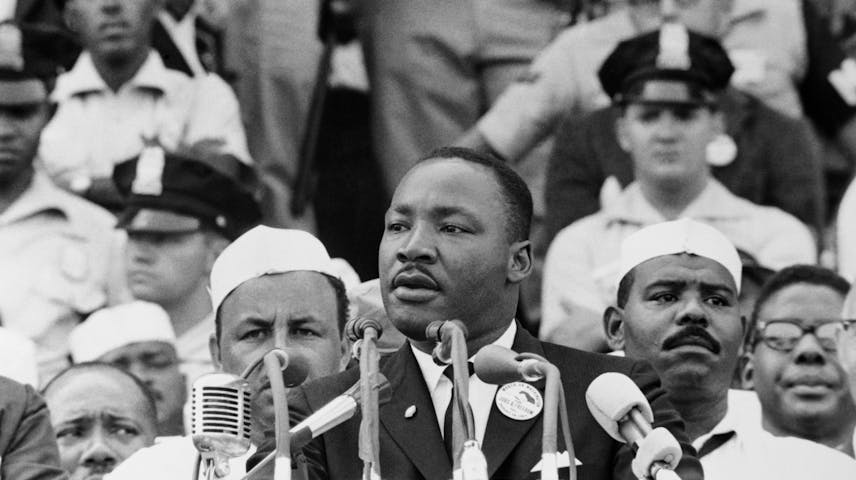
As students enter, display a historical image of Martin Luther King Jr. delivering the “I Have a Dream” speech, and begin playing the audio of the first four paragraphs as students settle.
Teacher Tip |
|---|
The excerpt uses the historical term Negro because this speech was delivered in 1963. Briefly name for students that this was common public language at the time but is not the preferred term today. Keep the focus on historical context and King’s argument rather than having students repeat outdated language unnecessarily. |
Play the recording of the first four paragraphs once through without stopping. Then give the brief background and move immediately into the written response.
Say: In the last lesson, we turned the Younger family’s decision into an argument about whether a dream was realized or deferred. Today, we’re shifting from a fictional family to a real historical speech that asks what America promised, and what it still owes people.
Martin Luther King Jr. delivered this speech on the steps of the Lincoln Memorial in Washington, D.C., on August 28, 1963, one hundred years after the Emancipation Proclamation, to call attention to the fact that Black Americans were still not receiving equal rights.
As you listen, pay attention to what he says America has promised and what he says people are still waiting for.
Say these Directions: After listening to the first part of King’s speech,
Ask: what do you think he is saying?
Ask: What is he asking for?
You have two minutes to write your first thoughts. Begin.
King is saying that America promised freedom and equal rights but has not actually given those rights to Black Americans. He is asking the country to finally act on its promises instead of delaying justice.
Connection to Today’s Learning:
Say: Now that students have the gist, they are ready to zoom in on one key sentence and see how King builds his argument through figurative language.
Use this routine to model a key research skill: strong readers do not just quote powerful lines, they attribute sources, unpack figurative language, and explain how language develops a claim.
Say these Directions: We are going to zoom in on one sentence because strong researchers do not just copy famous words. They explain who said it, what it means, and how the language builds an argument.
Target Sentence Block
“When the architects of our republic wrote the magnificent words of the Constitution and the Declaration of Independence, they were signing a promissory note to which every American was to fall heir.”
Display and read aloud. Then read in chunks, with students echoing.
Chunk | Meaning | Function |
|---|---|---|
When the architects of our republic wrote | when the founders created key documents | introduces the people responsible |
the magnificent words of the Constitution and the Declaration of Independence | the nation’s founding ideas | names the source of the promise |
they were signing a promissory note | they were making a binding promise to pay | introduces the metaphor |
to which every American was to fall heir | a promise meant for all people | shows who should receive it |
Say: A promissory note is a legal document where someone makes a promise to pay money. Default means failing to do what was promised, especially not paying a debt. A metaphor is a comparison used to represent an idea.
Say: When I analyze this source, I start by naming it precisely: in the 1963 speech “I Have a Dream,” Martin Luther King Jr. argues that the Constitution and Declaration were like a promissory note. King is not talking about real money. He is using a financial metaphor to argue that the country made a formal promise of rights and equality.
Ask: What does it mean for the Constitution to be a promissory note? What does it mean that America has defaulted on it?
It means the Constitution and Declaration of Independence promised rights and equality the way a promissory note promises payment. King says America has defaulted because Black Americans were supposed to receive those rights, but the country failed to deliver them.
Say: The phrase every American was to fall heir shows me the promise was meant for everyone. If America has defaulted on that note, King is saying the nation has failed to deliver what it owes. This metaphor makes the audience feel both betrayed and justified, because people have a right to demand what was promised to them.
Check for Understanding (RI.7.4, L.7.5.a) | |
|---|---|
Write one sentence that attributes the source and explains the promissory note metaphor. | |
Modeling: If students need support, prompt them to begin with: In the 1963 speech “I Have a Dream,” Martin Luther King Jr. compares __________ to __________ in order to show __________. |
Connection to Today’s Learning:
Say: Students will now reread the rest of the excerpt and track how King extends this money metaphor across multiple lines to strengthen his claim.
Place students in pairs, but have each student do the reread and charting on their own paper first so they are accountable for independent analysis before discussion.
Say these Directions: Reread the first four paragraphs of the excerpt. As you read, underline financial words and phrases like promissory note, defaulted, bad check, bank of justice, or vaults of opportunity. Then use the 3-column chart to:
Explain what each phrase means literally,
What it means figuratively,
How it helps develop King’s claim about justice and opportunity.
Use at least one of these words in your explanation: promissory note, default, or metaphor.
Create the following 3-column chart in your journal:
King’s Word/Phrase | What It Literally Means | Figurative Meaning & How It Develops the Claim/Affects the Audience |
|---|---|---|
If time is short, complete two strong rows instead of the full chart, or prefill two rows.
Say: I am going to model one row before you start the rest on your own. In the paragraph where King says America has given Black Americans a bad check, I first ask what a bad check means literally.
Literally, it is a check that cannot be cashed because the promised money is not available.
Figuratively, King is saying the country’s promise of freedom and equality looked official, but Black Americans could not actually receive what they had been promised.
That helps me infer his claim: America says it believes in justice, but it has not delivered justice equally.
Say: In the last column, I add the audience effect: this comparison can make listeners feel anger, betrayal, and urgency.
Ask: Which financial phrase from the excerpt best shows King's claim? Is his reasoning sound? Does the comparison actually hold up? Is the evidence he uses relevant and sufficient to prove that America defaulted on its promise, or is something missing?
The phrase "bad check" best shows King's claim because it makes the broken promise feel real and specific. His reasoning is sound: the Constitution did promise "life, liberty and the pursuit of happiness" to all men, and King argues Black Americans never received it. The evidence is relevant, but it relies mostly on the metaphor rather than naming specific laws or policies, so some readers might want more proof.
King’s Word/Phrase | What It Literally Means | Figurative Meaning & How It Makes the Audience Feel |
|---|---|---|
promissory note | a legal promise to pay a debt | The founding documents promised rights to all Americans; it makes the audience feel that justice is something the nation truly owes. |
defaulted on this promissory note | failed to pay what was promised | The United States failed to deliver equal rights to Black Americans; it makes the audience feel betrayed and justified in demanding action. |
bad check | a check that cannot be cashed | America’s promise of freedom was false in practice for Black Americans; it creates anger, disappointment, and urgency. |
bank of justice | a place where value is stored | True justice should exist and be available to all citizens; it gives the audience hope that fairness is still possible. |
vaults of opportunity | secure places where something valuable is kept | The nation has hoarded access and opportunity instead of sharing them equally; it makes the audience feel that change is overdue. |
Ask: After completing your chart, write two to three sentences in your journal responding to the following: Is King's reasoning sound? Is his evidence relevant and sufficient to support his claim that America defaulted on its promise of equal opportunity, or is something missing?
King's reasoning is sound because the Constitution really did promise equal rights to all Americans. His evidence — phrases like "bad check" and "insufficient funds" — is relevant and powerful, but it may not be fully sufficient because he does not name specific discriminatory laws in this section. The metaphor is convincing, but a reader might need more concrete historical facts to fully accept his claim.
Provide students with a confidence continuum (i.e., 1–5). As needed, model how to demonstrate a level of confidence using the continuum.
Reflection (RI.7.4, RI.7.8) | |
|---|---|
Use the Reflection routine to reflect on your ability to trace the development of metaphors over the course of a longer text. |
Replay or re-show the excerpt. Tell students to listen for volume, pace, emphasis, and pauses. Then have them share one chart row and one attributed source stith a partner.
Teacher Tip |
|---|
If you use video, explicitly distinguish between the source content and the source medium. Model precise attribution: In the printed 1963 speech... versus In the audio recording of the same speech... This helps students build strong habits for research writing. |
Say these Directions: Listen to the excerpt one more time. This time, notice where King slows down, where he pauses, and which words he emphasizes. Then turn to your partner and explain how the recording changes or strengthens your understanding of his claim and why this speech is a useful research source. Use an attributed source sentence.
Say: When I compare the print speech to the audio, I am not changing King’s claim. I am noticing how the delivery strengthens it.
For example, in the audio recording of the 1963 speech “I Have a Dream,” King pauses around key phrases like bad check and gives them weight. That emphasis makes the metaphor sound less like a clever phrase and more like a serious accusation.
Say: As a researcher, I also ask whether this is a strong source for my topic. Because this is a primary source delivered by King himself during the March on Washington, it is strong evidence for researching how people argued for equal opportunity in the civil rights era.
Say: My response needs an accurate attribution analysis of the delivery and evaluation of source usefulness.
Ask: How does hearing King’s voice change or strengthen your understanding of his claim? Why is this speech a useful source for research on opportunity?
In the audio recording of the 1963 speech “I Have a Dream,” King’s pauses and emphasis make the idea of a bad check sound urgent and personal. The speech is a useful research source because it is a primary source from a major civil rights leader explaining how America denied equal opportunity.
Pulse Check (RI.7.7, RI.7.8) |
|---|
Which response best compares the recording to the printed speech and correctly attributes the source?
D. Martin Luther King Jr. wrote a speech, and hearing it proves everything he says is true.
|
Say these Directions: Today you practiced using a historical source the way researchers do: by attributing the source, unpacking its language, and explaining how it supports the claim. In your quick write, answer one of the reflection prompts below and cite at least two specific details from the speech or recording.
Ask: Based on King’s idea of a “bad check,” what modern systems might still be “defaulting” on its promises?
Ask: What new information did you learn as a result of today’s research with King’s speech?
Ask: What new inquiry question arose from today’s work?
Ask: What are your next steps for researching how a modern system shapes opportunity?
Based on King’s idea of a “bad check,” the education system today might still be defaulting on its promises because all students are supposed to learn, but schools in different communities often receive unequal funding and resources. This shows that, like the promise King described, the system says opportunity is available to everyone, but in reality, some students are still being denied what they were promised.
Say: The work we did today is a must-have skill for your performance task. When you write your research argument, you will:
Need to introduce sources clearly,
Explain what important language means,
Show why a source supports your claim.
Ask: Which phrase, sentence frame, or note-taking move helped you most today?
The frame “In the 1963 speech ‘I Have a Dream,’ Martin Luther King Jr. argues that...” helped me most because it reminded me to attribute the source before I explained my evidence.
Say: Every time you practice turning a powerful source into clear evidence, you make future reading, research, and civic writing easier.
Instruct students to reread Martin Luther King Jr.’s “I Have a Dream” speech from today’s lesson. Instruct students to respond to the following prompt in their Journal:
As you reread Martin Luther King Jr.’s “I Have a Dream” speech from today’s lesson, think about which specific word, phrase, or sentence is most powerful or persuasive in expressing his argument. Record your answer in your Journal.
“I Have a Dream”
Martin Luther King Jr.