Loading course navigation
Loading lesson
50 min
Student Lesson
Lesson 28: “I Have a Dream,” Part 2
Content
Students will evaluate the argument in the first four paragraphs of “I Have a Dream” by identifying claim, evidence, and reasoning and judging whether the argument is convincing and useful for research.
Language
Students will explain how a speaker’s pacing, tone, and emphasis strengthen an argument using precise evidence-based language and attribution.
How can understanding the experiences of others help us think critically about fairness and opportunity?
Knowledge-Building:
Students build from Lesson 27’s study of King’s financial metaphor to evaluate how that figurative language functions as argument.
Enduring Understanding:
Studying how people argue against unfair systems helps students see how evidence and voice can advocate for opportunity.
Future Lessons:
Students will apply claim-evidence-reasoning analysis to evaluate whether sources are convincing and useful for their own research topics.
Unit Performance Task:
Students need to select credible, useful sources and explain how those sources support their own argumentative essays about systems and opportunity today.
| Lesson Flow | Purpose of Learning Experience |
|---|---|
Launch5 Minutes | Activate prior research learning by revisiting Lesson 27’s figurative language analysis and restating King’s argument to prepare for evaluation. |
Literacy Lab10 Minutes | Explicitly teach how to evaluate an argument by identifying claim, evidence, and reasoning, and by paraphrasing notes ethically. |
Learning in Action30 Minutes | Part A: Tracing King’s Argument (RI.7.8, SL.7.3) Students will work in small groups to identify King’s claim, track evidence, and evaluate whether his reasoning is sound and useful for researching how systems shape opportunity. Part B: Hearing the Argument (RI.7.7, SL.7.2) Students will compare the print excerpt to the audio recording and explain how King’s delivery strengthens his argument. |
Material List
Unit 3 Lesson 28 Student Edition
Students’ completed charts (from Lesson 27)
Audio recording of the first four paragraphs of “I Have a Dream”
Routines
Turn and Talk
Modeled Writing
Group Accountability Share
Quick Write
Have students take out their charts on King’s figurative language from Lesson 27. Pair students with the partner they worked with in Lesson 27 so they can quickly compare yesterday’s charting and move into today’s analysis. Students sit with a partner and place their completed charts between them.
Say these Directions: Take turns sharing your one-sentence argument with your partner. As you listen, decide which version is clearest and most precise.
Say: In Lesson 27, we unpacked King’s financial metaphor. Today, we’ll use that understanding to evaluate his argument and how his voice and delivery strengthen it. This matters because strong researchers don’t just understand sources; they evaluate how convincing they are.
Ask: Now that you understand the financial metaphor, what is King’s argument in one sentence? Your sentence should name what America promised and what actually happened instead.
King is arguing that the United States promised freedom and equality to all Americans, but it has not actually delivered on those ideals for Black Americans. In the paragraph where he says America gave Black citizens a “bad check,” he shows that the promise was made but not honored.
After students have finished working with their partners, invite 2–3 students to share one-sentence versions of King’s argument with the class.
Say: Yesterday, you analyzed how King’s financial metaphor helps us understand his message. Today, we’re going to take that same language and evaluate it as part of his argument, examining how he uses claim, evidence, and reasoning to persuade his audience.
Say: Now, let’s evaluate whether King’s argument is convincing and useful for research about how systems shape opportunity.
Continue using the same teacher model source from Lesson 27 so students can see research skills building across lessons. Today’s discrete research skill is evaluating whether a source’s argument is sound.
Teacher Tip |
|---|
The excerpt uses the historical term Negro because this speech was delivered in 1963. Briefly explain to students that this was common public language at the time but is not the preferred term today. Keep the focus on historical context and King’s argument rather than having students repeat outdated language unnecessarily. |
Say these Directions: Read the following sentence from the excerpt:
“America has given the Negro people a bad check, a check which has come back marked ‘insufficient funds.’”
Display this note-taking model:
Original Line from Source | Paraphrase | Modification of the Evidence |
|---|---|---|
“America has given the Negro people a bad check…” | The nation promised rights to Black Americans but did not deliver them. |
|
Say: When researchers evaluate an argument, they look for three parts: claim, evidence, and reasoning. The claim is the main argument of the source. . The evidence is material from the source that supports the claim. The reasoning explains how the evidence proves the claim. A source is useful for research when its evidence clearly supports its claim and helps answer your inquiry question about how systems shape opportunity.
Say: When I take notes on a source, I paraphrase instead of copying. That means I change the sentence structure and wording while keeping the meaning accurate.
Say: In the speech, King claims that the United States promised freedom and equality but had not delivered those rights.
Say: King uses the metaphor of a “bad check" as evidence. I can paraphrase that as: The country made a promise of rights but failed to fulfill that promise.
Say: This evidence is persuasive because it shows that the promise of freedom was not fulfilled, which directly supports King’s claim.
Say these Directions: Now, practice paraphrasing on your own. In your notes, write one sentence that states King’s claim in your own words. Then paraphrase one piece of evidence from the excerpt without directly copying it word-for-word.
Ask: Which sentence from the excerpt works as evidence, and how can you paraphrase it ethically?
In the paragraph where King says Black Americans are still “sadly crippled by the manacles of segregation and the chains of discrimination,” the evidence is that freedom has still not happened one hundred years later. I can paraphrase that as: “Black Americans are still restricted by segregation and discrimination even after emancipation.”
Check for Understanding (RI.7.8) | |
|---|---|
Read each quote from King's "I Have a Dream" and label it Claim, Evidence, or Reasoning. Then choose one and write two to three sentences explaining how you know it belongs in that category.
|
Say: Now you will use this same process, identifying claim, evidence, and reasoning, to evaluate whether King’s argument is convincing and useful for your research about how systems shape opportunity.
Place students in groups of three or four. Each group should reread the same excerpt and complete one shared analysis, but every student records the work in their own Student Edition.
Framing the Listener’s Role
Say: King is not just a writer — he is a speaker delivering an argument to an audience. As you read and listen today, your job is to delineate his argument — to break it down into its parts — and then evaluate it.
Say these Directions: As you listen to the first four paragraphs, track these three questions:
(1) What is King’s claim about America’s promise?
(2) What are 2 pieces of evidence he uses, and what rhetorical choices strengthen them?
(3) Is his reasoning sound? Is his evidence relevant and sufficient?
Say: A strong source is not useful just because it sounds powerful. Researchers ask: What is the claim? What evidence supports it? Does the reasoning logically connect the evidence to the claim?
Say: In this excerpt, King gives evidence about history, broken promises, and present-day inequality. As I evaluate his reasoning, I am asking whether those examples support his claim that America failed to deliver equality. I also notice that his figurative language helps translate a complex issue into something ordinary people can picture. Evaluating an argument means judging both the logic and how effectively the speaker reaches the audience.
Say these Directions: In your group, reread the first four paragraphs of King’s speech and use the 3-column chart to trace its argument. Record King’s claim, two pieces of evidence, and your evaluation of whether the evidence is relevant and sufficient and the reasoning is sound. In the final part of your chart, explain why figurative language strengthens his reasoning, and how this argument would be useful for researching how systems shape opportunity today.
Have students use an argument-tracing organizer in their journal:
Claim | Evidence | Reasoning / Why It Works |
|---|---|---|
SAMPLE RESPONSE
Claim | Evidence | Reasoning / Why It Works |
|---|---|---|
America has failed to deliver the freedom and equality it promised Black Americans. | In the sentence beginning with “But one hundred years later,” King says Black Americans are still not free and still face segregation and discrimination. | This evidence is relevant because it shows that the promise of the Emancipation Proclamation did not become real equality. |
The nation owes Black Americans rights that were already promised in its founding documents. | In the paragraph where King describes the Constitution and Declaration of Independence as a promissory note, he argues that these documents guaranteed rights to all citizens. | This reasoning is sound because if the promise was written into national ideals, then denying those rights shows the nation broke its own promise. |
King chooses figurative language to strengthen his argument. | King uses the “bad check” metaphor instead of opening with numbers or charts. | This choice helps the audience picture injustice in a familiar way and feel the urgency of the argument. |
Say: Before you begin your chart, think about how King persuades his audience, not just in what he says, but in how he says it.
Ask: What is one question you still have about how King tries to persuade his audience?
I still want to know why King uses metaphors instead of facts and numbers in this opening. I think he wants people to feel the unfairness right away, but I want to examine how that choice affects the audience.
Ask: What is King’s main claim in this excerpt?
King’s main claim is that the United States promised Black Americans freedom and equality but has still not provided those rights. In the section where he contrasts the Emancipation Proclamation with present-day segregation, he shows the gap between promise and reality.
Ask: Which piece of evidence is strongest, and how does it support the claim?
One strong piece of evidence is the part where King explains that Black Americans are still living with segregation and discrimination one hundred years after emancipation. This supports the claim because it proves that legal freedom did not lead to actual equal opportunity.
Ask: How does King’s reasoning, including his use of figurative language, strengthen his argument? Explain how it supports his claim.
King’s reasoning is strong because his figurative language makes the broken promise easier to understand. The “bad check” metaphor helps the audience see injustice clearly, which supports his claim that America failed to deliver equality.\
Ask: Assuming that King’s evidence is relevant, is it also sufficient?
The “insufficient funds” section of the speech does not provide multiple pieces of evidence, but the single piece of evidence—that justice and equality were promised but not delivered—seems sufficient in itself. As the reader/listener, I feel convinced by his evidence and how he delivers it. As the speech progresses, King provides more pieces of evidence to build upon this foundation.
Say: As you complete your chart, consider: How is this source useful for researching how systems shape opportunity?
Say these Directions: When your group finishes the chart, use these three questions to evaluate King’s argument as a whole.
Is King’s reasoning sound? Does his conclusion follow logically from his evidence, or does he rely on emotional appeal alone?
Is his evidence relevant to his claim? Does each piece of evidence actually address what he is arguing about?
Is his evidence sufficient? Is there enough evidence to convince you, or are there gaps you would push back on? What would make the argument even stronger?
Teacher Tip (RI.7.8, SL.7.3) |
|---|
As groups discuss, circulate and use the following checklist to provide feedback:
|
Provide students with a confidence continuum (i.e., 1–5). As needed, model how to demonstrate a level of confidence using the continuum.
Reflection (RI.7.8) |
|---|
Use the Reflection routine to reflect on your ability to trace and evaluate an author’s argument. |
Tell students to listen for a key moment where King’s rhetorical strategy engages the audience or adds to his argument. Play the first four paragraphs once all the way through, then replay the segment students choose if needed.
Say: When we compare print to audio, we are not asking which version is better. We are asking what the recording adds that the page cannot fully show. A speaker’s pacing is how fast or slow they talk, tone is the feeling carried in the voice, and emphasis is what the speaker stresses.
Say these Directions: Listen to the recording of the first four paragraphs. As you listen, mark one specific moment where King’s pacing, tone, or emphasis adds something important to the argument. Then write a short response to the prompt:
Ask: What does King’s delivery add to the argument that the words on the page cannot fully show? Choose one specific moment in the recording and explain its effect.
In the audio recording, King’s delivery adds urgency that the printed words alone cannot fully show. In the paragraph where he repeats “one hundred years later,” his pacing slows, and his emphasis grows heavier on the repeated phrase. On the page, I can notice repetition, but in the recording, I can hear the weight of time and delay. His voice makes the audience feel how unacceptable that long wait has been. This strengthens the argument because the delivery turns an idea about injustice into an emotional experience for listeners.
Say these Directions: Now that you have evaluated King’s speech, turn to your partner and share one sentence from your paragraph. The listener responds with: “The moment you chose was __________, and the effect you named was __________.”
Say: When researchers use audio or video sources, they consider how delivery affects meaning. This can make a source more powerful or useful when explaining how an argument persuades an audience.
Pulse Check (RI.7.7) |
|---|
Which statement best explains what the audio recording adds to the first four paragraphs of King’s speech?
|
Students reflect on the work they completed during this lesson in a final piece of writing.
Say these Directions: Today, you practiced an important research move: deciding whether a source is convincing. Strong researchers do not just choose sources that sound powerful; they evaluate the claim, evidence, reasoning, and delivery to decide how well the source supports their thinking. Take a few minutes to reflect on what you learned and what you will do next as a researcher.
Ask: Which element helped you most today: claim, evidence, reasoning, or delivery, and why?
Claim helped me most because once I knew King’s main point, it was easier to tell which details counted as evidence and which details were just powerful language choices.
Ask: Add one final sentence to your reflection using this frame:
“King’s argument is [convincing / partially convincing / not fully convincing] because his reasoning is [sound / unsound] and his evidence is [relevant and sufficient / relevant but insufficient] — specifically, _____.”
Say: The more carefully you evaluate sources now, the stronger your future essay will be. These same skills also help you outside of class when you hear speeches, watch videos, or read posts, so you can recognize what is convincing, what is supported, and what is not.
Students read their independent reading book for 20 minutes and complete a reading log entry.
Read your independent reading book for 20 minutes. In your reading log, record the date and pages you read, write 1–2 sentences about what happened or what you learned, and respond to this week's prompt using evidence from the text.
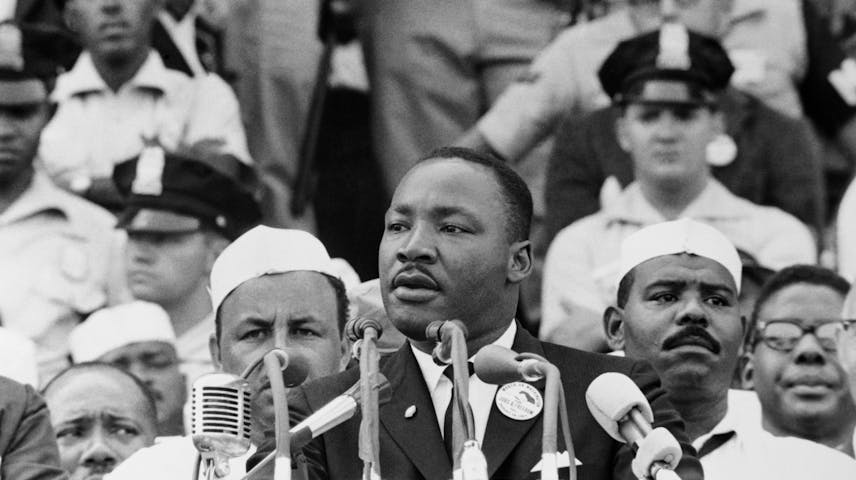
“I Have a Dream”
Martin Luther King Jr.