Loading course navigation
Loading lesson
50 min
Student Lesson
Lesson 37: Red White and Whole, Discussion
Content
Students will engage in collaborative discussions about how peer writers connect a photograph and a poem to the unit’s essential question, focusing on the strength of claims, evidence, and explanation.
Language
Students will use specific feedback stems, evidence-based explanations, and respectful discussion moves to respond to peers’ claims and evidence and to build on one another’s ideas.
What is culture, and how does it shape our identity and sense of belonging especially when we move between more than one world?
Knowledge-Building:
Students continue exploring how culture, grief, family, and belonging shape identity across visual and literary texts, deepening their understanding through peer analysis and comparison.
Enduring Understanding:
Identity is shaped by biological, cultural, and emotional connections, and literature helps us see how those layers form a whole person.
Future Lessons:
Students will use peer feedback from this lesson to revise and strengthen their final literary analysis writing and to participate more effectively in academic discussions.
Unit Performance Task:
This lesson supports the literary analysis task by helping students clarify claims, strengthen evidence integration, and explain meaningful connections between texts and the essential question.
| Lesson Flow | Purpose of Learning Experience |
|---|---|
Launch5 Minutes | Prepare students to give respectful, specific, and useful peer feedback by connecting today’s work to their recent drafting and revision. Students discuss what makes feedback helpful (specific, evidence-based, revision-focused). Students rehearse responding to both claim and evidence. |
Literacy Lab10 Minutes | Introduce and model the Gallery Walk feedback protocol so students can respond to claims and evidence with clarity. |
Learning in Action30 Minutes | Part A: Silent Feedback Walk (SL.7.1.a-d) Students will circulate through peer displays, read claims and evidence, and leave one strength and one suggestion on each response sheet. Part B: Pairings That Changed Our Thinking (SL.7.1.a-d) Students will discuss which photo– poem pairings deepened their understanding of the essential question and explain why. |
Material List
Red, White, and Whole by Rajani LaRocca
Unit 4 Lesson 37 Student Edition
Student drafts with each writer’s chosen photograph and poem excerpt to post (from Lesson 36)
T-Chart graphic organizer
Routines
Think-Pair-Share
Gallery Walk
Group Accountability Share
Quick Write
Have students stand near or sit beside a partner. Keep this launch fully oral so students can quickly rehearse feedback language before the Gallery Walk.
Say these Directions: In the last two lessons, you drafted and revised paragraphs connecting a photograph and a poem to ideas about culture, identity, and belonging. Today, you will review each other’s writing and give feedback to help make ideas clearer and stronger. This matters because strong analysis improves when we respond thoughtfully and revise with purpose.
You have already worked on strengthening your claim, evidence, and explanation. Now, you will look for those same elements in your classmates’ writing and use what you notice to improve your own writing. Be ready to share one idea with the class.
Discuss the questions with a partner:
Ask: What makes peer feedback actually helpful instead of just nice?
Helpful feedback points to something specific in the writing, like the claim or the evidence, and then explains why it works or what needs to be clearer. Just saying “good job” is kind, but it does not help the writer revise.
Say: Today our goal is to give feedback that helps a writer revise. As you move through the Gallery Walk, check: Is my feedback specific? Does it help the writer improve?
Ask: Why is it important to respond to both the writer’s claim and to the evidence they used?
A claim shows what the writer is trying to prove, and the evidence shows how they are proving it. If I only respond to one part, my feedback might miss whether the whole paragraph really answers the essential question.
Connection to Today’s Learning:
Say: As you give feedback today, listen for ideas that could help answer the question you brought about your own writing. Good feedback should not only help your classmate, it should also push your own thinking. Now you’re going to practice these exact feedback moves so you can use them during the Gallery Walk.
Teacher Tip |
|---|
Before students begin, remind them that today’s feedback is about helping the writing grow. Frame comments around the work, not the writer, and keep the tone focused, respectful, and specific. |
Use one teacher-created example or teacher-selected student exemplar with permission. The exemplar should include a photograph, a poem excerpt, and a short analytical paragraph so students can practice the exact protocol they will use.
Say these Directions: In this gallery walk, we will silently read a classmate’s claim and evidence and then leave two kinds of feedback: one strength (what works and why) and one suggestion (what could be clearer and how to improve it). As we review each classmate’s claim and evidence, we will record one “Strength” and one “Suggestion” in the T-chart next to each paper. As you review displays, read the work first before looking at others’ feedback so your thinking stays independent. If someone already wrote your idea, add a check mark to show agreement.
As you talk through the modeling of how to give specific and helpful feedback, also model how to record the feedback on a T-chart.
Say: I am going to read this display like a coach, not just like a reader. First, I look at the claim and ask myself what the writer is trying to show about identity or belonging. Next, I check whether the writer used both texts by naming a photo detail and a poem detail.
Say: I notice that this writer uses the line on page 2, “Because you are here, I must stay,” and connects it to an image of a mother holding a child. So my strength can be specific: “One strength I noticed was that the evidence from both texts works together because the photo detail and the poem line both show connection and belonging.” I need to record that feedback in the “Strengths” column of the T-chart.
Say: I also notice that the explanation jumps quickly from the image to a big idea. So my suggestion should focus on clarity, not on changing the whole claim. That means I might write, “One suggestion to make this clearer is to explain how the focal detail in the photo connects to the poem line.” I need to record that feedback in the “Suggestions” column of the T-chart. Good feedback is respectful, specific, and useful for revision.
Say: As you silently circulate to different claims, try not to read any feedback that someone has already given that author until you’ve had a chance to review it for yourself. That way, your feedback won’t be influenced by someone else.
Say: If you see that a reviewer before you has already given the same feedback you were going to give—whether it’s a Strength or a Suggestion—just put a check mark next to it. That will tell the author that multiple people felt the same way.
Say: Use these two feedback stems if you find them helpful:
One strength I noticed was __________ because __________.
One suggestion to make this clearer is __________.
Discussion norms for this routine:
Read the whole display before writing
Comment on the writing, not the writer
Name a specific claim, detail, or explanation
Make suggestions that help with revision
Ask: Which part of the model feedback made it specific instead of vague?
The feedback named the exact line from the poem and said the writer used both the photo and the poem. It also explained what needed to be clearer, so the writer knows what to revise.
Check for Understanding (SL.7.1a, SL.7.1c) | |
|---|---|
Write one feedback sentence you could leave on the mentor display. Use one of today’s stems and name a specific claim, quote, or image detail.
| |
Teacher Tip: If students write vague feedback, prompt them to add one exact detail from the display and one because clause. |
Connection to Today’s Learning:
You’ve practiced how to give specific, helpful feedback. Now you will use this exact process as you move through the Gallery Walk and study your classmates’ work.
Arrange displays so students can circulate in one direction. Keep the first half silent so students focus on reading closely and responding thoughtfully.
Say these Directions: During your gallery walk, visit two or three displays only, leaving one strength and one suggestion at each (more if time allows).
Say: We are going to move silently from display to display. At each one, read the photo, the poem excerpt, and the writer’s paragraph. Then write one strength and one suggestion on that display’s T-chart response sheet, responding to both the writer’s claim and how they used their evidence. Visit several displays and leave feedback at each one. Use the feedback stems from the model to guide your responses.
Say: As you circulate, also track two displays that stand out to you in your Journal because you may want to bring one of them into our class discussion. Leave at least one strength and one suggestion on each display you visit, responding to both the writer’s claim and how they used their evidence.
Say: Before I write anything, I slow down and ask three questions: What is this writer claiming about identity, belonging, grief, or culture? Which details from the photograph and the poem support the claim? What feedback would help this writer revise more clearly? If I can answer those questions, my feedback will be specific and useful, not random. That is how we make silent reading part of the discussion.
Say these Directions: Turn to your partner and choose one display that stands out to you. Explain what claim the writer made and one reason that display stayed with you. Partner A, share first. Then switch. Be ready to point to one exact detail when you share.
Ask: Which display made the strongest connection to the essential question, and what made that connection clear?
One display that stood out to me paired a photo of family cooking with a poem about family ties. The writer’s claim was clear because they showed that culture can shape belonging through everyday actions, and they used both the image detail and the poem detail to support that idea.
Ask: What is one suggestion you left that you think could really help a writer revise?
I suggested that one writer explain the connection between the caption and the poem line more clearly. Their evidence was strong, but the explanation jumped too fast to the big idea about identity.
Check for Understanding (SL.7.1.b, RL.7.1) | |
|---|---|
As you share with your partner, be ready to point to one exact claim or detail from a display that supports your response. | |
Teacher Tip If students speak generally, prompt: Which display? Which exact image or poem detail? Say that part aloud. |
The display I chose used a close-up family detail in the photograph and paired it with a poem moment about staying connected, which made the claim about belonging feel convincing.
Group students in table groups or groups of four. Give each group one minute to agree on a display they want to bring to the whole class. Make sure every group member can explain your group’s idea because any group member may be called on to speak.
Say these Directions: In your group, choose one pairing you wish you had chosen yourself. Be ready to explain what that display shows about the essential question and how the writer used evidence. As we discuss, build on each other’s ideas and refer to the writer’s claim or evidence when you speak. Name the pairing or describe one key detail so listeners can follow your thinking. As you listen, mark one idea you want to build on or challenge, and be ready to explain why.
Say: Use the following academic talk stems for our whole group discussion during our group accountability share
I want to build on __________’s idea because __________.
One pairing I wish I had chosen was __________ because __________.
That display showed me that the essential question can also be answered by __________.
The writer made this clear by using __________ as evidence.
Say: Explain how your thinking changed after seeing this pairing. You can use: “Before, I thought ________, but now I think ________ because ________.”
Prompt students to discuss the questions:
Ask: How did that writer use evidence from both the photo and the poem to deepen the idea?
The writer did not just describe the photo. They connected one focal detail in the image to a line in the poem and explained how both showed identity being carried through family and memory. That made the claim feel stronger.
Ask: Which photo– poem pairing did you see that you wish you had chosen yourself, and what did it show you about the essential question that you had not considered before?
One pairing I wish I had chosen was the photo of the girl wearing traditional clothing with the poem “Two.” It showed me that identity can feel split between different worlds, but those parts can still connect. Before, I thought belonging meant choosing one side, but this made me realize you can belong to more than one culture at the same time.
Pulse Check (SL.7.1.c, SL.7.6) |
|---|
Which comment best shows respectful, specific discussion that builds on a classmate’s analysis?
|
Have students reflect on how feedback and peer examples shaped their thinking using specific details.
Say these Directions: Reflect on how today’s feedback and discussion sharpened your thinking. Underline one place in your paragraph that you plan to revise based on feedback. For the Quick Write, write 2–4 sentences and include two specific details: one from a classmate’s display and one from the feedback or discussion you heard today. Use because to explain how your thinking changed.
Ask: Which pairing or piece of feedback changed your thinking the most, and how did it change your understanding? Include one detail from a classmate’s work and one from the discussion, and explain your thinking using because.
One pairing that changed my thinking used a photograph with a close family detail and a poem about ties and memory. The writer’s claim showed that belonging can come from daily family connections, not just from fitting in at school or in one culture. A classmate’s comment about how the writer connected both texts helped me see that strong evidence has to work together, not just sit side by side.
Optional Sentence Starter:
One pairing that changed my thinking was __________ because __________.
Students read their independent reading book for 20 minutes and complete a reading log entry.
Read your independent reading book for 20 minutes. In your reading log, record the date and pages you read, write 1–2 sentences about what happened or what you learned, and respond to this week’s prompt using evidence from the text.
Red, White, and Whole
Rajani LaRocca
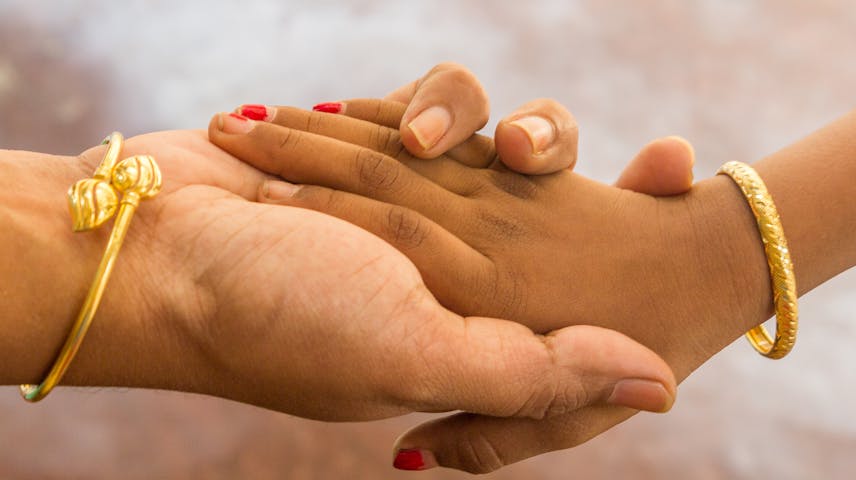
Through Her Grief, an Indian American Photographer Rediscovers Her Heritage
Maansi Srivastava, NPR