Loading course navigation
Loading lesson
50 min
Student Lesson
Lesson 35: Red, White, and Whole, Explanatory Writing, Part 2
Content
Students will write an informative response explaining how one photograph and one poem work together to develop ideas about culture, identity, and belonging.
Language
Students will use precise analysis verbs and evidence-linking phrases to connect visual details and poem evidence and explain how those details work together to support an explanatory claim.
What is culture, and how does it shape our identity and sense of belonging especially when we move between more than one world?
Knowledge-Building:
Students extend the unit’s study of bicultural identity by reading a visual text alongside verse from Red, White, and Whole and making connections across both texts.
Enduring Understanding:
Identity is shaped by biological, cultural, and emotional connections, and literature and visual texts help us see how those layers form a whole person.
Future Lessons:
Students will build from today’s cross-text drafting work into stronger literary analysis, using evidence and explanation to show how specific details reveal important connections.
Unit Performance Task:
Today’s work prepares students to explain how craft and evidence reveal an important connection in a focused literary analysis.
| Lesson Flow | Purpose of Learning Experience |
|---|---|
Launch5 Minutes | Students will activate prior thinking from Lesson 34 and connect bicultural identity to visual storytelling. |
Literacy Lab10 Minutes | Students will learn how to move from evidence to explanation using a short quote from the novel and apply the same structure to analyzing visual details using precise analysis verbs. |
Learning in Action30 Minutes | Part A: Pair a Photograph with a Poem (RL.7.1) Students will study photographs, choose one image and one poem that speak to each other, and collect evidence from both texts to prepare for writing. Part B: Draft a Cross-Text Response (W.7.2) Students will draft and refine an informative paragraph answering the unit essential question with evidence from both a photograph and a poem. |
Material List
Red, White, and Whole by Rajani LaRocca
Unit 4 Lesson 35 Student Edition
Notice, Wonder, Connect graphic organizer
3-Column Chart graphic organizer
RACE Writing Strategy graphic organizer
Routines
Think-Pair-Share
Language Study
Gallery Walk
RACE Strategy Response
Quick Write
Have students keep their novels and journals open. Invite them to jot one phrase before speaking so all students have a clear starting point.
Say: In a previous lesson, we compared how different writers described bicultural identity and saw that belonging can feel complex or unresolved. In your homework, you also reflected on your own culture and identity.
Say: Today, we are adding visual text so we can explore how culture and belonging can be conveyed through images as well as words. This matters because your performance task asks you to explain how a specific detail reveals an important connection, and today you will practice that move with two different texts.
Ask: In what ways can a single image convey ideas about identity or belonging more immediately or with greater emotional force than language alone?
An image can show identity right away through clothing, facial expression, objects, or body language. Writing can explain the inside thoughts more clearly, but a photograph can make me notice the feeling or setting immediately.
Say these Directions: Turn to your partner. Share an idea from your notes, then listen for one idea from your partner you want to borrow or build on. Partner A speaks first for 30 seconds, then switches with Partner B.
Connection to Today's Learning:
Say: Today, you will choose a photograph and a poem that connect and use specific details from both to explain how culture shapes identity and belonging to answer the essential question.
Guide students in strengthening analytical writing by using the structure: specific detail, analysis verb, and explanation.
Say these Directions: Strong analytical writing does not stop at naming a quote or an image detail. Today, our key move is evidence plus analysis: we will name one exact detail, add a strong analysis verb, and explain what that detail reveals about culture, identity, or belonging.
Display the poem “Give and Take” on page 2 of Red, White, and Whole, and direct students to read the line: “Because you are here, I must stay.”
Target Line:
"Because you are here, I must stay" (p.2)
Display the following teacher-created analytical sentence based on the quote:
Model Analytical Sentence:
The line "Because you are here, I must stay" reveals that connection gives Amma a reason to keep going.
Chunk | Meaning | Function |
|---|---|---|
"Because you are here, I must stay" | These exact words show a connection between people. | cites precise evidence from the text |
reveals that | The writer is interpreting the evidence. | introduces analysis |
connection gives Amma a reason to keep going | The relationship matters to Amma’s survival. | explains the significance of the evidence |
Say: When I write about a poem or a photograph, I do not want to stop at a vague sentence like “This shows culture.” That kind of sentence names a topic, but it does not teach the reader anything new. Instead, I start with one exact detail, like the line "Because you are here, I must stay." Next, I choose an analysis verb that shows my thinking, such as reveals, suggests, or emphasizes. Then I explain what the detail means: this line reveals that connection gives Amma a reason to keep going. That three-part move—detail, analysis verb, explanation—is the move you will use today with both your photograph and your poem.
Prompt students to discuss the questions with a partner.
Ask: What verb helps the writer move from evidence to commentary?
The verb reveals helps the writer to connect the evidence to its analytical commentary.
Ask: In the model sentence, which part is the explanation, and how do you know?
The explanation is “connection gives Amma a reason to keep going” because that part tells why the quote matters. It goes beyond repeating the line and explains its meaning.
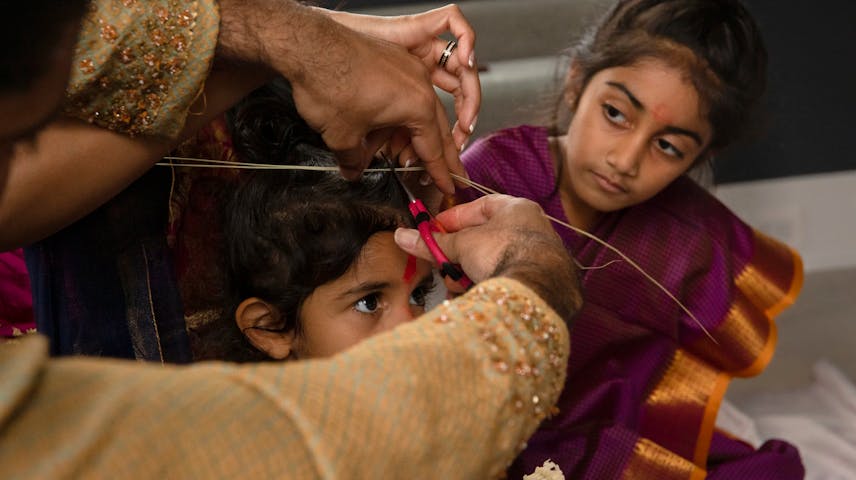
Display the image from the photo essay of the author’s mother holding her up so she can place tika (vermillion sandalwood powder) on her cousin's head, as part of a Raksha Bandhan ceremony.
Revise
Look closely at the photograph. Notice one specific visual detail. With your partner, revise this sentence so that it is more effective.
“The photo shows culture.”
Add one specific visual detail and one analysis verb, and explain what that detail reveals about culture, identity, or belonging.
Check for Understanding (W.7.2b) | |
|---|---|
In your Personal Dictionary, revise the sentence “The photo shows culture” by adding one specific visual detail and one analysis verb. | |
Teacher Tip: If needed, prompt students to begin with “The photograph’s ___ reveals . . .” and then finish with “because . . .” |
Connection to Today's Learning:
Students are ready to gather details from a photograph and a poem and use analysis verbs and explanation to build a cross-text response.
Say these Directions: As you move through the gallery walk of photographs, use the Notice, Wonder, Connect organizer. In Notice, write what you can literally see. In Wonder, write a question the image raises. In Connect, explain what the image may show about culture, identity, or belonging. Pause at each photograph, talk with your partner, and record one strong idea before moving on.
Ask: What does this image show about culture, identity, or belonging that words alone could not reveal in the same way?
The image can show several details at once, like clothing, objects, and expression, so I can see culture as something lived and visible. Words might explain it more fully, but the image makes the feeling immediate.
Say: Before we look closely at the images, learn what a photo essay is and the features it includes so you understand the type of text you are analyzing.
photo essay: a set of photographs that communicates an experience or idea
caption: a short text that gives context for a photograph
composition: how people, objects, space, and focus are arranged in the image
focal detail: the part of the image the viewer notices first
Display the rest of the photographs from Srivastava’s photo essay and read the captions aloud.
Teacher Tip |
|---|
Because this lesson asks students to interpret photographs connected to heritage, remind them to describe visible details first and avoid making assumptions about a person’s beliefs, feelings, or identity unless the image or caption supports that idea. |
Say: I am not looking for a poem that matches every single thing in the photograph. I am looking for a poem that speaks to the same big idea.
Say: For example, if a photograph shows heritage through clothing, family objects, or a careful pose like the image of the author placing tika on her cousin's head, I might connect it to the poem “Bindi” because that poem shows what happened when Amma was asked to remove her bindi at work.
Say: The image gives me something visible, and the poem gives me something felt. When those two pieces meet, I can make a stronger answer to the essential question. That is what I mean when I say the photo and poem “speak to each other.”
Say these Directions: Now choose one photograph from the gallery and one poem from Red, White, and Whole that connect around culture, identity, or belonging. Use the 3-Column Chart to collect one image-specific visual detail, one specific line or moment from the poem, and one connection sentence explaining how the two texts connect. Label your columns: Image/Poem/Connection.
Say: You will have three to four minutes to complete your chart.
Ask: How do your chosen photograph and poem speak to each other?
I paired the photograph of three generations of the Patil family gathering for a meal and the poem “My Mother’s Sister.” Both focus on the cultural tradition of family gathering together for a meal. In the photo, people are wearing traditional clothing as they talk and prepare food together to celebrate a ceremony. The poem shows how sharing a meal can make people feel safe and connected to each other, especially during important moments in life.
Ask: What does this word or phrase in the poem suggest about identity or belonging?
Prema Auntie’s line “I cannot rest until I make sure you and Reha have eaten properly” suggests that meals are more than just about food. They’re also about comfort and connection.
Pulse Check (RL.7.1, W.7.2) |
|---|
Which sentence best uses evidence from both a photograph and a poem to answer the essential question? (What is culture, and how does it shape our identity and sense of belonging—especially when you move between more than one world?)
|
Guide students in drafting a cross-text explanatory paragraph using the RACE structure.
Say these Directions: Use your 3-Column Chart and the RACE Writing Strategy organizer to draft one explanatory paragraph in response to the essential question. Your paragraph must start with a clear claim that answers the essential question, include one specific detail from the photograph, include one specific detail from the poem, and explain how the two texts work together. Use at least one analysis verb from today’s lesson: reveals, suggests, or emphasizes. Do not just list details—make sure you explain what each detail reveals about culture, identity, or belonging.
Display the following writing model if needed for support and guidance:
Culture shapes identity and belonging because the way a person is raised—including their language, traditions, and family values—is part of who they are and how they see the world. The photograph of the author’s mother holding her up so she can place tika on her cousin's head shows one way that culture can be seen on the outside. The poem “Bindi” explores Amma’s sadness when she was asked to remove her bindi at work, as if she had to hide part of herself. These details complement one another because the photograph shows a visual representation of culture, while the poem adds another layer about the feeling of living between two cultures. Together, they show that culture can be a source of pride and connection, but it can also make belonging feel complicated.
Say: As I draft, I start by answering the essential question in one clear sentence so my reader knows my main idea right away. Then I decide which detail should come first. If the image is what helped me understand the poem, I start with the photograph; if the poem clarified the image, I start with the poem. After I cite both details, I do not stop. I add an explanation sentence that tells how the two texts work together because that is where my thinking becomes visible. Before I finish, I check that every sentence connects back to culture, identity, or belonging. That final check keeps my paragraph from turning into a list of details.
Say these Directions: Check that your sentences are clear and connected so readers can follow your thinking.
As you draft, check your work for these three things:
Did I clearly answer the essential question?
Did I use one image detail and one poem detail?
Did I explain how the two pieces of evidence work together?
Lesson 35 Writing Rubric: Explanatory Paragraph — Photograph & Poem Working Together
Writing prompt: Write an explanatory paragraph that explains how one photograph and one poem from Red, White & Whole work together to develop a shared idea about culture, identity, or belonging. Use evidence from both the visual and the poem and explain how the two texts support one claim.
Criteria | 1 — Beginning | 2 — Developing | 3 — Proficient |
|---|---|---|---|
Thesis & Topic Sentence (W.7.2.a) One Claim Across Two Texts | The topic sentence does not identify a shared idea across the photograph and the poem. The paragraph treats them separately. | The topic sentence identifies a shared topic (e.g., belonging), but the claim does not yet explain how both texts work together to develop that idea. | The topic sentence states a clear claim about a shared idea (culture, identity, or belonging) that both the photograph and the poem develop, establishing how the two texts work together. |
Evidence & Analysis (W.7.2.b) Connect Visual & Poem Evidence | Evidence from only one text is used, or evidence from both is cited without explaining how they connect. | Evidence from both the photograph and the poem is present, but the analysis explains each separately rather than showing how they work together. | Evidence from both the photograph and the poem is integrated and analyzed for how they reinforce or extend each other's meaning. The explanation shows how the two texts together develop the shared idea more fully than either could alone. |
Teacher Feedback Look-Fors |
|---|
Activity: RACE Strategy Response Drafting |
Instruction: Circulate and provide real-time feedback on student journals or Student Editions based on the following observable language behaviors: |
Target 1 (The Strategy): Are students using a clear claim before listing evidence? |
Target 2 (Cross-Text Evidence): Are students including one specific photograph detail and one specific poem detail rather than general summary? |
Target 3 (Precision): Are students using an analysis verb such as reveals, suggests, or emphasizes and a connector such as because, while, or together? |
Target 4 (Standard): Does the paragraph meet the criteria of W.7.2 by explaining the topic with relevant details and clear organization? |
Have students write a brief response using evidence from both a photograph and a poem to deepen analysis.
Say: Today you practiced choosing evidence and explaining how two texts reveal a related idea. That is an important skill for the unit performance task, where you will write a literary analysis of one poem and then create your own poem. The stronger you get at naming a detail and explaining its meaning, the stronger both parts of your performance task will be.
Say these Directions: Refer to two specific details you used in your draft and use an analysis verb: reveals, suggests, or emphasizes. Write In 3–4 sentences.
Ask: How did using evidence from both a photograph and a poem help you answer the essential question more fully?
Using both texts helped me answer the question better because the photograph let me point to a visible sign of culture, while the poem helped me explain the inside feeling that goes with it. In my draft, I used one image detail and one moment from “Bindi,” and together they showed that belonging can be both seen and felt.
Say: The work we did today makes future reading and writing easier because you practiced explaining not just what you notice, but why it matters. That same move helps in literary analysis, discussion, and even when you create your own poem later in the unit.
Red, White, and Whole
Rajani LaRocca
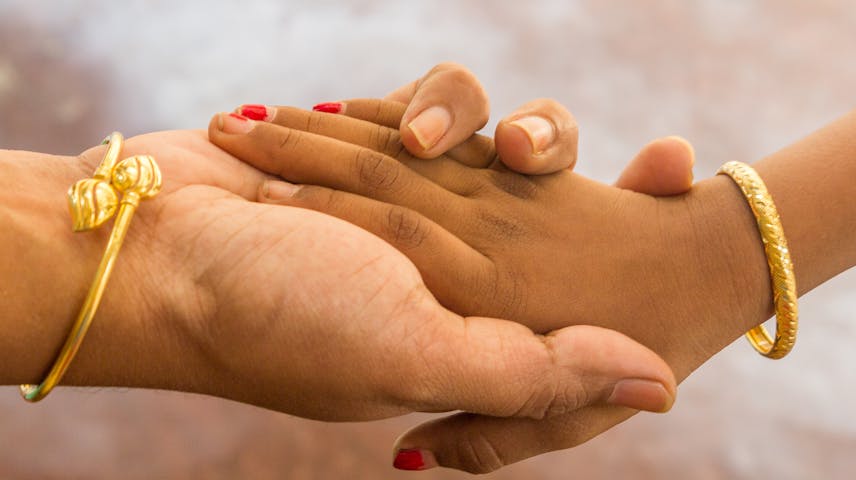
Through Her Grief, an Indian American Photographer Rediscovers Her Heritage
Maansi Srivastava, NPR