Loading course navigation
Loading lesson
50 min
Student Lesson
Lesson 36: Red, White, and Whole, Explanatory Writing, Part 3
Content
Students will revise a literary analysis paragraph by strengthening a claim, sharpening image-based evidence, and embedding and explaining poem evidence to deepen analysis.
Language
Students will refine precise word choice, sentence boundaries, and punctuation around quotations to increase clarity, coherence, and style in analytical writing.
What is culture, and how does it shape our identity and sense of belonging, especially when we move between more than one world?
Knowledge-Building:
Students continue analyzing how cultural images and poetic language work together to reveal identity and belonging.
Enduring Understanding:
Identity is shaped by biological, cultural, and emotional connections, and writers use symbols and images to show how those layers form a whole person.
Future Lessons:
Students will present, discuss, and refine their analytical writing as they move toward the culminating literary analysis task.
Unit Performance Task:
Today’s revision work strengthens students’ ability to produce a clear, coherent literary analysis that explains how imagery or symbolism reveals meaningful connections related to identity and belonging.
| Lesson Flow | Purpose of Learning Experience |
|---|---|
Launch5 Minutes | Students will activate prior learning and be prepared to revise their cross-text analysis drafts by identifying a clear, arguable claim and noticing where explanation is needed. |
Literacy Lab10 Minutes | Students will learn how to test whether a sentence functions as a claim (not just a topic) and how to revise for precise evidence and clear explanation. |
Learning in Action30 Minutes | Part A: Claim Check and Partner Feedback (W.7.5) Students will identify, underline, and revise the sentence that most directly answers the essential question, using partner feedback to strengthen clarity and arguability. Learning in Action B: Specificity, Embedded Evidence, and Final Revision (L.7.3.a, W.7.5) Students will revise their paragraphs by: making image evidence specific and visible, embedding and explaining poem evidence, and editing for sentence clarity, boundaries, and correct quotation punctuation. |
Material List
Red, White, and Whole by Rajani LaRocca
Student drafts (from Lesson 35)
Unit 4 Lesson 36 Student Edition
Dictionaries or other reference materials for checking word choice during final editing
Routines
Think-Pair-Share
Language Study
Iterative Conversation Exchange
Revision Sprint
Quick Write
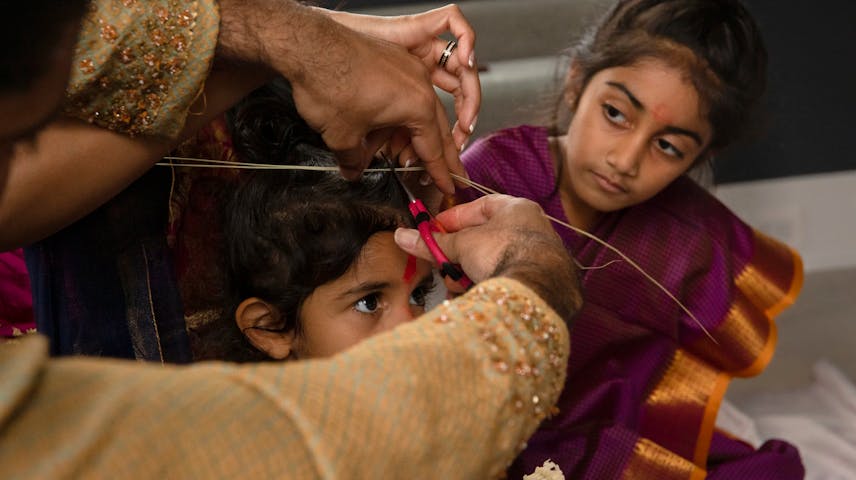
Display and invite students to take out their Lesson 34 draft and the poem and image they used as evidence.
Say: In the previous lesson, we matched a photograph and a poem to answer the unit question about culture and belonging. Today, we are making that writing stronger by checking whether our claim really answers the question and whether our evidence is specific and clearly explained. This matters because the final performance task asks students to write insightful literary analysis, not just collect interesting details. As you revise today, check: Does your claim show a clear idea about identity? Or does it also show something more complex, like tension, change, or multiple perspectives?
Keep students with the same partners they worked with in the previous lesson so they can build from their earlier cross-text thinking.
Say these Directions: Stay with the same partner from the previous lesson so you can build on your earlier cross-text thinking.
Take 20 seconds to reread your draft silently and find a place that seems effective and a place that needs some improvement. Then turn to your partner and share both parts. Partner A shares first for 30 seconds, then Partner B.
Prompt students to review their drafts and respond in writing to the question:
Ask: Which part of your draft best responds to the essential question, and which part still needs more explanation?
The strongest part of my draft is my sentence about how the image shows heritage through clothing and pose because it starts to answer the question about identity. The unfinished part is my ending because right now it mostly repeats my evidence instead of explaining how belonging is shaped.
Connection to Today's Learning:
Now that students have named a strength and an area to improve, they are ready to learn a quick way to test whether a sentence is truly making a claim. Today we are going to strengthen our writing in three ways: make our claim clear and arguable, make our evidence specific, and explain what our evidence shows.
Explain that writers do not improve a draft by changing random words. Strong revision starts by checking whether the paragraph actually answers the question, then explaining the evidence in a way that connects back to the claim.
Say these Directions: Review the claim with a partner.
“The photo and the poem both show identity and belonging. The photo shows cultural clothing and the poem talks about how much people care about each other. Identity and belonging are very important and both the image and the poem convey these ideas.”
Say: Evaluate the claim using the questions to guide your partner discussion.
Is there a clear claim that responds to the essential question?
Are there specific details included from both the image and the poem?
Did I explain how the two pieces of evidence work together to support the claim?
After analyzing the example paragraph, work with your partner to revise the paragraph. Be sure that your revised paragraph has a clear claim, details or evidence from both the poem and image, and an explanation that connects the details or evidence to the claim.
Prompt students to review their drafts and respond in writing to the question:
Review your draft and consider the questions. Mark the claim, details and explanation.
Does your draft:
Include a clear claim that responds to the essential question?
Underline the claim
Include specific details included from both the image and the poem?
Put a star next to each detail.
Include an explanation of how the evidence works together to support the claim?
Circle the explanation.
Say: I’m looking at the sentence "The photo and the poem both show identity and belonging," and I notice that it sounds true, but it is still too general. It names big ideas, but it does not yet answer what the texts suggest about culture or belonging.
Say: I want to revise it into a claim that is stronger, so I might say, “The photo and the poem suggest that cultural connection helps a person hold on to belonging during grief.”
Say: That version is stronger because it answers the question and gives me something specific to prove. A strong claim doesn’t just name a topic; it takes a stand. Now I check my evidence: if I just write "The photo shows culture," that is vague, so I need to name what is actually visible in the image. When I bring in the poem line "Because you are here, I must stay," I should not drop it and move on; I need to explain that the line shows belonging as a force that keeps the speaker connected and grounded.
Ask: Is the sentence “The photo shows culture” a claim or a description? How would you revise it to be more precise?
Ask: What makes the revised claim stronger than the first sentence?
The revised claim is stronger because it does more than list topics. It actually answers the essential question by saying that cultural connection can help someone keep a sense of belonging during grief.
Say: When you sharpen your claim and revise your sentences, you are practicing two related but distinct skills: precision and concision. Both are part of L.7.3.a — choosing language that expresses ideas precisely and concisely. Use these two passes on every claim and explanation sentence you revise today.
Display the following explanation of the two passes:
Pass 1 — PRECISION: Replace vague nouns and verbs with precise ones. Ask: what exact word names this idea? Examples: things → cultural traditions; shows → reveals; the photo → the photograph of the author’s mother applying tika.
Pass 2 — CONCISION: Cut wordy phrases and redundancy. Ask: can I say this in fewer words without losing meaning? Examples: in order to → to; due to the fact that → because. Also check for redundancy — if two adjacent sentences say the same idea, cut one or combine them.
Ask: Why is the sentence "The photo shows culture" too general for literary analysis?
It is too general because it does not tell the reader what is in the image. A stronger sentence would name the clothing, pose, expression, or another focal detail and explain how that detail connects to identity.
Teacher Feedback Look-Fors |
|---|
Activity: Claim Test |
Instruction: Circulate as students point to one sentence in their draft and test it against the two revision questions. Listen and look for the following: |
Target 1 (W.7.5): The student can identify one sentence as the current claim or recognize that the draft needs a new claim. |
Target 2 (L.7.3.a): The student can explain why a sentence is too general and name a more precise revision. |
Target 3 (Language Use): The student uses language such as “answers the question,” “specific detail,” “embed the quote,” or “explain the effect.” |
Connection to Today's Learning:
Students will now test their own claim sentences and use partner feedback to decide what needs revision first. Strong writers don’t just add more—they make their thinking clearer, more specific, and more precise.
Students remain in pairs with drafts, poem, and image visible.
Say these Directions: Underline the sentence in your draft that most directly answers the essential question. If you cannot find one sentence that does that, make that your first revision step. Then share your underlined sentence with your partner. Your partner will say one of two things: “This answers the question because ___” or “This mostly describes the texts because ___.” After you get feedback, revise the sentence immediately before switching roles. Partner A begins. As you listen, check: Does the sentence answer the essential question, and does it make a clear, arguable claim?
Encourage partners to point to the exact words in the claim that make it descriptive or analytical.
Ask: Does your partner’s underlined sentence answer the question, or does it mostly describe the texts?
This mostly describes the texts because it says the photo and poem both show culture, but it does not yet explain what they suggest about belonging. A stronger claim would say that the two texts show how heritage can make someone feel more connected during grief.
Ask: What one revision would make the claim clearer, more specific, and more arguable?
I would revise the claim by adding what the writer thinks the two texts reveal. For example, instead of saying they both show identity, I would say they suggest that cultural traditions help people hold on to identity when life feels uncertain.
Pulse Check (W.7.5) |
|---|
Which revised claim best answers the essential question instead of only describing the texts?
|
Provide students with a confidence continuum (i.e., 1–5). As needed, model how to demonstrate a level of confidence using the continuum.
Reflection (W.7.5) |
|---|
Reflect on your ability to revise your claim using feedback with the Reflection routine.
|
Connection to Today's Learning:
Once the claim is doing its job, students are ready to strengthen the evidence that supports it.
Guide students through focused revision by strengthening specificity, embedding evidence, and refining sentence clarity.
Say these Directions: You are going to revise your writing to make your ideas clearer and stronger. Effective writers revise by improving specificity, embedding evidence, and sentence clarity, not by adding more ideas right away.
Focus on revising your existing sentences. Do not add new ideas yet. Instead, look closely at what you already wrote and make it more precise, clearer, and more developed by strengthening your evidence and explanations.
Display the following writing model if needed for support and guidance:
Writing Model:
Culture shapes identity and belonging because the way a person is raised—including their language, traditions, and family values—is part of who they are and how they see the world. The photograph of the author’s mother holding her shows one way that culture can be seen. The poem “Bindi” explores when Amma was asked to remove her bindi at work. These details complement one another because the photograph shows a visual representation of culture, while the poem adds another layer about the feeling of living between two cultures. Together, they show that culture can be a source of pride and connection, but it can also make belonging feel complicated.
Ask: What makes this paragraph effective?
The writer uses precise nouns and verbs instead of vague ones. They say "the photograph of the author's mother holding her" instead of just "the photo," so the reader knows exactly which image. Strong verbs like shapes, explores, and complement name exactly what's happening. The word complement tells us the photograph and poem complete each other, not just that they "go together."
Say: I’m reading this anonymous draft sentence, and right away, I see two places to revise. First, the photo evidence is too general, so I want to ask, “What exactly is in the image that helps the reader see culture or identity?” I can revise that to name a focal detail, like clothing, expression, objects, or composition. I can build that sentence to say: “The photograph of the author’s mother holding her up so she can place tika on her cousin's head shows one way that culture can be seen on the outside.” Second, the poem detail is dropped in and left alone, so I need to build it into my sentence and explain it: “The poem ‘Bindi’ explores Amma’s sadness when she was asked to remove her bindi at work, as if she had to hide part of herself. ” After that, I do one more read for sentence boundaries, punctuation, and word choice so the paragraph sounds clear and finished. Strong writers revise by making details visible and explaining what those details mean.
Say: Keep your revised claim from the previous step, and now strengthen the evidence and explanation that supports it. Focus on revising existing sentences, not adding new ones.
Now you will revise your own paragraph in three passes.
First, revise one sentence so your evidence from the photograph names an exact focal detail instead of general description.
Second, revise one sentence so your poem evidence is embedded and explained.
Third, read the whole paragraph once for punctuation around quotations, sentence boundaries, and precise word choice. After your own revision, exchange drafts for one final partner read.
Lesson 36 Writing Rubric: Literary Analysis Paragraph — Revise for Claim Clarity & Embedded Evidence
Writing prompt: Revise a literary analysis paragraph to strengthen the claim about symbolism, sharpen image-based evidence, and embed and explain poem evidence to deepen analysis. Then edit for precise word choice, sentence boundaries, and punctuation around quotations.
Criteria | 1 — Beginning | 2 — Developing | 3 — Proficient |
|---|---|---|---|
Thesis & Claim Clarity (W.7.2.a) Claim That Stays Visible | Revision does not strengthen the claim. The claim remains vague or gets lost in the evidence. | The claim is revised to be clearer, but it still disappears in body sentences or does not connect forward to the evidence. | Revision strengthens the claim so that it is specific and arguable, and remains visible throughout the paragraph. Each sentence in the revised paragraph connects back to the claim. |
Evidence & Commentary (W.7.2.b) Embed Evidence + Explain | Evidence is still dropped in without signal phrases or commentary in the revised paragraph. | Evidence is embedded with signal phrases in the revision, but commentary is brief or paraphrases the line rather than explaining what the image or symbol reveals. | Evidence is embedded with a signal phrase and followed by commentary that explains what the imagery or symbolism reveals — not just what the line says. The commentary connects evidence to the claim using precise analytical language. |
Misplaced Modifiers & Sentence Clarity (L.7.3.a) Modifier Placement for Precision | Misplaced or dangling modifiers remain in the revised paragraph, creating sentences that are confusing or ambiguous. | Most modifiers are correctly placed in the revision, but one sentence is still awkward or unclear. | All modifiers are correctly placed in the revised paragraph. Sentence boundaries are clear, and punctuation around quotations follows conventions. The revision demonstrates precise, unambiguous prose. |
Checklist (W.7.5, L.7.3.a) |
|---|
As you revise, make sure you have:
|
Connection to Today's Learning:
Today, you revised your writing at three levels: claim, evidence, and sentence clarity. These moves help your ideas become more precise, more convincing, and easier for a reader to understand.
Have students reflect on which revision move most improved their paragraph using specific examples.
Say these Directions: In 2–4 sentences, explain which revision move most improved your paragraph today. Cite two specific places from your draft in your response: one revised photograph detail and one revised poem quote or explanation.
Ask: Which revision move—strengthening your claim, making evidence more specific, or explaining your evidence—made your paragraph stronger, and how can you tell?
The biggest revision move for me was making my evidence more specific. I changed a general sentence about the photograph into one that named the subject’s clothing and pose, and I revised my poem evidence so the line "Because you are here, I must stay" was embedded and explained instead of just dropped in. Those two changes made my paragraph sound more like analysis and less like a list.
Optional Sentence Starter:
The revision move that helped my paragraph most was ___ because ___.
Say: These revision moves (strengthening your claim, making evidence precise, and explaining clearly) are the same moves you will use in your final literary analysis for the performance task.
Instruct students to review their draft one more time and be ready to display it. Students should come prepared to the next lesson with the following:
One question you still have about your own writing (something you were not sure about or want feedback on). Write it on a sticky note or a small slip of paper to post with your draft.
Red, White, and Whole
Rajani LaRocca

Through Her Grief, an Indian American Photographer Rediscovers Her Heritage
Maansi Srivastava, NPR