Loading course navigation
Loading lesson
50 min
Student Lesson
Lesson 6: Comparing Red, White, and Whole and “What Is Blood?”, Part 1
Content
Students will determine the meaning of technical language in “What Is Blood?” and analyze how two texts shape the same topic differently.
Language
Students will compare texts using precise domain-specific vocabulary and contrast language in speaking and writing.
Foundational Skills
Students will read and pronounce multisyllabic science terms accurately and use those words in context.
What is blood, and how does it work as a symbol of both family ties and our shared humanity?
Knowledge-Building:
Students connect scientific terminology to literary symbolism by learning what red cells, white cells, and whole blood mean literally before tracing what they figuratively represent in Reha’s life.
Enduring Understanding:
Identity is shaped by biological, cultural, and emotional connections, and literature helps us see how those layers come together.
Future Lessons:
Students will build on this lesson when they continue tracking blood, color, and wholeness as motifs connected to the themes of illness, grief, and identity.
Unit Performance Task:
Students are practicing the exact work they will need for their literary analysis by explaining how imagery and symbolism reveal important connections to identity.
| Lesson Flow | Purpose of Learning Experience |
|---|---|
Launch5 Minutes | Activate prior learning about belonging and home. Then bridge to EQ1 by introducing blood as both science and symbol. |
Literacy Lab10 Minutes | Build precise technical meaning for red cells, white cells, and whole blood so students can later notice how poetry transforms those terms symbolically. |
Learning in Action30 Minutes | Part A: Reading the Science Map (RI.7.4) Students will closely read the informational text to determine the meaning and purpose of technical language. Part B: From Cells to Symbols (RI.7.9) Students will compare the article and poem set to analyze how each text approaches blood differently. |
Material List
Red, White, and Whole, “The Discovery”–“Red, White, and Whole” (pp. 20–27)
Unit 4 Lesson 6 Student Edition
Venn Diagram graphic organizer
Routines
Think-Pair-Share
Context Clues in Action
Close Read & Annotation
Graphic Organizer Deep Dive
Quick Write
Place students in pairs to answer the following question
Say these Directions: In the previous lesson, we looked at how the concept of home can live in people, memories, and rituals instead of just a place. Today, we are asking what blood means in the body and what it starts to mean in Reha’s life.
Ask: When you hear the word blood, what scientific meaning comes to mind, and what symbolic meaning comes to mind?
Scientifically, I think of blood moving through the body and keeping a person alive. Symbolically, I think of family, care, and connection. For example, the term blood ties means people related by blood, or relatives.
Connection to Today’s Learning:
Students now have in mind an idea that will be explored throughout this unit: that the word blood can carry multiple meanings, both literal or technical and symbolic. It can refer to both a physiological substance and to larger ideas of human connection.
Teacher Guidance: Have students keep their Personal Dictionaries open as they read the nonfiction article.
Say these Directions: We are going to learn three science terms from the article first, because literal or technical meaning will take the lead today. Once we know exactly what the words mean in the nonfiction article, we can notice how LaRocca uses those same ideas figuratively when we return to the poems.
Target Sentence Block:
“Red blood cells carry oxygen throughout the body. White blood cells help fight infection. Whole blood contains red cells, white cells, platelets, and plasma.” —“What Is Blood?”
In the title poem “Red, White and Whole,” Reha describes blood as a “precious river.” (p. 27)
Say: I want to start by reading the article language as literally as possible.
When I read “red blood cells carry oxygen,” I know the author is teaching about a biological function, not trying to create a feeling.
When I read “white blood cells help fight infection,” the verb fight tells me these cells protect the body, even though the article is still being scientific and precise.
Then I read "whole blood contains” different parts, so whole means complete blood with all its major parts together.
Now I look at the poem phrase “precious river,” (p. 27) and I can already feel the shift: the poem is not just defining blood; it is turning blood into an image.
Say: That is the move we will track today; first the literal biological meaning, then the figurative or symbolic meaning.
Ask: Based on the nonfiction article’s two sentences, what does each term (red cells, white cells, and whole blood) mean literally?
In the article, red cells are the part of blood that carry oxygen, white cells help fight infection, and whole blood means blood with all its main parts together.
Ask: How is the poetic phrase “precious river” different from the article’s depiction of blood? What figurative meaning is LaRocca implying with these words?
The article describes blood in functional terms: what it is made of and what it does in the body. LaRocca's phrase "precious river" does something different. A river moves constantly and connects places, which suggests blood isn't just a substance but something alive and flowing that links Reha to her family and her history. The word "precious" adds emotional weight the article never uses; it tells us this blood matters beyond biology. Together, the two words imply that when blood is threatened by disease, it isn't just a medical crisis. It is a threat to everything that connects Reha to who she is.
Check for Understanding (RI.7.4) | |
|---|---|
In your Personal Dictionary, choose one term: red cells, white cells, or whole blood, and write its literal, technical meaning in one sentence. Then add one phrase telling what role that component of blood has in the body. | |
Modeling:If needed, remind students to keep the definition literal and to use a job word like carry, fight, or contain. |
Connection to Today’s Learning:
Now that students know the scientific meanings, they are ready to see how the informational text builds knowledge and how the poem transforms that knowledge into symbolism.
Students read the section of “What Is Blood?” that explains the parts of blood and their functions. Have them annotate independently and then briefly compare notes with a partner.
Teacher Tip |
|---|
This lesson connects science language to illness and family experience. Acknowledge that medical topics can feel personal for some students, and let students know they may pause, write quietly, or check in with you if needed. |
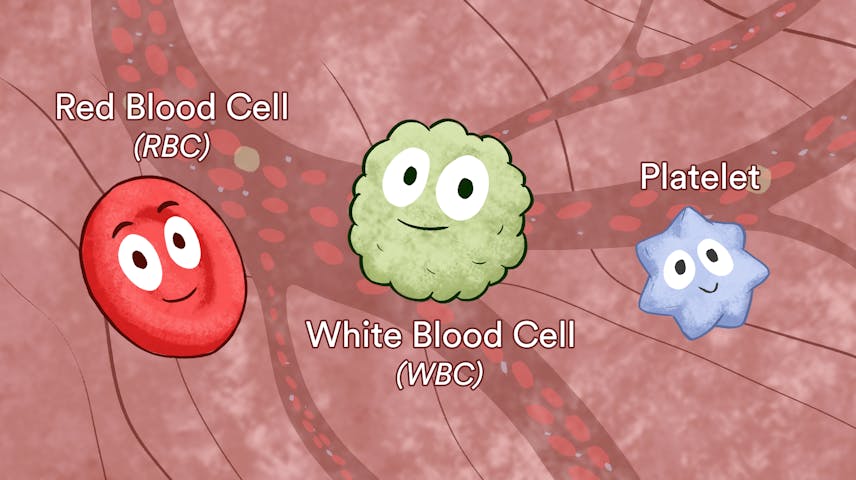
Say these Directions: Read the section of the article that explains the parts of blood. As you read, star one technical term and underline the definition. Study the illustration in this section to help you better understand the text. Think about why the author is including that term and its definition.
Say: When I read an informational text, I ask what the author wants me to understand clearly by the end. In this article, the author is building a science map of the body — so the voice is neutral, and every word is chosen to be exact. This kind of writing is not trying to inspire you or persuade you. Its goal is to make sure you cannot misunderstand.
Say: Notice how the article introduces each part of blood with a name, an abbreviation, and a specific job, and there is an illustration that presents this technical information Red blood cells — RBC — deliver oxygen from your lungs to your tissues and organs. White blood cells — WBC — fight infection and are part of your immune system. Platelets help blood clot when you have a cut or wound. Plasma, the liquid part, carries all of these through your body. Each term is defined immediately because in science writing, precision is everything.
Say: By the end of this section, you should be able to explain not just what each part of blood is called, but what it does and why all the parts have to work together for the system to function.
Ask: The article says bone marrow makes new blood cells constantly. Why does the body need to keep making new ones?
Because blood cells die. Red blood cells live about 120 days, platelets only about 6 days, and some white blood cells live less than a day. The body has to replace them to keep the system running.
Ask: The article explains that blood types have to match during a transfusion. What does that tell you about how the body treats blood that isn't its own?
It suggests the body recognizes its own blood and can reject what doesn't belong. The antigens on red blood cells act like an identity marker — if the markers don't match, the transfusion becomes dangerous instead of life-saving.
Ask: How do the illustrations of the blood cells and the human circulatory system help you better understand blood?
The illustration of the blood cells labels each type of cell and explains what it does, making it easier to keep track of all the different functions. The diagram of the human circulatory system helps me understand how blood travels through the whole body, showing me the path it takes rather than just reading about it.
Ask: How does the article help readers understand blood as a system made of parts that work together?
The article breaks blood into parts and explains each job clearly. For example, in the section that defines blood cells, it explains that red cells carry oxygen and white cells help fight infection. Readers can see that while blood is made up of different parts with different functions, all these parts work together as a system to keep the body running smoothly. Display the following journal model if needed for support and guidance:
Term | Technical meaning | How the language helps the reader |
|---|---|---|
red cells | cells that carry oxygen | gives a clear, exact function |
white cells | cells that help fight infection | shows blood also protects the body |
whole blood | blood with all its main parts together | helps readers understand blood as a complete system |
Provide students with a confidence continuum (i.e., 1–5). As needed, model how to demonstrate a level of confidence using the continuum.
Reflection (RI.7.4) | |
|---|---|
Use the Reflection routine to reflect on your ability to explain how technical language helps an author develop meaning. | |
Teacher Tip: If students only define the word, prompt them to add a second clause: This helps the reader understand ___ because ___. |
Connection to Today’s Learning:
Students have now built a literal science map they can use for comparison with the poem’s emotional and symbolic map.
Guide students in comparing how the article and poem set develop the ideas of red, white, and whole using a Venn diagram.
Say these Directions: Use the Venn Diagram to compare how the article and the poem set use the ideas red, white, and whole.
Put literal, scientific meanings on the article side,
Symbolic or emotional meanings on the poem side,
and shared ideas in the center.
Say: I want to compare one idea across both texts instead of treating them like two separate assignments.
In the article, white cells are explained by their function: they help fight infection in the body. In the poem set, that same idea becomes more emotional when white cells are described as warriors. This is figurative language that uses personification to convey meaning.
The science text is mainly trying to inform, while the poems use scientific language metaphorically, to convey a deeper meaning.
Say: I can do the same move with the word whole: in the article, it means blood with all its parts intact; in the poem, it also suggests Reha's wish to feel that she is a complete person. That comparison helps me understand the multiple meanings of the title Red, White, and Whole.
Display the following completed sample Venn Diagram if needed for support and guidance:
Article only | Both texts | Poem set only |
|---|---|---|
defines blood parts and their jobs | focus on blood and what it does | turns blood into imagery and symbol |
uses precise scientific language | show blood is necessary for life | connects blood to protection, value, and identity |
whole blood means blood with all parts together | use the ideas red, white, and whole | whole also suggests feeling complete as a person |
Ask: How does LaRocca transform one scientific term into a symbol in the poem set?
In the poem set, LaRocca takes a science idea and gives it emotional meaning. For example, after the article explains that white cells fight infection, the poem turns that idea into warriors, which uses personification to convey an idea of strength and protection.
Ask: What does the title “Red, White, and Whole” mean in both texts?
In the article, red and white point to real parts of blood, and whole means complete blood with its parts together. In the poem set, those same words also connect to Reha’s feelings, because whole starts to sound like wanting all parts of yourself and your life to fit together.
Pulse Check (RI.7.9) |
|---|
Which statement best explains how the two texts approach the idea of whole blood differently? A. Both texts use whole blood mainly to entertain readers with surprising details.
B. The article explains whole blood as the complete mixture of blood parts, while the poem turns whole into an idea about feeling complete as a person.
C. The article uses whole blood to show family sacrifice, while the poem uses it to explain a medical process.
D. Neither text gives enough information to understand the word whole.
|
Connection to Today’s Learning:
Students are now ready to put the science meaning and the symbolic meaning together in one clear explanation.
Have students write a short response synthesizing scientific and symbolic meanings of blood using evidence from both texts.
Say these Directions: For your Check for Understanding, write three to four sentences. Use at least two specific details: one from “What Is Blood?” and one from the poem set.
Ask: At this point in your reading, how would you answer the question: What is blood, and how does it work both as a symbol of family ties and our shared humanity?
Blood is a body system that keeps people alive because different parts do different jobs. In the article, red cells carry oxygen and white cells help protect the body, so blood is a real-life system. In the poem set, blood becomes more than science because it is described as a “precious river” and connected to protection and wholeness. That makes blood feel like a symbol of both family connection and the fact that all humans depend on the same life system.
Say: Today’s work matters because your Performance Task asks you to explain how an image or symbol reveals an important connection. When you can track a word like blood across a science text and a poem, you are practicing the exact kind of analysis strong literary essays need. Keep this comparison in mind when you choose a poem later in the unit.
Instruct students to revisit the Essential Question and to respond to the following prompt:
What is blood, and how does it work both as a symbol of family ties and our shared humanity? (Write your answer at this point in your reading. Use at least two specific details from today’s poems.)
What Is Blood?
National Institutes of Health (NIH) and Centers for Disease Control (CDC), adapted by Newsela