Loading course navigation
Loading lesson
50 min
Student Lesson
Lesson 1: Conditions for Revolution
Content
Students will learn about the concept of political revolution by examining the conditions and problems that led to the Russian Revolution through a gallery walk activity.
Language
Students will explain causes of revolution using visual evidence by using cause–effect connectors (because, leads to, results in), descriptive academic language (inequality, oppression, instability), and evidence-based explanation frames (The image shows . . . , This suggests . . .).
How do propaganda and rhetorical techniques influence what people believe and how they act?
Why do revolutions rise, and why do some end up betraying their own ideals?
Knowledge-Building:
In studying causes of political revolutions like the Russian Revolution, students build an understanding of how social and economic conditions can lead to a demand for governmental and societal change.
Enduring Understanding:
Political revolutions often begin with unjust and unequal economic and social conditions.
Future Lessons:
In Lesson 2, students will analyze examples of propaganda to understand how messages are crafted to influence belief and behavior. In Lesson 3, students will explore allegory and symbolism to examine how stories can reflect historical events, preparing them to begin Animal Farm in Lesson 4.
Unit Performance Task:
This lesson builds background knowledge about the causes of revolutions, which students will draw on when analyzing and writing about the revolution in Animal Farm.
| Lesson Flow | Purpose of Learning Experience |
|---|---|
Launch15 Minutes | Students will begin investigating the concept of a revolution through a turn-and-talk activity. |
Learning in Action30 Minutes | Investigating the Causes of the Russian Revolution (SL.8.1, SL.8.2) Students will be introduced to the Essential Questions of the unit and will learn about the conditions that led to the Russian Revolution through a gallery walk activity. |
Look Back5 Minutes | Students will reflect on the gallery walk and their understanding of what led to the Russian Revolution. |
Material List
Notice, Wonder, Connect graphic organizer
Unit 2 Lesson 1 Student Edition
Routines
Turn and Talk
Gallery Walk
Quick Write
Say: Throughout history, societies have experienced moments of dramatic change. These moments often begin when people believe the current system is unfair or no longer meets their needs. When large collective groups push for major political or social change, a revolution can occur.
Explain that understanding these concepts will help students analyze how movements gain momentum and how power can shift within societies through revolution.
Say: Revolution is a major and often sudden change in a political or social system, usually driven by people who want to replace the existing power structure.
Say these Directions: Turn and talk to discuss what you already know about revolutions.
Ask: What revolutions have you heard of before? What have you learned previously about revolutions?
(Student responses may vary.) I have heard of the American Revolution, which was a war against the British. I would consider the Black Lives Matter movement a social revolution because people are asking for equity and change within the power structure.
Say: Revolutions can be political, social, economic, or technological. You may have heard of the Industrial Revolution, which was a technological revolution in which manufacturing became machine-driven and based in factories. We have recently gone through another technological revolution since the invention of the Internet. What are some new technologies we now have because of our recent technological revolution?
(Student response may vary.) We now have social media because we have the Internet. People use email or text instead of writing letters or talking on the phone. We have better gaming systems like the PS5 because of improved technological advances.
Say: The type of revolution we are going to focus on in this unit is political. Political revolutions are often characterized by people wanting change in their government or political system. This kind of revolution can be more dramatic and sudden than an economic or technological revolution. For example, the American Revolution was a political revolution in that the people of the colonies wanted to be free of British rule. Let’s explore the concept of revolution in more depth. Let’s look at three distinct ideas about revolution.
Say: Read these statements and think about what conditions might cause people to seek large-scale change like a political revolution.
“Revolutions are the locomotives of history.” Karl Marx
“A social movement that only moves people is merely a revolt. A movement that changes both people and institutions is a revolution.” Dr. Martin Luther King Jr.
“Those who make peaceful revolution impossible will make violent revolution inevitable.” John F. Kennedy
Give students 30–45 seconds to read the quotes silently. Present the following questions.
Say: Turn and talk to discuss these questions:
Ask: What ideas about revolution are being expressed in each quotation?
Ask: What common problems or conditions might lead to a revolution as it is being described in these quotations?
(Student responses may vary.) Quote #1 suggests that revolutions are powerful forces that can change the course of history. It also suggests that revolutions are what make history move forward since a locomotive or train is a form of transportation. Quote #2 suggests that the difference between a revolt and a revolution is that a revolt changes people’s actions, but a revolution changes both people’s actions and institutions, like government policies or laws. Quote #3 suggests that people should support peaceful revolutions because if they don’t, then the revolution will become violent no matter what. Common problems or conditions that might lead to these kinds of revolutions could be when people believe the current system is unfair or needs major change. Problems or conditions might be unequal treatment, like segregation or discrimination, as in the Civil Rights Movement. Other problems could be government leaders who are harming their citizens or not taking care of them.
Bring the class back together and invite volunteers to share key takeaways. Record and display common ideas shared (for example: inequality, concentration of power, injustice, or the desire for systemic change). Explain that students will continue building their understanding of these ideas throughout the unit.
Check for Understanding |
|---|
List the word revolution in your Personal Dictionary. Write your definition of the word, and provide an example of a revolution from history. |
Teacher Tip |
|---|
If students need support with the word inevitable, consider providing the definition. |
Say: Today, we’re beginning our new unit by investigating why political revolutions arise by examining the conditions that can lead to major change. In upcoming lessons, we will continue exploring what happens after revolutions begin.
Present the two Essential Questions for the unit. Explain that later in this unit, students will examine how language can shape belief and how persuasive messages influence action, which will help them determine why movements for change sometimes succeed—and sometimes lose sight of their original ideals.
Tell students that these questions will guide their thinking as they read Animal Farm.
Say these Directions: Read the investigation questions and background information about life in Russia before the Russian Revolution.
Investigation 1: How do propaganda and rhetorical techniques influence what people believe and how they act?
Investigation 2: Why do revolutions rise—and why do some end up betraying their own ideals?
Tell students that this lesson will focus on the causes of the Russian Revolution, which aligns with the first part of Investigation Question #2: Why do revolutions rise?
Say: Today, you are beginning a unit that explores the Russian Revolution through an allegory. We will talk about allegories in an upcoming lesson. Today, our task is to learn more about this political revolution and determine the conditions or problems that contributed to the rise of this revolution.
Present the following background information and talk through this information with the students to help them better understand the historical context of the Russian Revolution.
Background Information
In 1917, Russia had an absolute monarch who ruled over the people. This monarch, named Tsar Nicholas II, did not take good care of his people.
An absolute monarch is a ruler who has complete and unrestricted power over their country and their people.
At the time, there were major economic and social issues. There was a huge gap between the rich and the poor. And the peasants and industrial workers often faced low wages, poor working conditions, and a lack of access to land.
Another factor during this time is that Russia is involved in World War I. There are lots of men losing their lives, and the people at home are facing food shortages because of the war.
And Tsar Nicholas II refused to implement reforms to support his people. He was allowing many of his people to starve because he did not want to make any changes to the government.
Introduce the gallery walk activity. Explain that students will act as historical investigators, examining visual evidence to understand the conditions that led Russia toward revolution in 1917. Tell students that revolutions rarely emerge suddenly; they typically develop in response to deep social, political, and economic pressures.
Teacher Tip |
|---|
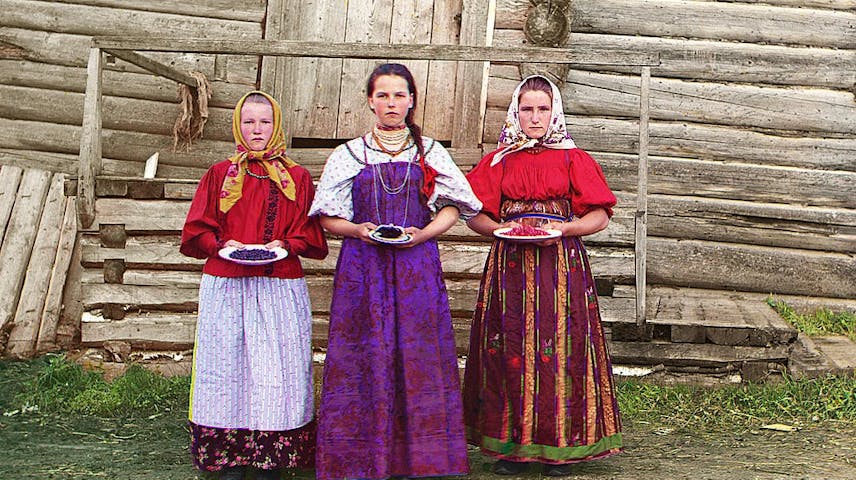
Use the curated image sets to set up the Gallery Walk routine. Consider selecting 7–10 images from pre-revolution Russia that highlight:
|
Provide students with the Notice, Wonder, Connect graphic organizer.
Transition students into small groups.
Say these Directions: With your group, closely examine each image and record observations in your Notice, Wonder, Connect graphic organizer. Focus on details that connect to the background information about the Russian Revolution previously discussed. Use the questions below to guide your thinking:
What economic or social conditions do you notice across these images?
(Student responses may vary based on the images selected.) Many images show extreme differences between social classes. Some people appear to live comfortably, while others live in more rural areas and may face more extreme working conditions or poverty. Additionally, it shows a lot of diversity in Russia and that there was some technology and transportation at the beginning of the Russian Revolution.
How might these conditions have influenced how the Russian people felt about their government or society, and why might those feelings lead to a revolution?
(Student responses may vary based on the images selected.) People experiencing inequality or instability might lose trust in leadership and begin demanding change. For example, if the peasants do not have enough food and the tsar is living well, the peasants might be upset and demand more food.
After students engage in the gallery walk, facilitate a whole-class discussion to surface common ideas about the conditions or problems that led to the Russian Revolution, such as inequality, abuse of power, poor living conditions, public frustration, and declining trust in leadership.
Say: Revolutions often begin when large groups of people believe the current system is no longer sustainable and seek solutions to persistent problems. These same types of pressures will help shape the fictional world students encounter later in Animal Farm.
Teacher Tip |
|---|
Remind students that historical change does not happen in isolation. Encourage them to consider the broader, integrated conditions and structures that may influence why revolutions begin. |
Reflection |
|---|
Reflect on your ability to explain the conditions that led to the Russian Revolution using the Reflection routine.
|
Transition students into reflecting on their learning from the lesson by completing a Quick Write response.
Say these Directions: Review your Notice, Wonder, and Connect graphic organizers. Respond to the following prompt based on this lesson’s learning:
Choose one visual detail from the gallery walk. Explain how that specific piece of evidence helps you understand why the Russian Revolution happened.
(Student responses may vary based on the images selected.) One image shows workers doing manual labor, while other images show people who look comfortable and well-off, suggesting that many people lived difficult and exhausting lives, while others didn’t. When large groups experience unfair treatment or limited opportunities, frustration can grow, making people more willing to support major societal change.
Introduce the homework to complete before the next lesson:
Take notes in your Journal on the following prompt:
Based on the evidence you examined today about the conditions that can lead to revolution, what predictions can you make about the kind of society or problems that might spark a revolution in Animal Farm? What factors do you think would push animals to demand change, and why?
Photographs of Pre-Revolution Russian Empire
Library of Congress, adapted by Newsela