Loading course navigation
Loading lesson
50 min
Student Lesson
Lesson 12: Animal Farm and “Russian Revolution: A New Kind of Power”
Content
Students will analyze central ideas in an informational text about the Russian Revolution and explain how those ideas connect to the allegory in Chapters I–V of Animal Farm, using evidence from both texts.
Language
Students will explain historical parallels between an informational text and Animal Farm by using comparative language (similarly, parallels, mirrors), abstract nouns (autocracy, oppression, ideology), expanded noun groups (political unrest, imperial failures), and cross-text evidence frames (“In the article . . . ,” “In the novel . . .”) to build cause–effect explanations.
Foundational Skills
Students will identify examples and non-examples of vocabulary words and reflect on their meanings.
How do propaganda and rhetorical techniques influence what people believe and how they act?
Knowledge-Building:
Students will build their knowledge of the Russian Revolution and make allegorical connections between Animal Farm and key figures and events of the Russian Revolution.
Enduring Understanding:
Students will examine historical events in the Russian Revolution and make connections to the text.
Future Lessons:
In Lesson 13, students will closely write about connections between the Russian Revolution and Animal Farm, using evidence from both the article and the novel. In Lesson 14, students will return to the academic discussion prompt from Lesson 11 and write about whether ideals, propaganda, or fear have the strongest influence over the animals’ beliefs and actions.
Unit Performance Task:
Analyzing the Russian Revolution and connecting it to the concrete characters and events in Animal Farm helps students better understand the animals’ revolution and its evolution in the novel.
| Lesson Flow | Purpose of Learning Experience |
|---|---|
Launch5 Minutes | Students will paraphrase their understanding of an informational text with a partner, then verify their knowledge. |
Literacy Lab10 Minutes | Students will explore examples of vocabulary words and compare them with non-examples. |
Learning in Action30 Minutes | Part A: Analyzing the Russian Revolution (RL.8.2, RI.8.2) Students will review and consolidate their understanding of the Russian Revolution and prepare to connect historical figures and events to characters and events in Animal Farm. Part B: Connecting the Russian Revolution to Animal Farm (RL.8.2, RI.8.1, RI.8.2) Students will examine the connections between specific figures and concepts of the Russian Revolution and characters and events in Animal Farm. |
Not available for this lesson
Material List
Animal Farm by George Orwell
Unit 2 Lesson 12 Student Edition
Index cards
3-Column Chart
Routines
Retell & Paraphrase Partner Check
Example/Non-Example
Think-Pair-Share
Give One, Get One
Turn-and-Talk
Students share about one Russian Revolution historical figure from the previous lesson’s homework reading.
Have students take out their homework from the previous lesson.
Lesson 11 Homework: Students read “Russian Revolution: A New Kind of Power” and responded to the following prompts:
What events led to the creation of the Union of Soviet Socialist Republics (USSR)?
Identify one event in the Russian Revolution article that is similar to an event in Animal Farm.
Say these Directions: Work with a partner to discuss the article you read by responding to the following prompt:
Choose one historical figure you read about in the article. Explain to your partner what you remember about the person and their role in the Russian Revolution. While one partner shares, the other partner will listen and then check the article to verify the information.
Tsar Nicholas II was the leader of Russia, whom people rebelled against. The people were hungry, and there were “food riots” and unrest until he stepped down from leadership.
Connection to Today’s Learning
Say: Today, we're going to zoom out from Animal Farm and look at the real historical revolution that inspired the novel. You read about the Russian Revolution for homework, and you’ll reread the article today. Then you will analyze what caused the revolution, why people followed certain leaders, and how ideals changed over time. Understanding this history will help us see how Orwell used the Russian Revolution as the foundation for Animal Farm.
Target words: socialism, dictatorship
Introduce Activity: Share with students that they will read a number of scenarios and decide if each is an example or a non-example of socialism, and then repeat the process with examples and non-examples of dictatorship.
Say these Directions: Read each scenario below. Decide on your own if each scenario is an example or a non-example of socialism. Then compare your answers with a partner. If you disagree on any answer, each of you should briefly explain your thinking and see if you can agree.
Then repeat the process with the second set of scenarios, deciding which are examples and non-examples of dictatorship.
Major industries and resources are typically owned or controlled by the state or the public.
The government plays a minimal role in regulating the economy, allowing supply and demand to determine prices and wages.
Citizens often receive access to services like healthcare, education, and housing, funded through taxation or state planning.
Wealth is redistributed through taxes, public programs, or state ownership.
Most people are born into a fixed social class and spend their lives working on land owned by nobles.
Religious authorities guide laws and social behavior.
Socialism | |
|---|---|
Examples:
| Non-examples:
|
Share Student Thinking: Invite partners to share any scenario where they did not initially agree and how they resolved their disagreement. As students share their thinking, prompt students to share their rationale and explain their connections. For example:
Ask: How did you come to agree that the second statement is an example?
We went back and checked the reading and agreed that the government plays a large economic role in socialism, not a minimal role
Citizens can publicly criticize their leaders in open discussion.
People have a say in how the wealth and resources of the whole society are used
The government is controlled by one person or a very small group of people.
People have no or very little choice in their leaders.
News and media are censored by the government.
People have many rights that are laid out for them.
Dictatorship | |
|---|---|
Examples:
| Non-examples:
|
Share Student Thinking: Invite partnerships to share their examples and non-examples. As students share their thinking, prompt students to share their rationale and explain their connections. For example:
Ask: How did you come to agree that the first statement is an example?
We agreed that the first is a dictatorship because the reading mentioned that the government often controls the flow of information that the people can see in a dictatorship.
Ask: Which system is Animal Farm moving toward by Chapter V? Use one detail to support your claim.
The Animal Farm is becoming a dictatorship because Napoleon makes decisions alone and uses the dogs to silence disagreement.
Connection to Today’s Learning
Say: The government in Animal Farm is changing, just as it did during the Russian Revolution. Today, you will learn more about the Russian Revolution and how it inspired and relates to this story.
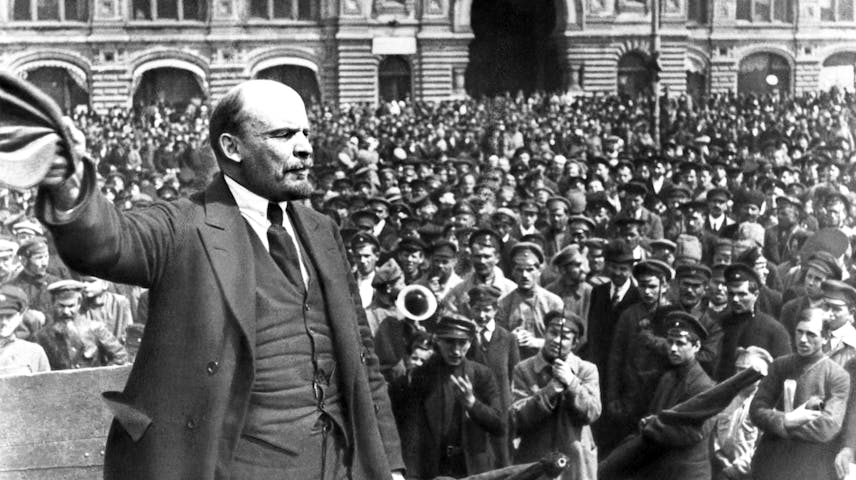
Students will analyze the leaders and events in the Russian Revolution to start drawing connections to Animal Farm.
Students will reread the “Russian Revolution” article with a partner, and jot down answers to at least three of the prompts below to then share with a new partner in the next section of the lesson. You may choose to assign items to pairs to ensure all items are answered.
Pass out blank index cards to the students.
Say these Directions: Read the prompts below and choose three you want to answer. Then reread the article “Russian Revolution: A New Kind of Power” with your partner. As you read, write your responses to the prompt on an index card. Use a new card for each of your three prompts. Each partner should have their own set of three cards.
one cause of the Russian Revolution
one leader in the Russian Revolution and how they influenced belief
one idea that was promised during the Russian Revolution and how it changed
one central idea from the article
one connection to Animal Farm characters
one connection to Animal Farm events
one connection to the use of propaganda in Animal Farm
Model for students with the first item by reading aloud the bullet and writing on an index card:
One cause of the Russian Revolution is that people were hungry and facing starvation, as it says in the article, there were “food riots and strikes”.
Encourage students to discuss questions they may have with their partner. Explain that they will exchange index cards with new partners when they are done rereading the text and responding to at least three items.
Teacher Tip |
|---|
You may create or display a timeline of key events related to the Russian Revolution to help students visualize the rise and fall of each leader. Additionally, consider searching for a video lesson on the Russian Revolution that includes visual aids and pictures to help aid students’ understanding. |
Have students use the Give One, Get One protocol to share their ideas with new partners.
Say: Now you will share your ideas about the history of the Russian Revolution and its connections to Animal Farm with new partners.
Say these Directions: Find a new partner, exchange one of your index cards, and briefly discuss your response. Then, repeat with another partner and another index card response.
Model the exchange of index cards as needed. Have students continue as time allows until all items from the list have been addressed.
One cause of the Russian Revolution was inequality because Russians, under the leadership of the tsar, had “very little freedom and lived in poverty.”
Lenin was a leader who promised that life would get better under his leadership by providing “land for the peasants and power to the workers.”
One promise Lenin made was to reform the rules of government to establish peace, and he was able to do so, but at a “huge cost” to Russia in terms of land.
One central idea is that the Russian people wanted revolution because life was difficult, but the life they were promised kept shifting under different leaders.
Lenin reminds me of Old Major and his early ideals of how life could be if there were a “classless” society. After they were both gone, the revolution did not go as originally planned.
The way ideals kept changing in Russia reminds me of how the ideals keep changing in Animal Farm. A certain way of life is promised, but the results are not there.
The leaders in Russia, like Stalin, used propaganda to persuade the soldiers and people to see the need for revolution in their own way. This reminds me of Squealer in Animal Farm and how he uses propaganda to influence the animals' beliefs and actions.
Have students reflect on how their thinking may have changed after hearing other points of view.
Pulse Check (RI.8.2) |
|---|
In Chapters I–V of Animal Farm, the pigs gradually take control by using persuasive speeches, spreading simplified slogans like “Four legs good, two legs bad,” and discouraging opposition through the threat of the dogs. Which historical theme from the Russian Revolution does this best represent?
|
Students will use their initial connections from the previous section to draw even deeper connections between the Russian Revolution and Animal Farm.
Say: In our reading, we learned some key information about the Russian Revolution:
Causes of revolution: inequality, famine, and failed leadership by the tsar
Rise of leaders: Lenin (ideals), Trotsky (intellect/strategy), Stalin (power and fear)
Messaging and propaganda: posters, slogans, simplified narratives
Betrayal of ideals: early promises vs. later authoritarian control and inequality
Say: This historical event inspired Orwell to write Animal Farm. There are some clear connections between the characters and events in the story and the events from the Russian Revolution.
Lead a whole-class discussion using the following question.
Ask: Which leader in the Russian Revolution is most similar to Napoleon so far, and which specific details from both texts show this?
Stalin is most similar to Napoleon. The article explains that Stalin used the “secret police” to control rivals, and he had Trotsky removed. In Chapter V, Napoleon uses trained dogs to chase Snowball away. Both leaders use fear to gain power.
Historical Snapshot Organizer
Say: We will begin creating a Historical Snapshot Organizer to record connections between the Russian Revolution and Animal Farm. This will be an important resource that we use in upcoming lessons.
Provide each student with a 3-Column Chart graphic organizer that will function as a Historical Snapshot Organizer.
Say these Directions: Create a Historical Snapshot Organizer by labeling the columns with the headings below. Then, fill in your organizer as we discuss key figures and concepts of the Russian Revolution:
Key Russian Revolution Figure/Concept
What the Article Says
Connection to Animal Farm
Get the students started by asking them to identify the key historical figures and concepts in the left column.
Ask: Who are the key historical figures and concepts in the article?
Use the responses below to fill out the left column together.
Tsar Nicholas II, Lenin, Trotsky, Stalin, secret police, and propaganda department.
Students will work together with a partner to complete the second and third columns about what the articles say about the historical figure or concept, and the connection to Animal Farm.
Say these Directions: Use the article and your notes/index cards to complete the second and third columns of the chart to explain what the article says about the historical figure or concept and the connection to Animal Farm.
Remind students to use gist statements or summary statements in the middle column as opposed to writing verbatim from the article so that they are paraphrasing what the article says.
Consider modeling Tsar Nicholas II as an example before transitioning students into partner work.
After students have worked on the charts in pairs, allow two to three pairs to share with the class.
Key Revolution Figure/ Concept | What the Article Says | Connection to Animal Farm |
|---|---|---|
Tsar Nicholas II | He had poor leadership; there was inequality; he was forced to abdicate “his throne.” | Mr. Jones showed poor leadership because he would drink too much and forget to feed the animals |
Lenin | Leader of the Bolsheviks who promoted early revolutionary ideals like “immediate peace and “land for peasants…” | Old Major was an early leader who got the animals excited about revolution with his ideals |
Trotsky | Used intellect to make plans and improvements for the “industrialization of Russia,” he was removed by Stalin | Snowball—loved to read and make plans by using his brain; was removed by Napoleon |
Stalin | Used fear and intimidation; consolidated all political and economic power; removed threats through his use of the “secret police.” | Napoleon—used fear and intimidation; threatened that Farmer Jones could return; removed Snowball because he wanted all the power |
Secret Police | Had the power to arrest, try, and execute all “threats” against Stalin | The dogs used by Napoleon to keep everyone under control |
Propaganda Department | Influenced the people everywhere and made Stalin seem “nurturing.” | Squealer’s persuasive speeches—used to change thinking and keep the animals from thinking for themselves |
Reflection |
|---|
Reflect on your understanding of the allegories in Animal Farm using the Reflection routine.
|
Have partners reflect on the connections between the Russian Revolution and Animal Farm.
Say these Directions: Turn and talk with a partner to discuss the prompt:
What was interesting or surprising to learn about the Russian Revolution and the connections to Animal Farm?
It’s interesting to think that Orwell has a character that matches all the major historical figures in the Russian Revolution, and how those characters match the descriptions of the Russian figures.
Instruct students to finish the Historical Snapshot Organizer for homework if they did not finish during the lesson. This organizer will support their writing in the following lesson.
Animal Farm
George Orwell
The Russian Revolution: A New Kind of Power
Standard News Bureau