Loading course navigation
Loading lesson
50 min
Student Lesson
Lesson 35: “The Four Freedoms Speech,” Four Corners Debate
Content
Students will evaluate the argument in “The Four Freedoms Speech” by assessing the strength of Roosevelt’s claims, evidence, and reasoning.
Language
Students will justify a stance using evaluation vocabulary and evidence-based discussion frames during a Four Corners Debate.
Why do revolutions rise, and why do some end up betraying their own ideals?
Knowledge-Building:
Students move from tracing Roosevelt’s argument to judging how well it works, deepening the unit’s study of how leaders shape belief through persuasive language.
Enduring Understanding:
Students continue examining how language can guide people toward action, but also how arguments must be evaluated based on claims, evidence, and reasoning.
Future Lessons:
In Lesson 38, students begin their Performance Task.
Unit Performance Task:
Students practice evaluating the strength of an argument so they can write stronger claims, use more relevant evidence, and explain their reasoning clearly in the final essay.
| Lesson Flow | Purpose of Learning Experience |
|---|---|
Launch5 Minutes | Students discuss what it means to evaluate an argument. |
Literacy Lab10 Minutes | Students are introduced to the Four Corners Debate protocol so they can take a stance, support it with evidence, and respond respectfully to other viewpoints. |
Learning in Action30 Minutes | Part A: Debate Preparation (RI.8.8, SL.8.1.a, L.8.6) Students will use homework notes and the full speech to prepare evidence-based positions about the strength of Roosevelt’s claims, evidence, and reasoning. Part B: Four Corners Debate (RI.8.8, SL.8.1.a-d, L.8.6) Students will evaluate Roosevelt’s argument by taking positions, defending them with text evidence, and responding to counterarguments in a structured debate. |
Not available for this lesson
Not available for this lesson
Material List
Unit 2 Lesson 35 Student Edition
Routines
Turn and Talk
Four Corners Debate
Quick Write
Say these Directions: In Lessons 33 and 34, we delineated Roosevelt’s argument by identifying his claims, evidence, and reasoning. Today, you will evaluate how strong that argument is by judging the quality of its claims, evidence, and reasoning.
Have students take out their homework notes from Lesson 34 on Roosevelt’s claims, evidence, and reasoning.
Say these Directions: Look back at your homework notes from Lesson 34. Today, you will evaluate FDR’s argument, so first, turn to your partner and talk about what the word evaluate means and how it might apply to a written argument.
Ask: What do we mean by the word evaluate, and how might that apply to a written argument?
Evaluate means to judge how strong or effective something is, not just to describe it. In a written argument, that means deciding whether the claims are convincing and whether the evidence and reasoning support those claims clearly.
After students share with their partner, clarify the term evaluate.
Say these Directions: In this lesson, evaluate means judging the quality of Roosevelt’s argument. We are going to ask whether his claims are strong, whether his evidence is relevant and sufficient, and whether his reasoning connects his evidence clearly back to his claims.
Connection to Today's Learning:
Say: Now that you understand that we will be evaluating Roosevelt’s argument, you are ready to practice the debate protocol you will use to evaluate Roosevelt’s argument in a discussion with your peers.
Explain that today, students will evaluate Roosevelt’s argument through a structured Four Corners Debate. Post or designate four areas of the classroom: Strongly Agree, Agree, Disagree, and Strongly Disagree.
Model for students how to use the Four Corners Debate Protocol.
Say these Directions: A Four Corners Debate is a discussion activity where you take a position on a statement and support it with evidence. Each corner of the room represents a different viewpoint: Strongly Agree, Agree, Disagree, or Strongly Disagree. After choosing a corner, you will explain your reasoning, listen to other perspectives, and decide whether new evidence strengthens or changes your thinking. In a Four Corners Debate, I do not move based only on my first reaction. First, I listen to the statement and decide which position best matches my thinking: Strongly Agree, Agree, Disagree, or Strongly Disagree. Next, I say my idea clearly: I chose this corner because Roosevelt’s evidence is relevant here, especially when he connects outside threats to American security. If I hear someone disagree, I respond to the idea respectfully and use more evidence instead of repeating myself. Good debaters are not trying to win by being loud; they are trying to justify a stance with relevant, sufficient support. If new evidence changes my thinking, I can move corners.
Say these Directions: Today’s discussion protocol is a Four Corners Debate. You will hear a statement, move to the corner that matches your stance, discuss your reasoning with others in that corner, and then respond to other corners using evidence from Roosevelt’s speech.
Say these Directions: As you debate, use these discussion frames to help you enter the discussion, support your stance, and respond respectfully:
Display the following language frames for students to read over.
I chose this corner because _____.
Evidence from the text shows _____, which supports my stance.
I disagree with _____ because _____.
A question I have for you is _____.
I understand what you just said, but I want to justify my ideas by _____.
Ask: Are there any discussion frames you would add here?
Allow students to suggest additional discussion frames.
Display the following discussion norms for students to read over.
Say these Directions: Keep these norms in mind during the debate:
Listen fully before responding.
Challenge ideas, not people.
Use evidence from the speech, not only opinion.
Be willing to change corners if another argument is more convincing.
Say these Directions: Before the debate begins, practice how to begin the debate with a partner. Use a discussion frame and one piece of evidence from Roosevelt’s speech.
Ask: Which discussion frame could you use to enter the debate, and what evidence might you pair with it?
I could say, “I chose this corner because Roosevelt gives relevant evidence when he warns that ‘the democratic way of life is…being directly assailed.’” That evidence supports my stance because it shows the threat is not just distant but affects core values.
Connection to Today's Learning:
Say: You now know how the Four Corners Debate works and how to present your positions in an evidence-based, respectful manner, so you are ready to prepare your evidence for the debate.
Students use their homework from Lesson 34 and the full speech to prepare for the Four Corners Debate. Remind students that all of the argument writing work they have done in this unit can help them evaluate someone else’s argument with more precision.
Say these Directions: Take out your annotated “Four Freedoms Speech” and all your argument delineation work from Lessons 33 and 34. Prepare for the debate by gathering possible responses to the following questions. Although the debate will use statements, these questions can help you figure out your stance in preparation for those debate statements.
Display the debate preparation questions.
Where do Roosevelt’s claims most strongly support his overall argument to Congress and the American people?
One of Roosevelt’s strongest claims is that the United States cannot remain detached from the crisis. He supports this by arguing that the nation should not accept “a peace dictated by aggressors,” which makes his argument feel urgent and action-oriented.
Where does Roosevelt use evidence that seems most relevant and sufficient, and why?
His evidence seems most relevant in the section where he explains that the United States should act as “an arsenal” providing “weapons of defense.” That part is specific and practical, so it supports his claim more clearly than general statements alone.
Where does Roosevelt use evidence that is irrelevant to his claims?
Some of his evidence about America’s past involvement in foreign wars detracts from his claims about isolationism because America has been involved in “events in other Continents.”
Where might Roosevelt’s reasoning feel less direct or more open to challenge?
The reasoning can feel less direct near the end when Roosevelt shifts to the “four essential human freedoms.” That vision is powerful, but some readers might argue that it relies more on shared democratic values than on detailed evidence connecting directly back to his earlier claims.
Provide students with a confidence continuum (i.e., 1–5). As needed, model how to demonstrate a level of confidence using the continuum.
Reflection (RI.8.8) |
|---|
Reflect on your ability to evaluate Roosevelt’s claims, evidence, and reasoning using the Reflection routine.
|
Transition students to the Four Corners Debate. Have students bring their copy of the speech and their debate notes to the discussion. For each round of the debate, students move to a corner, discuss their stance with others in that corner, choose one or two speakers, and then respond across corners with evidence. Remind students that they may move corners if another argument changes their thinking.
Say these Directions: Bring your speech and your notes with you. For each statement, move to the corner that best matches your stance on the statement, talk with peers in your corner, and then be ready to defend your stance with evidence from Roosevelt’s speech.
Say these Directions: During the debate, make sure you do these three things: state your stance clearly, use text evidence from the speech, and respond respectfully to a different point of view.
Ask: Statement 1: FDR’s claims sufficiently support his overall argument to Congress and the American people.
Students move to the corner that best represents their stance on the statement: Strongly Agree, Agree, Disagree, or Strongly Disagree.
I chose Agree because Roosevelt’s claims stay focused on one main idea: the United States cannot stay passive while freedom and security are threatened. When he argues that the nation should not “acquiesce in a peace dictated by aggressors” and later explains that it should act as “an arsenal,” his claims work together to define both the danger and the response America should take.
I chose Disagree because some of Roosevelt’s claims are strong, but the ending becomes broader than the argument he started with. When he shifts to the “four essential human freedoms,” the claim becomes more inspirational and less directly tied to practical actions that Congress and the American people can take.
Say these Directions: In your corner, each person should share their stance, their reasoning, and related text evidence. Then choose one speaker to share with the rest of the class and one person to ask a question of peers across the room who represent a different corner/stance.
Ask: Statement 2: FDR’s evidence is relevant and sufficient for each of his claims.
Say these Directions: Repeat the same discussion routine: share your stance, reasoning, and evidence, then prepare one speaker and one question for another corner.
Students move to the corner that best represents their stance on the statement: Strongly Agree, Agree, Disagree, or Strongly Disagree.
I chose Agree because Roosevelt gives relevant evidence when he connects events in Europe to American security and when he explains that the United States can help as an “arsenal.” Those details directly support his claims instead of drifting off topic.
I chose Strongly Disagree because some of Roosevelt’s evidence is relevant, but it is not always sufficient. In several places, he uses strong warnings and values, but a listener could argue that he gives fewer concrete facts than needed to prove every claim fully. For example, he doesn’t say how many “weapons” would be helpful.
Ask: Statement 3: FDR’s reasoning is sound and logical. His evidence connects directly to his claims.
I chose Agree because Roosevelt’s reasoning usually follows a clear line: there is an outside threat, that threat affects U.S. democracy and freedom, and therefore the nation must respond. In the section where he says domestic problems are part of the “great emergency,” he clearly links his evidence back to his claim.
I chose Disagree because Roosevelt’s reasoning becomes less direct at the end of the speech. The move to the “four essential human freedoms” is morally powerful, but some readers may think the logic depends more on shared democratic values than on clearly explained cause-and-effect connections.
Say these Directions: After this round, you may stay in your corner or move if another speaker changed your thinking. If you move, be ready to explain what evidence or reasoning influenced you.
Transition students into reflecting on their learning from the lesson by completing a Quick Write response.
Say these Directions: In 2 to 3 sentences, answer the question below. Use at least two specific details from Roosevelt’s speech to explain your thinking.
Display the following question for the students to respond to.
What made FDR’s argument strong? What weakened his argument?
Roosevelt’s argument was strong when he connected the war in Europe to American security and when he gave a concrete role for the United States by arguing it should act as “an arsenal” providing “weapons of defense.” However, his argument became weaker near the end when he shifted to the “four essential human freedoms,” because that part was inspiring but broader and less fully supported by specific factual evidence.
Students read their independent reading book for 20 minutes and complete a reading log entry.
Read your independent reading book for 20 minutes. In your reading log, record the date and pages you read, write 1–2 sentences about what happened or what you learned, and respond to this week’s prompt using evidence from the text.
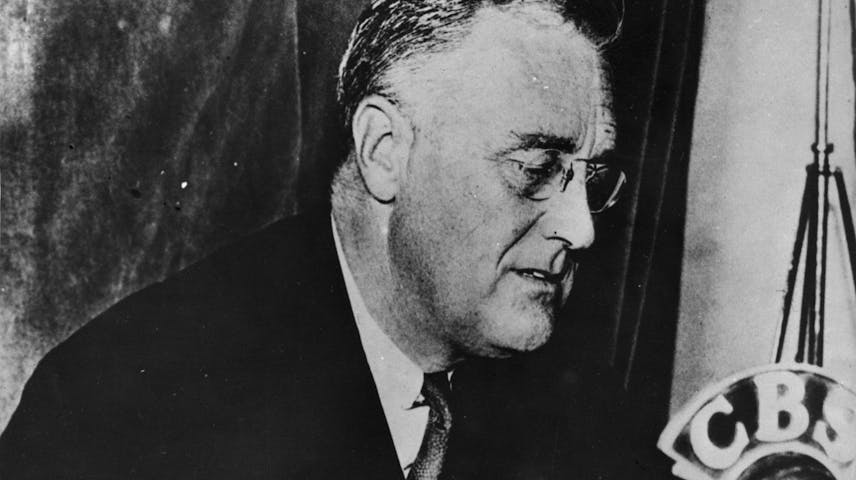
Famous Speeches: The Four Freedoms Speech
President Franklin Delano Roosevelt, original speech from the public domain