Loading course navigation
Loading lesson
50 min
Student Lesson
Lesson 33: Delineating “The Four Freedoms Speech” by FDR, Part 1
Content
Students will delineate claims and evidence and begin to analyze how Roosevelt supports his argument in the opening half of “The Four Freedoms Speech.”
Language
Students will use context clues, claim-evidence language, and cause-effect connectors to explain how Roosevelt develops his argument.
Foundational Skills
Students will use context clues to determine the meaning of two key words from the speech.
Why do revolutions rise, and why do some end up betraying their own ideals?
Knowledge-Building:
Students extend the unit’s study of power and persuasion by shifting from Orwell’s fictional story to a real historical speech by FDR about America’s involvement in World War II.
Enduring Understanding:
Students continue examining how leaders use language to define threats, frame choices, and influence how people support action.
Future Lessons:
In Lesson 34, students will continue delineating FDR’s argument in the second half of his speech. In Lesson 35, students will evaluate FDR’s argument, including his claims, evidence, and reasoning.
Unit Performance Task:
Students practice tracing claims, evidence, and reasoning in an argument so they can apply the same skills when they write their own argument for their Performance Task.
| Lesson Flow | Purpose of Learning Experience |
|---|---|
Launch5 Minutes | Students will activate prior knowledge about the meaning of delineating an argument as preparation for reading Roosevelt’s speech. |
Literacy Lab10 Minutes | Students will use context clues to determine the meaning of key words that shape Roosevelt’s argument in the speech’s opening. |
Learning in Action30 Minutes | Part A: Analyzing the Opening Argument of “The Four Freedoms Speech” (RI.8.3) Students will closely read and annotate the first half of the speech for historical background and key claims. Part B: Tracing Claims and Evidence in “The Four Freedoms Speech” (RI.8.8) Students will identify Roosevelt’s claims and connect them to supporting evidence. |
Material List
Unit 2 Lesson 33 Student Edition
Routines
Turn and Talk
Using Context Clues
Close Reading and Annotation
Quick Write
Students will discuss what it means to delineate an argument.
Say these Directions: Today, we are shifting from a fictional story to a real historical speech, so we can study how a leader builds an argument to influence belief and action. This matters because before we draft our Performance Task, we can study how authors develop claims, evidence, and reasoning to support a strong argument.
Say these Directions: Before we transition into writing for our Performance Task, we are going to focus on reading arguments closely so we can learn the craft of argument writing. First, jot a quick idea. Then turn to your partner and talk about what the word delineating might mean in this context.
Display the following and have students read it over.
Delineate and evaluate the argument and specific claims in a text, assessing whether the reasoning is sound and the evidence is relevant and sufficient; recognize when irrelevant evidence is introduced.
Ask: What do you think the word delineating means in this context?
I think delineating means breaking the argument down clearly and showing its parts. It is like tracing what the speaker is claiming and how they support it with reasoning and evidence.
After partners share, clarify the term delineate.
Say these Directions: In this context, delineate means “to describe something precisely by tracing its parts.” When readers delineate an argument, they identify the speaker’s claims and how those claims are supported with evidence and reasoning.
Connection to Today's Learning:
Say: Today, we will trace Roosevelt’s claims and evidence in the opening half of the historical speech we will be analyzing. In the next lesson, you will continue tracing how the argument develops and how Roosevelt builds his argument step by step.
Display the following target sentences from the speech for students to read.
“I address you, the Members of this new Congress, at a moment unprecedented in the history of the Union. I use the word unprecedented, because at no previous time has American security been as seriously threatened from without as it is today.”
“What I seek to convey is the historic truth that the United States as a nation has at all times maintained clear, definite opposition to any attempt to lock us in behind an ancient Chinese wall while the procession of civilization went past. Today, thinking of our children and of their children, we oppose enforced isolation for ourselves or for any other part of the Americas.”
Read the sentences aloud. Remind students that we are going to use the context — the words and sentences around the two bold vocabulary words- to figure out what they likely mean. The focus words for today are unprecedented and isolation.
Ask: What clues (words and phrases) around the word unprecedented help you infer its meaning?
Roosevelt explains the word himself when he says “at no previous time,” so the clue shows that unprecedented means something that has never happened before. The context makes it sound serious and new.
Ask: What clues (words and phrases) around the word isolation help you infer its meaning?
The speech says “lock us in behind an ancient Chinese wall,” which gives a picture of being cut off from the rest of the world. That clue helps me infer that isolation means separation or staying apart from other countries and events.
Say these Directions: When I hit a word like unprecedented, I do not stop and panic. I look around the word for clues the speaker gives me. Roosevelt actually helps us by saying, “at no previous time,” which restates the idea in simpler language. That tells me the word means something new in a serious way, not just unusual. Then I test the meaning by plugging it back into the sentence: “at a moment that has never happened before in the history of the Union.” That makes sense and strengthens the urgency of the speech. I do the same with isolation by noticing the image of being locked behind a wall, which suggests separation from the rest of the world. Good readers use nearby phrases, images, and restatements to make a smart guess and then test that guess in context before verifying it.
Say these Directions: In your Personal Dictionary, write unprecedented and isolation. Next to each word, list the context clue that helped you most. Then write your inferred meaning.
Say these Directions: Check your definition using a dictionary or other reference material. Does the definition match what we figured out? Revise as needed.
Say these Directions: Rewrite the words from memory and then check your spelling. Correct anything that does not match.
Ask: Which part of the word helped you remember how to spell it?
The un- in unprecedented helped me because I know that prefix often means not.
The -ion in isolation helped me because I have seen that ending in other nouns.
Ask: How do the words unprecedented and isolation help Roosevelt frame the situation in the sentences we read?
These words make the situation sound urgent and unusual. Roosevelt says the threat is unprecedented, so the country cannot act as usual, and he argues that isolation is not a safe choice.
Ask: How do these word choices help Roosevelt persuade his audience about how serious the situation is?
Roosevelt’s word choices make the situation seem urgent and dangerous. By calling the moment “unprecedented,” he shows that this is not a normal situation. By rejecting “isolation,” he suggests that staying out of global events is not safe. These choices help persuade the audience that action is necessary.
Check for Understanding |
|---|
In your Personal Dictionary, write one context clue for unprecedented and one for isolation. Then write a definition for each word and use one of the words in a sentence about Roosevelt’s argument. |
Connection to Today's Learning:
Say: Now you understand two key words Roosevelt uses to frame danger and response, which prepares you to read the speech’s opening argument more precisely.
Before reading, introduce students to the concept and features of a presidential speech, which is a public address meant to inform, persuade, and sometimes move a nation toward action.
Before reading, provide key background knowledge about the historical context of this speech. Roosevelt gave this speech on January 6, 1941. Europe was already involved in World War II. At this time, Hitler is in charge of Germany and has invaded several countries, including France, Poland, Denmark, and Belgium. Even though war raged in Europe and the Pacific, many Americans still wanted the United States to stay out of the conflict. This background knowledge helps students understand why Roosevelt must persuade a cautious audience rather than assume agreement as they start analyzing the speech.
Place students in groups of 3 or 4. Explain that students will read from the opening of the speech through the paragraph ending with “For all our domestic problems are now a part of the great emergency.”
Say these Directions: Read with your group from the opening of the speech through the paragraph ending with “For all our domestic problems are now a part of the great emergency.” As you read, annotate for two elements:
BG for historical background that Roosevelt provides about the conflict
C for specific claims about the war in Europe and America’s role in responding to it
Be ready to explain how the background information helps him introduce and support his claims.
Teacher Tip |
|---|
If students need support with the complexity of the speech, read the opening section aloud once with brief pauses before students reread in groups and annotate. |
After students have had time to read and annotate the opening of the speech, have them discuss the following questions in their small groups.
Ask: What historical background does Roosevelt give about America’s involvement in foreign wars, and why does he include it?
Roosevelt explains that the United States has participated in some “events in other Continents” but often avoided being drawn into serious foreign conflicts, reminding Congress that in earlier wars no “serious threat been raised against our national safety or our continued independence.” He continues to explain different international wars that America has been involved in, but says that they have only been a “small threat of danger” to America. He includes this background to show that past conflicts did not directly threaten the country.
Ask: Why does Roosevelt claim World War II is different from earlier conflicts?
Roosevelt argues this moment is different because American security is now directly threatened, stating that “at no previous time has American security been as seriously threatened from without as it is today.” In this passage, where he uses the word unprecedented, he argues that the danger from outside the country is more serious than in previous historical events.
Ask: How does Roosevelt use the situation in Europe to set up his argument to Congress and the American people?
Roosevelt describes the spread of “tyranny” in Europe to show that the United States cannot pretend the crisis is far away. Roosevelt connects events in Europe to the United States by warning that if democratic nations fall, “all the population and all the resources of Europe … will be dominated by conquerors.” This helps him argue that the crisis abroad will eventually affect American security. By connecting events overseas to American security, he prepares Congress to see the emergency as their problem too.
Pulse Check (RI.8.3) |
|---|
Which statement best explains how Roosevelt builds his argument in the opening half of the speech? A. He starts by listing domestic problems so Congress will ignore events in Europe.
B. He gives a historical background about past American distance from foreign conflicts and then argues that the current threat is different and more urgent.
C. He mainly tries to entertain Congress with dramatic language about foreign leaders.
D. He argues that America should stay isolated because Europe’s problems do not affect American security.
|
Say these Directions: When we delineate an argument, we do more than summarize. First, we identify the speaker’s main claim, or what the speaker wants the audience to believe or do. Next, we trace the evidence the speaker uses to support that claim, including examples, facts, and descriptions. Then we ask whether the evidence is relevant by checking if it actually connects to the claim instead of drifting away from the point. In this speech, Roosevelt is not just describing world events; he is building a case for how Congress and the American people should think and respond when it comes to World War II and America’s involvement.
Say these Directions: The first part of delineating an argument is identifying the speaker’s claims. Remember, a claim is a position the speaker wants the audience to accept. In the opening half of this speech, Roosevelt claims that tyranny in Europe threatens more than Europe and that the United States cannot rely on isolation as protection. Then he supports those claims with descriptions of outside threats, the spread of dictatorship, and the idea that domestic problems are tied to a larger emergency. Once I can name the claim, I can explain how the evidence fits it and supports the speaker’s point. That is what strong readers do when they evaluate an argument.
Instruct students to stay in their small groups from the previous Learning in Action activity. Have them draw a three-column chart in their journals labeled claim, evidence, and why the evidence is relevant and supports the claim.
Say these Directions: Draw three columns in your journal labeled claim, evidence, and why the evidence is relevant. Work with your group to identify Roosevelt’s claims and match each claim to the evidence he uses. Be prepared to explain how each piece of evidence directly supports the claim.
Display the following completed example if needed for support and guidance:
Claim | Evidence | Why the evidence is relevant |
|---|---|---|
The current threat of war in Europe is unprecedented for the United States. | Roosevelt says that at no previous time has American security been as seriously threatened from outside by the “tyranny” in Europe. | This evidence directly supports the claim because it explains why he sees the present moment as different from previous foreign wars. |
Isolation is not a safe response. | Roosevelt uses the image of being locked behind a wall and says the nation opposes enforced isolation. | This evidence is relevant because it directly addresses the choice he wants Congress and the American people to reject |
If democracy fails in Europe, then democracy in America will be threatened. | Roosevelt claims that if democracy is conquered in “four continents,” then they will easily have the “population and resources” to take over America. | This evidence matters because it directly shows that if America does not defend democratic nations in Europe and in other continents, then America will be the next to fall. |
After student groups have made their charts, instruct them to engage in a small group discussion using the following questions.
Ask: What claims does Roosevelt make about “tyranny” in Europe?
Roosevelt claims that tyranny in Europe is spreading and creating a serious danger, destroying “whole patterns of democratic life in an appalling number of independent nations,” and is not just a distant conflict. He wants Congress and the American people to see dictatorship as a threat that can affect American security, too.
Ask: What claims does Roosevelt make about America’s involvement?
Roosevelt argues that the United States cannot remain isolated, warning that “in times like these it is immature … to brag that an unprepared America … can hold off the whole world.” This shows that he believes isolation is unrealistic and dangerous. He argues that even if America once stayed more separate from foreign wars, this emergency now reaches beyond Europe.
Ask: What evidence does Roosevelt use to support his claims in this part of the speech?
He uses evidence like his statement that American security is threatened “from without,” his description of tyranny expanding in Europe, and his warning that domestic problems are part of the same emergency. These details all support the idea that the nation cannot treat the war as someone else’s problem.
Ask: Which piece of evidence in the opening half of the speech seems most relevant to Roosevelt’s argument to Congress, and why?
One of the most relevant pieces of evidence is Roosevelt’s warning that “the future and the safety of our country … are overwhelmingly involved in events far beyond our borders.” This directly supports his argument that Congress cannot treat the war as distant. That detail matters most because it directly supports his message that Congress must treat this as an urgent national issue, not a distant one.
Lead a whole-class discussion after small groups have discussed the questions.
Provide students with a confidence continuum (i.e., 1–5). As needed, model how to demonstrate a level of confidence using the continuum.
Reflection (RI.8.8) |
|---|
Reflect on your ability to identify Roosevelt’s claims and explain whether his evidence is relevant to those claims using the Reflection routine.
|
Explain that students will now synthesize Roosevelt’s opening argument to Congress.
Explain that students will now synthesize Roosevelt’s opening argument to Congress in a Quick Write response.
Say these Directions: In 2–3 sentences, answer the question below. Use at least two specific details from the opening half of the speech to support your answer.
Display the following question for the students to respond to.
Review the claims Roosevelt made in the first half of the speech. Ultimately, what is he arguing for in this first half of the speech? What is his message to Congress?
In the opening half of the speech, Roosevelt argues that Congress must recognize the war in Europe as an urgent threat to the United States rather than treat it as a distant conflict. He supports this message by saying the moment is unprecedented, warning that American security is seriously threatened from outside the country and insisting that domestic problems are now part of the same “great emergency.”
Instruct students to read the second half of “The Four Freedoms Speech,” starting with the paragraph beginning “Just as our national policy in international affairs has been based upon...” and continuing to the end of the speech. In their Journal, students respond to the following prompt:
Annotate for the claims Roosevelt makes and identify at least one example of supporting evidence for each claim.
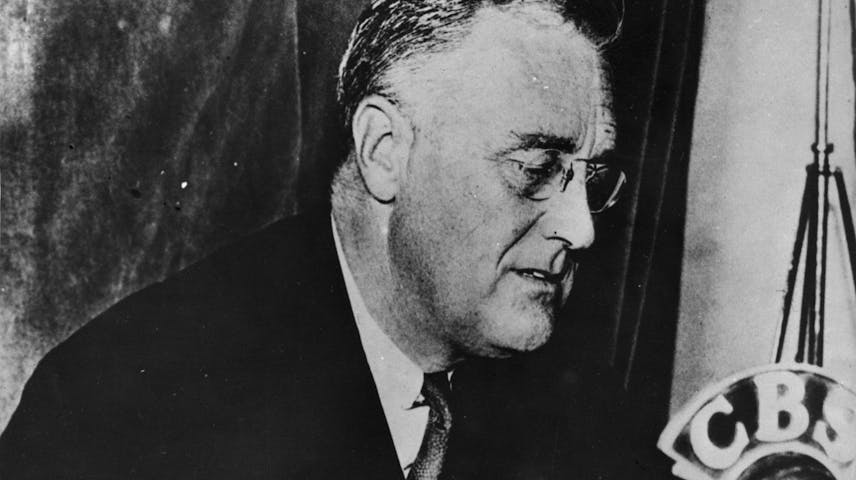
Famous Speeches: The Four Freedoms Speech
President Franklin Delano Roosevelt, original speech from the public domain