Loading course navigation
Loading lesson
50 min
Student Lesson
Lesson 10: March, Explanatory Writing, Part 2
Content
Students will write an explanatory paragraph about the social and political factors that led to the Civil Rights Movement using their analysis of the article, “Separate and Unequal: Jim Crow and the Road to Civil Rights.”
Language
Students will use verbals and causal transitions to add precision and cohesion to an explanatory paragraph.
Foundational Skills
Students will learn about verbals and how to identify them in sentences from the article.
How does storytelling become a tool for civic change?
Knowledge-Building:
Students build an understanding of how social and political factors in the 1950s created a pivotal moment for the formation of the Civil Rights Movement.
Enduring Understanding:
Students see how historical events become shared memory that can move people toward civic action.
Future Lessons:
In Lessons 11 and 12, students continue to read and analyze March.
Unit Performance Task:
Students are practicing the evidence-based explanation and organization they will need when writing their Multimedia Civic Memory Brief.
| Lesson Flow | Purpose of Learning Experience |
|---|---|
Launch5 Minutes | Students talk about one political and one social factor that led to the birth of the Civil Rights Movement in the 1950s. |
Literacy Lab10 Minutes | Students learn how verbals function in sentences so they can add detail and precision to explanatory writing. |
Learning in Action30 Minutes | Part A: Modeling the RACE Strategy (W.8.2.a-c) Students review how to use the RACE writing strategy to identify relevant evidence and use transitions to develop an explanatory paragraph. Part B: Writing an Explanatory Paragraph Using the RACE Writing Strategy (RI.8.1, RI.8.3, W.8.2.a-c, W.8.4, L.8.1.a) Students draft an explanatory paragraph using the RACE writing strategy to explain how social and political factors contributed to the birth of the Civil Rights Movement. |
Not available for this lesson
Not available for this lesson
Material List
Unit 1 Lesson 10 Student Edition
RACE Writing Strategy graphic organizer
Routines
Turn and Talk
Language Study
Modeled Writing
RACE Strategy Response
Instruct students to turn and talk with a partner to discuss the notes they took in their journal for homework.
Say these Directions: Take out your journal and the article, “Separate and Unequal: Jim Crow and the Road to Civil Rights.” Discuss with a partner one social factor and one political factor you identified from the article that contributed to the Civil Rights Movement in the 1950s.
One political factor is Brown v. Board of Education because it was the court ruling that overturned Plessy v. Ferguson, which had established “separate but equal.” A social factor is World War II and how veterans had fought against “racist fascism” but then were treated like “second-class citizens at home,” which led to more resistance and organization against segregation.
Connection to Today's Learning
Say: You have identified one social and one political factor that contributed to the rise of the Civil Rights Movement. Now you will learn how to clearly express your ideas in an explanatory response using verbals.
Teach: Investigating the Function of Verbals
Say: A verbal is a word that is formed from a verb but acts like an adjective, adverb, or noun. There are three kinds of verbals: gerunds, infinitives, and participles.
Display the chart and review the information with students. Explain that verbals can stand alone, but they often begin phrases.
Verbal | Description | Function | Example from Article |
|---|---|---|---|
gerund | ends in -ing | noun | Southern states began passing laws. … |
infinitive | “to” plus verb | noun adjective adverb | Many refused to accept Jim Crow. … (noun) Du Bois became the first Black American to earn a doctorate. … (adjective) State governments … quickly moved to take back power. (adverb) |
participle | ends in -ing or -ed | adjective | State governments dominated by white former Confederates quickly moved. … |
Say: Writers often need to pack a lot of information into one sentence. They can use verbals to make their explanations more precise and their sentences more interesting.
Say: This sentence contains participles, infinitives, and gerunds. To identify these verbals, let’s start by breaking the sentence into chunks. Look at the first chunk.
Display and read aloud the sentence from the article.
Target Sentence
“For a brief period called Reconstruction, the federal government sent troops to the South to enforce these new rights, and Black Americans began to participate in public life by serving in state legislatures and holding political office.”
Direct students to the prepositional phrase that begins the sentence: “For a brief period called Reconstruction…”
Say these Directions: Look at the beginning of the sentence.
Ask: Which word is formed from a verb? How does it act in this part of the sentence?
Called is formed from a verb and acts like an adjective. It describes “a brief period.”
Underline the participial phrase “called Reconstruction”.
Say: Now let’s look at the next chunk of the sentence.
Draw students’ attention to the main clause: “the federal government sent troops to the South to enforce these new rights”. Guide students to identify the subject (federal government) and the predicate (sent).
Say these Directions: Look at the main clause of the sentence.
Ask: What kind of verbal does this chunk of the sentence contain? How does the verbal function in the sentence?
To enforce explains why the government sent troops, so it acts as an adverb.
Teacher Tip |
|---|
If students struggle to identify the function, explain that verbals functioning as adverbs can often move within the sentence without changing the meaning. For example, To enforce these new rights, the federal government sent troops to the South. |
Repeat the process with the chunks, “and Black Americans began to participate in public life by serving in state legislatures and holding public office”. Help students identify the infinitive to participate and gerunds “serving” and “holding.”
Display and read aloud another target sentence.
Target Sentence
“In 1892, a group of Black citizens in New Orleans decided to challenge Louisiana’s law requiring separate railroad cars.”
Have students copy the sentence in their journals and instruct them to underline each verbal in the target sentence and label it as G for gerund, P for participle, or I for infinitive, and write a short note about how it functions and what it adds to the overall meaning of the sentence.
Say these Directions: Copy the target sentence into your journal. Underline each verbal. Label each verbal as G for gerund, P for participle, or I for infinitive, and then write a short note about how each verbal functions and what that verbal adds to the overall meaning of the sentence.
Participle: “requiring separate railroad cars”
Function: This participial phrase modifies the noun “law.” It describes what kind of law it was, a law that required separate railroad cars.
Infinitive: “to challenge Louisiana’s law requiring separate railroad cars”
Function: This infinitive functions as the direct object of the verb “decided.” It explains what the group decided to do.
🎯 PURPOSE Support students in identifying how verbals function so they can use more precise sentence structures in their own writing. Language Focus: grammar language for gerund, participle, and infinitive function language for subject, detail, and purpose sentence precision Encourage students to paraphrase each sentence in everyday language before naming the grammar pattern. |
|---|
🗣️ SAY / ASK Emphasize the job the verbal is doing in the sentence before naming the type. Revoice student explanations using function words such as acts as, adds detail, and shows purpose. You said “it names the thing doing the action”—we can say: the gerund acts as the subject of the sentence. You said “it tells why they went to court”—we can say: the infinitive phrase acts as an adverb and shows purpose. The verbal _____ is a gerund/participle/infinitive because it _____. In this sentence, the verbal adds detail by _____. The writer uses this structure to show _____. |
👁️ WATCH FOR / SUPPORT IF NEEDED If a student labels every -ing word as a gerund → _Prompt:_ “Check its job. Is it the subject, or is it adding information about a noun?” If a student cannot explain the function of the infinitive → _Prompt:_ “Try moving it to another place in the sentence to see if the meaning changes.” Student identifies the type of verbal and its function. Student explains function with precise language rather than relying only on the word ending. |
Connection to Today's Learning:
Say: Now you are ready to enhance your own writing by using verbals to clarify ideas and create interesting syntax.
Teacher Tip |
|---|
Students may choose text evidence connected to racist violence, including evidence from the Emmett Till section. Remind students that strong explanatory writing can be respectful, precise, and evidence-based without becoming graphic. |
Provide students with RACE Writing Strategy graphic organizer and display the following prompt:
Model Writing Prompt: How did events after the Civil War lead to segregation?
Teach: Using the Race Strategy to Write an Explanatory Paragraph
Say: When developing an explanatory paragraph, you need to develop a topic with well-chosen details and use varied transitions to connect your ideas with your evidence. You can use the RACE strategy to organize your ideas. Remember that we learned about and practiced the RACE writing strategy in Lesson 6. I will model writing a response paragraph to the prompt using the RACE Strategy.
R: Restate the Question | Following the Civil War, segregation arose as a result of several events. |
|---|---|
A: Answer the Question | Broken promises and segregation laws created a system that treated Black Americans as unequal while pretending to be equal. |
C: Cite evidence from the article | “When federal troops were withdrawn from the South in the late 1870s, state governments dominated by white former Confederates quickly moved to take back power.” |
|---|
E: Explain Your Answer | No one stayed to enforce the laws, so “state governments dominated by white former Confederates quickly moved to take back power.” Although the government controlled by Confederates claimed that segregation was separate but equal, it was not. “These laws were not just about separating people—they were about keeping Black Americans in a position of social and economic inferiority.” |
|---|
Point out the transitions and then guide students to the verbals to vote, to enforce, controlled by Confederates, and ask students to identify what these verbals add.
Keep the model displayed so students can use it as a reference for their own writing.
🎯 PURPOSE Support students in noticing how strong explanatory writing organizes evidence and signal words to make relationships clear. Language Focus: RACE language transition language for sequence, cause, and contrast evidence-to-explanation language |
|---|
🗣️ SAY / ASK Point to each RACE section as students name it so organization stays visible. Push students to explain why a detail is relevant, not just where it appears. You said “that fact fits the answer”—we can say: that detail is relevant evidence that supports your claim. You said “the transition helps it flow”—we can say: the transition clarifies the relationship between the evidence and the explanation. This detail develops the topic because _____. The transition _____ helps connect _____ to _____. The writer explains the evidence by showing _____. |
👁️ WATCH FOR / SUPPORT IF NEEDED If a student points to a detail but cannot explain its relevance → _Prompt:_ “Finish this sentence: This fact belongs here because it proves _____.” If a student treats transitions as decoration only → _Prompt:_ “What relationship is the transition showing: order, cause, result, contrast?” Let students rehearse the paragraph structure orally with a partner before naming the RACE parts in academic language. Invite students to connect the idea of transition words to similar linking words they use in conversation or another language. Student identifies a specific detail as relevant to the paragraph’s answer. Student names the relationship shown by a transition instead of only noticing that a transition is present. |
Reflection |
|---|
Reflect on your understanding of how to use the RACE writing strategy to draft an explanatory paragraph using the Reflection routine.
|
Make sure students have clean copies of the RACE Writing Strategy graphic organizer, their copy of the article, and their journals. Display the writing prompt.
Writing Prompt: What social and political factors made the 1950s a pivotal moment for the rise of the Civil Rights Movement?
Read the prompt aloud.
Say these Directions: Before you begin writing your paragraph, use the RACE Writing Strategy graphic organizer to help you organize your ideas. Choose your text evidence carefully, making sure that the quotations are directly related to your answer.
Allow students a few minutes to take notes on their RACE Writing Strategy graphic organizer.
Say: Use the notes from your graphic organizer as a basis for your explanatory paragraph in response to the prompt. Be sure to use varied transitions to clarify the relationships among ideas and events. To add interest and information to your sentences, include at least one verbal.
The 1950s were a pivotal moment for the rise of the Civil Rights Movement as a result of long-term pressure combined with major events that underscored the lack of equality and its impact on the Black community. To begin, segregation and disenfranchisement had shaped daily life for many years for Black Americans. During the late 1800s and the first half of the 1900s, “Black Americans in the South lived in a world where the color of their skin determined where they could sit, eat, learn, work, live, and even be buried.” Because “Separate was never truly equal,” the laws created deep frustration and a need for change. When World War II ended, the way people treated Black veterans “as second-class citizens” inspired action. In response, “many veterans became community organizers and activists leading into the Civil Rights Movement.” In addition, the ruling in Brown v. Board of Education in 1954 was a major political factor, changing the “separate but equal” doctrine. Challenging the unfair laws that had oppressed a large group of American citizens allowed for systemic change and opened the door for Black Americans to demand equality during the Civil Rights Movement.
Teacher Tip |
|---|
Circulate and provide real-time feedback on student writing based on the following:
|
🎯 PURPOSE Support students in drafting a complete explanatory paragraph that uses evidence, transitions, and sentence precision to communicate historical analysis clearly. Language Focus: category language for social and political factors transition language for addition and cause precise sentence structures with verbals |
|---|
🗣️ SAY / ASK Confer with students by asking them to point to their answer sentence first, then to the details that match it. If a paragraph becomes a list of events, prompt the student to add a transition and an explanation sentence that shows why the factor mattered. You said “this made people want change”—we can say: this social factor increased public pressure for change. You said “Brown was important in government”—we can say: Brown v. Board of Education was a political factor because the Supreme Court challenged the constitutionality of segregation. One social factor was _____, which mattered because _____. A political factor appears in the section _____, where the article shows _____. As a result, these factors helped the movement _____. |
👁️ WATCH FOR / SUPPORT IF NEEDED If a student writes a topic sentence that repeats the prompt only → _Prompt:_ “Add your answer after the word because so the reader knows your claim.” If a student cites evidence without explanation → _Prompt:_ “Finish this sentence: This factor mattered in the 1950s because _____.” If a student struggles to use a verbal naturally → _Prompt:_ “Try starting with a gerund like ‘Challenging segregation…’ or an infinitive phrase like’'to demand equal rights.’” Student groups evidence into social and political categories rather than listing facts randomly. Student uses a transition or verbal in a way that clarifies meaning instead of making the sentence more confusing. Allow students to orally rehearse one sentence at a time before writing the full paragraph. Encourage students to use familiar spoken language first, then revise one sentence into more formal academic language. |
Lesson 10 Writing Rubric: Explanatory Paragraph — Connecting Words
Writing prompt: How does the use of the graphic novel Maus support the authors’ central claim about graphic novels and social justice?
Criteria | 1 — Beginning | 2 — Developing | 3 — Proficient |
|---|---|---|---|
Topic Sentence & Answer (W.8.2.a) Restate + Answer | The topic sentence does not restate the question, or it does not clearly identify that the paragraph is about how Maus supports the authors’ central claim. The paragraph does not preview a clear answer about the relationship among the authors’ examples. | The topic sentence restates the question as a statement, but the wording is vague or incomplete. The paragraph previews an answer, but it only lists examples rather than naming a clear relationship among them. | The topic sentence clearly restates the question as a declarative statement and introduces the topic of how Maus supports the authors’ central claim about graphic novels and social justice. The paragraph previews a specific answer that names the relationship among the authors’ examples — shared purpose, repeated structure, or how the examples build the claim. |
Transitions & Connecting Words (W.8.2.c) Connecting Words to Show Relationships | The paragraph uses few or no transitions between ideas, or the transitions chosen do not show a clear relationship. Evidence is dropped in without a reporting verb or signal phrase. | The paragraph uses some transitions, but they are limited or repetitive and do not consistently show relationships among ideas. Evidence is introduced with a reporting verb in some places but not others. | The paragraph uses precise connecting words and phrases to show relationships among ideas — for example, To begin with (introducing), For example (illustrating), This matters because (explaining), and Ultimately (concluding). Evidence is introduced smoothly with reporting verbs such as states, shows, explains, argues, or notes, and at least one well-integrated quote uses location language. |
Verbals (L.8.1.a) Verbals for Precision | The paragraph does not use a verbal, or a verbal is used incorrectly. | The paragraph includes a verbal, but the sentence may be awkward or the verbal does not clearly add precision. | The paragraph uses at least one verbal (gerund, participle, or infinitive) correctly to add precision or detail to a sentence explaining how Maus supports the authors’ claim. |
Partners do a quick reread of their paragraph before speaking so the reflection stays tied to actual writing choices.
Say these Directions: Turn to your partner and share one strength in your writing and one area that could be improved. Be sure to use specific examples.
(Student responses may vary.) One strength is that I quoted relevant evidence to support my ideas. I would like to strengthen my use of transitions and verbals in my explanation to better connect the evidence to my analysis.
Instruct students to take notes in their Journal on the following prompt:
Next, we will look at a pivotal moment in John Lewis’ childhood: a road trip he took from Alabama to the North. To prepare, think about your own experiences with big journeys and responsibilities. Choose one of the prompts below, and write a reflection in your Journal.
Think about a time you traveled somewhere or went to a new place (like a new school, a different city, or even a friend’s house). What are the “rules” you or your family follow to make sure you stay safe and respected in a new environment? Why is it important to have a plan when you are entering an unfamiliar place?
Think about a time you realized that something you wanted to do was “off-limits” or impossible because of a rule or a situation you couldn’t control. Describe the feeling of being disappointed by a reality you didn’t expect. How did you handle that feeling, and what did it make you want to change for the future?
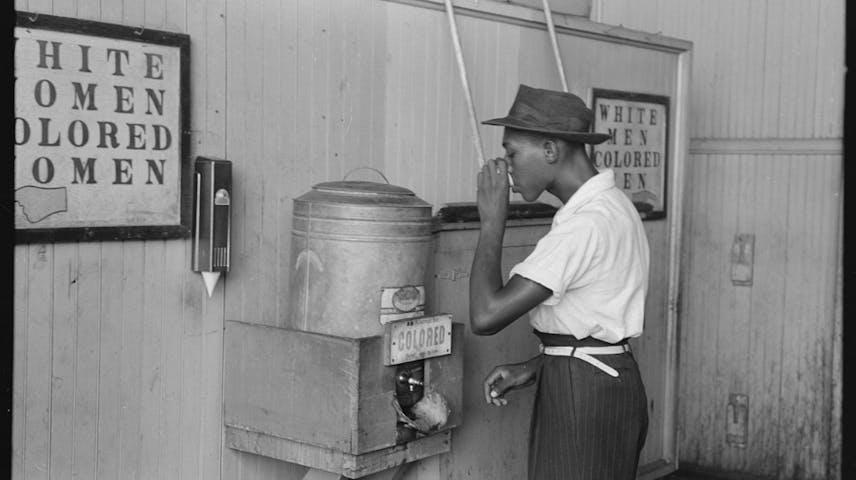
Separate and Unequal: Jim Crow and the Road to Civil Rights
Standard News Bureau