Loading course navigation
Loading lesson
50 min
Student Lesson
Lesson 30: March: Book One, Nashville Sit-Ins
Content
Students will analyze how Lewis draws connections between the ideas of liberation and nonviolent protest during the Nashville lunch counter sit-ins.
Language
Students will explain how nonviolent discipline leads to liberation by linking events with temporal connectors, abstract academic nouns, and interpretation verbs.
Foundational Skills
Students will practice reading fluently, using context to determine word meanings, and deconstructing sentences.
What is civic memory, and how does testimony help us remember and learn?
Knowledge-Building:
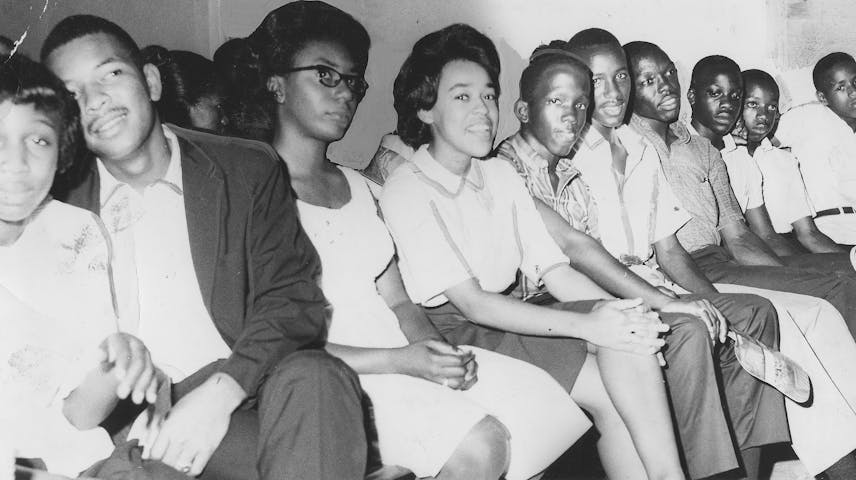
Students will learn about the first series of official Nashville lunch counter sit-ins.
Enduring Understanding:
People shape civic memory through storytelling.
Future Lessons:
In Lesson 31, students will engage in an Academic Discussion of March: Book One and the “SNCC Statement of Purpose.” In Lesson 32, students will begin engaging with the next section of March.
Unit Performance Task:
Students might write about the Nashville lunch counter sit-ins for their Civic Memory Brief.
| Lesson Flow | Purpose of Learning Experience |
|---|---|
Launch5 Minutes | Students will engage in a Think-Pair-Share to discuss the homework question from the previous lesson. |
Literacy Lab10 Minutes | Students will unpack two key sentences from March, practicing their fluency, using context to determine word meanings, and synthesizing their understanding. |
Learning in Action30 Minutes | Part A: Close Reading of Nashville Sit-Ins (RI.8.4, RI.8.5) Students will reread pp. 90–97 of March and discuss text-dependent questions with partners. Part B: Give One, Get One Discussion (RI.8.3, RI.8.4, RI.8.6) Students will reread pp. 98–102 before engaging in the Give One, Get One routine to discuss text-dependent questions with partners. |
Material List
March: Book One, by John Lewis, Andrew Aydin, and Nate Powell
Unit 1 Lesson 30 Student Edition
Give One, Get One Graphic Organizer
Routines
Think-Pair-Share
Using Context Clues
Give One, Get One
Quick Write
Say these Directions: Take out March: Book One with the annotations completed for homework and review the notes. Follow the Think‑Pair‑Share routine and work with a partner to share your thoughts. Use homework annotations to support the discussion. Consider the following question:
Ask: How are the philosophy and discipline of non-violence further developed in this section of the text?
In this section of text, nonviolence is shown as disciplined self-control during real danger. The protesters stay seated for hours and do not retaliate even when the situation at the lunch counters turns violent (pp. 94–96, 100–101). Lewis also connects this choice to liberation, describing feeling “free” after deciding not to be afraid (p. 102).
Provide students with a minute to think about the question before sharing their thoughts with their partner.
Say: Today, we will closely analyze this section of March to trace the sequence of events during the Nashville sit-ins and explain how Lewis connects nonviolent protest to liberation. As we discuss, we will pay attention to key phrases and word choices and to how the text is structured to project certain feelings and emotions.
Say these Directions: Look at the sentences from March displayed on the board. Work through the meaning of each sentence by unpacking the language and ideas.
"Violence does beget violence, but the opposite is just as true. Fury spends itself pretty quickly when there's no fury facing it." (pp. 100–101)
Guide students through unpacking the two sentences.
Model Fluent Reading: Model reading aloud the sentences fluently.
Ask: While reading, what did I do to make sure my reading was fluent?
Class Echo-Read: Reread the sentences aloud. This time, have students read aloud with you.
Ask: Did you read the sentences fluently? Why or why not?
Unpack Sentence 1: “Violence does beget violence, but the opposite is just as true.”
Ask: What does beget mean? How can we figure it out from context?
Beget means “to cause” or “to lead to.” The sentence suggests violence creates more violence, so the word must mean something like “produces” or “brings about.”
Ask: What pattern is the author describing first? What contrast does but signal?
First, Lewis describes a chain reaction: violence leads to more violence. The word but signals a contrast, meaning the opposite can also happen.
Ask: What would be the opposite of violence begetting violence?
Nonviolence can lead to less violence, or calm responses can stop the cycle from continuing.
Unpack Sentence 2: “Fury spends itself pretty quickly when there's no fury facing it."
Ask: What does fury mean?
Fury means intense anger or rage.
Ask: What does it mean for fury to ‘spend itself’? What condition makes this happen?
It means the anger runs out or loses power. This happens when no one responds with anger back, so the fury has nothing to “feed” on.
Verify Definition:
Prompt students to use a dictionary or other reference materials to verify their inferred definition. Confirm or revise the inferred meaning together.
Say: Check your inferred definition using a dictionary or other reference material.
Synthesize:
Ask: How do these two sentences work together as one idea?
Together, they explain a cause-and-effect pattern: violence and anger can grow when people respond in kind, but they can fade when people refuse to match them.
Ask: What is the author's larger point about how violence and nonviolence work?
Lewis suggests nonviolence is not weakness, it is a strategy that interrupts the cycle. When protestors stay disciplined, they reduce escalation and keep the focus on injustice instead of retaliation.
Teacher Tip |
|---|
Invite students to add beget and fury to their Personal Dictionaries. After each word, have them write the definition of that word. |
Say: Today, we will continue to analyze this section of March to explain how events build during the Nashville sit-ins and how Lewis connects disciplined nonviolence to liberation. As we read closely, we will use more context clues to determine new word meanings and track how Lewis’s cause-and-effect structure is developed across panels and captions.
Students reread pages 90-97 in March to analyze the Nashville Sit-Ins.
Say these Directions: Work with a partner to reread pages 90–97. Discuss these questions together.
Ask: How do the visuals (colors, graphics, panels) on pp. 90–93 establish the chain of events of the first Nashville sit-in?
The panels move step-by-step from preparation to action: Lewis puts on his scarf, the caption shifts to the past with a time stamp, and the wide panel shows a long line outside the store in the snow (p. 90), which is the beginning of the protest. Then the visuals show the protest plan, with little text, in order from entering the store to purchasing an item to sitting at the counter and waiting; the reader can follow exactly how the sit-in begins (pp. 91–92). The images and dialogue show that the workers refuse service to the protestors and close the lunch counter. The dark, high-contrast “COUNTER CLOSED” p. 90 emphasizes the store’s response and marks a turning point in the protest (p. 93) in that the protestors don’t leave but sit in the dark.
Ask: How does the “eerie” quiet of the first sit-in compare to the celebration afterward? Why might Lewis use the word eerie in this context?
During the sit-in, the panels show students sitting in silence or the “eerie quiet” and the dark for hours, which makes the moment feel tense and uncertain (p. 94). Afterward, the church scene is crowded and energetic, with people talking and celebrating what happened (p. 95), comparing it to “New Year’s Eve.” Lewis uses eerie because the quiet is not peaceful. It feels strange and heavy, like everyone is waiting for something bad to happen.
Ask: How does the pacing of events change over pp. 96–97? Why might Lewis change the pace at which he explains the events that follow the first sit-in?
The pacing speeds up with quick time jumps and short captions: The next sit-in happens days later, then “two days later” they march again, and “that night” Lawson meets with leaders (pp. 96–97). Lewis changes the pace to show momentum as more people join, the sit-ins repeat, and more people start to “notice” the protests (p. 96). The fast pace also shows that decisions have to be made quickly as pressure grows, like Lawson talking about how the store owners need a “moratorium” (p. 97).
Ask: How do the department stores respond after several sit-ins, and what does moratorium mean in this context?
The stores keep shutting down the counters instead of serving the students, and later the store owners ask for a moratorium on the sit-ins (pp. 96–97). In this context, moratorium means a temporary pause or stop so the owners can “buy time” to respond or negotiate by “putting together a proposal” (p. 97).
Pulse Check (RI.8.5) |
|---|
Which choice best explains how Lewis structures pp. 90–97 to show how the first sit-in leads to larger action?
|
Provide students with the Give One, Get One graphic organizer.
Say these Directions: Use the graphic organizer provided for this activity. Reread pages 98–102 independently. Respond to the questions in the organizer on your own. Participate in the Give One, Get One routine by sharing one idea with a partner and receiving one idea in return.
Ask: How does Lewis's response that he feels “free” and “liberated” (p. 102) compare to the textual and visual depictions of the February 27, 1960, sit-in?
On February 27, the text and panels show danger, intimidation, and physical violence, as the protestors are attacked and “beaten” (pg. 101). Yet on p. 102, Lewis says he “felt free” and “liberated,” which shows that even while facing fear, violence, and arrests, he experiences an inner freedom because he refuses to be controlled by segregation or by the “mob” (pp. 101–102).
Ask: Lewis first mentions liberation on p. 78 when learning about the philosophy and discipline of nonviolence. How do the events on pp. 98–102 further develop Lewis's point of view about liberation and “the way out”?
The events show that “the way out” is disciplined nonviolence, even when violence is expected. After leaders warn that police may not protect them and a mob attacks, Lewis and the others still choose to sit in and practice the discipline of nonviolence (pp. 98–101). When Lewis says he was “not afraid” and felt “liberated,” the memoir suggests liberation comes from acting against injustice and segregation with dignity and commitment (p. 102). Because the protestors do not retaliate and do not use “fury,” they are the ones who rise above the angry “mob,” thus feeling “liberated” (pp. 100–102).
Teacher Tip |
|---|
Remind students that they were introduced to the vocabulary word liberated in Lesson 24 when Lewis first meets Jim Lawson and hears him speak about nonviolence. |
Reflection (RI.8.3, RI.8.4) |
|---|
Reflect on your ability to explain how Lewis draws connections between the ideas of liberation and nonviolent protest in March using the Reflection routine.
|
Transition students into reflecting on their learning from the lesson by completing a Quick Write response.
Say these Directions: Return to the two sentences from March that were introduced during the Literacy Lab. Write a Quick Write response to the question below.
Ask: How do the events in this section of the text support Lewis's point of view in these two sentences?
The sit-ins show that violence can create more violence, but the students’ nonviolent discipline interrupts that pattern. Even when a mob attacks and the police are “conspicuously absent,” Lewis and the others do not strike back, and the narration explains that the “fury” eventually “subsided” (pp. 100–101). These events support Lewis’s point of view that refusing to respond with violence can drain the anger of its power.
Provide students with a copy of the document: “SNCC Statement of Purpose.” Prompt students to read the “SNCC Statement of Purpose.” Instruct students to take notes in their Journal on the following prompt to prepare for the Academic Discussion in the next lesson:
As you read the “SNCC Statement of Purpose,” annotate the text for the following:
How do Lewis and the other protestors fulfill or realize the “SNCC Statement of Purpose” during the sit-in events depicted on pp. 79–102 of March? Write two to three connections you make between the “SNCC Statement of Purpose” and the sit-in events.
Teacher Tip |
|---|
Consider providing vocabulary definitions for key words from the “SNCC Statement of Purpose” for this homework assignment if necessary for student support. |
March: Book One
John Lewis, Andrew Aydin, Nate Powell

SNCC Statement of Purpose
Student Nonviolent Coordinating Committee