Loading course navigation
Loading lesson
50 min
Student Lesson
Lesson 5: March: Book One, USA Today Bloody Sunday Gallery, and “Confrontations for Justice”
Content
Students will discuss and summarize how the events of Bloody Sunday are connected across multiple sources.
Language
Students will explain the connection between key events using cause-and-effect language (because, as a result, therefore) and academic vocabulary.
Foundational Skills
Students will identify roots and analyze how affixes change word meanings.
How does storytelling become a tool for civic change?
Knowledge-Building:
Students continue to build knowledge of Bloody Sunday, a key historical event of the Civil Rights Movement.
Enduring Understanding:
People shape and preserve civic memory through storytelling.
Future Lessons:
In Lesson 6, students will return to pp. 1–11 of March: Book One to practice writing an informational response using evidence from the prologue and “Confrontations for Justice” to explain how events from Bloody Sunday are connected. Then, in Lesson 7, students will continue reading March.
Unit Performance Task:
The depiction of Bloody Sunday in March, the Bloody Sunday gallery, and “Confrontations for Justice” reinforces the idea that storytelling can be a tool for civic change.
| Lesson Flow | Purpose of Learning Experience |
|---|---|
Launch5 Minutes | Students will read and discuss the article “Confrontations for Justice.” |
Literacy Lab10 Minutes | Students will be introduced to three new vocabulary words relevant to Bloody Sunday using morpheme instruction. |
Learning in Action30 Minutes | Part A: Gallery Walk Preparation (RI.8.3) Students will prepare for a Bloody Sunday gallery walk by viewing images and connecting them to the article. Part B: Gallery Walk (RI.8.2, RI.8.3) Students will engage in a gallery walk of ideas based on the Bloody Sunday images viewed in Learning in Action A. |
Not available for this lesson
Material List
March: Book One, by John Lewis, Andrew Aydin, and Nate Powell
Unit 1 Lesson 5 Student Edition
Routines
Turn and Talk
Introduce New Words Using Morphology
Gallery Walk
Have students take out their homework from Lesson 4: Read the article “Confrontations for Justice” and annotate for new information that the article provides about Bloody Sunday.
Say these Directions: Re-read the article “Confrontations for Justice.” As you read, annotate the text for new information about Bloody Sunday. After reading, turn and talk with a partner about one or two new details you learned from the article about Bloody Sunday.
Ask: How might other informational sources, like articles or photographs, help us build our knowledge of Bloody Sunday?
Additional sources can provide more factual details about the events or might show a different perspective on the same events. We might be able to see actual photos from the events to get more visuals of who was involved and what happened in the moment.
As students orally share their responses, listen to evaluate whether students have activated the necessary background knowledge related to Bloody Sunday and learning across multiple sources.
Connection to Today’s Learning
Say: Today, you’ll further develop your knowledge of Bloody Sunday by studying a Bloody Sunday photo gallery and reading “Confrontations for Justice.” You will consider the new information you are learning from these sources and share those ideas with your peers in a gallery walk. Then you’ll revise your gist statement from your 3-2-1 Summary from the previous lesson.
Target Words: demonstration, escalation and disperse
Say these Directions: We’re learning about the words demonstration, escalation and disperse today.
Ask: Have you seen any of these words before? Where?
Identify the Roots: Underline the root monstr in demonstration and spers in disperse. Explain that monstr comes from Latin monstrare, meaning “to show,” and spers comes from Latin spargere, meaning “to scatter.”
Ask: Do you know any other words with either of these roots? (demonstrate; dispersion)
Identify Affixes: Circle de- and -ation in demonstration and dis- in disperse. Explain that de- means “down, off, from, or away from,” implying the showing/expressing of something down from a higher place or away from oneself.
Ask: What do you think the prefix dis- might mean based on words you know, like disagree?
apart/not
Say: The suffix -ation means “the act or process of.”
Language Connection: Spanish has demostración and dispersar/disperse with similar meanings (demostración: a public “showing” or display; dispersar/disperse: to scatter/spread out).
Show the Text Excerpt: "With Hosea Williams of the Southern Christian Leadership Conference (SCLC) leading the demonstration, . . . some 150 Alabama state troopers, sheriff’s deputies, and possemen, . . . ordered the demonstrators to disperse.” (“Confrontations for Justice”)
Verify Meaning Using Context Clues: Turn and quickly talk to a partner:
Ask: What context clues in this sentence help you figure out what a demonstration might be?
Ask: Based on context clues, what do you think disperse means?
Confirm or explain that a demonstration is public protest or organized public action where people gather to show their message and that disperse means “to scatter and move apart; to break up and leave the area.”
Encoding Practice:
Ask: Now write two of the additional morpheme examples for each word from memory. Use the spelling of the shared morpheme as your anchor — if you know how to spell the affix, that part of the word stays the same across all the examples.
Repeat the routine with escalation:
Introduce the Word: Write escalation on the board and pronounce it.
Ask: Have you seen the word escalation before? Where?
Identify the Root: Underline the root scal in escalation. Explain that scal is derived from Latin scala, which connects to the idea of steps or ladders—moving upward by levels.
Ask: Do you know any other words connected to scal?
scale, escalator
Language Connection: Spanish has escalera (a ladder, stairs) and escalar (to climb), which share the same “moving upward by steps” idea.
Identify Affixes: Circle -ation in escalation. Explain that -ation means “the act or process of.”
Ask: What other words do you know that use the suffix -ation?
population, foundation, information
Language Connection: Connect to other words with the prefix -ation, showing how the prefix often means “the act or process of,” like in formation (the act or process of forming), education (the act or process of educating), and operation (the act or process of operating).
Determine Meaning:
Ask: Using what we know about scal and -ation, what do you think escalation means?
an increase or intensifying process; when something grows more serious or more intense in steps
Verify Meaning:
Ask: Use a dictionary, thesaurus or other reference material to review and verify the meaning of the word constructed using morphemes.
Encoding Practice:
Ask: Now write two of the additional morpheme examples from memory. Use the spelling of the shared morpheme as your anchor — if you know how to spell the affix, that part of the word stays the same across all the examples
Build Word Relationships: Write escalate next to escalation.
Ask: What is the relationship between escalate and escalation?
Escalate is the verb (to increase); escalation is the noun (the process of increasing).
Check for Understanding (L.8.4b) |
|---|
Add the words demonstration, escalation, and disperse to your Personal Dictionary. For each word, underline the root, circle the prefix and suffix. After each word, write (1) the definition of the word and (2) the definition of each focus morpheme. |
Connection to Today’s Learning:
Say: Understanding vocabulary like demonstration, disperse, and escalation will help you describe what happens in today’s sources. Use these words to explain events clearly in your discussion and writing today.
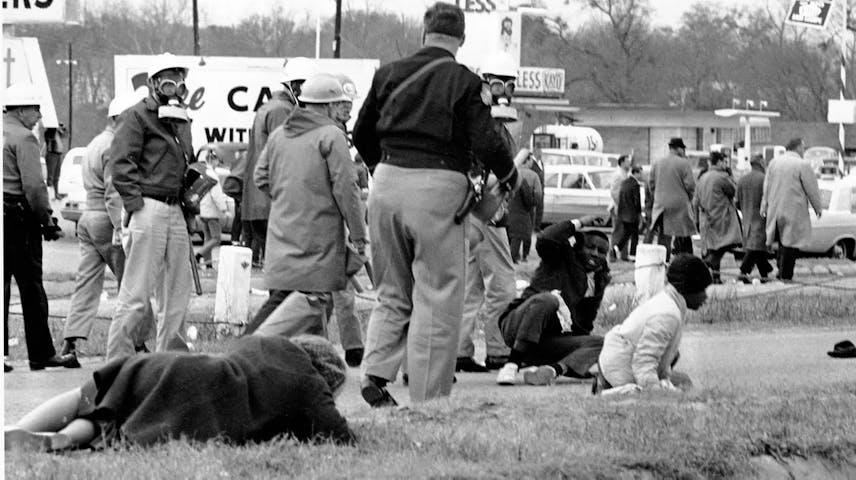
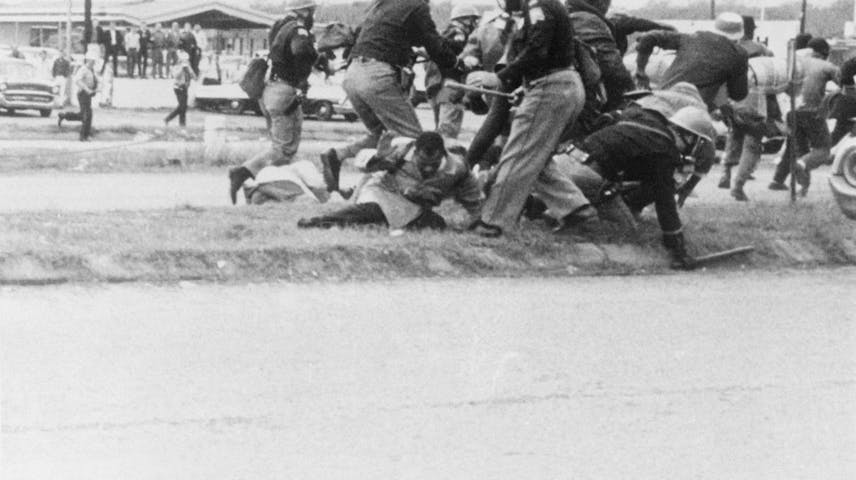
Provide students with the USA Today Bloody Sunday gallery and “Confrontations for Justice” text. Then transition students into small groups to engage with both sources to further develop their knowledge of Bloody Sunday.
Say these Directions: Work with your small group to analyze the photographs and captions in the Bloody Sunday gallery and reread the article “Confrontations for Justice”. As you discuss and write about what you notice, think about the vocabulary words demonstration, disperse, and escalation. Use these words to explain what happened and why the events unfolded the way they did. Record your group’s ideas on chart paper so you can share them during the gallery walk. As a group, discuss and write your responses to the following questions.
Ask: What new information do you learn about the events of Bloody Sunday from the photographs and captions in the Bloody Sunday gallery?
People had to come and help the demonstrators who had been injured. The state troopers used whips in addition to clubs. There were lots of people; the text names “several hundred.”
Ask: How does the information you learned from the Bloody Sunday gallery (photographs and captions) connect to the information you learned about Bloody Sunday in the article “Confrontations for Justice”?
The Bloody Sunday gallery shows John Lewis before his skull fracture. The photographs show lots of people, and the article says there are about 600 people marching that day. The photographs confirm the use of bullwhips, clubs, and tear gas as mentioned in the article.
Teacher Tip |
|---|
The purpose of this activity is for students to read informational texts that provide more details about the events of Bloody Sunday to add to their initial knowledge-building from March, pages 5–9. Consider how you will balance the demonstrators’ agency with the violence they endured. You could frame the viewing by reminding students that the marchers knew they faced danger but chose to march anyway because they believed voting rights were worth the risk. Note that photographers risked their safety to document what happened. |
Transition students into a Gallery Walk in which they will post their chart paper with their responses around the classroom for their peers to view. Students will move around the classroom in their small groups, reading and discussing their peers’ ideas. Invite students to consider both what the marchers endured and what they were trying to accomplish.
Say these Directions: Post your group’s chart paper around the classroom to begin a Gallery Walk. Move around the room with your group to read and discuss the ideas your classmates recorded. As you view each group’s responses, think about both what the marchers endured and what they were trying to accomplish during the events of Bloody Sunday. Read the ideas from your peers and discuss the following questions in your small groups. After your group has reviewed and discussed each question, we will come together for a whole-group discussion to share and compare ideas.
Ask: How do the photographs, captions, and the article further develop your understanding of Bloody Sunday?
Student answers may vary, but may include:
The high number of people involved in the march
The extreme violence the marchers went through, and how many people were injured as a result
How the march led to Lewis providing testimony at a federal hearing less than a week later
How the marchers were peaceful, as they were “walking silently” (“Confrontations for Justice”)
Ask: The marchers knew that law enforcement might use violence to stop them. Why do you think they chose to march anyway?
They might have chosen to march because they had organized the march for voting rights, and they were not going to let the threat of law enforcement stop them from getting the rights they deserved. Also, they knew they had a right to peacefully assemble and march, and they were not going to let law enforcement override their rights as American citizens.
Ask: How do these additional Bloody Sunday resources help readers understand the key events and central idea of Bloody Sunday that are depicted in March on pages 5-9?
The resources provide more information and context about Bloody Sunday. For example, in “Confrontations for Justice,” readers learn about Lewis’ personal testimony from that day, including moment-by-moment actions on the bridge. These resources show readers the central ideas of peaceful demonstration on behalf of the protesters and violent escalation by the Alabama state troopers.
Pulse Check(RI.8.3) |
|---|
Which statement best explains how the Bloody Sunday gallery and “Confrontations for Justice” work together to deepen your understanding of Bloody Sunday? A. The gallery gives opinions, while the article gives facts, so readers should trust only the article.
B. The gallery shows visual evidence of the violence and crowd, while the article explains the sequence of events and responses that led to that violence.
C. The gallery and the article give the same information in the same way.
D. The gallery focuses on a different historical event than the article does.
|
Say these Directions: Reflect on your ability to gather new background information to gain a better understanding of the text using the Reflection routine.
Reflection |
|---|
Reflect on your ability to gather and learn new background information to help you better understand a text like March.
|
Reflection: Think about the three texts we have analyzed to learn about the historical event Bloody Sunday. Write some notes to prepare for the next lesson’s writing work by responding to the following question in your Journal:
How does each text share similar and different information about Bloody Sunday?