Loading course navigation
Loading lesson
50 min
Student Lesson
Lesson 31: March: Book One, Fishbowl Discussion 1
Content
Students will draw connections between SNCC's Statement of Purpose and the Civil Rights Movement events depicted in March on pp. 74–102 through a fishbowl academic discussion.
Language
Students will synthesize connections between March and the “SNCC Statement of Purpose” in a fishbowl discussion using discussion stems, evidence-based responses, and clarifying/probing questions.
What is civic memory, and how does testimony help us remember and learn?
Knowledge-Building:
Students will draw connections between the “SNCC Statement of Purpose” and the actions of nonviolent protest in March.
Enduring Understanding:
People shape civic memory through storytelling.
Future Lessons:
In Lesson 32, students will begin engaging with the next section of March: Book One. In Lesson 33, students will consider the impact of the final events in March: Book One.
Unit Performance Task:
Students will discuss the philosophy and discipline of nonviolent protest when analyzing an episode or action from the Civil Rights Movement for their Civic Memory Brief.
| Lesson Flow | Purpose of Learning Experience |
|---|---|
Launch5 Minutes | Students will engage in a whole-group discussion about the connections they made for homework. |
Literacy Lab10 Minutes | Students will be introduced to the Fishbowl Conversation routine and what they will be expected to do during today’s academic discussion. |
Learning in Action30 Minutes | Part A: Preparing for Discussion (RI.8.2, RI.8.3, RI.8.6, SL.8.1.a, SL.8.2) Students will prepare for the Fishbowl Conversation by looking for connections between March and the “SNCC Statement of Purpose.” Part B: Fishbowl Conversation (RI.8.2, RI.8.3, RI.8.6, SL.8.1.a-d, SL.8.2) Students will engage in a Fishbowl Conversation to discuss connections between the “SNCC Statement of Purpose” and March. |
Not available for this lesson
Not available for this lesson
Material List
March: Book One, by John Lewis, Andrew Aydin, and Nate Powell
Unit 1 Lesson 31 Student Edition
Accountable Talk Sentence Stems Graphic Organizer
Reflect and Respond Graphic Organizer
Routines
Fishbowl Conversation
Quick Write
Say these Directions: Take out March: Book One and the “SNCC Statement of Purpose” along with the annotations completed for homework. Review the homework reflections, which focused on making connections between the “SNCC Statement of Purpose” and the sit-in events on pages 79–102 of March. Consider this question for a brief whole-group discussion:
Ask: How do Lewis and the other protestors fulfill or realize the “SNCC Statement of Purpose” during the sit-in events depicted on pp. 79–102 of March? Write two to three connections you make between the ‘SNCC Statement of Purpose’ and the sit-in events.
The “SNCC Statement of Purpose” emphasizes students taking responsibility for creating change through nonviolence, and Lewis’s group does that by organizing themselves, training for nonviolence, and carrying out sit-ins as a planned form of direct action (March, pp. 79–86, 96–97). The Statement of Purpose stresses human dignity and justice, and the sit-ins challenge segregation by calmly demanding equal service, then refusing to retaliate even when they are threatened or attacked, which keeps the focus on the injustice (March, pp. 92–96, 100–101). The “SNCC Statement of Purpose” also highlights appealing to “conscience” and “moral nature of human existence,” and March shows that through the trainings of the protestors to “disarm our attackers by connecting with their humanity” (p. 82).
Say: Today, you will use a fishbowl discussion to explain how the “SNCC Statement of Purpose” connects to the events in March. As you speak and listen, use evidence from both texts to identify central ideas, trace how key events develop those ideas, and explain how Lewis’s point of view connects to ideas in the “SNCC Statement of Purpose.”
Preparation for Fishbowl Conversation
Provide students with the Accountable Talk Sentence Stems and Reflect and Respond graphic organizers to help them formulate their thoughts before and during the discussion.
Say these Directions: During our discussion today, we’re going to follow the Fishbowl Conversation routine. This routine helps us build meaning together instead of just sharing separate opinions. Here’s how it works:
Two groups are assigned—either the inner circle or the outer circle.
If in the inner circle: Discuss the question prompts for 10 minutes.
If in the outer circle: Listen silently while the inner circle discusses.
Take notes on the ideas shared to add to personal thinking and prepare responses.
Switch roles after 10 minutes.
The new inner circle will begin discussing the prompts.
The new outer circle will take notes silently during the discussion.
Say these Directions: For the Fishbowl Conversation, use the Accountable Talk Sentence Stems to help express ideas clearly during the discussion, and the Reflect and Respond Graphic Organizer to organize thoughts before and during the discussion.
Say these Directions: Review the question prompts for the Fishbowl Conversation. Use the modeled response as an example of how to use discussion stems and evidence in the discussion. Prepare to discuss the prompts:
How do Lewis and the other civil rights protestors realize or fulfill the “SNCC Statement of Purpose” during the many events depicted on pp. 74-102 of March? Make sure to draw connections between the specific events (text and visuals) and the specific ideas captured in the “SNCC Statement of Purpose.”
How does Lewis's personal testimony and point of view on pp. 74–102 deepen or clarify the ideas expressed in the “SNCC Statement of Purpose”?
What central ideas are shared between the two texts, and how does March demonstrate those ideas through the text dialogue and graphics?
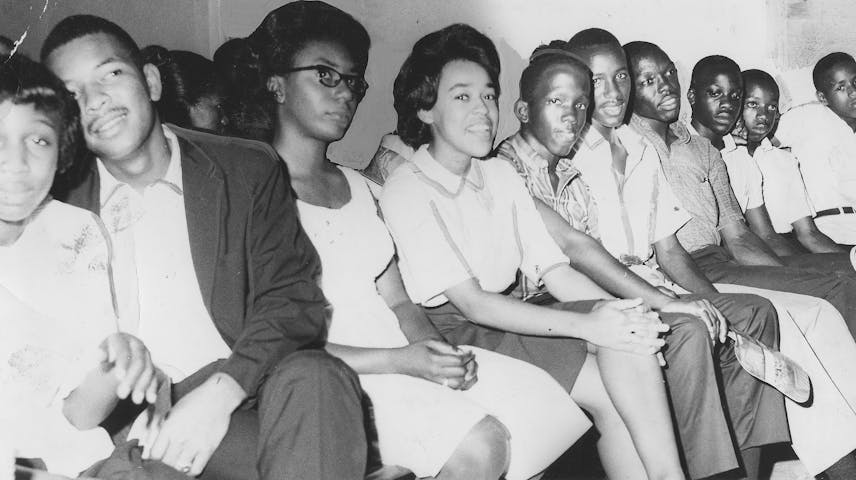
How does the inclusion of the photograph of SNCC members praying during a demonstration support the ideas expressed in the “Statement of Purpose,” and what does this suggest about SNCC’s social and political motives in presenting the movement this way?
Teacher Tip |
|---|
Invite students to stop you and ask questions as you model the procedure. Highlight and discuss when/why/how you use citing/reporting verbs and cause–effect language to support your points. Tell students that, during their discussion, they should focus on grounding their ideas and responses in textual and visual evidence from both texts. Students can use the Accountable Talk Sentence Stems for examples of discussion stems they can use during the Fishbowl Conversation. |
Say these Directions: Prepare for the fishbowl discussion by reviewing your homework connections and preparing textual evidence from both texts to support their ideas.
Display the following discussion prompts.
How do Lewis and the other civil rights protestors realize or fulfill the “SNCC Statement of Purpose” during the many events depicted on pp. 74-102 of March? Make sure to draw connections between the specific events (text and visuals) and the specific ideas captured in the “SNCC Statement of Purpose.”
I noticed that the Statement of Purpose calls on students to take direct responsibility for creating change, and March shows that through disciplined action: Lawson trains them to stay nonviolent, then they follow a plan during the sit-ins and keep returning even when the counters close (pp. 83–87, 96–97). I believe this is true because the students do not just talk about justice, they practice it, and Lewis explains that violence “begets violence,” so they choose a different way to fight (pp. 100–101) that aligns with the ideas in the SNCC document, like “love transforms hate.”
How does Lewis's personal testimony and point of view on pp. 74–102 deepen or clarify the ideas expressed in the “SNCC Statement of Purpose”?
I discovered that the Statement of Purpose speaks in big ideas about dignity and freedom, but Lewis’s testimony makes the cost and meaning of those ideas feel real. This reminds me of the sit-in scenes where the group is attacked and threatened, yet Lewis says he felt “free” and “liberated” because he connects freedom to choosing nonviolence even under pressure (pp. 98–102). The Statement’s goal of “justice” becomes personal when Lewis shows what that commitment feels like from the inside.
What central ideas are shared between the two texts, and how does March demonstrate those ideas through the text dialogue and graphics?
I think both texts share the idea that real change requires collective, disciplined action rooted in moral purpose and love. I noticed that March demonstrates this visually through repeated panels of students sitting calmly together, through the sharp contrast when a mob attacks, and the pages emphasize chaos against their self-control (pp. 94–96, 100–101). The Statement’s belief in organized student action rooted in nonviolence is shown by the protestors bravely sitting through violence (pp. 96–99) and showing “hope, courage, and peace.”
How does the inclusion of the photograph of SNCC members praying during a demonstration support the ideas expressed in the “Statement of Purpose,” and what does this suggest about SNCC’s social and political motives in presenting the movement this way?
The photograph of SNCC members praying during a demonstration supports the ideas in the “Statement of Purpose” by visually showing the group’s commitment to nonviolence, faith, and justice. In the statement, SNCC explains that nonviolence is rooted in “love,” “faith,” and reconciliation, and the image reinforces those values because the protesters are shown praying peacefully instead of responding with anger or violence. The photograph helps readers see how SNCC wanted its members to act during the Civil Rights Movement. The image also suggests that SNCC had both social and political motives in presenting the movement this way. Socially, the organization wanted to encourage equality and reduce prejudice by promoting peaceful action and unity. Politically, the photograph helps build support for the Civil Rights Movement by portraying SNCC members as disciplined, moral, and committed to justice. By combining the written statement with the visual image, SNCC strengthens its message that nonviolent protest was the best way to create social change.
Reflection (SL.8.1.a) |
|---|
Ask students to self-reflect on their ability to prepare for a group discussion using the Reflection routine.
|
Engage students in the Fishbowl Conversation routine. Divide students into the inner circle and outer circle groups. After 10 minutes, have the groups switch places so that all students have the chance to contribute to the discussion. Instruct the outer circle groups to use the Reflect and Respond graphic organizer to take notes during the discussion.
Say these Directions: Join your group and begin the Fishbowl Conversation. If you are in the outer group, use the Reflect and Respond graphic organizer to take notes during the discussion.
Checklist (SL.8.1.a-d) |
|---|
As you discuss and take notes, check if you:
|
Say these Directions: Complete a Quick Write by writing a one-to two-sentence response to the question provided.
Ask: What is one new connection between the “SNCC Statement of Purpose” and the ideas in March that you learned from this lesson's discussion?
I noticed that the Statement of Purpose emphasizes nonviolent direct action, and March shows what that looks like in practice when the Nashville students follow a plan, stay calm under hostility, and keep returning to the counters to expose injustice (pp. 90–97). This connection helps me see that nonviolence is not passive; it is organized and purposeful.
Have students read pp. 103–110 of March. Instruct students to take notes in their Journal on the following prompt:
As you read, annotate the text for the following:
What are all the ways in which Lewis and his fellow protestors/community members are trying to "change America" in this section of text?
March: Book One
John Lewis, Andrew Aydin, Nate Powell

SNCC Statement of Purpose
Student Nonviolent Coordinating Committee