Loading course navigation
Loading lesson
50 min
Student Lesson
Lesson 35: March: Book One, Fishbowl Discussion 2
Content
Students will draw connections between the Nashville Student Movement’s actions and philosophy and Lewis’s participation in Bloody Sunday as they analyze the structural choices Lewis makes in the graphic novel through an academic discussion.
Language
Students will synthesize structure, events, and ideas across March in discussion by using evidence-based discussion stems, synthesis language (overall, taken together), and clarifying and probing questions.
What is civic memory, and how does testimony help us remember and learn?
Knowledge-Building:
Students will synthesize their understanding of the civil rights events presented in the book, including the Nashville lunch counter sit-ins and Bloody Sunday.
Enduring Understanding:
People shape civic memory through storytelling.
Future Lessons:
In Lesson 36, students will read and analyze an op-ed through discussion. In Lesson 37, students will write a comparison of the op-ed to March.
Unit Performance Task:
Students will need to know how to discuss connections between structure, events, and ideas when writing about events or actions for their Civic Memory Briefs.
| Lesson Flow | Purpose of Learning Experience |
|---|---|
Launch5 Minutes | Students will engage in a whole-group discussion about how March has enhanced or added to their understanding of the Civil Rights Movement. |
Literacy Lab10 Minutes | Students will be introduced to the goals of today’s Fishbowl Conversation and the question prompts they will be discussing. |
Learning in Action30 Minutes | Part A: Preparing for Discussion (RI.8.1, RI.8.3, RI.8.5, RI.8.6) Students will prepare for the Fishbowl Conversation by looking for evidence in March. Part B: Fishbowl Conversation (RI.8.1, RI.8.3, RI.8.5, RI.8.6, SL.8.1.a, SL.8.1.b, SL.8.1.c) Students will engage in a Fishbowl Conversation to discuss the question prompts. |
Not available for this lesson
Not available for this lesson
Material List
March: Book One, by John Lewis, Andrew Aydin, and Nate Powell
Unit 1 Lesson 35 Student Edition
Accountable Talk Sentence Stems graphic organizer
Reflect and Respond graphic organizer
Routines
Fishbowl Conversations
Quick Writes
Have students take out March: Book One with their annotations.
Lesson 34 Homework: Students were instructed to review the entirety of March and write a three- or four-sentence response to the following question: What connections can you draw between Lewis’s early life, his participation in the Nashville Student Movement, and his eventual involvement in Bloody Sunday?
Say these Directions: Think about the question you answered for homework. This question supports your preparation for today’s academic discussion. Consider the following:
Ask: How does March enhance (add to) your understanding or knowledge of the Civil Rights Movement?
March helps me understand the Civil Rights Movement as a series of organized plans and decisions made by real people, not just a list of events. It shows how planning, discipline, and nonviolence shaped what happened, and it also shows the fear, pressure, and courage behind public protests for equality. (Student responses may vary.)
Say: Today, we’ll use what March helped us understand about the Civil Rights Movement to discuss why Lewis tells his story the way he does. As we engage in discussion, we’ll trace how the Nashville Student Movement’s philosophy connects to later events like Bloody Sunday, and we’ll analyze how Lewis’s structural choices shape the message and impact of the text.
Preparing for Fishbowl Conversation
Provide students with the Accountable Talk Sentence Stems and Reflect and Respond graphic organizers to help them formulate their thoughts during the discussion.
Say: Today, we’re going to follow the Fishbowl Conversations protocol once again. During your discussion, you should focus on asking questions and responding to others’ questions with relevant evidence, observations, and ideas to propel the discussion forward.
Remind students that they engaged in a Fishbowl Conversation in Lesson 31.
Share the directions and then model a response to at least one of the prompts using discussion stems, questions, and examples (see the sample responses below).
Say these Directions: Use the Accountable Talk Sentence Stems and the Reflect and Respond Graphic Organizer to record your ideas for the discussion. Review the following question prompts for the Fishbowl Conversation to participate and share your thoughts during the discussion:
What key events in Lewis’s life led him to Bloody Sunday?
How did the Nashville Student Movement’s philosophy, discipline, and actions prepare Lewis for Bloody Sunday?
Why might Lewis have chosen to start with the events of Bloody Sunday rather than another period of his life?
Authors make choices about whose story to tell, how to tell it, and why. How does Lewis choose to tell his story about famous historical events, and what is his purpose in doing so?
Teacher Tip |
|---|
Invite students to stop you and ask questions as you model the procedure. Highlight and discuss when/why/how you use citing/reporting verbs and cause–effect language to support your points. Students can use the Accountable Talk Sentence Stems as examples of discussion stems for the Fishbowl Conversation. Determine if students need a review of the Fishbowl Conversations protocol and structure from Lesson 31. Consider displaying the protocol and guidelines to help students follow the steps of the discussion protocol. |
Say these Directions: Prepare for the Fishbowl Conversation by reviewing your homework connections and annotations and preparing textual evidence from March to support your ideas.
Teacher Tip |
|---|
Remind students to review their Personal Dictionaries for a list of target vocabulary words they can use when engaging in discussion. |
Reflection (RI.8.3, RI.8.5, RI.8.6) |
|---|
Reflect on your ability to prepare to discuss text connections, analyze text structure, and determine the author’s purpose using the Reflection routine.
|
Engage students in the Fishbowl Conversations protocol. Divide students into the inner circle and outer circle groups. While the inner circle group is discussing, encourage the outer circle group to take notes that include feedback to the inner circle on their use of probing questions and text evidence. After 10 minutes, have the groups switch places so that all students have the chance to contribute to the discussion.
Say these Directions: Participate in Fishbowl Conversations.
Ask: What key events in Lewis’s life led him to Bloody Sunday?
I noticed that Lewis doesn’t treat Bloody Sunday as a sudden moment. Instead, he shows a chain of events that prepares him over time. For example, he thinks about trying to desegregate Troy State through a lawsuit and talks to Dr. Martin Luther King about it. In Nashville, he goes through nonviolence training with Lawson, participates in sit-ins, and faces arrests and pressure, including violent threats like the bombing at Looby’s home (pp. 111–116). These key experiences teach him what organized, courageous protest looks like. I wonder: Which event do you think prepared Lewis the most—his training, the arrests, or the community march to City Hall—and what evidence makes you say that?
Ask: How did the Nashville Student Movement’s philosophy, discipline, and actions prepare Lewis for Bloody Sunday?
I discovered that the Nashville Student Movement is built on the philosophy and discipline of nonviolence. Lawson’s keynote talks about people who can act in a “disciplined manner” to put constitutional rights into practice (p. 112), and that connects to how the students keep organizing even after violence and intimidation. This reminds me of later events like Bloody Sunday because disciplined nonviolence is what allows protesters to keep moving forward even when they expect danger. I wonder: How does the text show the protesters are disciplined—through what they say, what they do, or how they stay organized as a group?
Ask: Why might Lewis have chosen to start with the events of Bloody Sunday rather than another period of his life?
I think Lewis starts with Bloody Sunday because it immediately shows the stakes of the events of the Civil Rights Movement and makes readers ask, “How did he get here?” Then Lewis can rewind and build the background that explains how his past got him to the march on Bloody Sunday. I noticed that the ending of March: Book One also points forward to bigger national change, like the formation of SNCC (p. 112), which makes Bloody Sunday feel like part of a larger movement, not an isolated moment. I’m wondering: What effect does it have on you as a reader to start with a dramatic event and then go back to Lewis’s childhood? How does it engage you as a reader?
Ask: Authors make choices about whose story to tell, how to tell it, and why. How does Lewis choose to tell his story about famous historical events, and what is his purpose in doing so?
I noticed that Lewis mixes personal memory with public history, so we don’t just learn what happened factually; we learn how it felt personally. We also learn from a first-person point of view what motivated the Black community to keep pursuing integration. For instance, the book includes big turning points like the City Hall confrontation and Mayor West’s response about discrimination (pp. 118–119), but it also shows community reactions and the movement’s organizing decisions, like rejecting “partial integration” and pushing for real change (p. 111). I believe Lewis’s purpose is to show that trying to achieve equality is done through ordinary people’s actions, planning, and courage, not only famous speeches. I have a question: When Lewis includes dialogue and crowd scenes, is he trying to persuade the reader, build empathy, or prove a point about civic responsibility? What panels or captions best support your thinking?
Check for Understanding (SL.8.1.a, SL.8.1.b, SL.8.1.c) |
|---|
As you discuss and take notes, check if you:
|
Say these Directions: Follow the Quick Write routine by writing a two- or three-sentence response to the following question.
How are the events and the philosophy of the 1960s Nashville Student Movement connected to Lewis’s participation in Bloody Sunday?
The Nashville Student Movement taught Lewis disciplined nonviolence, strategic planning, and the courage to face violence when addressing injustice. (pp. 111–121). He was then able to apply this same nonviolent philosophy and courage when participating in events like Bloody Sunday. For example, the marchers during Bloody Sunday are calm and kneel to pray while facing attacks and violence from the troopers.
Introduce the homework to complete before the next lesson:
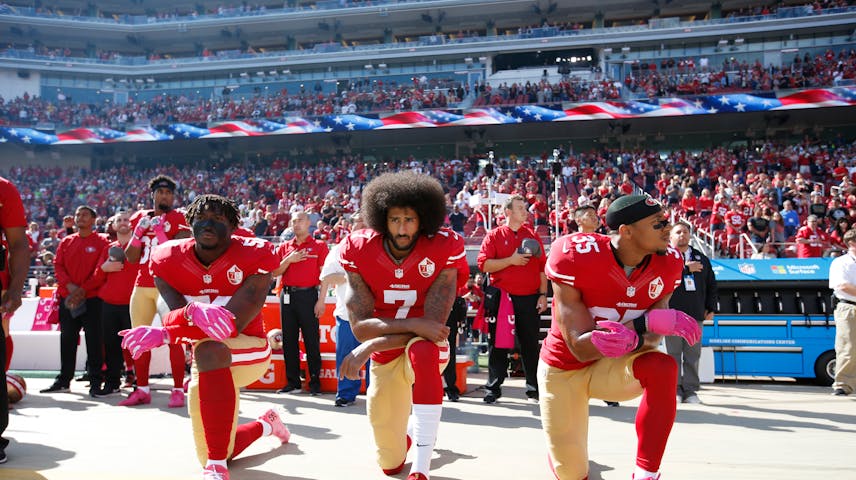
Provide students with a copy of the article “Eric Reid: Why Colin Kaepernick and I Decided to Take a Knee.” Instruct students to read the article and take notes in their Journal on the following prompt:
As you read the article “Eric Reid: Why Colin Kaepernick and I Decided to Take a Knee,” annotate the text for the following: What is Eric Reid protesting, and why?
March: Book One
John Lewis, Andrew Aydin, Nate Powell
Eric Reid: Why Colin Kaepernick and I Decided to Take a Knee
Eric Reid, New York Times