Loading course navigation
Loading lesson
50 min
Student Lesson
Lesson 40: Multimedia Civic Memory Brief, Planning and Prewriting
Content
Students will use graphic organizers to engage in the prewriting and planning stages of their performance tasks.
Language
Students will explain how historical memory motivates civic action by planning a multimedia brief using civic vocabulary, evidence integration phrases, and clear explanatory connections.
How does storytelling become a tool for civic change?
What is civic memory, and how does testimony help us remember and learn?
Knowledge-Building:
Students will begin to organize their ideas and research about a specific episode or event of the Civil Rights Movement for their performance task.
Enduring Understanding:
People shape civic memory through storytelling.
Future Lessons:
Lesson 41 will build upon students’ prewriting in this lesson as they begin drafting their performance task.
Unit Performance Task:
This lesson guides students through the first steps of planning and outlining their performance task.
| Lesson Flow | Purpose of Learning Experience |
|---|---|
Launch5 Minutes | Students will be reintroduced to the prompt for the performance task, along with its significance and criteria for success, and then discuss with a partner how their chosen topic fits the prompt. |
Literacy Lab10 Minutes | Students will review using ellipses to shorten quotations for their outline drafting. |
Learning in Action30 Minutes | Part A: Analyzing an Exemplar (W.8.5) Students will analyze an exemplar performance task and discuss how they know it meets the criteria of the prompt and the rubric. Part B: Planning and Outlining (W.8.5) Students will set a writing goal and begin outlining the written portion of their performance task. |
Not available for this lesson
Not available for this lesson
Material List
March: Book One, by John Lewis, Andrew Aydin, and Nate Powell
Student copies of texts from the unit text set
Unit 1 Lesson 40 Student Edition
Research Essay Outline graphic organizer
Student copies of the Unit 8.1 Performance Task Rubric
Routines
Turn and Talk
Think-Pair-Share
Reintroduce the performance task topic, clarify the criteria for success, and allow students to discuss and justify the topics they chose.
Reintroduce the Prompt:
Say: For this task, you will create a multimedia Civic Memory Brief. You will choose one specific action, event, or episode from the Civil Rights Movement and write a multi-paragraph explanation of how it shows people using memory and testimony to change systems. You will also include a cover page with two meaningful visuals related to your topic, accompanied by headlines and captions to explain them. This task will be based on your analysis of March and at least one other source from the unit or your research.
Explain the Significance of the Task:
Say: Learning to tell stories and leverage historical memory effectively is an important part of engaging with civic life and learning about the past.
Explain the Criteria for Success:
Say: The explanation must have at least four paragraphs and include an introduction with a thesis, accurate evidence from March and at least one other relevant text, a clear conclusion, and precise academic language. The cover must include two clear visuals related to your topic and purposeful headings and captions that help explain the visuals.
Allow Students to Discuss Their Topic Choices:
Say these Directions: Turn to your partner and discuss why you think the topic you selected during the research lessons is a strong example of how civil rights leaders and activists used memory and testimony to inspire action.
Teacher Tip |
|---|
Remind students that they chose initial topics for their performance tasks in the research lessons, Lessons 22 and 23. |
Transition:
Say: Today, we’ll look at an example of a complete Civic Memory Brief, and then you’ll begin the process of planning and prewriting your own.
Remind students that ellipses can be used to show an omission, or leaving something out, when writing a quotation. This can help them make sure they only include the most necessary or interesting parts of quotations in their writing.
Present a sample quotation that you might wish to include in a Civic Memory Brief.
Say these Directions: Read the sentence from March:
“I was on my way out the door to our 6:30 a.m. Nashville Student Movement central committee meeting when the phone rang” (March, p. 115).
Remind students of the context of this sentence—the phone call is how he hears that the Loobys’ house has been bombed—then discuss what parts of the quote they might want to omit and how they would mark it with an ellipsis.
Ask: What part of this quote might you want to omit so that you just have the most important information?
I would omit everything from “6:30 a.m.” to “committee.”
Ask: How could you indicate that using an ellipsis?
I would replace everything I want to omit with the ellipsis: “I was on my way out the door to our ... meeting when the phone rang.”
Tell students that during today’s planning and prewriting, they can use ellipses to help them shorten quotations they can use in their briefs.
Transition:
Say: You can use ellipses to help you shorten quotations when you are drafting your outline today.
Display and Read Through a Performance Task Exemplar: Display both parts of an exemplar Civic Memory Brief. Allow students some time to look over the cover images and multi-paragraph brief.
Say these Directions: Follow along as we look over and read the performance task exemplar.
Headline:
Headline: 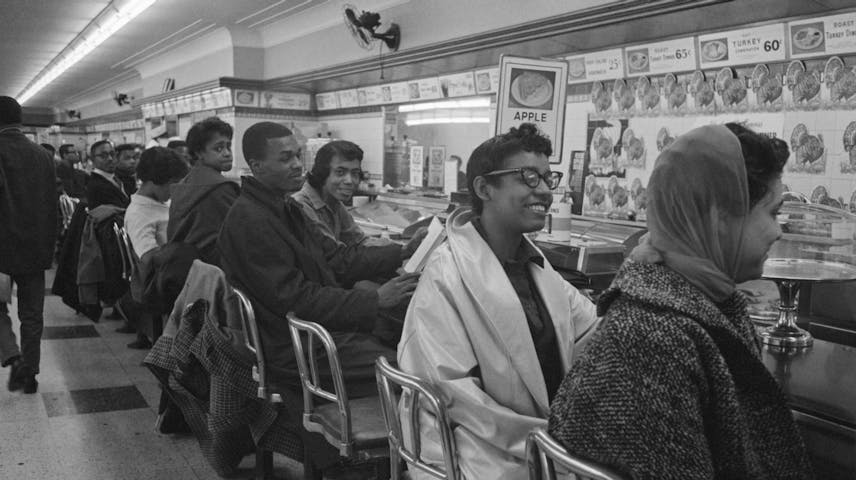 Activists hold a sit-in against segregation at a Nashville lunch counter, 1960. | Headline:  Activists hold a demonstration outside a Woolworth’s to protest segregation. |
|---|
Fighting for social change takes courage, hard work, and discipline. But other factors can make a big difference too. Memory and testimony are powerful tools to help inspire people to work for change. One event from the Civil Rights Movement that shows this idea was the 1960s sit-ins and march on the city hall in Nashville. Activists like John Lewis and Jim Lawson used memory and testimony to change the city and influence desegregation in the South.
Before this event, public lunch counters in Nashville were segregated. Black customers could order food to go, but they were not allowed to eat at the counter. John Lewis remembered this as “humiliating” (March, p. 83). Lewis began working with a group of student activists who met at a local Baptist church. They taught him the philosophy and tactics of nonviolence. This meant learning how not to fight back while being taunted and attacked. Some found this impossible. But John Lewis and others embraced it as the best way to fight for change (March, pp. 77–82). Testimony showed them that nonviolence had worked in the past, like with Gandhi, who used nonviolence “to free an entire nation of people” (March, p. 77). Eventually, the movement grew so big that they had to hand out simplified lists of rules instead of training everyone (March, p. 97). Protesters who participated in sit-ins at restaurants were attacked by locals and arrested by police. But they didn’t give up (March, pp. 98–109).
The violence reached a new height when someone threw dynamite at the home of Z. Alexander Looby. He was a well-known NAACP lawyer involved with the movement. Luckily, Looby’s family narrowly avoided injury (The Tennessean, 4/18/2020). Outraged, thousands of activists marched to Nashville City Hall to give testimony directly to the mayor (The Tennessean, 4/18/2020). They accused him of failing to stop the violence (March, pp. 116–119). The mayor realized he did not want to be remembered as someone who failed to stand up for what was right. For the first time, he formally announced his support of integration, putting pressure on businesses to change (March, pp. 116–119). Afterward, activists began negotiations with local businesses. A month later, six of the businesses changed their policies, and many others soon followed. Nashville became the first major Southern city to integrate its public spaces (Black Past, “Nashville Sit-Ins (1960)”).
The actions of the activists in Nashville showed courage, discipline, and commitment to what they believed was right. They also showed the incredible power of memory and testimony to inspire change. The testimony that activists gave the mayor about the terrible violence committed against them spoke to his own sense of how he wanted to be remembered. While he insisted that he could not force businesses to integrate, he finally agreed to use his power as mayor to influence them to do so. Activists today can remember and learn from this event because it shows how intense and repeated public pressure can create change that previously seemed impossible.
Discuss How the Exemplar Addresses the Prompt: Ask students to share their thoughts on how this exemplar addresses the prompt.
Say these Directions: Share your thoughts on how this exemplar addresses the prompt.
It has a multi-paragraph written explanation with an introduction/thesis and evidence from March and other texts. The cover page has two photos with headlines saying what they show and captions further explaining them.
Share the Rubric: Display the Unit 8.1 Performance Task Rubric for this task.
Say these Directions: Review the Performance Task Rubric.
Discuss How the Exemplar Addresses the Rubric: Ask students to identify a trait from the “Proficient” row of the rubric and explain how they know the exemplar addresses that trait.
Say: Now let’s focus on the “Proficient” row of the rubric. Pick a trait from this row, and explain how you know this exemplar fits it.
I picked the trait “develops the topic by citing specific evidence from March and at least one other text to support the thesis statement.” I know this task meets the rubric criteria because it has relevant quotes in the second paragraph that support the thesis statement, along with paraphrases in the third paragraph from The Tennessean and Black Past, which show how activists used memory and testimony to encourage action.
Transition:
Say: Thinking about this exemplar and the ways it addresses the prompt and rubric will help you when you are planning your own Civic Memory Briefs. You can use the prompt and rubric as checklists to make sure your briefs include all the necessary components.
Check for Understanding |
|---|
Look/listen for students who:
|
Introduce the Outlining Process and Set Goals:
Say these Directions: Begin prewriting and planning your Civic Memory Briefs. Use the Research Essay Outline graphic organizer to outline your brief and keep track of the information in each part of your multi‑analysis paragraph. Copy over information you already recorded from your additional source(s) if it fits into your outline. Remember that your first paragraph will introduce your topic and include your thesis statement. A thesis statement is a 1–2 sentence claim that clearly explains your topic and the information you will share in your essay.
Fill in notes in the first part of the organizer as a model for students.
Introduction |
|---|
Importance of memory and testimony Important figures, such as John Lewis and Jim Lawson Thesis that includes the chosen event: Nashville sit-ins and march on Nashville City Hall |
Remind students that the body paragraphs should each have information about their chosen event and should connect back to their thesis. Tell them that for now, their information can be short phrases and does not need to be complete ideas yet. Tell them that if they know the page numbers now, they should include them along with their textual evidence.
Explain that, in addition to filling in the outline with basic information about each paragraph, students should also set and try to achieve one writing goal. Model choosing a goal and explain how you would achieve it.
Say: For example, my goal might be to figure out how I’m going to explain the cause-and-effect relationship between the way activists used memory and testimony and the results they achieved. So I think I would add a description of the testimony to body paragraph 2, such as “Activists marched to Nashville City Hall and confronted the mayor with testimony about the bombing attack,” and then a description of the effect, such as “The mayor called on businesses to desegregate but would not force them to.” And I might draw an arrow from one to the other to show the cause and effect.
Reminder About Citing Evidence: Remind students that everything they say in the brief must be supported by evidence and that they need to avoid plagiarism when using evidence from sources. Model citing evidence in a way that avoids plagiarism.
Say: For example, let’s say I wanted to cite this quote from The Tennessean about the bombing against activists in Nashville: “Asleep inside his house, Looby—a nationally known NAACP civil rights attorney—and his wife, Grafta, barely escaped unharmed.” I could either paraphrase it, saying something like “Looby was a well-known civil rights lawyer who was asleep at the time of the bombing. He and his wife, Grafta, just barely avoided being injured in the attack.” Or I could use a direct quote and say where it came from, such as “According to The Tennessean, Looby and his wife, Grafta, ‘barely escaped unharmed.’”
Students Begin Planning and Prewriting: Allow students to begin the process of planning and prewriting their Civic Memory Briefs through outlining. Circulate as students work, answering questions and offering help as needed.
Say: Now you’re ready to get started prewriting and planning with your outline organizers. Remember, you just need to focus on the most important ideas in each paragraph and what evidence you’ll use to support them.
Introduction |
|---|
Importance of memory and testimony Important figures, such as John Lewis and Jim Lawson Thesis that includes the chosen event: Nashville sit-ins and march on Nashville City Hall |
Body Paragraph 1 |
Background of segregation in Nashville businesses (March, p. 83) Nonviolence philosophy (March, pp. 77–82) Growth of the movement and sit-ins (March, p. 97) Increasing violence against protesters (March, pp. 89–109) |
Body Paragraph 2 |
Bombing at Looby’s house (Tennessean) Protesters march to city hall as a result of ongoing violence (Tennessean; March, pp. 116–119) Testimony of people about the violence relayed to the mayor (March, pp. 116–119) Mayor wanted to be remembered for doing the right thing; put pressure on businesses (March, pp. 116–119) Negotiations led to eventual integration (Black Past, “Nashville Sit-Ins (1960)”) |
Conclusion |
Repeat some parts of intro in different words to support thesis statement Emphasize thesis about sit-ins and march and how this connects to memory and testimony |
Check for Understanding (W.8.5) |
|---|
As you outline your briefs, check if you:
|
Reflection (W.8.5) |
|---|
Reflect on your ability to draft an outline using the Reflection routine.
|
Say these Directions: Reflect on which parts of the prewriting process were easiest and most difficult for you and why, then discuss it with a partner. Be prepared to share your thoughts with the class.
For me, the easiest part was the introduction because I know my event and I think I know what I want to say about it. The hardest part is being sure I have enough evidence in each body paragraph to support my thesis.
Introduce the homework to complete before the next lesson: Reflect on your progress so far in your Journals, noting whether you feel you met your writing goal for the day.
Tell students that they need to complete their outlines for the next lesson. Explain that in the next class, they will think about what more information they will need to support their topics and begin drafting.
March: Book One
John Lewis, Andrew Aydin, Nate Powell