Loading course navigation
Loading lesson
50 min
Student Lesson
Lesson 36: Analyzing an Op-Ed
Content
Students will read Eric Reid’s op-ed and analyze his purpose in writing through collaborative discussion.
Language
Students will explain how point of view shapes an argument by using perspective markers, evaluative language, and comparison frames supported by evidence.
Foundational Skills
Students will practice reading accurately during a fluency activity.
What is civic memory, and how does testimony help us remember and learn?
Knowledge-Building:
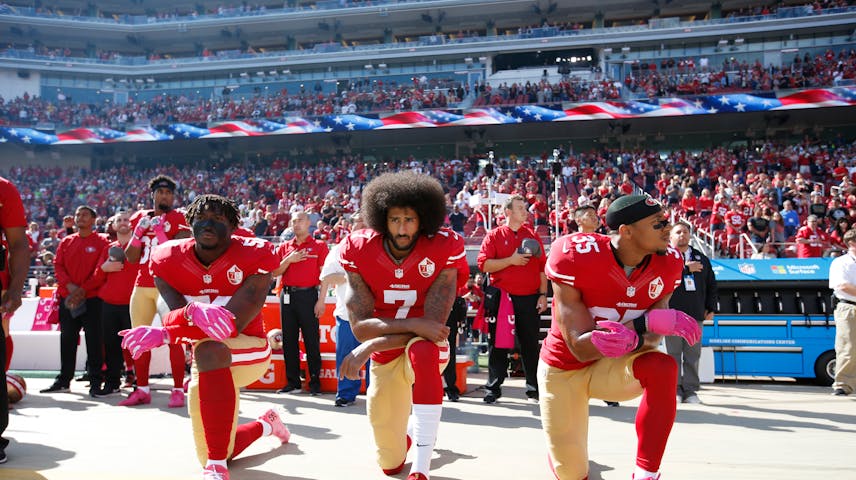
Students will learn about how nonviolence philosophy and discipline still shape civil rights reform as they read about recent protests in the National Football League.
Enduring Understanding:
People shape civic memory through storytelling.
Future Lessons:
In Lesson 37, students will write a comparison of the op-ed’s point of view to Lewis’s point of view in March. In Lesson 40, students will begin working on the Showcase Performance Task.
Unit Performance Task:
Students will need to consider an author’s purpose when writing about sources for their Civic Memory Briefs.
| Lesson Flow | Purpose of Learning Experience |
|---|---|
Launch5 Minutes | Students will engage in the Think-Pair-Share routine to share ideas with partners about a question relevant to today’s lesson. |
Literacy Lab10 Minutes | Students will practice reading for accuracy using “Eric Reid: Why Colin Kaepernick and I Decided to Take a Knee.” |
Learning in Action30 Minutes | Part A: Analyzing the Introduction of an Op-Ed (RI.8.3, RI.8.6) Students will reread paragraphs 1–5 of the op-ed and discuss text-specific questions with partners. Part B: Analyzing the Body and Conclusion of an Op-Ed (RI.8.3, RI.8.6) Students will reread paragraphs 6–14 of the op-ed and discuss text-specific questions with partners. |
Not available for this lesson
Material List
March: Book One, by John Lewis, Andrew Aydin, and Nate Powell
Unit 1 Lesson 36 Student Edition
Routines
Fluency Practice
Give One, Get One
Think-Pair-Share
Have students take out March: Book One and “Eric Reid: Why Colin Kaepernick and I Decided to Take a Knee” with their annotations.
Lesson 35 Homework: Students were instructed to read “Eric Reid: Why Colin Kaepernick and I Decided to Take a Knee” and annotate the text for the following question: What is Eric Reid protesting, and why?
Say these Directions: Engage in the Think-Pair-Share routine, considering the following question:
Ask: What present-day issues are the civil rights issues of our time?
Some civil rights issues today include police brutality and racial profiling, unequal treatment in schools and jobs, and unfair systems that limit people’s rights or safety. People also point to issues like voting access, immigration rights, and discrimination based on identity as civil rights concerns because they affect whether groups are treated equally under the law and in everyday life.
Transition students into partnerships. After providing think time, instruct students to share a few responses with a partner, and then lead a brief whole-class share-out.
Say: Today, we will read Eric Reid’s op-ed and analyze how he explains the causes and effects behind his protest and what message he wants the public to understand. As we discuss his purpose and point of view, we will also connect his ideas to how people use protest to respond to civil rights issues today.
Tell students that they will be practicing fluency by rereading part of the “Eric Reid: Why Colin Kaepernick and I Decided to Take a Knee” article while focusing on accuracy.
Model Fluent Reading: Model reading the first paragraph aloud with accuracy.
Ask: While reading, what did I do to make sure I pronounced the words accurately?
Class Echo-Read: Read the second and third paragraphs aloud. This time, have students read aloud with you.
Ask: Did you read the paragraphs accurately? Why or why not?
Partner-Read: Place students in pairs. Have the first partner read the fourth paragraph aloud while the second partner listens. Then prompt them to switch roles, having the second partner read the same section aloud while the first partner listens. Remind them to focus on reading with accuracy.
Ask: Did you have trouble reading any of the words accurately? If so, which words?
Ask: How can we improve?
Teacher Tip |
|---|
As students partner-read their portion of text, listen to one line per student, checking for accuracy. |
Transition students into partnerships to reread and analyze the “Eric Reid: Why Colin Kaepernick and I Decided to Take a Knee” op-ed article through the Think-Pair-Share routine. Instruct students to reread paragraphs 1–5 and discuss the following text-specific questions with a partner before leading a brief share-out.
Say these Directions: Reread paragraphs 1–5 and discuss the following text-specific questions with your partner:
What are Eric Reid and Colin Kaepernick protesting and why?
How is Eric Reid's move to “take action” similar to John Lewis's motivation for taking action in March?
How is Reid's “respectful gesture” related to a central idea in March?
Lead a brief shareout:
Ask: What are Eric Reid and Colin Kaepernick protesting, and why?
Reid explains that he and Kaepernick are protesting police brutality and racism, especially violence against Black people. For example, he talks about an unarmed Black man named Alton Sterling from his hometown, who was killed. He argues they took a knee to draw attention to injustice and “seek equality for all Americans, no matter their race or gender.”
Ask: How is Eric Reid’s move to “take action” similar to John Lewis’s motivation for taking action in March?
Both Reid and Lewis describe seeing injustice and deciding that staying silent is not acceptable. Each chooses a nonviolent form of protest to challenge unfair systems and to push their communities and leaders to act. Additionally, Reid talks about his “faith” moving him, which is similar to Lewis’s motivation in March when he talks about the “social gospel” and how it spoke “directly” to him.
Ask: How is Reid’s “respectful gesture” related to a central idea in March?
Reid emphasizes that kneeling is respectful but still a form of protest, which connects to March’s central idea that disciplined, nonviolent action can communicate a powerful message. In both texts, the method matters because it shows self-control, purpose, and moral seriousness and is not meant to be “disrespectful.”
Instruct students to reread paragraphs 6–11 and discuss the following text-specific questions with partners before leading a brief share-out.
Say these Directions: Reread paragraphs 6–11 and discuss the following text-specific questions with your partner:
What opposition do Reid and Kaepernick experience with their protest? What reasons does Reid give for the opposition's “backlash”?
How does Reid address the opposing viewpoints?
Lead a brief shareout:
Ask: What opposition do Reid and Kaepernick experience with their protest? What reasons does Reid give for the opposition’s “backlash”?
Reid describes backlash such as criticism, smears, and people misrepresenting the protest as “disrespectful” to the flag or military. Additionally, he talks about the backlash Kaepernick has taken through his “unemployment” as not related to his football “performance.” He suggests the backlash happens because some people feel threatened by the message, misunderstand the purpose, or do not want to face the reality of systemic racism and police violence. He cites evidence of people making excuses for the violence against Black folks and saying that “racism ended years ago.”
Ask: How does Reid address the opposing viewpoints?
Reid directly clarifies what the protest means and explains why they chose kneeling, as he says that it is a “respectful gesture.” He counters misinterpretations by separating respect for the country from agreement with injustice, and he argues that speaking up against unfairness is part of civic responsibility. For example, he quotes James Baldwin and says that he has “the right to criticize” America because he loves his country. He also says that the military women and men who have died for our country did so to ensure a “fair and free society,” so his protest is an integral part of America’s civil rights.
Provide students with a confidence continuum (i.e., 1–5). As needed, model how to demonstrate a level of confidence using the continuum.
Reflection (RI.8.6) |
|---|
Reflect on your ability to analyze the author’s purpose using the Reflection routine.
|
Instruct students to reread paragraphs 12–14 and discuss the following text-specific questions with a partner before leading a brief share-out.
Say these Directions: Reread paragraphs 12–14 and discuss the following text-specific questions with your partner:
What is Reid's call to action in this conclusion of the text? In other words, what actions does he want people to take?
What ideas or philosophies does Reid share with Lewis? How are they similar in their beliefs?
Lead a brief shareout:
Ask: What is Reid’s call to action in this conclusion of the text? In other words, what actions does he want people to take?
Reid calls on people to stop being “silent bystanders,” to show solidarity, and to take concrete action against injustice. He pushes readers of all “races” to support efforts that address racism and police brutality and to speak out rather than accept the status quo or do “nothing.”
Ask: What ideas or philosophies does Reid share with Lewis? How are they similar in their beliefs?
Both Reid and Lewis argue that protest is a moral response to injustice and that people have a responsibility to act and not just “[watch] injustices yet [do] nothing.” They share the belief that nonviolent protest can get the public to pay attention and can create pressure for change, even if it is “not the popular or easy choice.”
Pulse Check (RI.8.6) |
|---|
Select the answer that makes the most sense. Which statement best explains how Eric Reid’s point of view shapes the way he presents the protest in the op-ed?
|
Lead a whole-group discussion.
Say these Directions: Consider the following question:
What is Reid’s overall purpose in writing this opinion piece?
There are several reasons why Reid wrote this opinion piece: He wants to clarify the reasons for his and Kaepernick’s kneeling protest, he wants to address the opposition to the kneeling protest and clear up misunderstandings about their reasons, and he wants folks to join him and Kaepernick in their protest.
Remind students that the point of view is a speaker’s or writer’s position on a topic. There can be multiple points of view in a text.
Introduce the homework to complete before the next lesson:
Tell students to think about the points of view that John Lewis takes throughout March. Then have students write some notes in response to the following questions in their Journal:
How do Lewis’s points of view in March compare to Reid’s points of view in the article? How are they similar, and how are they different?
March: Book One
John Lewis, Andrew Aydin, Nate Powell

Eric Reid: Why Colin Kaepernick and I Decided to Take a Knee
Eric Reid, New York Times