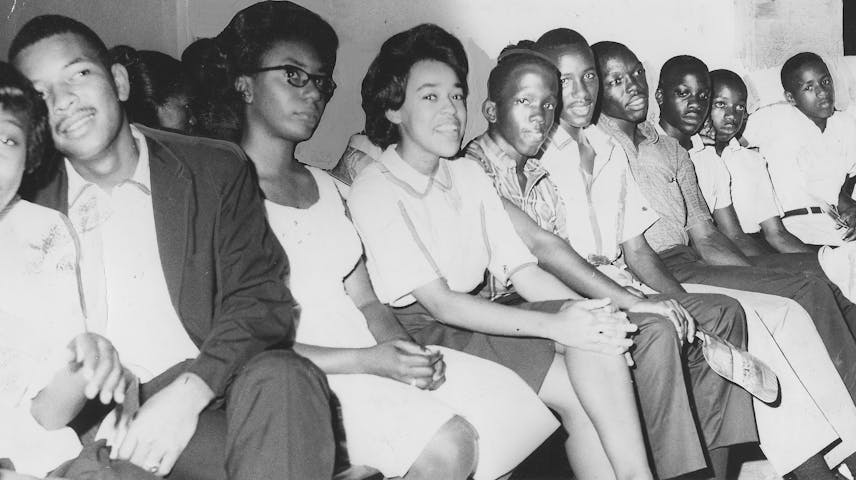
Members of the Student Nonviolent Coordinating Committee (SNCC), 1964. Photo by Afro American Newspapers/Gado/Getty Images
By
Student Nonviolent Coordinating Committee
Text Type
Primary Source
Words
209
Lexile
830L
Published
04/17/1960
Student Nonviolent Coordinating Committee
STATEMENT OF PURPOSE
1960
Constitution of the Student Nonviolent Coordinating Committee Originally adopted spring 1960, Raleigh, North Carolina
As revised 29 April 1962
We affirm the philosophical or religious ideal of nonviolence as the foundation of our purpose, the presupposition of our faith, and the manner of our action. Nonviolence as it grows from the Judaeo-Christian tradition seeks a social order of justice permeated by love. Integration of human endeavor represents the crucial first step towards such a society.
Through nonviolence, courage displaces fear; love transforms hate. Acceptance dissipates prejudice; hopes ends despair. Peace dominates war; faith reconciles doubt. Mutual regard cancels enmity. Justice for all overcomes injustice. The redemptive community supersedes systems of gross social immorality.
Love is the central motif of nonviolence. Love is the force by which God binds man to himself and man to man. Such love goes to the extreme; it remains loving and forgiving even in the midst of hostility. It matches the capacity of evil to inflict suffering with an even more enduring capacity to absorb evil, all the while persisting in love.
By appealing to conscience and standing on the moral nature of human existence, nonviolence nurtures the atmosphere in which reconciliation and justice become actual possibilities.
Turn and Talk
Have students take out March: Book One with their annotations.
Lesson 17 Homework: Students were instructed to read pp. 63–73, annotating for key events, connections, and a central idea.
Say these Directions: Turn and talk with a partner about the following question to prepare for today’s lesson.
Ask: “What patterns of injustice and early activism have we already seen in March?”
March shows a pattern of segregation enforced through everyday systems and a pattern of early activism growing in response. Lewis notices unequal treatment in public spaces and schools. For example, he is contrasting Black and white buses and schools as he says, “We passed their schoolhouse as well, with nice playground equipment outside.” (pp. 47–48). We also see how Southern racism and injustice escalate into danger and death for Emmett Till, with no accountability for his murderers (p. 57). We have seen early activism in the resistance and collective action of Rosa Parks’s arrest, leading into the Montgomery bus boycott (pp. 58–59). The text also shows activism spreading through community leadership and the “social gospel” (p. 57) as Lewis listens to Dr. King’s message and begins moving from observing events to starting to preach himself (pp. 56, 60–61).
Connection to Today’s Learning:
Say: We will continue to trace these patterns of injustice and early activism as we read more of March. Today, we will first focus our attention on pp. 63–73, rereading the section before discussing and summarizing it in pairs. Then we will examine how visual choices in the prior text excerpts of March communicate ideas about injustice and early activism.
Fluency Practice
Have students get out their copies of “SNCC Statement of Purpose.” Tell them that they will be practicing fluency by reading part of the document while focusing on accuracy.
Model Fluent Reading: Model reading aloud the first paragraph with accuracy.
Ask: While reading, what did I do to make sure I pronounced the words accurately?
Class Echo-Read: Read the second paragraph aloud. This time, have students read aloud with you.
Ask: Did you read the paragraph accurately? Why or why not?
Partner-Read: Place students in pairs to read aloud and practice fluency.
Read these Directions: Read “SNCC Statement of Purpose” aloud with a partner. Have the first partner read aloud the third and fourth paragraphs while the second partner listens. Then switch roles, having the second partner read aloud the same paragraphs while the first partner listens. Focus on reading with accuracy.
Ask:
Did you have trouble reading any of the words accurately? If so, which words?
How can we improve?
🎯PURPOSE
Support students in using oral language to monitor accuracy, notice when a word does not sound right, and explain how they self-correct while reading aloud.
Language Focus:
pronunciation of multisyllabic words
self-monitoring language
partner feedback language for fluency practice
🗣️SAY / ASK
Model one brief self-correction aloud by intentionally stopping after a difficult word and showing how to reread the full sentence so it sounds smooth and makes sense.
Prompt students to name the strategy they used when they fixed a word, such as slowing down, chunking the word into parts, or rereading the sentence.
You said “I got stuck on that long word” — we can explain that by saying “I broke the word into parts and reread it to improve my accuracy.”
“That idea connects to self-correction because the reader noticed the word did not sound right and fixed it.”
I slowed down when I got to the word ___.
I corrected the word ___ by breaking it into ___.
One strength in your reading was ___, and one word to practice again is ___
👁️WATCH FOR / SUPPORT IF NEEDED
If students rush through the sentence and do not notice miscues → Prompt: “Go back to the beginning of the sentence and read it again more slowly. Which word did not sound right?”
If students identify a misread word but cannot explain how to fix it → Prompt: “Try reading the word in parts. What do you notice at the beginning, middle, and end?”
Allow students to quietly rehearse a difficult word with a partner before reading the full sentence aloud, including using a shared home language to talk through what the word might mean or sound like.
Student rereads after a miscue and corrects the word so the sentence sounds smooth and makes sense.
Student gives a partner specific feedback that names one reading strength and one word or phrase to revisit for accuracy.
Situation
Try this
Struggling with: Reading for accuracy
Briefly re-model how to slow down and self-correct by (1) tracking print with a finger, (2) breaking longer words into syllables/word parts, and (3) rereading the full sentence after correcting a word so it sounds smooth and makes sense.
Ready for extension: Reading for accuracy
Invite them to identify two to three words they mispronounced or hesitated on, practice those words in isolation, and then reread the full paragraph a second time to improve accuracy and reduce errors.
Connection to Today’s Learning:
Say: This fluency practice prepares students to reread March carefully so they can focus on how events unfold and how the text builds ideas about injustice and activism.
Part A: Close Reading: Meeting Dr. King (RI.8.2, RI.8.3) (15 minutes)
Transition students into partnerships. Have partners reread pp. 63–73 of March before engaging in the Think-Pair-Write-Share routine.
Think-Pair-Write-Share
Say these Directions: Reread pages 63–73 of March and then use the think-pair-write-share routine to answer these questions with your partner.
Ask: Why does John Lewis apply to Troy State University?
Lewis applies because he wants to challenge segregation in higher education close to home so that he can do “more” (p. 65). He knows Troy State does not allow Black students, so applying is a first step toward pushing the segregated system to change. (pp. 65–66).
Ask: Who does Lewis reach out to for help or guidance, and why do those people matter in this moment?
Lewis reaches out to Dr. King by writing a letter, and he also connects with leaders and allies like Ralph Abernathy, attorney Fred Gray, and others involved in civil rights work (pp. 66–67). They matter because they understand both the legal strategy and the personal risks of challenging segregation, as Fred Gray “represented Rosa Parks” (p. 66). They helped Lewis see what action would actually require by questioning him to find out if he knew what he “would really face” (pp. 70–71).
Ask: What role do Lewis’s parents play in this section, and how does their response connect to the challenges Lewis is facing?
Lewis’s parents become a key barrier and a reality check for him when making this decision. The civil rights leaders explain that a lawsuit would require his parents’ permission and could put their “jobs,” “home,” and safety at risk (p. 71), and Lewis’s parents ultimately refuse because they are afraid of what could happen to them and their community (p. 72). His parents' refusal shows how dangerous fighting segregation could be as they “were afraid not only for themselves but also for their “‘friends and neighbors’” (p. 72).
Ask: How does this section show a shift from Lewis wanting change to Lewis taking action toward that change?
Lewis moves from thinking about justice to taking concrete steps: applying to Troy State, writing letters to civil rights leaders, waiting for responses, traveling to Montgomery, and directly telling Dr. King he wants to desegregate Troy State (pp. 64–71). The section shows how Lewis wants to stop thinking and reading about justice and take action because he starts “to feel guilty for not doing more” (p. 65)
Ask: How does the author use a sequence of smaller events (writing, waiting, traveling, meeting) to build tension across the section?
The text presents small events like writing a letter, months passing with no answer, traveling in silence with his father, waiting in hallways, and finally engaging in talks with Dr. King and other civil rights leaders (pp. 66–71) to show that this kind of activism work takes time, risk, and organization. Challenging the political system of segregation had to be a serious decision because of the possible consequences of lost “jobs,” “burned” homes, and possible violence (pp. 71–72).
Once students have finished discussing the questions, provide them with the 3-Column Chart graphic organizer.
Say these Directions: With your partner, use the graphic organizer to write a 3–2–1 Summary of pp. 63–73, providing:
3 key events
2 connections
1 central idea
3 Key Events
2 Connections
1 Central Idea
1. Lewis learns about opportunities through his mother’s work and applies to schools, including Troy State (pp. 64–66).
2. Lewis writes to Dr. King and is eventually brought to meet him through organizers and attorney Fred Gray (pp. 66–70).
3. Lewis is told that desegregating Troy State would require a lawsuit and could endanger his family; his parents refuse to support it (pp. 71–72).
1. Lewis’s decision to write and persist (letters, waiting) leads to his meeting with Dr. King and other civil rights leaders (pp. 66–71).
2. The push for integration connects to real-world consequences because that kind of legal action is tied to family safety and community fear (pp. 71–72).
Lewis’s commitment to justice grows into action, but this section shows that acting for justice requires patience, guidance, and facing serious risks, especially for his family (pp. 66–72).
🎯PURPOSE
Support students in explaining how a sequence of small actions builds civic meaning (patience, risk, guidance) using temporal sequencing + multimodal references.
🗣️SAY / ASK
Partners identify:
one action step (writing/waiting/traveling/meeting), and
what it leads to (consequence/stakes).
First, ___; next, ___; then ___.
The narration or dialogue explains ___; as a result, ___.
This sequence highlights ___ (risk/patience/pressure).
This suggests ___ about early activism.
👁️WATCH FOR / SUPPORT IF NEEDED
If students answer “what happened” only → Prompt: How does the order/pacing change the meaning?
If students cite without explaining → Prompt: What does that detail highlight?
Pulse Check (RI.8.2)
How does John Lewis’s choice to apply to Troy State University support the central idea?
A. It shows that he wanted a better education no matter what.
Incorrect: While he wanted a better education, this choice alone doesn’t explain the danger or fear he faced.
B. It proves that it was easy for Black students to attend college in Alabama.
Incorrect: The excerpt shows that attending college was not easy for Black students, so this is false.
C. It shows he was willing to fight against segregation.
Correct: His choice to apply, even knowing the risks, demonstrates his willingness to challenge segregation, which supports the central idea.
D. It shows that he ignored all advice from adults around him.
Incorrect: He didn’t ignore advice; in fact, his family’s fear influenced what he could do, which is part of the risk.
Part B: Examining Injustice and Early Activism (RI.8.5, W.8.4, W.8.9.b) (15 minutes)
Say these Directions: With your partner, select one text excerpt from pp. 1–73 of March and analyze it to answer this question.
How does the visual narrative convey ideas about injustice or early activism?
Then, annotate the chosen text excerpt to identify:
Key panels
Important narration or dialogue
Sequencing or visual emphasis choices
Potential text excerpts for students to work with:
Prologue: Edmund Pettus Bridge (pp. 3–9)
Childhood Segregation and Daily Limits (pp. 12–15)
Road Trip North (pp. 37–45)
MLK, Emmitt Till, and Rosa Parks (pp. 57–61)
Troy State and Family Risk (pp. 68–73)
Say these Directions: After annotating the excerpt, write a brief, three-to-five-sentence explanation answering the following question.
Ask: How does the visual narrative convey ideas about injustice or early activism?
In the Troy State sequence, the memoir shows early activism as a slow buildup of decisions under pressure, not one sudden heroic moment (pp. 66–72). The panels move from Lewis writing letters and waiting to travel and closed-door meetings, so the pacing mirrors how long and uncertain change can feel. Tight close-ups, dark shading, and warning dialogue about jobs, safety, and home make the risks of challenging segregation feel immediate (p. 71). The final shift to Lewis’s parents refusing support shows how activism can put an entire family in danger (p. 72).
Collect students’ explanation paragraphs to assess performance.
🎯PURPOSE
Prepare students to explain how visual sequencing (panel order, pacing, emphasis) conveys civic ideas about injustice or early activism.
🗣️SAY / ASK
Partners identify:
one sequencing choice (zoom/close-up, repetition, panel size, white space, pacing), and
the civic idea it conveys (risk, fear, persistence, moral commitment, family impact).
The panel shows ___; then the next panel ___, which highlights ___.
The narration explains ___; this suggests ___ about injustice/activism.
The sequence builds tension because ___.
This visual choice symbolizes ___.
👁️WATCH FOR / SUPPORT IF NEEDED
If students summarize plot → Prompt: Which visual choice shapes how the reader understands injustice or early activism?
If students name a craft move without meaning → Prompt: What civic idea does that highlight/symbolize?
Students cite 2+ multimodal details (panel/caption/dialogue/visual emphasis).
Students use sequencing language (then/after/next).
Students use at least one interpretation verb (highlights/symbolizes/suggests).
Situation
Try this
Struggling with: Choosing a panel grouping
Prompt. (Ex. “Where does the scene begin and end?” “Which three to six panels tell one mini-story?”) Explaining effect: Offer frames. (Ex. “The author emphasizes ___ by ___.” “The sequence builds tension because ___.” “The close-up/contrast makes the reader notice ___, which suggests ___.”)
Ready for extension
Ask: How do panel size and shading enhance the reader’s understanding of the risks of participating in activism against segregation? In the Troy State pages, darker shading and close-ups make the warnings about danger feel personal and urgent (p. 71). Larger or more visually heavy panels slow the reader down, so the risk feels harder to ignore. That design choice shapes the message that activism requires courage because the consequences can reach beyond Lewis to his family and community (pp. 71–72).
Reflection
Provide students with a confidence continuum (i.e., 1–5). As needed, model how to demonstrate a level of confidence using the continuum.
Say these Directions: Reflect on your ability to analyze a text using the Reflection routine.
Ask: Based on our work today, how confident are you in analyzing events, connections, and visual structure in future readings? What goal would you like to accomplish next?
Refer students to their copy of March. Instruct students to take notes in their Journal on the following prompt:
Think back on the Essential Question, “How does storytelling become a tool for civic change?” How would you respond to this question now after reading pp. 1–73 of March? Write your initial thoughts in your Journal and review your annotations in preparation for the Academic Discussion in the next lesson.