Loading course navigation
Loading lesson
50 min
Student Lesson
Lesson 23: Flex Research: Conducting Research
Content
Students will continue their research from the previous lesson and will learn how to use ellipses to indicate omission when integrating text quotes into their writing.
Language
Students will integrate text evidence accurately by quoting and paraphrasing with correct structures, using attribution verbs (states, explains, notes), and condensing ideas without changing meaning.
What is civic memory, and what responsibilities come with remembering?
Knowledge-Building:
Students continue to research a specific action, event, or episode from the Civil Rights Movement for their Civic Memory Brief.
Enduring Understanding:
People shape civic memory through storytelling.
Future Lessons:
In Lesson 24, students will begin engaging with pp. 74–82 of March. Then, in Lesson 25, students will begin engaging with pp. 83–90.
Unit Performance Task:
Students can use the research they gather for their Civic Memory Brief.
| Lesson Flow | Purpose of Learning Experience |
|---|---|
Launch5 Minutes | Students will engage in a discussion reviewing why writers sometimes need to shorten quotations. |
Literacy Lab10 Minutes | Students will learn how to use ellipses appropriately when omitting text from quotations. |
Learning in Action30 Minutes | Part A: Conducting Research (W.8.7, W.8.8) Students will conduct research to gather and evaluate sources for their upcoming Civic Memory Brief. Part B: Quoting and Paraphrasing (W.8.8, W.8.9, L.8.2b) Students will practice quoting and paraphrasing text from one of their chosen sources. |
Material List
March: Book One, by John Lewis, Andrew Aydin, and Nate Powell
Unit 1 Lesson 23 Student Edition
Comparing Multiple Sources graphic organizer
Research Notes graphic organizer
Routines
Quick Write
Give students time to think about the question below, then lead a whole-class discussion.
Say these Directions: Think about this question:
Ask: Why might writers sometimes need to shorten quotations when using them as evidence in their writing?
Writers shorten quotations to include only the most relevant words/phrases that directly support their point and to avoid bulkiness in their writing. This keeps the writing clear and focused, avoids unnecessary details, and helps writers smoothly blend evidence into their own writing while staying accurate to the source.
Say: Today, you’ll practice quoting and paraphrasing textual evidence in a precise way, choosing the exact words you need, shortening quotes when appropriate, and integrating evidence with correct punctuation and a clear explanation. You will also continue your research on your Civic Memory Brief topic, using your research question to guide your search.
Using Ellipses to Shorten Quotations and Indicate an Omission
Introduce Ellipses:
Say: An ellipsis (. . .) is often used to indicate omitted words in a quotation. Writers use them to shorten quotations in their writing. To use ellipses accurately and ethically, writers must be sure to omit words without altering or misrepresenting the original meaning of the quotation.
Model Using Ellipses: Present the sentence from the “Jim Lawson Conducts Nonviolence Workshops in Nashville” article and the correct and incorrect quoted versions.
Say these Directions: Look at the original sentence from the article “Jim Lawson Conducts Nonviolence Workshops in Nashville.”
“He taught nonviolence as both a theory and a practice, believing, as he told students at SNCC’s founding conference, that sit-ins were ‘a judgment upon middle-class conventional, half-way efforts to deal with radical social evil with also a religious ideal.’”
Say: Now, I will quote this sentence using ellipses appropriately.
Correct: Lawson taught that sit-ins were “a judgment upon . . . half-way efforts to deal with radical social evil . . .”
Say: I removed the words introducing Lawson’s quote and some connecting phrasing within it, but I kept the author’s main idea: Lawson believed sit-ins challenged “half-way” responses to serious injustice. The meaning stays the same, and the quote still matches what the article actually says.
Say: Next, I’ll show an example that misrepresents the meaning.
Incorrect: Lawson believed sit-ins were “a judgment . . . with . . . a religious ideal.”
Say: This is inappropriate because the ellipsis cuts out the key point about criticizing “half-way efforts to deal with radical social evil.” It makes the quote sound vague and more positive about middle-class efforts than the original message. That changes the meaning.
Notice how unnecessary words are removed, but the main idea and the author’s meaning stay the same. Pay attention to how the shortened quote retains the original meaning.
Guided Practice:
Have students identify where an ellipsis could be used appropriately in the following excerpt from “Jim Lawson Conducts Nonviolence Workshops in Nashville.”
Consider the following excerpt from “Jim Lawson Conducts Nonviolence Workshops in Nashville” and identify where an ellipsis could be used appropriately. Explain what is being omitted and why.
“‘As long as those white ladies were sitting there at the newly desegregated lunch counter,’ Diane Nash remembered, ‘there could not be a boycott by white people, and that worked very well.’”
“Diane Nash explains that ‘as long as those white ladies were sitting there . . . , there could not be a boycott by white people.’” Explanation: I omitted the words “at the newly desegregated lunch counter” to shorten the quote, but the meaning stays the same. The key idea is that white supporters prevented a boycott of lunch counters.
Teacher Tip |
|---|
Encourage students to double-check that their ellipsis does not remove the part of a quote that carries the author’s main point. For example, if they shorten a quote about nonviolence, they should keep words that explain the purpose of nonviolence (not just the action). |
Connection to Today’s Learning
Say: Today, you’ll practice shortening quotations in a way that keeps the evidence accurate. This will help you integrate evidence into your civic writing performance task without changing what a source is truly saying.
Have students get out the Comparing Multiple Sources and Research Notes graphic organizers they started working with in the previous lesson.
Say these Directions:
Take out the Comparing Multiple Sources and Research Notes Graphic Organizers you started working with in the previous lesson.
Use the graphic organizers to continue your research by finding both primary and secondary sources in different media, such as news articles, archival photos, short videos, and speeches.
Take clear notes that include citations, important quotes, and major points.
Evaluate your notes and highlight the most useful evidence.
Decide how you will use each source in your Civic Memory Brief.
Remind students to think about the credibility of the author and the source. When looking at their sources, they should think about where each source is coming from and if the publication has expertise in the writing they are producing. Also, students should look at the authors and make sure they have the expertise or the credentials to write about the topics they are writing about.
Make sure students prioritize and narrow their collection to a select set of high-quality sources (including multimedia sources and both primary and secondary sources), revise their notes to highlight the strongest evidence they may reference in their Civic Memory Brief, and articulate how they plan to use each source.
Reflection (W.8.7, W.8.8) |
|---|
Reflect on your ability to gather sources using the Reflection protocol.
|
Say these Directions: Select one source from your research set. Use the source to practice these skills:
Selecting a quotation you believe you will use in your Civic Memory Brief
Shortening the quotation with an ellipsis where appropriate
Paraphrasing the same idea accurately
As students practice, circulate around the room to check students’ accuracy and clarity in their work.
Check for Understanding (W.8.9. L.8.2) |
|---|
As you practice quoting and paraphrasing, check if you:
|
Transition students into reflecting on their learning from the lesson by completing a Quick Write response.
Say these Directions: Write a one-sentence response to the following prompt:
Explain when it is appropriate to use an ellipsis and one mistake to avoid.
It is appropriate to use an ellipsis when you remove extra words from a quotation without changing its meaning, and one mistake to avoid is cutting out key words in a way that makes the quote sound like it means something different.
Introduce the homework to complete in preparation for the academic discussion in the next lesson:
Review the entirety of March and your text annotations. In your Journal, write a three- or four-sentence response to the following text-specific question:
What connections can you draw between Lewis’s early life, his participation in the Nashville Student Movement, and his eventual involvement in Bloody Sunday?
March: Book One
John Lewis, Andrew Aydin, Nate Powell
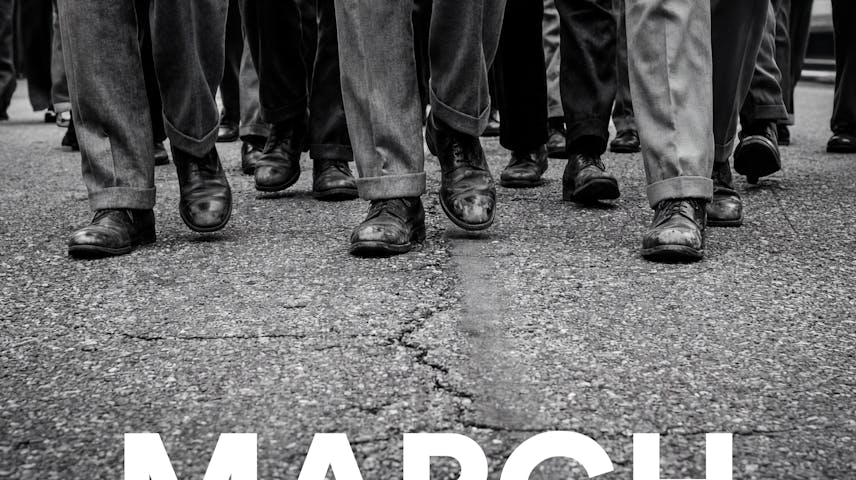
Jim Lawson Conducts Nonviolence Workshops in Nashville
SNCC Digital Gateway, SNCC Legacy Project