Loading course navigation
Loading lesson
50 min
Student Lesson
Lesson 31: “The Comet”
Content
Students will analyze events and characters in the first half of “The Comet” and examine how W. E. B. Du Bois uses narrative techniques to establish context and point of view.
Language
Students will explain how Du Bois’s narrative techniques (point of view, pacing, description) orient readers to character and conflict by using analytical verbs and evidence-based explanation frames.
Foundational Skills
Students will use context clues to determine the meaning of unfamiliar words.
How do stories help communities survive change and imagine a future worth building?
Knowledge-Building:
Students will build knowledge of racism and segregation during the 1920s in New York City via the perspective of Jim’s character in the first half of “The Comet.”
Enduring Understanding:
Stories shape how humans remember the past and imagine the future.
Future Lessons:
In Lesson 32, students will finish reading and analyzing “The Comet.” In Lesson 33, students will compare Higuera’s and Du Bois’s structural choices in their respective stories.
Unit Performance Task:
Students study how Du Bois quickly establishes point of view, context, and conflict so they can apply similar techniques in their own narrative writing.
| Lesson Flow | Purpose of Learning Experience |
|---|---|
Launch5 Minutes | Students will summarize and retell the key events of the first half of the short story “The Comet.” |
Literacy Lab10 Minutes | Students will use context clues to infer the meanings of haggard and bedraggled. |
Learning in Action30 Minutes | Part A: Analyzing Events and Their Impact (RL.8.3) Students will work with small groups to respond to questions that help them explore key descriptions, events, and characters in the first half of “The Comet.” Part B: Analyzing Du Bois’s Writing Craft (RL.8.3) Students will examine how Du Bois orients the reader, introduces conflict, and uses pacing, description, dialogue, and transitions in the first half of “The Comet.” |
Material List
Unit 4 Lesson 31 Student Edition
Routines
Turn and Talk
Using Context Clues
Quick Write
Teacher Tip |
|---|
Before beginning a class discussion of “The Comet,” address with students the use of outdated racial terms and racial slurs in the short story, and establish ground rules for respectful dialogue. Explain to students that the words Negro and colored are being used by characters in the story to describe Jim and that these words are considered outdated and inappropriate today. Ensure that students understand that the racial slurs they will encounter in the second half of the story should not be read aloud and are not allowed to be used at any time, in or out of class. Explain that the historical context of these slurs relates to bigotry and that they are not synonyms for Black people. In tonight’s homework reading, students will encounter the n-word racial slur. Tell students that W. E. B. Du Bois’s choice of this word emphasizes the racism and hatred that the white men direct toward his main character, Jim, who has done nothing but help save the white woman, Julia. Before students engage with this section of the short story, ensure that you have taken steps to support a safe learning environment for all students. Depending on your context, this may mean creating norms about engaging with texts that have slurs or derogatory language (e.g., “We do not speak this word aloud in this class”); making space for students’ processing time before, during, or after engaging with this content; and helping students understand why Du Bois may have included this word in his short story, despite its harmful history and impact. |
Have students take out their copy of “The Comet” and their homework annotations. Pair students for a quick oral retelling of the first half of the story they read for homework before a whole-class review.
Say these Directions: Turn to your partner, and summarize the key events in the first half of “The Comet.” Make sure to include only key events, not small details.
Ask: What happens in the first half of the short story “The Comet”?
Jim, a Black man, works as a messenger at a bank. The bank president talks about the comet that will hit at noon and sends Jim down to the lower vaults to retrieve old records. While Jim is underground, he finds a secret vault and, for a moment, believes he is trapped there. Meanwhile, the comet hits. When he exits, he finds dead bank employees littering his way. He walks out of the building, and everything is silent. Everyone seems to be dead. He freaks out, runs until he collapses, and then takes a car. As he’s driving, a white woman calls for help. He goes back, and the two of them start searching the city for other survivors, but they have no luck. Jim finds that he has lost “everybody.”
After partners discuss, lead a whole-class review of the first half of the story to ensure everyone understands the key events.
Say: Now that you understand what has happened in the story, you are ready to look more closely at how Du Bois builds Jim’s character and the story’s conflict.
Display the target words.
Target Words: haggard, bedraggled
Say: We are going to use context to determine the meaning of two words that Du Bois uses to describe his characters. After Jim and Julia meet, they go looking for their loved ones. They decide to search the city, and Du Bois describes what that search is like for Jim and Julia.
Say these Directions: Read the following paragraph and answer the questions below.
Read this paragraph aloud with students.
Up and down, over and across, back again—on went that ghostly search. Everywhere was silence and death—death and silence! They hunted from Madison Square to Spuyten Duyvel; they rushed across the Williamsburg Bridge; they swept over Brooklyn; from the Battery and Morningside Heights they scanned the river. Silence, silence everywhere, and no human sign. Haggard and bedraggled they puffed a third time slowly down Broadway, under the broiling sun, and at last stopped. He sniffed the air. An odor—a smell—and with the shifting breeze a sickening stench filled their nostrils and brought its awful warning. The girl settled back helplessly in her seat.
Ask: What is happening in this part of the text? Which words or phrases help explain the target words?
Jim and Julia are desperately looking for their loved ones, but everywhere are dead people. They are driving all over New York City, and it’s silent, with no sign of any humans. Words or phrases that help explain the target words include “puffed a third time slowly down Broadway, under the broiling sun.”
Ask: Based on these clues, what do the words haggard and bedraggled most likely mean in this text? How do the words describe the characters?
The words could mean stressed out, worn down, tired, and just looking dirty or worn out from all that driving around, searching for their loved ones.
Ask: If we replace the words with our meaning, does the sentence still make sense?
Confirm or revise the inferred meaning together.
Stop displaying the words for a moment.
Say these Directions: Write haggard and bedraggled from memory in your Personal Dictionary.
Display the words again.
Say: Check your spelling. Revise if needed.
Ask: Which part of the word helped you remember how to spell it?
(Student responses may vary.) The part that helped me with bedraggled was drag because it is a familiar chunk inside the word. For haggard, the double g helped me remember the spelling.
Prompt students to use a dictionary or other reference material to confirm the meaning of each word.
Say: Check your definition using a dictionary or other reference material. Does the definition match what we figured out? Revise as needed.
Ask: What kind of mood is created by Du Bois’s use of the words haggard and bedraggled to describe Jim and Julia at this point in the story?
These words make the scene feel really harsh and desperate. Jim and Julia are literally confronted with death everywhere, and it wears them down and stresses them out. The act of searching for their loved ones is stressful and makes them seem worn down and tired, creating a mood of tension and anxiety.
Check for Understanding (L.8.4.a) | |
|---|---|
In your Personal Dictionary, write a short definition for haggard and bedraggled. Then write one sentence explaining which clue or word part helped you most. |
Say: Continue to notice the word choice that Du Bois uses to capture the action of the story and convey experiences and events as we further analyze the first half of his short story.
Remind students that this story was written and takes place in New York City in the 1920s. At the time, most white Americans engaged in and supported extreme racism and instituted segregation as a rule. Through discriminatory housing practices, school segregation, unfair labor practices, discriminatory banking practices, and myriad other (often legal) immoral actions, a system that privileged white Americans above all others was created and enforced. In New York, there were no official laws addressing segregation, but it was enforced nonetheless.
Explain that Harlem was an African American neighborhood in New York City that would become the home of the Harlem Renaissance, a literary and artistic movement of Black Americans.
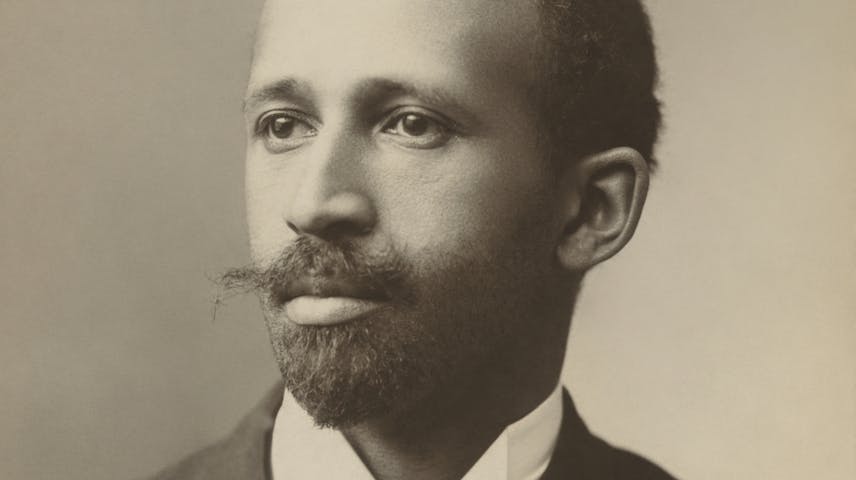
Re-introduce students to DuBois. Students were first introduced to DuBois in Unit 8.1. Explain that W.E.B. DuBois (February 23, 1868 – August 27, 1963) was an important American sociologist, writer, professor, historian, and civil rights activist. He was a leader of the Niagara Movement (founded 1905), a group of Black civil rights activists seeking equal rights, as well as a founder of the National Association for the Advancement of Colored People (NAACP) in 1909. DuBois advocated for full civil rights and increased political representation for Black Americans and also helped organize and fight for the independence of African colonies from European powers. DuBois also wrote seminal texts, including The Souls of Black Folk, in which he introduced foundational sociological concepts about race and racism, including “double consciousness” and “the color line.”
Teacher Tip |
|---|
If students are unfamiliar with New York City and all the neighborhoods Du Bois mentions in the short story, consider showing them a map. Julia and Jim travel all over Manhattan and Brooklyn, so it could be helpful to show students the distance and the neighborhoods they travel as they search for their loved ones. |
Divide students into small groups to discuss the following questions about the first half of the short story “The Comet.”
Say these Directions: With your small group, discuss the following questions based on the first half of the short story. Take brief notes on your responses to share with the class. Be sure to include details from the text in support of your responses.
Display the questions for students.
How does Du Bois establish that Jim is not a “valuable” man in the beginning of the story?
In the first paragraph of the story, the narrator notes, “Few noticed him. Few ever noticed him save in a way that stung,” demonstrating that Jim is invisible to other people. In response to the bank president’s request, the narrator shares Jim’s perspective: “Of course, they wanted him to go. . . . It was too dangerous for more valuable men,” demonstrating that the president thinks Jim is not as important as others and can be sent into the basement of the bank. When Jim arrives at the woman’s house, Jim “th[inks] with bitterness, she would scarcely have looked at him twice. He would have been dirt beneath her silken feet.”
What is unique about the encounter between Jim and the white woman, given the setting of the story?
Du Bois shows that at the time, in the 1920s, such an encounter was unlikely if not impossible. When the woman sees Jim, she is surprised that a man “like him” would have come to her rescue. She thinks, “Not that he was not human, but he dwelt in a world so far from hers, so infinitely far, that he seldom even entered her thought.” Jim notes that, “He had not thought of her as white...Yesterday, he thought with bitterness, she would scarcely have looked at him twice. He would have been dirt beneath her silken feet.” Through these character reflections, Du Bois is showing that Jim and Julia would not likely cross paths because of their respective races and the effects of segregation. Another unique reflection, given the time period this story was written in, is that Julia “had not noticed before that he was a Negro. He had not thought of her as white.”
What circumstances impact the characters’ decisions in this part of the story? What decisions do they make, and why?
The overwhelming tragedy and terrifying unknowing spur the characters into action together. The “dead girl in here and a man and ... dead horses” spur the white woman to ask Jim for help and bring him into her apartment. She and Jim get in her car, and Jim says that they must go to Harlem first to see if anyone he knows and loves has been spared. They then return to her father’s place of work in hopes of finding him. Their lack of success after scouring all the boroughs and finding more “death” drives his plan: “The long-distance telephone—the telegraph and the cable—night rockets and then—flight!”
What mood is created by their journey to find their loved ones and any survivors? How does Du Bois establish this mood?
The journey sets up a feeling of terror, shock, and desperation. Much of the dialogue ends in exclamations: “Something . . . swept across the earth this morning and—many are dead!” The words used to describe the woman’s actions and speech reveal her shock and horror: “She gasped”; “she cried nervously.” Also, the descriptions of the setting establish a horrifying mood and tone: “among the dark and lined dead of Harlem—the brown, still faces, the knotted hands, the homely garments, and the silence—the wild and haunting silence.” The journey of confronting so much “death,” isolation, and “silence” creates an eerie, alarming, and desparate mood.
After groups have discussed the questions, reconvene the class and invite volunteers to briefly share their responses.
Pulse Check (RL.8.3) |
|---|
Which quotation from the story shows that the catastrophic events are creating a small breakthrough in the racist stereotypes of the time period?
|
Have students keep their notes from the previous activity available and their stories open in preparation for discussion.
Say: To create an engaging story and develop strong characters, authors need to use narrative techniques effectively and begin by orienting readers to the context and narrative point of view. You have been learning how to do this in your own narrative writing throughout the unit. Today, we are going to analyze Du Bois’s narrative craft in the first half of his short story.
Teacher Tip |
|---|
Students have been learning about and practicing narrative techniques throughout the unit. The narrative techniques they have been introduced to and practiced are the following:
|
Transition students back into their small groups from Learning in Action Part A.
Say these Directions: Work together with your small group to discuss the questions about Du Bois’s choices for structuring his story and developing his characters. Remember, you can use other authors’ works, like this story, as examples for your own narrative writing development.
Display the following questions.
How does Du Bois orient the reader to the narrative point of view and the context of his story? How does he introduce Jim? How does he introduce the conflicts in the story early on?
Du Bois uses a third-person point of view, which is indicated by the use of he and the outside perspective on the events. In the first paragraph, Du Bois introduces Jim as someone “few noticed,” someone who was “outside the world—‘nothing!’ as he said bitterly.” So from the very first paragraph, readers know Jim is someone who experiences being treated as less than by others in society. By describing Jim like this, Du Bois is introducing an internal conflict immediately. Du Bois also introduces the inciting event of the comet in the second paragraph as Jim overhears the walkers’ conversations: “The comet?” It is further described when the president asks Jim if he is scared, and the others talk about the approaching comet.
How does Du Bois use narrative techniques like dialogue, description, and reflection to develop the characters and their experiences in the first four pages of his short story?
In the first scene, Du Bois uses dialogue between the president, the junior clerk, and Jim to develop Jim’s experience as less “valuable” to the outside world. Jim’s short answer of “No” to the president’s question about being afraid of the comet shows that Jim and the president do not have a friendly relationship. When the president tells Jim that he wants him to go into the vault, he states that being down there “isn’t very pleasant,” and the reader sees that Jim is being told to do work that no one else wants to do. Additionally, the description of the scene after the comet hits includes lurid details alongside Jim’s reflections. For example, Jim’s inner thoughts are revealed when “he glance[s] almost wildly up and down, then across the street, and . . . a sickening horror [freezes] in his limbs.” This precipitates Du Bois’s description of the resulting action: “With a choking cry of utter fright he lunged, leaned giddily against the cold building, and stared helplessly . . .” Du Bois combines dialogue, description, and reflection to develop Jim’s character and to establish the horror of his experience as he witnesses the destructive aftermath of the comet.
How does Du Bois shift from one event or setting to another? What is the pacing like in the story?
Du Bois shifts scenes by moving Jim physically through the city, from the “vault” to Wall Street, then to other neighborhoods. He uses clear transitions to show the movement. For example: “Quietly he turned the latch and stepped out into Wall Street.” Jim, upon witnessing the scene in detail, “ran as only the frightened run.” Du Bois establishes pacing by slowing events down to provide descriptions of the horror and speeding actions up to reflect Jim’s fear. For example, he writes lengthy descriptions about how the “hundred men and women and children lay crushed and twisted and jammed” to slow down time and show the horror of the situation. He builds quick, fast-paced sentences to convey the desperation of Jim and the woman’s search for the living: “Up and down, over and across, back again—on went that ghostly search.”
Provide students with a Reflection (i.e., 1–5). As needed, model how to demonstrate a level of confidence using the continuum.
Reflection |
|---|
Reflect on your understanding of Du Bois’s use of narrative techniques in his short story “The Comet” using the Reflection routine.
|
Remind students that a Quick Write calls for them to jot down their ideas quickly. They should focus on content and ideas, not on the perfect wording.
Say these Directions: Write two or three sentences in response to the following question. Be sure to include a specific example from Du Bois’s story and explain how you can use the same technique in your own narrative writing.
Display the following question.
Which of Du Bois’s narrative techniques do you think you might use in your own narrative writing, and why?
Du Bois makes me think I should introduce conflict by having my character notice details rather than just explaining everything. In “The Comet,” Jim wakes “with a sense of horror,” and readers find out about the disaster the same way he does: by seeing and observing the silence and the empty streets with him in real time. In my own writing, I will try the same kind of technique. Instead of just saying, “When Earth’s core exploded . . . ,” I will write about the rumbling underneath the characters’ feet, the cracks appearing in the ground, the bridges collapsing, and what the characters think and feel.
Instruct students to read the rest of “The Comet,” starting with the paragraph “‘The long distance telephone—the telegraph and the cable—night rockets and then—flight!’” Instruct students to take notes in their Journal on the following prompt:
As you read, annotate for how Du Bois concludes the story.
Teacher Tip |
|---|
In tonight’s homework reading, students will encounter the n-word racial slur. Tell students that W. E. B. Du Bois’s choice of this word emphasizes the racism and hatred that the white men direct toward his main character, Jim, who has done nothing but help save the white woman, Julia. Before students engage with this section of the short story, ensure that you have taken steps to support a safe learning environment for all students. Depending on your context, this may mean creating norms about engaging with texts that have slurs or derogatory language (e.g., “We do not speak this word aloud in this class”); making space for students’ processing time before, during, or after engaging with this content; and helping students understand why Du Bois may have included this word in his short story, despite its harmful history and impact. Students may be unfamiliar with a telegraph cable and with how Jim and Julia are using it to try to contact others. Consider showing students what a telephone exchange would have looked like in the 1920s so they can visualize this scene in the short story. |
The Comet
W.E.B. Du Bois