Loading course navigation
Loading lesson
50 min
Student Lesson
Lesson 21: Braiding Sweetgrass, “Defeating Windigo,” Explanatory Writing Part 4
Content
Students will build on their explanatory writing skills to craft a written response using evidence from across Braiding Sweetgrass to describe how Kimmerer argues that "defeating" the Windigo inside ourselves is necessary to live responsibly within natural systems.
Language
Students will use the conditional verb mood to express relationships between actions and consequences and consider how their language choices help clarify these relationships.
Foundational Skills
Students will practice forming sentences using the conditional verb mood to express conditional ideas.
What does it mean to live responsibly within natural systems?
Knowledge-Building:
Students examine Kimmerer’s use of the Windigo myth and other Indigenous stories, focusing on how these examples support her ideas about human responsibility toward the natural world.
Enduring Understanding:
Students analyze how Kimmerer uses the Windigo myth to argue that humans must improve their relationship with the natural world through reciprocity and gratitude.
Future Lessons:
In Lessons 22 and 23, students will read and analyze an op-ed to delineate and evaluate an argument about Jane Goodall.
Unit Performance Task:
Students will use this same approach to planning and outlining to prepare their reciprocity research presentations as part of their Performance Task.
| Lesson Flow | Purpose of Learning Experience |
|---|---|
Launch5 Minutes | Students will discuss the “Defeating Windigo” chapter of Braiding Sweetgrass with a partner. |
Literacy Lab10 Minutes | Students will learn how to form sentences with verbs in the conditional mood to express conditional ideas, first watching a teacher model and then practicing on their own. |
Learning in Action30 Minutes | Part A: Planning an Evidence-Based Outline (W.8.5, L.8.1.c, L.8.3a) Students create an outline for their written response. Part B: Defeating Windigo Response (W.8.2.a-f, W.8.4, W.8.9.b, L.8.1.c-d, L.8.3.a) Students draft a written response to the following prompt: Using evidence from across the book, how does Kimmerer argue that “defeating Windigo” is necessary to live responsibly in relation to the natural world and one another? |
Not available for this lesson
Not available for this lesson
Material List
Braiding Sweetgrass for Young Adults by Robin Wall Kimmerer, adapted by Monique Gray Smith, illustrations by Nicole Neidhardt
Unit 3 Lesson 21 Student Edition
Research Essay Outline graphic organizer
Routines
Think-Pair-Share
Language Study
Quick Write
Have students take out their Homework Journals and copies of Braiding Sweetgrass.
In their Lesson 20 Homework, students were instructed to read the “Defeating Windigo” chapter and the Author’s Note in Braiding Sweetgrass (pp. 283–293) and respond to the prompt: How does Kimmerer describe how to defeat the Windigo?
Transition students into partners. Instruct students to discuss their homework reading with a partner using the Think-Pair-Share routine.
Ask: What stood out to you most in the "Defeating Windigo" chapter? How has Kimmerer’s message shifted from earlier chapters?
What stood out to me was Kimmerer’s idea that the earth should be treated like “One Bowl and One Spoon,” where everyone shares and takes only what they need (p. 285). One shift I noticed is that in this chapter, she places more emphasis on how people’s choices affect others and the natural world. Earlier chapters introduce ideas like gratitude and reciprocity, and here she shows more clearly what those ideas look like in practice, especially in how people share resources.
Say: Today, we’re going to plan and start writing a response to the final chapter of Braiding Sweetgrass. We’ll explain how Kimmerer develops the idea that, by living responsibly in relation to the natural world and sharing resources, humans can defeat the Windigo.
Say these Directions: We’re learning about verbs in the conditional mood today. These verbs help express what might or will happen under certain conditions, which will help you talk about what Kimmerer thinks might happen if people do or do not change how they live in relation to the natural world and one another.
Introduce Sentences Written with Verbs in the Conditional Mood: Explain how conditional ideas are important to the last chapter of Braiding Sweetgrass and display a couple of examples of how to express conditional ideas using the conditional verb mood.
Remind students that they studied verb mood and were introduced to the conditional mood in Lesson 17.
Say: This chapter deals with a lot of conditional ideas, like imagining what the consequences for the Earth might be if people continue to behave like Windigo, or how life might improve if they learn to defeat the Windigo inside themselves. Here are a couple of sentences that help us express these ideas using the conditional verb mood:
Kimmerer suggests that, if we recognize the Windigo within ourselves, we can begin to resist its hunger.
Kimmerer believes that, when people embrace gratitude and reciprocity, there will be enough for everyone.
Point Out the Pattern: Explain the structure of sentences that use the conditional verb mood.
Say: Notice how phrases with the conditional verb mood follow a pattern. They start with if or when, then give a condition or action that could happen, and then explain the consequences that will or can happen in that case.
Model Crafting Sentences with the Conditional Mood: Model converting a simpler sentence into one that uses the conditional mood to express a conditional idea.
Say: Let’s say we start with these simple sentences: “We defeat Windigo. We live responsibly in natural systems.” How can we convert this to one sentence that uses the conditional mood so we can express the idea that this is conditional?
Say: We could rewrite this as “If we defeat Windigo, we can live responsibly in natural systems.” The word if lets us know that “we defeat Windigo” is a condition that may or may not be met, and then the word can lets us know that “we live responsibly in the natural world ” is a consequence that might happen if this condition is met.
Say: Words like if/when/unless signal conditions, while words like will/can/might/would/could signal consequences.
Say: Notice how using this type of sentence helps make the relationship between actions and consequences clear. As you write your response, think about how your language choices—such as using conditional sentences—can help clearly show how one action leads to a particular outcome.
Say: Writers also need to make sure they do not shift verb mood or verb voice in a way that makes the sentence confusing. Verb mood shows what kind of idea the verb is expressing, such as a condition or a statement of fact. Verb voice shows whether the subject is doing the action, which is active voice, or receiving the action, which is passive voice.
Practice: Present students with an opportunity to work with partners to write a sentence that expresses a conditional idea using conditional verb moods, given conditions, and consequences.
Say these Directions: Now, let’s practice writing a conditional sentence. Let’s say our condition is “recognize the Windigo inside us,” and the consequence is “resist greed.” Work with your partners to write one sentence that clearly shows how this consequence depends on this condition.
If we recognize the Windigo inside us, we can resist greed.
Say these Directions: Now revise this sentence so it does not have an inappropriate shift in verb voice or mood: If people recognize the Windigo within themselves, the natural world was protected by them.
If people recognize the Windigo within themselves, they can protect the natural world.
Provide students with a confidence continuum (i.e., 1–5). As needed, model how to demonstrate a level of confidence using the continuum.
Reflection |
|---|
Self-reflect on the Literacy Lab you just completed. Describe how confident you are in your ability to use the conditional verb mood to clearly express relationships between actions and consequences in your writing using the Reflection routine.
|
Connection to Today’s Learning
Say: Today, you’re going to be writing a response to the final chapter of Braiding Sweetgrass, explaining how Kimmerer shows the relationship between people’s actions and their consequences. Using the conditional verb mood and checking for clear verb voice will help you express these relationships clearly in your writing.
Students draft an outline in response to a writing prompt about the final chapter of Braiding Sweetgrass, producing a topic sentence containing a verb with the conditional mood and an outline for the rest of the response.
Start by presenting the writing prompt to students.
Say these Directions: Today, we’re going to write a response to this prompt: “Using evidence from across the book, how does Kimmerer argue that 'defeating Windigo' is necessary to live responsibly in relation to the natural world and one another?”
Say: As you plan your response, you will begin by drafting a topic sentence that answers the prompt and uses a verb in the conditional mood. Then, you will create an outline that organizes your evidence and ideas for the rest of your response.
Model responding to the prompt with a topic sentence that uses the conditional verb mood.
Say: Here is a model of how to create a topic sentence that uses the conditional verb mood. The prompt asks how Kimmerer shows that a certain condition—defeating Windigo—leads to a particular consequence, living responsibly in relation to the natural world and with one another. This is a conditional idea, so our topic sentence should express it using the conditional verb mood we practiced earlier.
Say: My topic sentence might read:
Kimmerer argues that if we defeat Windigo, a symbol of greed, overconsumption, and imbalance, we can learn to live responsibly in relation to the natural world and one another.
Next, hand out copies of the Research Essay Outline graphic organizer to each student.
Explain that students can use their graphic organizer to outline their written response. Explain that they do not need to use all three Body Paragraphs and can instead write one Body Paragraph only. Students should include an Introduction, Body Paragraph, and Conclusion in their written response.
Say these Directions: Use the following research essay outline organizer to outline your response to the prompt. You do not need to use all three body paragraphs. At a minimum, you need an Introduction, Body Paragraph, and Conclusion.
Introduction Topic sentence with conditional mood: Kimmerer argues that if we defeat Windigo, a symbol of greed and selfishness, we can learn to live responsibly within natural systems. |
|---|
Body Paragraph 1 In the Chapter: Windigo Footprints, Kimmerer explains Windigo and what he represents.
|
Body Paragraph 2 In Chapters: People of Corn, People of Light, and Shkitagen: The People of the Seventh Fire, Kimmerer explains how we can build a better world through gratitude and reciprocity.
|
Body Paragraph 3 In the Chapter: Defeating Windigo, Kimmerer explains that we need to “defeat Windigo” in order to live responsibly within natural systems.
|
Conclusion Restate the topic sentence and sum up the evidence from the body paragraphs. |
Provide students time to write their topic sentences and outlines. Circulate through the room and offer help as needed, but allow students to work independently as much as possible.
Teacher Tip |
|---|
If necessary, provide students with this checklist to review what their outline should include.
|
Students draft a response to the writing prompt using their outlines.
Say these Directions: Before you begin drafting, use these writing reminders from Unit 8.1, 8.2, and earlier lessons in Unit 8.3. As you write, keep checking that your response includes these explanatory writing criteria:
I clearly introduce my topic or thesis statement and preview what is coming next.
I organize my ideas into clear sections so my explanation is easy to follow.
I develop my topic with relevant facts, concrete details, quotations, and examples from across the book.
I use transitions to connect my ideas and show how they relate.
I use precise language and text-based vocabulary, such as reciprocity, gratitude, overconsumption, and imbalance, when those words fit my explanation.
I maintain a formal style.
I include a conclusion that follows from and supports the explanation I presented.
I reread my draft to correct inappropriate shifts in verb mood so my conditional ideas stay clear.
I reread my draft to correct inappropriate shifts in verb voice, so it is clear who is doing the action.
Say these Directions: Begin writing your response to answer the following prompt. Use your outline, the text, and your annotations as needed.
Using evidence from across the book, how does Kimmerer argue that “defeating Windigo” is necessary to live responsibly in relation to the natural world and one another?
In the final chapter of Braiding Sweetgrass, Kimmerer would argue that “defeating Windigo”—a symbol of greed and overconsumption—is necessary for living responsibly in relation to the natural world and one another. She explains that practices such as reciprocity and gratitude offer ways to resist the mindset of endless taking. For example, she describes the teachings of “One Bowl and One Spoon,” which emphasize taking only what is needed and ensuring there is enough for others (pp. 286–287). She also explains that gratitude is “a powerful antidote to Windigo psychosis” (pp. 287–288).
Kimmerer develops this idea across the book by showing how shifting the way people think about the natural world can change their behavior. Earlier, she describes how referring to “berries or apples or beans as gifts” (p. 42) encourages a sense of respect and responsibility rather than ownership. She also critiques patterns of “compulsive overconsumption” (p. 254), suggesting that these behaviors reflect the influence of Windigo thinking. By connecting these ideas, Kimmerer argues that if people practice gratitude and reciprocity, they can resist greed and begin to live in more balanced and sustainable relationships with the earth.
Circulate while students draft to check that they are clearly explaining Windigo as a symbol and connecting it to Kimmerer’s ideas about gratitude and reciprocity. Prompt students to use evidence from multiple parts of the text and to include a topic sentence with a verb in the conditional mood. Prompt students to reread for inappropriate shifts in verb voice and mood, especially when they move from a conditional topic sentence into body sentences. Also, encourage students to maintain a formal style as they write.
If students finish early, have them pair up with a partner to give each other feedback.
Lesson 21 Writing Rubric: Extended Response — “Defeating Windigo”
Writing prompt: Using evidence from across Braiding Sweetgrass, write a multi-paragraph response explaining how Kimmerer argues that “defeating Windigo” is necessary to live responsibly in relation to the natural world and one another.
Criteria | 1 — Beginning | 2 — Developing | 3 — Proficient |
|---|---|---|---|
Thesis & Introduction (W.8.2.a) Clear Thesis + Preview | The response does not open with a clear thesis or does not connect to Kimmerer’s argument about defeating Windigo. The introduction lacks context for the claim. | The response includes a thesis connected to defeating Windigo, but it is vague or does not fully explain what Kimmerer argues. The introduction may not clearly preview the main ideas. | The response opens with a clear thesis that states Kimmerer’s argument for why defeating Windigo is necessary for responsible living in relation to the natural world and one another. The introduction establishes context and previews the main ideas to be developed. |
Evidence & Analysis (W.8.2.b) Evidence Across the Book | Evidence from Braiding Sweetgrass is absent or drawn from only one section. Analysis is missing — the response retells rather than analyzes. | Evidence from the book is present, but it may be drawn from only one or two passages and not synthesized across the book. The explanation is present but does not fully show how the evidence builds Kimmerer’s argument. | Evidence from multiple sections of Braiding Sweetgrass is integrated and analyzed to show how Kimmerer builds the argument across the book. The explanation demonstrates how each piece of evidence contributes to the larger claim about defeating Windigo as a condition for responsible living. |
Instruct students to complete a quick write to reflect on their writing from today’s lesson.
Say these Directions: Review your written draft and check for the following:
Did I answer the prompt directly in my topic sentence?
Did I use a conditional verb mood in my topic sentence?
Did I organize my body paragraph to show how Kimmerer develops her ideas?
Did I use evidence from two or more chapters with page numbers?
Did I correct any inappropriate shifts in verb voice or mood?
Instruct students to review their draft with the checklist questions and then write a one-to two-sentence response about next steps with their writing.
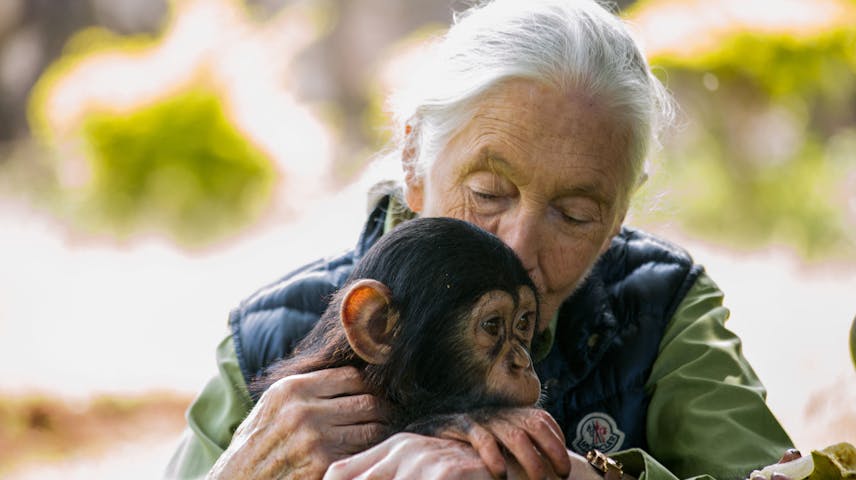
Provide students with the op-ed "Jane Goodall taught us to see the natural world. Now it's our turn to act." Instruct students to take notes in their Journal on the following prompt:
Read the op-ed "Jane Goodall taught us to see the natural world. Now it's our turn to act." Annotate for the argument the author is making about Jane Goodall.
Teacher Tip |
|---|
Remind students that they read an op-ed in Unit 8.1. An op-ed is an article in which an author expresses a strong, personal opinion on a relevant topic. |
Jane Goodall Taught Us to See the Natural World. Now It’s Our Turn to Act.
Jeff Corwin, USA Today