Loading course navigation
Loading lesson
50 min
Student Lesson
Lesson 22: “Jane Goodall taught us to see the natural world. Now it’s our turn to act,” Delineating an Op-Ed
Content
Students will read an op-ed about Jane Goodall’s impact and delineate the author’s claims, evidence, and reasoning.
Language
Students will explain an argument using claim–evidence–reasoning language and connectors such as because and as a result, along with key vocabulary such as affirmation and detachment.
Foundational Skills
Students will use context clues and word parts to determine and confirm the meaning and spelling of unfamiliar academic words.
What does it mean to live responsibly within natural systems?
Knowledge-Building:
Students learn about Jane Goodall’s impact on science and the natural world by reading and analyzing an op-ed.
Enduring Understanding:
Students can deepen their understanding of Jane Goodall’s work and impact to better understand the need for living responsibility within natural systems.
Future Lessons:
In Lesson 23, students will engage in an academic discussion, evaluating an op-ed’s argument. In Lesson 26, students will start their student-led research project.
Unit Performance Task:
Today’s work helps students evaluate claims, evidence, and reasoning in sources they may later use in their research and presentation parts of their Performance Task.
| Lesson Flow | Purpose of Learning Experience |
|---|---|
Launch5 Minutes | Students activate prior knowledge about argument texts. |
Literacy Lab10 Minutes | Students use context clues to determine the meanings of affirmation and detachment in the article. |
Learning in Action30 Minutes | Part A: Close Reading an Op-Ed (RI.8.4, RI.8.8) Students reread and analyze Corwin’s argument in his op-ed. Part B: Delineating the Argument (RI.8.8, SL.8.1.a) Students work in groups to delineate Corwin’s claims, evidence, reasoning, and overall argument using a Collective Idea Board routine. |
Material List
Unit 3 Lesson 22 Student Edition
Routines
Turn and Talk
Using Context Clues
Think-Pair-Share
Collaborative Idea Board
Quick Write
Instruct students to turn and talk with a partner about the following questions.
Say these Directions: Think back to the “Four Freedoms” speech and the argument writing you did in Unit 8.2. Turn and talk with a partner to discuss your response to the following questions.
How is an argument different from other informational texts?
What clues help you recognize an argument when you are reading?
An argument tries to convince the reader to believe a position and/or take action. A key clue is that the text includes claims supported by reasons or evidence, like in the “Four Freedoms,” where FDR argued for the freedoms people should protect. An informational text that is just providing information will not include persuasive language and a position or opinion.
Say: In Unit 8.2, we delineated and evaluated FDR’s “Four Freedoms” speech and wrote arguments of our own. Today, we will use those same skills to read an op-ed about Jane Goodall and examine how an author builds an argument about responsibility and action.
Target Words: affirmation, detachment
Display the key sentences from the op-ed with target words highlighted:
“That affirmation pushed me to work even harder, just as she had inspired so many others.”
“At a time when the scientific establishment prized distance and detachment, she chose connection.”
Read the sentences aloud. Remind students that they will use context—the words and sentences around the bold vocabulary words—to determine their meanings.
Ask: What clues (words or phrases) around the word affirmation help you infer its meaning?
The sentence says it “pushed me to work even harder,” which suggests affirmation is something positive, like support or encouragement.
Ask: What clues (words or phrases) around the word detachment help you infer its meaning?
It is contrasted with “connection,” which suggests detachment means being distant or separate rather than emotionally involved.
Say: When I come to a word like affirmation, I do not stop reading. I look at what happens around the word. The author says it “pushed me to work even harder,” which shows that affirmation must be something positive, like support or approval. I test that meaning in the sentence: “That support pushed me to work even harder.” That makes sense. I do the same with detachment by noticing that it is contrasted with “connection.” That tells me detachment means distance or separation. Good readers use nearby words, contrasts, and examples to infer meaning and then test that meaning in the sentence.
Say these Directions: Reread the key sentence and the sentence before or after it. As you read, look for words or ideas that hint at what affirmation and detachment might mean.
Ask: What does affirmation most likely mean in this sentence?
It means support or approval because it encouraged the author to work harder.
Ask: What does detachment most likely mean in this sentence?
It means emotional distance or separation because it is the opposite of connection.
Prompt students to use a dictionary, thesaurus, or other reference material to confirm the meaning of the words.
Say these Directions: Write the words from memory in your Personal Dictionary. Then, check and correct your spelling. Circle any word parts (root, affixes) that helped you spell the words correctly.
Ask: Which part of the word helped you remember the word and how to spell it?
The ending -tion in affirmation helped me because I have seen it in other nouns. The word detach in detachment helped me remember how to spell it.
Say these Directions: In one sentence, explain how the contrast between detachment and connection helps show the author’s view of Jane Goodall.
Ask: How do the words affirmation and detachment help show the author’s view of Jane Goodall?
These words show that Goodall’s work was encouraging and meaningful and that she was different from other scientists because she rejected detachment and chose connection with animals rather than treating them only as test subjects.
Ask: How do these word choices help the author communicate his message about how humans should relate to the natural world?
The word affirmation shows that caring for the natural world can inspire action, and detachment is shown as something to move away from. This helps communicate that people should build connections with nature rather than stay distant from it.
Check for Understanding |
|---|
In your Personal Dictionary, write affirmation and detachment. Next to each word, list one context clue that helped you determine its meaning. Then write your inferred definition. |
Say: Knowing what these words mean will help you read Corwin’s op-ed more closely and notice how his language supports his argument.
Before reading, introduce students to the concept of an op-ed. Display the following information and read over it with students.
Op-Ed (Opposite the Editorial Page)
op-ed: A short opinion piece in which a writer presents a position on an issue. Usually, the essay is written by a guest contributor or expert who expresses a strong, evidence-based opinion on a current, relevant topic.
call to action: language that urges readers to do something or take action as a result of the argument the writer is making
Remind students that they read an op-ed in Unit 8.1 from Eric Reid about his and Colin Kaepernick’s nonviolent protest during NFL games.
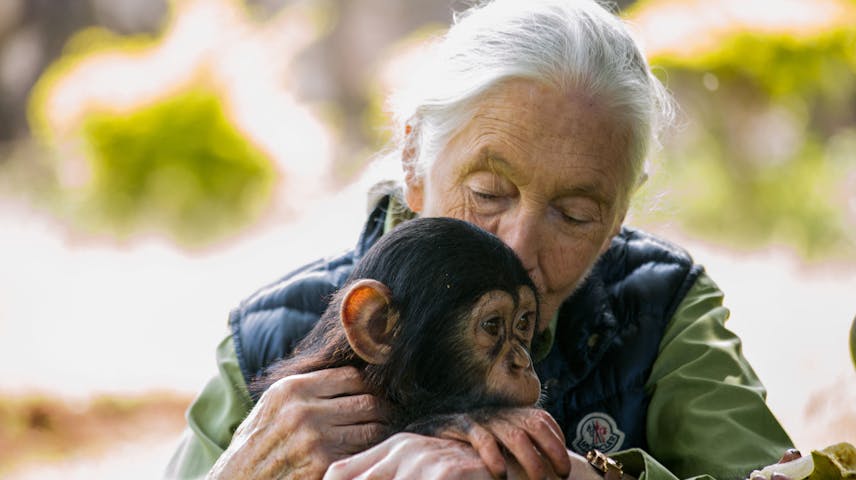
Display the article. Introduce Jane Goodall to the students by explaining that she is a primatologist and anthropologist whose work changed how many people understand chimpanzees and the natural world.
Say: When I read an op-ed, I ask a different question than I would in an informational article. I ask: What is the writer trying to convince me to believe or do?
Point to the title.
Say: Look at the title; it gives us the first clue. It moves from what Jane Goodall taught “us” to the idea that it is “our turn to act.” As you reread, you will delineate the writer’s argument by identifying his claims, evidence, and reasoning and, additionally, consider his call to action.
Transition students into pairs to reread the op-ed and annotate for claims, evidence, reasoning, and moments where the author urges action.
Say these Directions: Reread Corwin’s op-ed in your small group. As you reread, annotate:
C for claims
E for evidence
R for reasoning
A for the call to action
Remind students that they previously annotated Corwin’s argument in their Lesson 21 homework, so this annotation should be more detailed and precise.
After students have had time to reread and annotate, provide pairs with the following questions to deepen their understanding of Corwin’s argument.
Display the following questions.
Say these Directions: Now that you have reread and annotated for Corwin’s argument, discuss the following questions with your partner.
How did the author’s early encounters with Jane Goodall spark his “dream”?
Corwin describes reading Goodall’s work as a “light bulb moment” that sparked his dream, showing how her example helped shape his future. That early affirmation of his interest pushed him to keep going.
How does the author’s use of the word empathy demonstrate the “power” of Goodall’s work throughout the essay?
Corwin emphasizes that Goodall’s work shows how “empathy can save a life,” using the example of the rescued chimpanzee. This suggests her approach changed how people see animals, not just as research subjects but as living beings worthy of care and protection.
How did Goodall impact the world of science, according to the author?
Corwin explains that Goodall challenged a scientific tradition that valued “distance and detachment.” By choosing connection instead, she changed how scientists study animals and what they value.
What idea is Corwin building across these examples about Goodall’s impact?
Corwin builds the idea that Goodall changed how people understand and relate to the natural world by showing that empathy and connection, not detachment, should guide how humans interact with other living things.
What is the author’s call to action at the end of his opinion piece?
Corwin calls readers to act by “protect[ing] the fragile beauty” of the natural world. He argues that it is now “our turn to act,” not just admire Goodall’s work.
If time allows, lead a whole-class discussion of the questions, calling on student volunteers to share their thinking.
Teacher Tip |
|---|
Consider providing more background on Jane Goodall by showing students images or short video clips of her work with chimpanzees. You might highlight that she was one of the first scientists to observe chimpanzees using tools, which challenged traditional scientific beliefs about human uniqueness. You can also explain how she named the chimpanzees she studied and built relationships with them, rather than treating them as distant research subjects. If helpful, briefly note that her work led to greater awareness of animal behavior, conservation efforts, and the importance of protecting habitats. This context can help students better understand why the author emphasizes empathy, connection, and responsibility in the op-ed. |
Pulse Check (RI.8.8) |
|---|
Which statement best explains how Corwin supports his claim that Jane Goodall changed science?
|
Situation
Situation | Try this |
|---|---|
Struggling with: recognizing the call to action | Direct students to the title and final paragraph. Ask: What does the author want readers to do now? |
Struggling with: moving from summary to analysis | Give students the frame: “Corwin includes this example to show ___.” |
Ready for extension | Ask students to identify where Corwin uses emotional appeal versus credibility (expertise) and compare the two. Ask students to explain how the op-ed connects to Kimmerer’s ideas of reciprocity between humans and the natural world. |
Teacher Tip |
|---|
Remind students that they learned how to delineate an argument in Unit 8.2. Reconnect to that prior learning by reviewing the parts of an argument if necessary. |
Transition students into small groups. Provide students with chart paper or a digital board to create a Collective Idea Board to delineate Corwin’s argument.
Say these Directions: You will collaborate with your peers to create a Collective Idea Board to delineate Corwin’s argument into claims, evidence, and reasoning. First, you will generate ideas on your own. Then, you will share and organize your ideas with your group.
Display the steps students will take:
Step 1: In your journal, draw a simple chart with three columns labeled Claim, Evidence, and Reasoning. Leave space at the bottom for the Overall Argument.
Step 2: Write one idea in your chart for each column: a claim, a piece of evidence, and an example of reasoning.
Step 3: After working individually, share your ideas with your group. As a group, add new ideas to your charts, group similar ideas together, decide whether each idea fits best as a claim, evidence, or reasoning, and be ready to explain your thinking.
Step 4: As a group, agree on 1–2 clear claims, the strongest evidence, how the reasoning connects them, and the overall argument.
Say: As you work, focus on identifying what Corwin is arguing (claim), the examples or details he uses (evidence), and how those details support his ideas (reasoning).
Circulate while students work to ensure they are distinguishing between claims, evidence, and reasoning. Prompt students to explain how their evidence supports their claim, and guide them to include specific details from the text.
Claim | Evidence | Reasoning |
|---|---|---|
Jane Goodall changed how people understand animals. | She rejected “distance and detachment” and built trust through observation. | If animals are understood as complex and connected, people must rethink how they treat the natural world. |
Goodall’s example should inspire action. | Corwin describes a “light bulb moment” and urges readers to “protect the fragile beauty.” | If her work inspired others to care, that understanding should lead to responsibility and action. |
Overall Argument: Corwin argues that Jane Goodall’s work changed how people understand the natural world, so readers now have a responsibility to act to protect it. |
|---|
After students have created their Collective Idea Board, lead a whole-class discussion using the following questions.
What is one claim Corwin makes in his op-ed?
Corwin makes the claim that Goodall changed how people see and work with the natural world by choosing connection instead of “distance and detachment.”
What evidence best supports his claims?
Corwin talks about his own “light bulb moment” and the example of the rescued chimp, which shows how Goodall’s work influenced both individuals and broader efforts to care for and protect animals.
How does the author connect that evidence to his claim?
Corwin shows that if people learn to see animals with empathy, they will feel responsible for protecting them.
What is Corwin’s overall argument?
Corwin argues that Jane Goodall helped people see the natural world differently and modeled an “example for the rest of us to follow” and that now it is “our turn to act” to protect it.
Provide students with a confidence continuum (i.e., 1–5). As needed, model how to demonstrate a level of confidence using the continuum.
Reflection |
|---|
Reflect on your ability to delineate an argument using the Reflection routine.
|
Instruct students to respond to the following question using a Quick Write routine.
Say these Directions: In 2–3 sentences, explain Corwin’s overall argument. Be sure to:
state his main claim
include one piece of evidence
explain how the evidence supports the claim
Corwin argues that Jane Goodall changed how people understand the natural world and that people now have a responsibility to protect it as a way to “honor” Goodall. He supports this by describing how her work inspired others, including his own “light bulb moment.” This evidence shows that when people develop empathy for animals, they are more likely to take action to care for the natural world.
Instruct students to reread Corwin’s op-ed and to take notes in their Journals on the following questions:
How relevant and sufficient is his evidence in supporting his claims?
Is his reasoning sound? Does he clearly connect his evidence to his claims?
Jane Goodall Taught Us to See the Natural World. Now It’s Our Turn to Act.
Jeff Corwin, USA Today