Loading course navigation
Loading lesson
50 min
Student Lesson
Lesson 26: The Outsiders, Chapter 7, Part 1
Content
Students will analyze significant character relationships using a graphic organizer, explore themes related to empathy and chosen family, and begin reading Chapter 7.
Language
Students will explain how word choice reveals character relationships in The Outsiders by using interpretation verbs (reveals, suggests, indicates), evidence frames, and expanded sentences with adverbials for clarity.
Foundational Skills
Students will use a morphology routine to learn two new vocabulary words and explore the connotative relationship between these words.
What helps people navigate social differences and see from one another’s perspectives?
Knowledge-Building:
Investigate how character relationships help authors build themes and expand characters’ perspectives.
Enduring Understanding:
Empathy and difference can strengthen the groups to which people belong.
Future Lessons:
In Lesson 27, students will use knowledge from this lesson to analyze the importance of the Greasers’ extended chosen family.
Unit Performance Task:
As students consider how characters build connections and cross divides, they can connect this knowledge to how empathy helps them connect across divides in their own lives.
| Lesson Flow | Purpose of Learning Experience |
|---|---|
Launch5 Minutes | Students will consider how people connect to others across divides and will be introduced to the Essential Question of Investigation 2. |
Literacy Lab10 Minutes | Students will use a morphology routine to learn two new vocabulary words and then consider the words’ connotations and relationships. |
Learning in Action30 Minutes | Part A: Analyze Main Character Relationships (RL.7.2, RL.7.3, RL.7.6) Students will identify text evidence that explains the relationships between the Curtis brothers and use a triple Venn diagram to analyze their family connections and divisions. Part B: Read and Discuss (RL.7.3, RL.7.6) Students will begin reading Chapter 7 of The Outsiders and answer text-dependent questions related to themes and character perspectives. |
Material List
Unit 1, Lesson 26 Student Edition
Character Chart
Triple Venn Diagram graphic organizer
The Outsiders by S. E. Hinton, Chapter 7
Routines
Quick Write
Morphology & Vocabulary
Turn and Talk
Think-Pair-Share
Quick Write
Launch: Quick Write
Say these Directions: Respond in one to two sentences to this prompt. Include relevant examples from The Outsiders in their responses.
Ask: What helps people connect to others across divides, such as different life experiences, backgrounds, or perspectives?
Noticing what you admire about another person can help people understand and connect across differences. Ponyboy admires Dally’s courage in saving Johnny from the fire. This is shown when Ponyboy states, "I had always thought of him as a tough, hard, cold person. But I was wrong... I saw that I had been wrong about him, that he was more than just a person to be afraid of." (76) This helps Ponyboy connect to Dally even though they are from different backgrounds and have different personalities.
Bring the class back together, have students briefly share ideas, and record their responses.
Introduce the Essential Question for Investigation 2: What helps people bridge social divides and see from one another’s perspectives? Point out any common threads from the recorded responses that address the Essential Question (e.g., empathy, listening, shared experience).
Say: Today, you’ll prepare to analyze the second half of The Outsiders by focusing on core character relationships. You already know a lot about the characters, their bonds and connections, and some ways they are divided. You’ll use your knowledge of the text to analyze the characters’ family bonds and the importance of chosen family.
Say these Directions: We’re learning about the words delinquent and juvenile today. Let’s explore these words more deeply.
Introduce the Word: Present the word delinquent to students and pronounce it.
Ask: Have you seen the word delinquent before? Where?
Identify the Root: Underline the root linquent in delinquent. Explain that linquent comes from Latin linquere, meaning “to leave.”
Ask: Do you know any other words with the root linquent? (delinquency, relinquish)
Identify Affixes: Circle de- in delinquent. Explain that de- can mean “down,” “away,” “off,” or “completely.” In this case, it means “away.”
Ask: Do you know any other words with the prefix de-? (detective, decide, depend)
Determine Meaning: Explain that the Latin word delinquere means “to fail” or “to offend.”
Ask: How do the meanings of de and linquere help you understand this meaning? (When you fail or offend, you “leave” or move “away” from the right thing to do.)
Ask: Using what we know about de-, linquere, and delinquere, what do you think delinquent means?
Affirm and clarify as needed that a delinquent is someone who fails in their duties or who often breaks the law.
Explain that the word can be used as a noun (a delinquent) or an adjective (a delinquent person, or someone who acts in a delinquent way).
Language Connection: The Spanish word delincuente and the Portuguese/Italian delinquente both have similar meanings (a criminal or offender).
Build Word Relationships: Write delinquency next to delinquent.
Ask: How are the words delinquency and delinquent related to each other? (Delinquency is a noun describing the state of acting delinquent, or like a delinquent.)
Repeat the routine with juvenile.
Introduce the Word: Present the word juvenile to students and pronounce it.
Ask: Have you seen the word juvenile before? Where?
Identify the Root: Underline the base word juven in juvenile. Explain that juvenile comes from Latin iuvenis, meaning “young man.”
Ask: Do you know any other words with the root juven?
Language Connection: The Spanish word joven means “young.” The word junior, which comes from the same Latin root, can mean “the younger or less experienced of two people.”
Identify Affixes: Circle -ile in juvenile. Explain that -ile can mean “having the quality of.”
Do you know any other words with the suffix -ile? (hostile, agile)
Determine Meaning:
Ask: Using what we know about juven and -ile, what do you think juvenile means? (having the quality of being young)
Explain that juvenile means “young, not considered old enough to be an adult.” It can also be used to mean “immature.”
Build Word Relationships: Write juvenile next to delinquent.
Ask: What do you think the phrase juvenile delinquent describes?
A young person who fails in their duties and breaks the law
Ask: These words are often used together. What does this use suggest about the connotation of both words?
I think juvenile might have a negative connotation since it is often used with a word that relates to crime. I think delinquency may be associated with young people rather than with older people.
Tell students that this vocabulary will be further analyzed in this lesson's text analysis work. Allow students to share their work.
Ask: Explain to a partner how identifying base/root words and building word relationships helped you to understand the words.
Connection to Today’s Learning
Say: The words juvenile and delinquent can help readers understand how others outside the Greasers’ social circle may view them. Today, you’ll take a closer look at how words and phrases in the text help readers understand the way the Curtis brothers see each other and what that means about their relationships.
Keep students in pairs. Remind students that early in the unit, they learned about poverty and inequality and discussed how these factors can impact people’s sense of belonging. They also learned about how working-class subcultures arose partly as a response to economic inequality. Briefly review any details students remember about these topics.
Say these Directions: Turn and talk with a partner to discuss these questions before sharing ideas in a whole-class discussion:
Ask: What do you think a “chosen family” is? How does this phrase contribute to your understanding of family?
I think a chosen family is a group of people who decide to love and care about each other the way a family does. The phrase helps me understand that there are many ways to form a family, and it can be something you choose instead of something you are born with.
Ask: Consider what you learned about poverty, inequality, and working-class subcultures. How do you think these factors affected the Greasers’ “chosen family” in The Outsiders?
I think the Greasers chose to love and support each other because they knew they faced similar challenges in poverty, and they would be more likely to overcome these disadvantages if they helped each other. Sticking together was their way to combat economic inequality.
Discuss student responses. Explain that one theme in the novel is the importance and responsibility of chosen family bonds.
Define chosen family and explain that there are many types of chosen families. Several chosen families, like Ponyboy’s gang, form strong friendships. They may include people who are biologically related, like the Curtis brothers, as well as people who are not. They may also form when people are not supported by their family of origin; for instance, Johnny is loved and cared for by the gang rather than by his parents.
Say these Directions: In today’s lesson, we will focus on three central members of the Greasers’ “chosen family” dynamic—the brothers Ponyboy, Darry, and Sodapop.
Have students take out The Outsiders with their annotations.
Display the Character Chart from early in Investigation 1. Have students review the adjectives used to describe Ponyboy, Darry, and Sodapop.
Then, assign half the students to analyze Ponyboy and Sodapop’s relationship and the other students to analyze Ponyboy and Darry’s relationship.
Say these Directions: Use Chapters 1–6 (including any relevant annotations) to record brief responses to these questions about your assigned characters, using short quotes or paraphrases of the text:
Ask: Choose one or two words or phrases Ponyboy uses to describe Sodapop/Darry. What does this language suggest about their relationship?
Ponyboy describes Sodapop as handsome and explains how Sodapop attracts girls. Ponyboy says, “He’s movie-star handsome, the kind that people stop on the street to watch go by” (p. 7). This language suggests that Ponyboy wishes he were more like Sodapop and that he admires Sodapop.
Ponyboy compares Darry’s eyes to ice, and he says that Darry “uses his head,” or thinks ahead. He says that Darry’s eyes “look as if they can see right through you, and he seems to use his head for something more than a hitching post for his hair” (p. 6). This language suggests that Ponyboy respects Darry but is slightly afraid of him and finds him cold.
Ask: Choose one word or phrase Sodapop/Darry uses to describe Ponyboy or one quote that shows Sodapop’s/Darry’s feelings about Ponyboy. What does this language suggest about their relationship?
Sodapop describes Ponyboy as “brainy” (p. 17) because he does well in school, and Darry is proud of him. This language suggests that Sodapop also admires Ponyboy for his intelligence.
Darry is frustrated because he feels that Ponyboy always makes excuses for forgetting or not thinking about important things. Darry tells Ponyboy several times, “You don't ever think.” This language suggests that Darry feels responsible for Ponyboy and wishes Ponyboy would be more responsible himself.
Ask: Choose one quotation, from narration or dialogue, that you think best reflects the relationship between Ponyboy and Darry/Sodapop. Explain why you chose this quotation.
I chose the quotation in Chapter 3 when Ponyboy says he cried when Sodapop lost his horse because he felt bad for Sodapop. He says, “I had cried, too, if you want to know the truth, because Soda never really wanted anything except a horse, and he'd lost his” (p. 35). This quote shows that the two brothers have a lot of empathy for one another and hurt when the other one hurts.
I chose the quotation near the end of Chapter 6 when Ponyboy describes how Darry really does care about him. Ponyboy says, “Darry did care about me, maybe as much as he cared about Soda, and because he cared he was trying too hard to make something of me” (p. 86). This quote shows that their relationship is meaningful to Darry and that he only wants the best for Ponyboy.
Say these Directions: Form pairs with a partner previously assigned to the other relationship. (Groups of three can be formed if needed.)
Label and fill out a Triple Venn Diagram graphic organizer to analyze the brothers’ relationships. This is how the organizer works:
Each circle will represent a different brother—Ponyboy, Darry, or Sodapop.
The outer spaces within only one circle will describe the brother as an individual.
The connecting spaces between two circles will describe the relationship between the two brothers whose circles overlap (Ponyboy/Darry, Sodapop/Darry, or Ponyboy/Sodapop), including traits they have in common.
The center space where all three circles meet will describe the relationship between all three brothers, including the traits they have in common.
Use the words, phrases, and quotations they identified in their individual work to begin filling in the diagram.
Make sure you also:
Identify words that describe each brother for the outer circles. Use adjectives from the Character Chart if needed.
Ponyboy: sensitive; Sodapop: understanding; Darry: hardworking
Identify words/phrases that describe each family relationship, including the relationship the brothers all have with each other, to write in the overlapping portion of the circles.
Ponyboy/Sodapop: best friends; Sodapop/Darry: supportive; Ponyboy/Darry: like father and son; Ponyboy/Sodapop/Darry: committed, loving
Choose a quotation that best reflects Sodapop and Darry’s relationship and explain why.
The passage from Chapter 1 that says Darry enjoys being teased by Sodapop and only Sodapop; this shows that Darry and Sodapop have a unique way of connecting to one another. Ponyboy says, “And Soda can make him grin, which is something nobody else can do” (p. 8).
Choose a quotation that best reflects the relationship all three brothers have and explain why.
The passage from Chapter 5, when Ponyboy describes how the brothers would take turns doing the dishes and then play football. He recalls “Soda and I would be doing the dishes, and Soda would start a fight... and then we'd be wrestling on the floor.” This shows that even though the brothers share responsibilities, they also have fun together.
Say: Keep these family connections in mind as you consider how the Curtis brothers relate to members of their chosen family and how empathy can help people reach across divides.
Teacher Tip |
|---|
Since this activity requires students to review a lot of text, guide them to specific passages as needed to find more information on the brothers’ relationships. Ex. Chapter 1: Ponyboy describes his brothers’ looks and personalities and talks to Sodapop about Darry; Chapter 3: Ponyboy thinks about how unfairly life treats his brothers and has a fight with Darry; Chapters 4–5: Ponyboy misses and reflects on his brothers and gets a letter from Sodapop; Chapter 6: Ponyboy meets his brothers in the hospital. |
Pulse Check (RL.7.2) |
|---|
Which statement about the Curtis brothers provides the best example of how empathy can connect people across divides?
|
Transition by explaining that in Chapter 7, students will learn more about how family relationships, including chosen family relationships, impact the characters and plot.
Say these Directions: Begin reading The Outsiders, Chapter 7 up until the moment when Ponyboy says “I had a nightmare . . .” on page 110.
Depending on the needs of your class, engage in a whole-class read-aloud and have students take turns reading for fluency practice, have students take turns reading aloud in small groups, or have students read independently.
Say these Directions: After reading the passage, independently consider some or all of these questions and share and refine your responses with a partner before the whole-class discussion.
Ask: Based on what you know about the Curtis brothers, why do you think it is important to them to expand their chosen family and include other Greasers?
I think Darry wants to take care of people the way he takes care of Ponyboy. He knows that some Greasers, like Johnny, need support and resources that they don’t have at home. I know that Sodapop is outgoing and good at understanding people, and I think it’s easy for him to welcome others and treat them like family if he trusts them.
Ask: What do you think Ponyboy’s haircut symbolizes? Why?
I think Ponyboy’s haircut symbolizes his individuality and changing identity. He is starting to see himself as separate from the other Greasers because he has had an experience that few of them shared, and he has different interests and may have different goals. It also symbolizes the inner conflict Ponyboy feels about his new identity since he is still very close to the group. Ponyboy is uncomfortable with his haircut; he also seems uncomfortable with being different or standing out in any way.
Ask: What does the phrase “juvenile delinquents” in the newspaper headline indicate about how others view the Greasers? Why do you think the author uses this phrase?
The phrase indicates that other people see the Greasers as young troublemakers and not as full human beings and that people may be surprised that Greasers can take heroic actions. The author might use this phrase to point out the contrast between how the reader sees the Greasers after getting to know them and how strangers might see them.
Checklist (RL.7.3, RL.7.6) |
|---|
During your discussion, make sure you:
|
Say these Directions: Write a few sentences in response to the following question.
Ask: How does empathy play a role in the way the Curtis brothers build and strengthen their chosen family?
Optional Sentence Starter: “The Curtis brothers show empathy by ____.”
Empathy helps the Curtis brothers understand that other people need the kind of family connections the three of them have with each other. The brothers rely on one another for financial and emotional support, and they want to extend this support to the other Greasers. One way they do this is by offering them a peaceful place to stay when they need it. On page 92, Ponyboy says, “Our front door is always unlocked in case one of the boys is hacked off at his parents and needs a place to lay over and cool off. We're all used to it.”
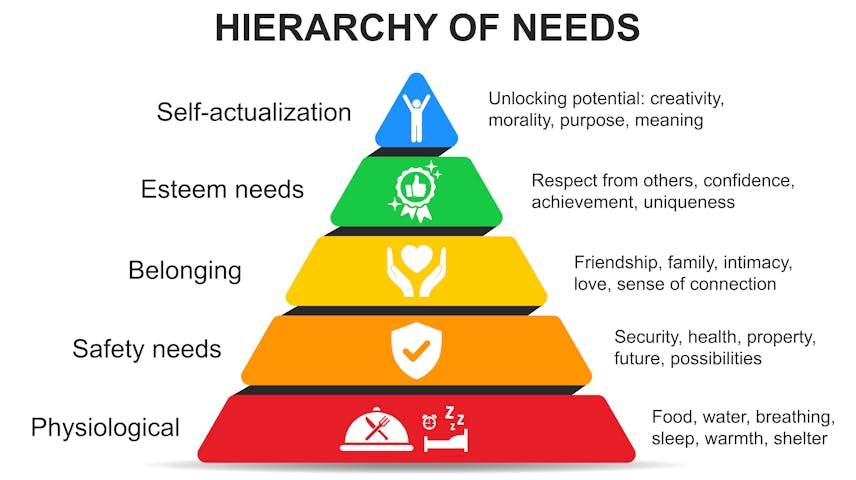
Provide students with a copy of the brief article “Maslow’s Hierarchy of Needs” and Chapter 7 of The Outsiders. Instruct students to take notes in their Journal on the following prompt:
As you read, annotate the text for the following:
Which moments show characters demonstrating empathy toward others?
The Outsiders
S.E. Hinton

Maslow’s Hierarchy of Needs
Standard News Bureau