Loading course navigation
Loading lesson
50 min
Student Lesson
Lesson 1: Building Background Knowledge: The 1960s, Part 1
Content
Students will analyze how the 1960s contained multiple, often contradictory realities for American youth culture.
Language
Students will describe and compare different aspects of 1960s youth culture by stating a clear claim about a specific group or subculture, using evidence from two nonfiction sources.
Foundational Skills
Students will build knowledge of vocabulary words in historical context and learn the concept of historical complexity.
How do relationships and communities shape a person's sense of belonging and identity?
What helps people navigate social differences and see from one another’s perspectives?
Knowledge-Building:
Students will explore the social and cultural complexity of the 1960s, learning that the decade was not defined by a single youth experience but by many different ways of being young in America. This prepares students to understand how social context can contribute to individual identity.
Enduring Understanding:
Historical eras are rarely simple. Different groups of people can live through the same decade in very different ways, and understanding this complexity helps readers empathize with a wider range of characters and experiences.
Future Lessons:
In Lessons 2 and 3, students will investigate poverty and youth subcultures in the 1960s more specifically as they relate to the anchor text.
Unit Performance Task:
Building a nuanced picture of the 1960s will help students understand how social context shapes the choices characters make, informing their own narrative writing.
| Lesson Flow | Purpose of Learning Experience |
|---|---|
Launch15 Minutes | Students activate prior knowledge about the 1960s, question whose stories are centered in a familiar historical narrative, and learn the idea of historical complexity. |
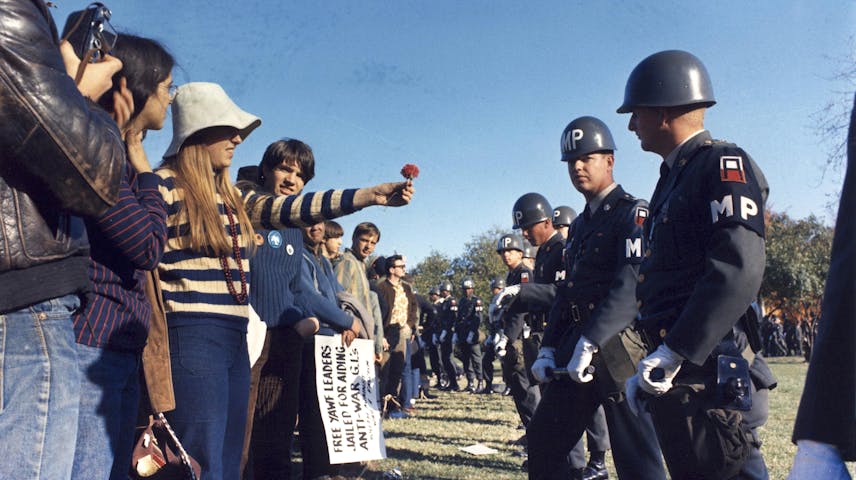
Learning in Action30 Minutes | Part A: The 1960s You Already Know (RI.7.1, RI.7.2, RI.7.3) Students read “A Decade of Change: The 1960s in America” and identify central ideas about activism, division, and counterculture. Part B: The 1960s You Might Not Know (RI.7.1, RI.7.2, RI.7.3, RI.7.7) Students analyze photographs and excerpts from Cool, Chrome and Rock ‘n’ Roll through a Jigsaw routine to build a more complex picture of youth identity in the era. |
Look Back5 Minutes | Students synthesize both texts by reflecting on how two very different truths can exist at the same time in the same historical period. |
Material List
Unit 1 Lesson 1 Student Edition
Jigsaw Worksheet
T-Chart graphic organizer
Routines
Turn and Talk
Think-Pair-Share
Jigsaw Reading/Viewing
Activate students’ prior knowledge by engaging them in a brief discussion about what they already think they know about the 1960s. The goal is to surface the familiar image of the decade so students can later complicate and deepen that picture.
Place students with a nearby partner. Keep the conversation brief and energetic so students can quickly surface background knowledge before the whole-class debrief.
Setup: Students turn to an elbow partner.
Say these Directions: Today, we are exploring the 1960s, a decade many people think they already know. As you talk, name the images or ideas that come to mind first.
Ask: When you hear “the 1960s,” what images or ideas come to mind? What do you already know or think you know about that decade?
I think of protesters carrying signs, the Vietnam War, and marches for civil rights.
I think of hippies, flower power, tie-dye, and music from that time.
I also think of Martin Luther King Jr. and people fighting for change.
Capture student responses in a visible class list. Do not evaluate or correct responses yet. Tell students you will return to this list at the end of the lesson.
Display and read aloud the unit Essential Question: How do relationships and communities shape a person’s sense of belonging and identity?
Ask: Looking at the ideas on our list, whose story do you think we are telling? Who might be left out?
We are mostly telling the story of activists and big political events. Teens who were not marching or protesting might be left out, even though they were also living through the same decade.
Say: Historians do not just memorize facts. They look for the full picture, even when the picture is messy. When I hear “the 1960s,” I might first think about protests, civil rights, and the Vietnam War because those are the images that show up most often. But if I stop there, I am acting like one story stands for everyone.
Say: A stronger reader asks, Who else was alive at that time, and what was their life like? That is what we mean by historical complexity: More than one truth can exist at the same time.
Say: Today, we are going to practice holding two different pictures of the same decade in our minds without forcing one to cancel out the other.
Connection to Today's Learning:
Now that students have named the familiar story of the 1960s, they are ready to test that story against two different kinds of evidence.
Build students’ background knowledge about the political and social upheaval of the 1960s. Guide students through a collaborative reading and Think-Pair-Share routine to identify central ideas and analyze how major events both connected and divided people.
Say: We are going to read an article that covers major historical events of the 1960s. As you read, think about this question: Is this the version of the 1960s I already had in my head? Notice what feels familiar and what surprises you.
Introduce and define subculture and counterculture before reading.
Subculture: a group within a larger society that shares its own style, values, and identity
Counterculture: a movement that rejects mainstream values and promotes different ways of living
Ask: What groups do you belong to that have their own style, music, or way of doing things? How does belonging to that group shape how you see yourself?
A sports team or friend group can feel like a subculture because it has its own style, rules, and inside jokes. Belonging to that group can shape how I act, what I wear, and whom I feel connected to.
Teacher Guidance: Students first think silently, then discuss with a partner, then share with the class. Encourage students to point to a text landmark when they cite evidence.
Setup: Students keep the article open and pause after reading key sections.
Say these Directions: Read the informational article “A Decade of Change: The 1960s in America” with a partner or in a small group. Then think on your own, talk with your partner, and refine your answer before we discuss it as a class.
Ask: According to the text, what were two or three of the most significant forces dividing Americans in the 1960s? Cite evidence from the text.
The article explains that segregation divided Black and white Americans, and it shows that even after the Civil Rights Act of 1964, inequality still affected many Black communities. The Vietnam War also divided Americans between people who supported it and people who protested it.
Ask: The article describes the counterculture and hippie movement as one response young people had to the events of the 1960s. What specifically were hippies responding to? Use the text to explain.
The text says hippies rejected traditional values like conformity, consumerism, and strict social rules. They were responding to the Vietnam War and to a society they believed cared too much about fitting in and following the mainstream.
Ask: In two sentences, summarize the central idea of this article.
The 1960s was a decade of major social change, as Americans debated race, war, and national identity. These debates brought some people together around shared goals, but they also created deep division.
In Part B, photographs do the work. Students examine a curated set of images from Cool, Chrome and Rock ‘n’ Roll organized into photo groups. The Jigsaw routine allows students to become experts on their assigned images before sharing observations with the whole class.
Say these Directions: We just read about big events of the 1960s. Now set that picture aside for a moment. You are going to study a different set of images from an overlapping era. As you look closely, ask yourself: What does this tell me about how young people lived and who they were?
Say: When I analyze a photograph, I do not jump straight to a big claim.
First, I notice what is actually there: people, clothing, setting, body language, and anything the caption tells me.
Then I ask what those details might suggest about identity or belonging. For example, if I notice a group gathered around cars at a drive-in, I might infer that leisure, style, and social scenes mattered to how some teens saw themselves.
Next, I compare that image to the article we just read and ask, “Is this the same story or a different side of the same decade?”
Say: That is how readers use visual evidence to build historical complexity instead of relying on one single narrative.
Keep students in expert groups for Part 1. Each group studies assigned photographs and captions before re-forming into mixed groups for Part 2.
Setup: Students work in small groups with assigned photographs and captions.
Say these Directions: With your group, study your assigned photographs carefully. Read the caption for each image because it counts as evidence. Use the Jigsaw Worksheet to jot your observations and thinking before you share with a new group in Part 2.
Ask: What do you notice in this photograph? Describe who is in it, what they are doing, and any details about clothing, setting, or expression.
In the drive-in photograph, I notice teenagers sitting in a convertible while a carhop serves them drinks. Their clothes and the car suggest that style and hanging out were important parts of teen life.
In the hot rod photograph, I notice a teen posing proudly next to a customized car. The setting and the pose suggest that cars were connected to status and identity.
Ask: What does this image suggest about how teenagers in this era formed their identity or sense of belonging? How does this picture of teen life compare to what you read about in Part A?
This image suggests that some teenagers formed identity through style, cars, and social scenes instead of politics. While Part A focused on protest and change, this image reveals a more everyday kind of belonging.
The photograph suggests that belonging could come from being part of a subculture like greasers or from joining a social scene like the drive-in. That is different from the activist communities in Part A, but it is still a real form of identity.
Group | Assigned Photo(s) |
|---|---|
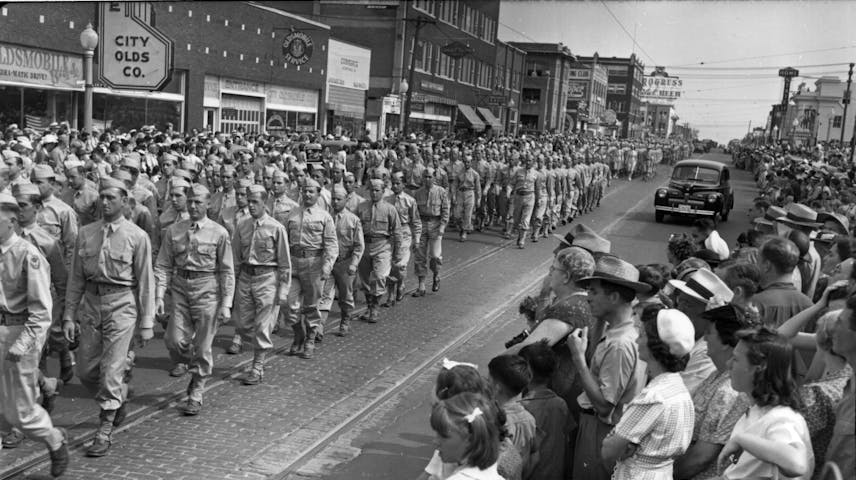
Group 1 | Fig. 1: Independence Day parade, Oklahoma City, 1942 |
Group 2 | Fig. 2: Two young couples in a convertible at a Huddle drive-in restaurant, 1964, with a carhop serving drinks Fig. 3: Packed drive-in movie theater, 1950s |
Group 3 | Fig. 4: 1950s teenager with hot rod Fig. 5: 1950s diner with “squares” enjoying milkshakes |
Group 4 | Fig. 6: Members of the Hell’s Angels stopped by California Highway Patrol, 1966 Fig. 7: The cast of the 1982 film adaptation of The Outsiders |

Teacher Tip |
|---|
Fig. 6 may prompt questions about gang culture and law enforcement. Briefly contextualize that motorcycle clubs such as the Hell’s Angels were a visible part of mid-century subculture, often romanticized in media while also feared by mainstream society. Preview all images before class and be ready to provide brief context if students ask. |
Say these Directions: In your new group, take turns sharing the photographs you studied and what you observed. As each person shares, the rest of the group listens and records in the T-Chart graphic organizer. Your goal is to collect at least two entries in each column.
insert T-Chart graphic organizer}
The 1960s: The Story We Know | The 1960s: The Story in the Photos |
|---|---|
How did young people form identity through politics and protest? | How did young people form identity through style, cars, and social scenes? |
What movements or events defined youth in this era? | What does each photograph reveal about belonging and community? |
Sample entries: Anti-war protesters formed community through shared opposition to Vietnam; Civil rights marchers connected across race through a shared goal of equality | Sample entries: Greasers formed identity through style, leather jackets, slicked hair, and hot rods; Drive-in crowds created community through shared leisure rather than shared politics |
Ask: Look at both columns of your T-Chart. Could everything in both columns be true about the same decade? What does that tell us?
Yes. Some teenagers were marching for civil rights or protesting the war while others were going to drive-ins or customizing cars. That tells us the decade was not just one story. It included many different youth experiences at the same time.
Ask: The photographs in Text 2 do not show protest signs, marches, or political events. Does that mean those teens did not care about what was happening in the country, or does it mean something else?
It could mean something else. People live through the same historical moment in different ways. Some teenagers may have cared most about activism while others found belonging through their social scene or subculture.
Ask: The final image in Text 2 shows you how the people behind a film adaptation of the anchor text of this unit, The Outsiders, chose to portray its cast. Based on your knowledge of 1960s subcultures, where do you think these characters would best “fit in”?
Based on the photographs we looked at today, that photograph shows actors dressed up like greasers. They don’t look like the teenagers at war protests or the teenagers eating in the diner; they look like they spend more time on the streets and are posing as “tough.”
Pulse Check (RI.7.2, RI.7.7) |
|---|
Which statement best explains what both sources show about the 1960s? A. The decade was mainly about protests and politics.
B. The decade was mainly about cars, diners, and drive-ins.
C. Different groups of young people experienced the same time period in different ways.
D. The photographs prove the article is inaccurate.
|
Return to the list of student responses from the start of the lesson.
Students write first, then share with a partner if time allows. Require at least two specific details from today's learning so the task measures synthesis rather than a general impression.
Say these Directions: At the start of class, we named what we thought we knew about the 1960s. Now use at least two specific details from today’s article, photographs, or captions to show how your thinking has changed. Then name one question you still have.
I used to think most young people in the 1960s were activists or hippies. Now I think there were many youth subcultures at the same time because the article showed protests and counterculture, while the photographs showed greasers, drive-ins, and teens forming identity through cars and style. One question I still have is whether these different groups ever crossed paths or influenced one another.
Optional Sentence Starter:
I used to think _____, but now I think _____. One question I still have is _____.
Instruct students to answer the following prompt in their Journals:
Choose one youth subculture from today’s texts: greasers, hippies, “squares,” or anti-war activists. In 3–4 sentences, describe how belonging to that group might have shaped a teenager’s sense of identity in the 1960s. Use at least one detail from the text as evidence. Write your response in your Journal.