Loading course navigation
Loading lesson
50 min
Student Lesson
Lesson 2: Building Background Knowledge: The 1960s, Part 2
Content
Students will review a video and an informational article to analyze how poverty and economic inequality impacted Americans in the 1960s and beyond.
Language
Students will summarize ideas from an informational text and use these summaries to develop original ideas.
Foundational Skills
Students will explore the relationship between two vocabulary words and connect these words to informational texts.
How do relationships and communities shape a person's sense of belonging and identity?
What helps people navigate social differences and see from one another’s perspectives?
Knowledge-Building:
Students will use what they learn about economic inequality in the United States as a foundation to examine deeper ideas of how class divides affect belonging.
Enduring Understanding:
Social systems of the 1960s created class divides that impacted people’s senses of belonging.
Future Lessons:
In Lesson 3, students will learn more about how poverty and inequality impacted the youth subcultures featured in the anchor text.
Unit Performance Task:
Examining the broader social context that makes a main character feel like an “outsider” will help students understand the many ways that “outsider” status can affect people.
| Lesson Flow | Purpose of Learning Experience |
|---|---|
Launch5 Minutes | Students will explore the setting of the anchor text by reviewing photos of Tulsa, Oklahoma, in the 1960s and learning how class divides impacted Tulsa. |
Learning in Action40 Minutes | Part A: Build Knowledge of the 1960s (RI.7.7, L.7.4.a) Students will watch a video summarizing the intent of Johnson’s “War on Poverty” and discuss how it connects to their knowledge of the decade from Lesson 1 and how it impacts their understanding of class divides. Part B: Analyze Data about Inequality (RI.7.7) Students will read and summarize data from an informational article and make inferences about the challenges of addressing poverty and poverty’s impact on belonging. They will share their findings with their peers using the Give One, Get One routine. |
Look Back5 Minutes | Students will reflect on what they learned about belonging and inequality. |
Material List
Unit 1, Lesson 2 Student Edition
Give One, Get One graphic organizer
Routines
Turn-and-Talk
Give One, Get One
Begin to build background knowledge of the anchor text’s setting by showing students photos of Tulsa, Oklahoma, during the 1960s. Explain that the book they will read takes place in this city. You also may want to show Oklahoma on a map of the United States to help students connect it to the American Southwest.
Informative photos from Oklahoma and Tulsa history may include urban, suburban, and rural or semi-rural settings; suburban sprawl in Tulsa; settings that were part of public life in the 1960s, such as drive-in movie theaters; or settings specific to Southwestern culture, such as cowboys and rodeos.
Say these Directions: With your group, review the photographs and discuss the following question:
Ask: Based on these photos, what do you think life was like in 1960s Tulsa?
The photos show a growing city but not a large, powerful city like New York or Los Angeles; I think life in Tulsa might have been slower-paced than in other cities.
Tulsa, like many cities in the 1960s United States, was expanding rapidly and becoming more modern. Many Tulsa residents—often white people in upper economic classes—moved to suburbs and wealthier neighborhoods. However, not all people in Tulsa experienced the benefits of this growth. While some residents lived comfortably, others lived in poverty.
Say: Today, we’ll use our background knowledge of the 1960s to learn more about how poverty and inequality affected people who lived at that time and how these conditions continued to affect people in the 21st century.
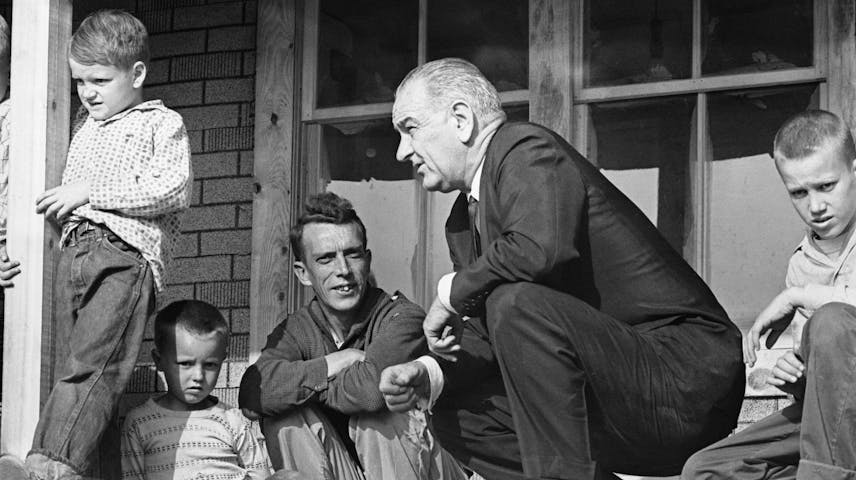
If possible, have students watch the PBS LearningMedia Video “1964: LBJ’s War on Poverty.” Then, discuss these questions in your small group. If not possible, students could read Johnson’s “Special Message to the Congress Proposing a Nationwide War on the Sources of Poverty.” Activate prior knowledge of inequality and poverty, then guide students in analyzing the video to deepen their understanding of 1960s social issues. Support discussion and vocabulary development through collaborative responses.
Say these Directions: Turn and talk with a partner to share your responses to the homework prompt:
Ask: What does the word inequality make you think of? What do you think this word means as it relates to groups of people, including groups of people in the 1960s?
Connecting Inequality and Poverty
Transition to a whole-class discussion.
Say these Directions: Define inequality and record your ideas below. Refer to what we learned in Lesson 1 about segregation and discrimination.
Define inequality and poverty for students.
Say these Directions: Now, write a sentence that uses both words and shows how the words are connected.
If students need more support, provide simple sentence frames. (Ex. _________ can create economic ________ between people.)
If some people in a city live in poverty and others do not, the city is a place of inequality.
Say these Directions: Watch the PBS LearningMedia Video “1964: LBJ’s War on Poverty.” Then, discuss these questions in your small group.
Say: Consider what you learned about social issues and divisions in the 1960s, such as racial segregation and the influences of Martin Luther King Jr. and John F. Kennedy. How did the video help you understand these issues?
The video explained how race and poverty are connected. It helped me understand that when Dr, King was working to end racial segregation, he also wanted to improve life for Black Americans who lived in poverty.
Say: The video notes that many groups of Americans were “completely left out” in the 1960s. What do you think they were “left out” of?
I think that many groups were “left out” of American prosperity and the ability to enjoy access to the same comfortable life enjoyed by other Americans because they experienced poverty. They may also have been left out of opportunities like higher-paying jobs.
Say: Based on the context of the video, what do you think the word alleviate means? How do you think alleviating poverty might be different from ending poverty?
I think that alleviate means to change something in a way that makes it better or easier. Alleviating poverty could mean making people’s lives easier while they live in poverty, but if poverty was ended, they would not have to live that way at all.
Say: Think about how the words justice and injustice are used in the video. How do you think inequality is connected to injustice?
I think inequality is a kind of injustice. When people do not have equal opportunities to earn money or access basic needs, some of them are experiencing unjust or unfair treatment.
Check for Understanding (RI.7.7, L.7.4.a) |
|---|
As you discuss in your groups, make sure you:
|
Transition students into partnerships to engage with the informational article “Who’s Poor in America?”
Say these Directions: Let’s read the opening paragraphs of “Who’s Poor in America?” as a class. Keep in mind that you do not need to understand the analytical terms (such as those describing data measures) or all the vocabulary words. To understand the author’s points, pay attention to transitional terms such as “but” and “for example.”
Ask: What does the phrase ‘War on Poverty’ describe?
It describes the efforts made to reduce poverty rates.
Ask: What is the meaning of the word demographics?
Demographics are facts about a group of people, such as their age, race, income, and where they live.
Say these Directions: Complete the sentence and discuss it with your partner.
According to the author, some critics believe that poverty rates have ___________ since the 1960s, while others think that poverty rates have _________________.
According to the author, some critics believe that poverty rates have fallen only a little since the 1960s, while others think that poverty rates have fallen a lot.
Say these Directions: Review the rest of the article with a partner, paying particular attention to the subheadings (in bold font) that summarize the data. Then, write brief (two- or three-sentence) responses to each of these questions in the “My Ideas” column of your graphic organizer.
What do the article and statistics help you understand about the challenges of addressing poverty? Use evidence from the text in your response.
How and why do you think poverty impacted people’s sense of belonging in the 1960s?
After completing the article and discussion with your partner, rotate to new partners and “give” and “get” ideas to collect a variety of responses to each question. In this routine, one partner will share a response, then the other will write the response under the “Your Ideas” column in the graphic organizer. Rotate between partners until you have collected at least two new ideas for each question.
Model one exchange by “giving” a response to a student for each question, such as:
Question 1: “The article showed me that one challenge of addressing poverty is that different groups have different needs. For example, more people of working age lived in poverty in 2012 than in 1959, but fewer elderly people did. Programs of the 1950s may have addressed elderly people’s needs more successfully than they addressed the needs of working-age people.”
Question 2: “I think that poverty limited people’s sense of belonging in the 1950s to 1970s because they may not have had as many opportunities as others in their community.”
Say these Directions: After your final rotation, discuss this question with your new partner:
Ask: How did the article and the video portray the War on Poverty differently?
The video portrayed the War on Poverty as a major accomplishment that would improve people’s lives. Johnson seemed determined that it would succeed. The article portrayed the War on Poverty as a series of programs that helped some people more than others and that may not have succeeded for everyone since many people still live in poverty; for some groups, poverty rates have increased.
Provide students with a confidence continuum (i.e., 1–5). As needed, model how to demonstrate a level of confidence using the continuum.
Reflection (RI.7.7) |
|---|
Use the Reflection routine to reflect on your ability to compare and contrast two different mediums’ portrayal of the same topic. Write a sentence comparing and contrasting the text’s and video’s portrayal of poverty and inequality. |
Teacher Tip |
|---|
The topic of poverty requires sensitivity to student economic situations. Many students may have personal experience with poverty and/or belong to a demographic that is stigmatized or associated with higher poverty rates. While poverty should be discussed as a reality rather than an abstraction, it should not be presented as a failure or as a situation that people will face simply because they fall into a certain demographic. Reinforce, as needed, that poverty has complex causes and can affect people of any racial, ethnic, and cultural background. Likewise, households’ reliance on social antipoverty programs shouldn’t be presented as a failure or sign of inadequacy (e.g., when the article refers to “cycles of dependency,” the author is describing some observers’ opinions, not stating a judgment or fact). |
Have students briefly reflect on how inequality impacts belonging and share their ideas with a partner. Use responses to assess understanding and reinforce key concepts.
Say these Directions: With a partner or small group, answer the question:
Ask: What have you learned about how inequality can impact belonging from today’s lesson?
Optional Sentence Starter:
“I learned that inequality can _____, which may impact people’s sense of belonging by _____.”
I learned that inequality can limit people’s access to job or educational opportunities, which may impact people’s sense of belonging by causing them to feel rejected by certain places or communities.
Explain that the main character in The Outsiders, which students will begin reading in the following lesson, is a teenage boy living in poverty in 1960s Tulsa, Oklahoma. Instruct students to take notes in their Journal on the following prompt:
Based on what you have learned about social class in the 1960s and the impact of inequality on belonging, what does the title lead you to expect the book will be about?
Who’s poor in America? 50 years into the ‘War on Poverty,’ a data portrait
Drew DeSilver, Pew Research Center