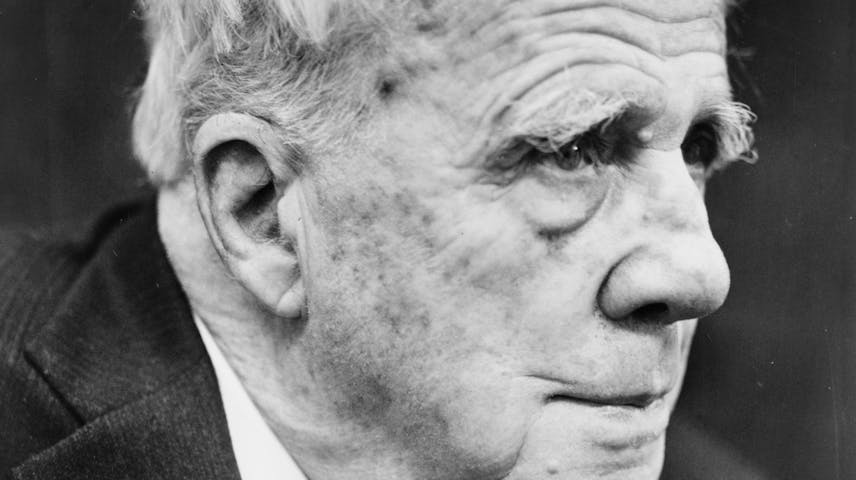
Robert Frost in 1949. Photo by: Walter Albertin/NY World Telegram/Library of Congress.
By
Robert Frost
Text Type
Poem
Words
95
Published
1923
Editor's Note: "Nothing Gold Can Stay" by Robert Frost appears in his poetry collection, "New Hampshire: A Poem with Notes and Grace Notes," which was first published in 1923. The eight-line poem consists of four couplets. Couplets are two lines of verse, usually in the same meter and joined by rhyme to form a unit.
Nature's first green is gold,
Her hardest hue to hold.
Her early leaf's a flower;
But only so an hour.
Then leaf subsides to leaf.
So Eden sank to grief,
So dawn goes down to day.
Nothing gold can stay.
Review elements of narrative writing through partner discussion.
Retell and Paraphrase Partner Check
Say these Directions: With a partner, take turns completing this sentence. Continue until each partner has offered at least two examples.
Narrative writing can include _____.
a story; a plot; a conflict; a point of view; characters; sensory details; figurative language; inner thoughts; direct address; a unique voice; vivid word choice; dialogue.
Bring the class back together and elicit students’ ideas until several different elements of narrative writing have been shared.
Connection to Today’s Learning
Say: In narrative writing, you can use language in many ways to tell a story and convey ideas. It’s also important for narrative writing to be clear and easy to understand. Today you’ll look at how Hinton uses specific words and sentences to develop characters and point of view. You’ll learn more about how to craft strong sentences, with the goal of revising and editing a narrative nonfiction paragraph.
Guide students in combining sentences using Kernel Sentences to show relationships between ideas and improve clarity. Model examples, then support partner practice, including correcting misplaced modifiers.
Language Study
Combining Kernel Sentences
Say these Directions: Today, we will combine sentences. Read the kernel sentences and answer the questions.
Project these kernel sentences and read them aloud.
Ponyboy was hiding. He felt nervous.
Model one way to combine the kernel sentences.
When Ponyboy was hiding, he felt nervous.
Ask: Which word shows the connection between the two sentences?
when
Ask: How does this word connect the sentences?
It shows that two things are happening at the same time.
Model another way to combine the kernel sentences.
Ponyboy felt nervous; he was hiding.
Point out the semicolon. Explain that this punctuation mark is a way to connect two ideas that are closely related.
Ask: Which connecting word could I use in place of the semicolon?
and
Project two more kernel sentences and read them aloud.
Ponyboy read books. Books distracted him.
As needed, explain that distracted means “makes someone think or pay attention to something else.”
Point out the repeated word “books.”
Ask: If I wanted to use a pronoun instead of saying books a second time, which pronoun could I use?
they
Say: With a partner, practice combining the two new kernel sentences above, replacing books with a pronoun as needed. Write more than one new sentence, combining the sentences in different ways. You may change some of the words and their order as needed.
When Ponyboy read books, he was distracted; Ponyboy read books and they distracted him; Ponyboy read books to distract himself.
Bring the class back together and review how the ideas in each sentence are related. Allow students to share their work. Discuss how each new combination changes the meaning.
Ask: How does the sentence show a cause-and-effect relationship?
Correcting Misplaced Modifiers
Present these two sentence combinations and read them aloud:
While reading, books distracted Ponyboy.
While reading, Ponyboy was distracted.
Ask: One of these sentences is correct, and one is incorrect. Which one do you think is incorrect? Do you know why?
While reading, books distracted Ponyboy.
Ask: Who is performing the action of reading in the sentences, Ponyboy or the books?
Ponyboy
Reread the first sentence. Explain that since the noun “books” comes right after the phrase “while reading,” the sentence implies that the phrase is describing the books, not describing the person reading them.
Reread the second sentence.
Ask: Which noun does the phrase “while reading” describe in this sentence?
Ponyboy
Say: When a phrase describes or gives more detail about a word in a sentence, it modifies the word. Another word for this description is a modifier. When modifiers are placed next to the wrong word, as they are in the first sentence, they are called misplaced modifiers.
Say these Directions:Read the sentence below. Then, work in pairs to rewrite the sentence correctly.
Feeling nervous, the church was where Ponyboy hid.
Feeling nervous, Ponyboy hid in the church.
Allow students to share their work. Discuss sentence meaning as a class.
Teacher Tip
For this activity, accept sentence combinations that are grammatically correct and make sense even if they do not reflect the relationship between events in the book. (Ex. Because Ponyboy felt nervous, he was hiding.)
As needed, use student responses to discuss how transition words change the meaning of sentences, such as by connecting events in time (as, when, while) or showing a cause–effect relationship (so, because).
🎯PURPOSE
Help students combine kernel sentences and correct misplaced modifiers so that relationships between ideas are clear and pacing supports meaning in narrative writing.
🗣️SAY / ASK
Explicitly name the relationship between clauses: time (when/while), cause (because/so), contrast (but/however).
Require students to identify the subject performing the action before revising misplaced modifiers.
Model how punctuation choices (semicolon vs. conjunction) change tone and pacing.
Press for subject clarity: “Who is doing the action in this sentence?”
“These clauses are connected because ___.”
“I chose ___ (when/because/while) to show ___.”
“The modifier describes ___, not ___.”
👁️WATCH FOR / SUPPORT IF NEEDED
Validate multiple grammatically correct combinations and highlight how each shifts emphasis and pacing.
Revoice vague combinations: “He was hiding and nervous” → “When he was hiding, he felt nervous.”
Upgrade connectors: “and then” → “while,” “because,” “as a result.”
If students write comma splices → Prompt: “Is this two complete ideas? Add a conjunction or use a semicolon.”
If modifier is misplaced → Prompt: “Who is doing the action? Move the phrase next to that noun.”
Students correctly combine at least one set of kernel sentences using a logical connector.
Students can explain why a modifier is misplaced and fix it.
Students articulate how punctuation affects meaning or pacing.
Connection to Today’s Learning
Say: As you reread a passage from The Outsiders, pay attention to how the author uses sentences and transition words to show relationships between ideas.
Situation
Try this
Struggling with: Combining Sentences in Original Ways
Provide additional examples for the first two kernel sentences, and guide students to use them for the second two kernel sentences. (Ex. As Ponyboy was hiding, he felt nervous; Ponyboy felt nervous when he was hiding.)
Struggling with: Identifying Misplaced Modifiers
Work through a simpler example and non-example. Ask guiding questions to help students identify the modifier and what it modifies. (Ex. Example: Angrily, I slammed the door. Non-example: Angrily, the door slammed.)
Ready for extension: Exploring Sentence Combinations
Have students practice “mixing and matching” the four kernel sentences from the activity to create different combinations. Challenge them to create a sentence that includes details from all four kernel sentences. Ponyboy felt nervous as he was hiding, so he read books to distract himself.
Part A: Review Examples of Craft Elements: The Outsiders, Chapter 3 (W.7.9.a) (10 minutes)
As a class, reread the paragraph from Chapter 3 beginning “In the country” (p. 48) where Ponyboy imagines country life and describes his parents. Have students take turns reading sentences aloud.
Think-Pair-Share
Say these Directions: Think about your response to this question first, and then share and refine your answers with a partner.
How does Ponyboy’s narration show that there was a “golden” time in his past? How does this passage help you understand what “gold” symbolizes in the text?
Ponyboy describes a time when his brothers were happier than they are now. For instance, he explains that Darry used to be different. He also chooses positive memories associated with his parents and calls his mother “golden.” These times are “golden” to him both because they are special and because they are short-lived. He knows he will never experience them again. For instance, he will never see his mother again because she passed away.
How Authors Connect Ideas and Pace a Scene
Say: As we read, we will review clauses and how they are connected. We will also consider the pacing of the text and how it relates to how narratives are written.
Clause: A group of words that includes a subject and a verb; can appear once or multiple times in a sentence
Pacing: The speed at which a story is told
Draw students’ attention to a sentence in the “In the country . . .” passage that connects multiple clauses using commas and the word and. Have them reread the sentence.
Explain or review that a clause is a group of words that includes both a subject and a verb. A sentence can have a single clause or multiple clauses. Clarify this idea by pointing out or having students point out a single clause in the sentence.
Ask: How are the clauses in this sentence related?
Each clause describes something Ponyboy wishes would happen if his parents were still alive.
Ask: How are the clauses in this sentence connected to each other?
The clauses are connected with commas and the word and.
Explain that authors can use long sentences with multiple clauses to share several ideas that are related to each other. Then introduce the concept of pacing.
Ask: What does the word pace mean?
the speed at which you move
Ask: Based on this meaning, what do you think pacing is in narrative writing?
the speed at which a story moves
Explain that pacing describes the speed at which a story is told. Authors can use sentences, punctuation, and other elements to speed up or slow down a story, creating a rhythm that helps the narrative “flow.” This affects how quickly or slowly the reader moves through the story.
Point out a set of two or three sentences within the passage where the author follows a short sentence with a long sentence or vice versa.
Ask: How does the length of sentences affect the pacing?
The reader can move quickly through the short sentences and more slowly through the long sentences.
Point out the final sentence of the paragraph (“My mother was golden and beautiful . . .”). Explain that the author makes this sentence short so the reader will focus on its ideas.
Ask: How is this sentence important to the paragraph?
The sentence emphasizes how Ponyboy’s memories of his mother are special to him and how his time with her was “golden” or precious and temporary. It leaves a strong image in the reader’s mind.
Point out the ellipses in the passage and explain what they are called.
Ask: Have you seen this punctuation before? These three dots are called ellipses. How does this choice of punctuation affect the pacing of the text?
It slows the pace down and draws out the passage.
Explain that authors can use ellipses to give the narrative more depth by creating dramatic pauses. As the reader pauses during the ellipses in this paragraph, they can imagine what the narrator is thinking and feeling.
Choose a set of ellipses in the passage.
Ask: What could Ponyboy be thinking or feeling at this moment?
He could be imagining what his life would be like if his parents were still alive.
Ask: How do these ellipses help readers focus on this moment?
They help readers slow down and think.
Ask: Why do you think the author would want readers to focus on this moment?
The author wants readers to learn more about Ponyboy by imagining what his relationship with his parents was like.
🎯PURPOSE
Support students in analyzing how sentence length, clause structure, and punctuation shape pacing and deepen understanding of Ponyboy’s perspective.
🗣️SAY / ASK
Require students to identify at least one long sentence and explain how its clauses build emotional layering.
Ask students to label pacing moments: “slow reflection” vs. “quick realization.”
Push students to connect craft to meaning: “Why here? Why this sentence length?”
Press for effect language: “This emphasizes ___.”
“The author slows the pacing by ___, which makes the reader ___.”
“This clause adds ___ to Ponyboy’s perspective.”
“The short sentence emphasizes ___.”
👁️WATCH FOR / SUPPORT IF NEEDED
Affirm analytical risk-taking and multiple interpretations when grounded in textual evidence.
Upgrade general comments: “It’s long” → “The long sentence layers memories and slows the pacing.”
Revoice symbolic thinking: “gold = good” → “gold symbolizes a brief, precious stage of life.”
If students summarize only → Prompt: “How does the sentence structure shape the feeling?”
If students struggle with clause identification → Prompt: “Find the second subject + verb. That’s another clause.”
Students identify at least one pacing move (long sentence, ellipsis, short sentence).
Students connect craft choice to point of view.
Students use academic vocabulary (clause, pacing, symbolizes).
Provide students with a confidence continuum (i.e., 1–5). As needed, model how to demonstrate a level of confidence using the continuum.
Reflection (W.7.9.a)
Use the Reflection routine to reflect on your understanding of the elements of good narrative writing that you have learned so far, such as sensory detail, imagery, a unique voice, clear connections between ideas, and appropriate pacing using the Reflection routine.
How confident are you with your ability to identify these elements in text when you read?
Part B: Revise a Narrative Paragraph (W.7.3.c, W.7.3.d, W.7.5, L.7.1, L.7.3.a) (20 minutes)
Identifying Areas for Revision
Display the sample paragraph and explain that it is a draft of a narrative nonfiction paragraph about the poem “Nothing Gold Can Stay.” Read the paragraph aloud.
Early in the day, the poem describes a gold dawn when everything is perfect. The poem describes how a pretty flower will disappear. It starts bright, like dawn. It fades to be darker. Feeling special, gold could stand for happiness. But flowers and leaves will disappear, the poet calls nature “her,” and the color green represents the natural world. Nature has a hard time holding on to happy things like dawn and flowers. The poem describes how nothing good lasts, even if you feel good now, you might feel grief later.
Then, guide students through revisions of the first four sentences.
Read the first sentence aloud.
Ask: What is happening “early in the day”? Is the poem itself happening “early in the day”?
No, the gold dawn is happening.
Say: This is a misplaced modifier. I’ll rewrite the sentence to say, “Early in the poem, everything is perfect in the gold dawn.” This sentence will set the scene.
Read the second sentence aloud.
Ask: Which words in this sentence could be more vivid and precise? Which words could we use instead?
pretty: delicate, gorgeous, glowing
Say: Let’s revise this sentence so it connects to the first sentence clearly by showing a time transition.
Model a revision. (Ex. Later, a glowing flower disappears.)
Read the third and fourth sentences aloud.
Ask: What exactly are these sentences describing?
the day, the light in the day
Ask: Do any words make these sentences confusing? How?
The word “it” is confusing because readers do not know what “it” is.
Ask: Do these sentences express any new ideas that have not appeared earlier in the paragraph? Why do you think the author included these sentences?
Answers may vary; listen to students’ suggestions and guide them to understand that while the sentences include new images, they do not include new ideas. The author included these sentences to emphasize the ideas using new images.
Model and explain a revision, such as:
Combining the sentences and using imagery to describe an idea in a new way (Ex. The shine of the dawn dims.)
Deleting the sentences altogether to pace the paragraph more quickly
Say these Directions: Work with a partner to revise and rewrite the paragraph.
Consider these questions as you revise:
Are the clauses or ideas in each sentence related to each other in a way that makes sense? If not, can any clauses be edited, added to another sentence, or deleted?
Is each description, or modifier, clearly connected to the word(s) it describes? If not, how can you rewrite the sentence so the reader understands what is being described?
Does the paragraph describe a logical sequence or order of events/ideas? If not, how can you put ideas in the right order for a clear beginning, middle, and end?
Did you use transition words, phrases, or clauses to show sequence and signal shifts in time or setting?
Where can you choose more vivid, precise words, such as to describe sensory details?
Where can you change or omit words and details that are repetitive?
Where can you change the punctuation to make transitions clearer?
Circulate as students revise, providing assistance as needed.
Early in the poem, everything is perfect in the gold dawn. Later, a glowing flower disappears. The shine of the dawn dims. Gold stands for joy and satisfaction, but these feelings will disappear, like flowers and leaves do. Green represents the natural world, where signs of happiness are delicate and temporary. The poem uses images of nature to show how sunny moments in life can quickly give way to grief.
Teacher Tip
Students may need clarification about how narrative nonfiction writing “tells a story.” As needed, reinforce that narrative nonfiction can often tell a story by describing a sequence of events in a connected, logical way. In this case, the paragraph is retelling the “story” of the poem: describing how “gold” (newness, freshness) eventually disappears because it is fragile and temporary.
🎯PURPOSE
Help students revise a narrative paragraph by improving clarity, precision, sentence variety, and pacing so the paragraph tells a coherent “story” of the poem’s ideas.
🗣️SAY / ASK
Encourage students to retain their voice while strengthening precision and clarity.
Require one revision for each category: clarity (modifier), precision (stronger word), pacing (sentence length), and transitions ( words, phrases, or clauses) that show sequence or shifts in time/frame or setting.
Model think-aloud revision: explain why each change improves flow or meaning.
Emphasize that revision is meaning-driven, not just grammar correction.
Upgrade redundancy: combine repetitive sentences into one cohesive sentence.
“I revised this sentence to ___ because ___.”
“This word is more precise because ___.”
“I combined these clauses to show ___.”
👁️WATCH FOR / SUPPORT IF NEEDED
Validate improvement rather than perfection during revision.
Replace vague wording: “pretty flower” → “delicate golden flower.”
Press for transition clarity: “But” → “However,” “Later,” “As a result.”
If paragraph lacks clear sequence → Prompt: “Add one transition that shows time or change.”
If sentences are repetitive → Prompt: “Can two of these sentences become one stronger sentence?”
If pacing is flat → Prompt: “Add one short sentence to emphasize the key idea.”
Student identifies and corrects misplaced modifier.
Student uses at least one stronger descriptive word.
Student includes at least one varied sentence type (complex or compound).
Paragraph shows clearer logical progression of ideas.
Situation
Try this
Struggling with: Identifying Potential Revisions
Close-read the paragraph, sentence by sentence, with a small group. Ask either-or questions to guide revisions. (Ex. Would the word sunshine or satisfaction be a better way to describe what gold stands for?)
Struggling with: Rephrasing Sentences
Provide blank sentence frames to help students rephrase the main ideas in the paragraph with varied pacing. (Ex. “Gold images, like _________ and ________, ________. The dawn ______.”)
Ready for extension: Preparing to Revise Their Own Writing
Ask: Which narrative craft element do you want to get better at using in your own writing? How do you think you can improve this element?
I want to get better at pacing in my own writing. I think I can improve by using a variety of sentence lengths rather than making all my sentences the same length. Scoring Rubric
Checklist (W.7.3.d, W.7.5, L.7.1.b, L.7.1.c)
As you revise your draft narrative paragraph, make sure that you:
Identified and adjusted the misplaced modifier.
Changed words in the original paragraph, where appropriate, to create more vivid and specific imagery and/or add sensory detail without altering meaning.
Rewritten or broken up long, disconnected sentences in a way that shows clear connections between ideas.
Varied sentence lengths and omitted unnecessary repetition of words.
Ordered ideas from beginning to end in a clear, logical sequence that relates to the progression of ideas in the poem.
Used varied punctuation to accurately show relationships between words, phrases, and ideas.
Writing prompt: Write a narrative paragraph that includes at least one exchange of dialogue and uses pacing techniques to slow down a key moment. Show how the characters speak and act in a way that reveals something about their relationship or identity.
Criteria
1 — Beginning
2 — Developing
3 — Proficient
Organization & Pacing
(W.7.3.c)
Pacing to Shape the Reader
The paragraph does not use pacing intentionally. All moments receive equal space, or the most important moment is rushed.
The paragraph attempts to slow down the key moment, but pacing is inconsistent. Some details are vivid, others remain general.
The paragraph intentionally slows down the key moment using specific details, and moves quickly through background. Pacing guides the reader's attention to what matters most in the scene.
Voice & Style
(W.7.3.d)
Dialogue That Reveals Character
Dialogue is absent or does not sound like the characters. Speech does not reveal anything about the relationship or identity.
Dialogue is present and generally appropriate for the characters, but it is used without much effect. What is revealed about the relationship or identity is vague.
Dialogue sounds authentic to the characters and reveals something specific about their relationship or identity. The way characters speak — their word choices, tone, what they say and don’t say — does real narrative work.
Dialogue Punctuation
(L.7.1.b)
Punctuating Dialogue Correctly
Dialogue is not punctuated correctly. Quotation marks, commas, and capitalization conventions are missing or misused throughout.
Dialogue punctuation is correct in most places, but one or two errors remain — particularly with commas inside quotation marks or capitalizing after speech tags.
All dialogue is correctly punctuated: quotation marks enclose speech, commas set off speech tags, and capitalization follows conventions. Punctuation supports clarity and readability.
Sentence Variety
(L.7.1.c)
Varied Sentences for Effect
Sentence structure is repetitive. Most sentences follow the same subject-verb pattern without variation.
Some sentence variety is present, but it is not consistent. Two or more consecutive sentences may follow the same structure.
Sentence structure is varied purposefully. Short sentences create emphasis or pace; longer sentences develop detail. The variation creates rhythm that supports the pacing of the narrative.
Have students reflect on challenges in revision and identify areas for growth. Use responses to guide future instruction on writing skills.
Quick Write
Say these Directions: Complete a quick written response to this prompt:
Ask: Which part of revision is most challenging to you—combining and connecting ideas, correcting grammar and punctuation to improve sentences, or making stronger word choices? What do you want to understand about this part of revision?
I find it challenging to correct grammar and punctuation because there are many possible corrections I could make, and I don’t always know which corrections are the best ones. I want to understand more about what makes one grammar and punctuation choice better than another.
Optional Sentence Frame: “_____ is most challenging to me because ______. I want to understand ____.”
Have students finish reading and annotating Chapter 5, if they have not already done so, and use their annotations and notes to write a brief paragraph in their Journal that answers the question in the Lesson 14 homework prompt. Their paragraph should show clear connections between ideas.
How does being in the church change the way Ponyboy and Johnny see themselves?