Loading course navigation
Loading lesson
50 min
Student Lesson
Lesson 27: The Outsiders, Chapter 7, Part 2
Content
Students will read an informational article about Maslow’s hierarchy of needs and apply this framework to analyze relationships and the theme of empathy in The Outsiders.
Language
Students will use cause/effect connectors (because, therefore, as a result), academic verbs (reveals, suggests, demonstrates), and comparative language (similarly, in contrast) to explain how empathy bridges social divides.
Foundational Skills
Students will apply knowledge of high-utility roots/affixes to understand vocabulary related to physical and relational needs.
What helps people navigate social differences and see from one another’s perspectives?
Knowledge-Building:
Apply ideas from an informational text to themes in a literary text as they examine the importance of relationships and empathy.
Enduring Understanding:
Communities help meet fundamental human needs, and empathy can help strengthen communities and bridge divides.
Future Lessons:
In Lesson 28, students will discuss the ideas they explored in this lesson with a focus on how people can bridge divides.
Unit Performance Task:
Analyzing examples of unexpected empathy may help students consider the ways empathy might have unexpectedly crossed divides in their own lives.
| Lesson Flow | Purpose of Learning Experience |
|---|---|
Launch5 Minutes | Students will build knowledge of the prefix physio- and the suffixes -logy and -logical. |
Literacy Lab10 Minutes | Students will use a word matrix to explore words that can be formed with the root act and build this knowledge to understand the term self-actualization. |
Learning in Action30 Minutes | Part A: Discuss Informational Text: “Maslow’s Hierarchy of Needs” (RI.7.2, RI.7.3, L.7.4.c, L.7.4.d) Students will read and explore central ideas in an informational article and relate concepts in the article to their prior knowledge of key themes/topics in the text. Part B: Close Read, Write, and Share (RL.7.2, RL.7.3, RL.7.6) Students will use a Think-Write-Pair-Share routine to discuss text-dependent questions about Chapter 7 and explore key themes further. |
Not available for this lesson
Material List
Word slides with prefix and suffix
Academic Talk Stems/Moves cue cards
Write-Pair-Share graphic organizer
The Outsiders, S.E. Hinton, Chapter 7
Unit 1, Lesson 27 Student Edition
Routines
Daily Warm-Up: Introduce New Words Using Morphology
Word Matrix
Academic Talk Stems/Moves
Think-Write-Pair-Share
Prepare a slide with the prefix physio- and another slide with the suffixes -logy and -logical.
Explain or review that the prefix physio- means "nature, natural, physical," from Greek physios, "nature."
Explain or review that -logy means “the study, knowledge, or science of.”
Ask: Based on your knowledge of physio- and -logy, what do you think physiology means?
related to the study of the physical and the natural
Have student pairs complete one or more of these sentence frames to confirm understanding.
Physio- means __________, (physical/natural) and -ological means _________________ (related to the study of), so physiological probably means ______________. (related to the study of the physical and natural)
When someone studies physiology, they are studying the science of ___________. (living, natural things)
One physiological need that people have is _______________. (Ex. air, drinking water, food)
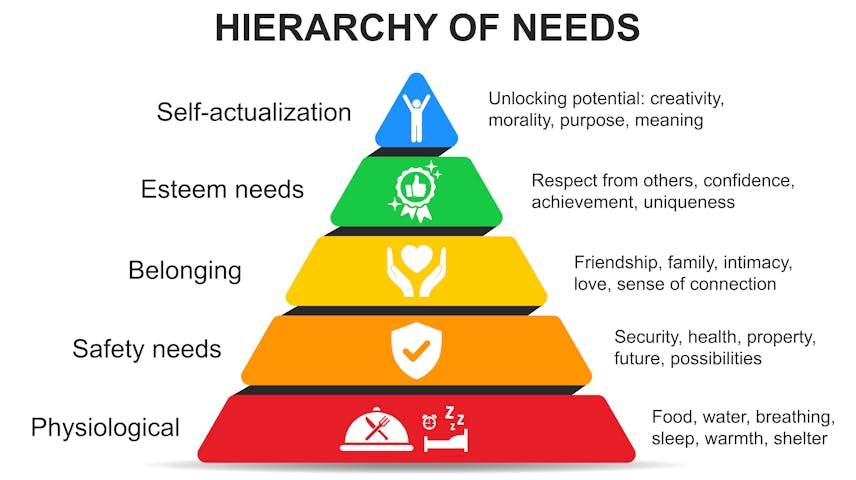
Say: You may have noticed from the informational article that some of our needs are physiological needs—needs related to our physical bodies. You also learned there are other kinds of needs, such as relational needs. As you reread the article and discuss Chapter 7, you will consider the importance of nonphysical needs and how they relate to communities in The Outsiders.
Target Word: self-actualization
Introduce Activity: Students will build word families by adding prefixes and suffixes to the root act. Display the word matrix below or create it on a board as a class.
Build Words from the Matrix : Explain that the left column contains prefixes; the middle column contains a root word: act (meaning “do” or “to do,” as in to perform an action); and the right column contains suffixes. Guide students in selecting word parts from the columns to create new words and determine the meanings by combining prefixes and/or suffixes to the root.
For actualization (root: act= do/to do):
Prefix | Root | Suffix |
|---|---|---|
inter- | (blank) | -ion |
re- | act | -ing |
(blank) | (blank) | -ive |
(blank) | (blank) | -ual |
(blank) | (blank) | -ivate |
(blank) | (blank) | -ually |
(blank) | (blank) | -ualize |
(blank) | (blank) | -ualization |
Prefix | Root | Suffix | New Word | Meaning |
|---|---|---|---|---|
re- | act | -ing | reacting | responding to a situation or event |
blank | act | -ual | actual | Real, not imagined |
blank | act | -ualize | actualize | make real; turn into a reality |
re- | act | -ion | reaction | response to a situation or event |
blank | act | -ivate | activate | make something start happening |
inter- | act | -ion | interaction | an event when two or more people/things communicate with, or react to, each other |
Share Words: Prompt students to share some of the words they created and what they think they mean.
Discuss Patterns: Prompt students to discuss patterns and explain meanings:
Ask: How do the prefixes re- (back/again) and inter- (between/among) change the meaning of words?
Re- describes something that is happening as a response to something else, or happening “again”/coming “back” to the first event. Inter- describes something that involves or occurs “between” two or more things, such as an interaction between two people.
Build Word Relationships: Point out or display the words actual and actualize.
Say: When something is actual, it is real. What does this suggest about the meaning of actualize? When you actualize an idea, what could you be doing?
making the idea real or making it happen
Display the word actualization.
Ask: How are actualize and actualization related?
Actualization describes the state or action of actualizing or making something real.
Determine Meaning: Display the word self-actualization.
Ask: Based on your knowledge of the root word act and the words actualize and actualization, what do you think self-actualization could mean?
making something real or making something happen for yourself
Explain that self-actualization is the state of fulfilling or reaching your full potential, or becoming the best version of yourself. In other words, it means you are making something—your potential—real for yourself.
Ask: Explain to a partner how identifying the root word and building word matrixes helped you to understand how words “work.”
Say: Today, you’ll reread an article that describes self-actualization as one of many human needs. As you revisit the article, consider why self-actualization and other human needs might be important to people in general and to the characters in The Outsiders.
Transition by asking students to volunteer what they think hierarchy might mean based on the article’s title, the image, and their initial reading. (Ex. order, grouping)
As needed, explain that a hierarchy is a system in which people, groups, or things are ranked in order according to importance. It often applies to people in groups, but it can also apply to ideas or concepts, as it does in the article.
Read the article once more as a class. Have students take turns reading aloud and practicing fluency. Assist with pronunciation as needed. Pause after each subsection and ask comprehension questions to check for understanding.
Ex: Why does Maslow believe people do not need to completely satisfy “lower” needs before they move on to “higher” needs?
Provide cue cards with the following talk moves:
Add On: I’d like to add to that … / I also think/feel that …/ That reminds me of …
Inquire: Why do you think that? /Why do you feel that way? /Can you give an example? /What if…
Challenge: I agree because…/I disagree because…/ In my opinion…/Could it also be that …
Begin by having students briefly consider this question:
What is one possible way that love, belonging, or esteem could help someone reach self-actualization?
Have a student volunteer a response. Model replying to them using a talk move.
Someone could feel they belong in a community and then achieve self-actualization by working to help that community.
Say: Could it also be that this person gets their esteem needs met from being a valued member of their community?
Invite students to use any of the provided talk moves to continue the discussion.
Repeat the routine with the questions below. Model using talk moves, as needed, as students discuss. Encourage students to use the terms physiological, self-actualization, and hierarchy in their responses as relevant.
After briefly discussing the opening question, transition into discussing these questions. Continue to model using Inquiry and Challenge talk moves as appropriate.
Ask: How does the article help you understand the role of relationships in meeting people’s needs?
The article explains that even if people do not have their physiological needs fully met, such as safety and food, they can still pursue needs higher in the hierarchy, such as esteem and belonging, and these needs are still important to them. It helps me understand how, in some cases, feeling valued in a relationship can be just as important as having your material needs met.
Ask: How does the article contribute to your understanding of chosen family, belonging, and identity?
I learned that belonging is an important human need, which helps me understand that people may form chosen families out of need. The idea of self-actualization helps me see how feeling fulfilled, or that you are doing what you are supposed to do, can be important to identity.
Listen for students to:
Connect the article’s ideas to their prior knowledge of chosen family and the way belonging impacts identity.
Use a variety of talk moves to support, build on, and—as appropriate—respectfully challenge others’ ideas.
Show understanding of the terms hierarchy, physiological, and self-actualization.
Teacher Tip |
|---|
As appropriate, use unfamiliar words in the article as opportunities for students to identify meaning from context. Remind students to look at the words, phrases, and sentences surrounding an unfamiliar word to see if they explain it, give an example, or restate the idea. For instance, students may not know the word inferior, but the surrounding sentences contrast it with feeling "confident and proud," suggesting it means feeling not good enough or less than others. Similarly, self-actualization is explained directly in the text as "becoming the best version of yourself," with examples that follow to illustrate the idea. |
Pulse Check (RI.7.2) |
|---|
Which statement best expresses a central idea of the article “Maslow’s Hierarchy of Needs”?
|
Introduce this variation of the Essential Question: Why does empathy help us see across divides? Ask students to consider this question during the following routine and Look Back.
Say: Now that we understand how people have physical and relational needs, we can use Maslow’s ideas to better understand empathy in The Outsiders. When characters meet one another’s needs—note belonging or esteem—they begin to ‘see across divides.’ Refer back to the hierarchy as needed as we examine Chapter 7.
Display Character Chart and allow students 1–3 minutes to look over the present entries up to Chapter 7.
Review the Character Chart and its entries for Two-Bit, Steve, Soda, and Randy. Ask if students want to add any more adjectives to the chart to describe characters they know better now, such as Randy and Bob. (Ex. Randy: conflicted, concerned; Bob: loyal, intelligent)
Have students independently review and annotate the second part of Chapter 7, page 105, starting with “Anybody home? …”. Assign each student one of the questions below. If possible, assign an equal number of students to each question.
Ask students to annotate in response to their assigned question. Have them use their annotations, the observations they recorded in their Lesson 26 homework, and the information they learned from the article (as relevant) to help answer the question.
Have them write a brief response to the question using the Write-Pair-Share graphic organizer. Then have them share and refine their responses with a partner assigned the same question before transitioning to a whole-class discussion. Students could form three-person groups as needed based on class size.
Question 1: Choose a moment when a greaser shows empathy for another member of his chosen family. What does this interaction show you about how empathy can strengthen groups to which people belong? What does the interaction suggest about how people meet their needs in the hierarchy?
Two-Bit shows empathy for Darry when he offers to spend time with Ponyboy as Darry goes to work. He knows Darry doesn’t want to leave Ponyboy alone and says, “Darry, you ought to let me take him for a while. You’ve got to go to work, and I ain't got nothing to do. We can go to a movie or something." This interaction shows that empathy can strengthen groups when group members are able to meet one another’s needs, even if the other person does not ask. It suggests that people can meet their needs for safety and belonging by turning to others.
Question 2: Choose a moment when Ponyboy shows empathy for Randy. What does this interaction show you about how unexpected empathy can help people see across divides? What does the interaction suggest about how people meet their needs in the hierarchy?
Ponyboy shows empathy for Randy by being willing to listen when Randy describes what a good friend Bob was. This interaction shows that people can empathize with someone they once saw as an enemy. When they learn more about that person, they may understand why they acted in a certain way. The interaction suggests that even when people seem to have all their needs met, such as a wealthy person like Bob, they may not feel belonging or esteem.
Question 3: What does Ponyboy learn by considering events from Randy’s perspective? How does Ponyboy’s own perspective change? What does the reader learn, and how does the reader’s view of the characters change?
Ponyboy learns that the Socs do not have everything they want—they want protection and boundaries, and some of them, like Randy, want an end to conflict. Ponyboy starts to see how the Socs have some of the same needs and vulnerabilities as the greasers do, despite their different circumstances. For instance, both groups feel disconnected from “the whole world.” The reader also learns more about how it is “rough” for the Socs in a different way than it is for the greasers. They see that the characters are more complicated than they thought.
Check for Understanding [RL.7.2, RL.7.3] |
|---|
Listen for students to:
Modeling: Begin by focusing on one key quote and explaining how it contributes to the reader’s understanding of empathy and connection across divides. Have students select a second quote and put it on either side of the first quote to begin ranking the importance of quotes. |
Ask: Consider how and why Ponyboy compares Randy to Darry in Chapter 7. What does this comparison show you about the impact of unexpected empathy?
Optional Sentence Starter:
Ponyboy compares Randy to Darry because ____. This comparison shows me_______.
Ponyboy notices that both Randy and Darry look older than they really are. He believes this is because of the stress and worry Randy and Dally have both experienced at a young age. This comparison shows that when people pay attention to details about others, they may find unexpected empathy by imagining the circumstances of others’ lives.
Students will begin reading Chapter 8 and take notes in their Journal on the following prompt:
As you read, annotate the text for the following:
Where do you notice moments of connection, and where do you notice moments of division?
Maslow’s Hierarchy of Needs
Standard News Bureau