Loading course navigation
Loading lesson
50 min
Student Lesson
Lesson 23: Flex Research: When History Looks Different
Content
Students will corroborate two sources about the same aspect of Japanese American incarceration by identifying agreement, divergence, and reasons the accounts differ.
Language
Students will explain how purpose, audience, access, and time of creation shape source differences using evidence-based language and source attribution.
How can readers evaluate words and images for accuracy, perspective, and ethical use?
Knowledge-Building:
Students build on the previous lesson by returning to a photograph that was already analyzed and pairing it with a second source.
Enduring Understanding:
Historical understanding depends on how events are documented and interpreted across different kinds of sources.
Future Lessons:
In future lessons, students will revisit survivor stories and associated photographs with attention to perspective, tone, and purpose.
Unit Performance Task:
Students gather and compare image and text evidence so they can present a hidden or overlooked story with accurate context and ethical representation.
| Lesson Flow | Purpose of Learning Experience |
|---|---|
Launch5 Minutes | Students reconnect to the photograph they analyzed in Lesson 22 and identify what new source could deepen or challenge their first reading. |
Literacy Lab: Corroboration Moves + Search Terms10 Minutes | Students learn the corroboration routine and build precise search terms that help them find a useful second source. |
Learning in Action30 Minutes | Part A: Find a Second Source (W.7.7, W.7.8) Students use search terms and a source set to locate and record a second source connected to their original image. Part B: Explain Agreement and Difference (RI.7.6, RI.7.9) Students compare two sources on the same event or aspect and explain why the sources might represent it differently. |
Material List
Seen and Unseen
Unit 2 Lesson 23 Student Edition
Comparing Multiple Sources graphic organizer
Students’ Lesson 22 annotated photograph or image notes
Approved printed corroboration source set with short oral-history excerpts, captions, historical notices, and archival images related to Japanese American incarceration
Routines
Turn and Talk
Quick Write
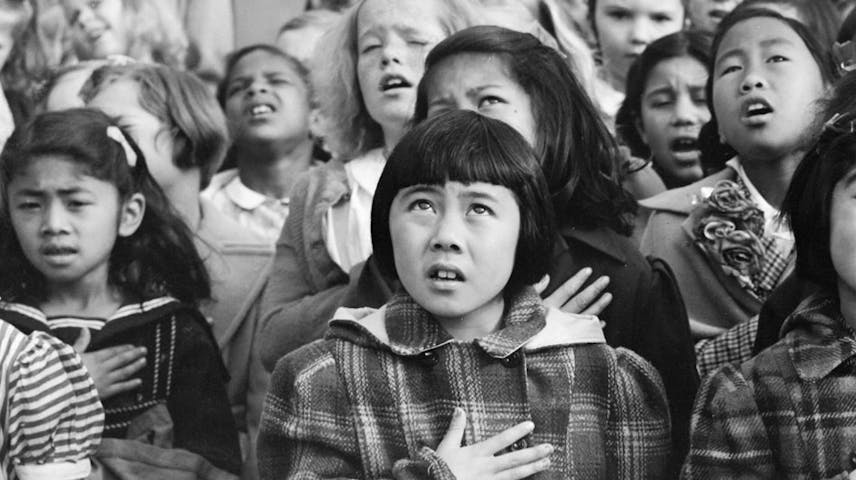
Display the photograph students analyzed in Lesson 22 and invite them to take out their annotated notes from that lesson.
[Image URL= [https://drive.google.com/file/d/1rkHOLICUd6s4usFUsvuM3KSNT4fgYFHJ/view?usp=drive_link]}
Students briefly revisit their carry-forward artifacts from Lesson 22 so they can move from visual analysis to source comparison.
Say these Directions: In Lesson 22, we studied how a photograph can show some things and hide others. Today, we are using that same image to find a second source that helps us test, deepen, or complicate what we think we know. This matters because responsible witnesses do not stop with one source.
Ask: What question did your photograph leave you with, and what kind of second source might help answer it?
My photograph made me wonder where the people in the image were going and what they were thinking, because the photo shows their faces, clothing, and how closely they are crowded together but not their thoughts. A survivor interview or letter could help answer that because it might reveal emotions the camera cannot show.
Connection to Today’s Learning:
Say: We now move from noticing visual perspective to corroborating across source types.
Continue using the shared class model topic from the Lesson 22 research pair: a photograph showing a Japanese American family waiting for removal. The class will model how to find and compare a second source about the same event or aspect.
Display the three corroboration moves:
Read laterally: check who made the source and what kind of source it is before trusting its claims
Identify agreement: notice what both sources show, state, or suggest
Interpret divergence: explain why sources may differ because of purpose, audience, access, or time created
Teach:
When I corroborate, I do not ask only, “Did these sources match?” I ask, “What exact part of the event am I researching, and what second source could show a different angle on it?” A broad search like “WWII” is too wide, but a search like “Japanese American family removal 1942 oral history” is focused enough to find something usable. Once I find a second source, I compare where the sources agree, and then I explain the divergence by thinking about purpose, audience, access, and when each source was created.
Display this search formula:
event or aspect + place or year + source type
Examples:
Japanese American removal 1942 interview
assembly center family letter California
Dorothea Lange evacuation caption 1942
Ask: Which search string is most likely to help you find a useful second source about the photo of a Japanese American family in 1942?
“Japanese American family removal 1942 interview” is the strongest search string because it names the group, the event, the time, and the kind of source I want.
Check for Understanding (W.7.8) |
|---|
Write one focused search string for your own photograph and explain why it is more useful than a broad topic word.
|
Modeling: |
If needed, prompt students to move from a one-word topic to a searchable phrase by adding the event, time, place, or source type. |
Connection to Today’s Learning:
Say: You are ready to use focused search language to locate a second source and record it accurately.
Students use their Lesson 22 photograph as Source 1 and search the approved source set for Source 2. Keep the focus on the same event or aspect, not just the same general topic.
Say these Directions: Take out your Lesson 22 photograph notes. Use the Comparing Multiple Sources organizer to record your photograph as Source 1, then use two search strings to locate a second source that addresses the same event or aspect. Record full source information before you begin comparing the two sources.
Ask: What detail from your first source are you using as the anchor for your search?
I am using the detail that the families are crowded together and a mother is holding her baby before removal. That helps me search for a source about removal, departure, or evacuation instead of a general source about camp life.
Ask: What details from each source are important to your understanding?
Source 1 | Source 2 | |
|---|---|---|
What do you know about this source? | Dorothea Lange photograph of families at Turlock Assembly Center before removal, May 1942, photograph | Later oral-history excerpt from a person removed with family members, interview, oral history, published 1976 |
What do you know about the author or photographer? | Dorothea Lange was hired by the War Relocation Authority (WRA) to photograph the forced removal and incarceration of Japanese Americans. | Survivor who experienced removal as a child alongside family members. Firsthand account, but not much more known. |
What can you learn from this source? What mood, tone, or emotion does it convey? | The photograph shows the human reality of forced removal. It reveals how nervous these ordinary families and small children were, undermining any wartime justification that they posed a threat. | The oral history reveals the emotional impact of removal that a photograph cannot capture: fear, confusion, loss, and the lasting trauma on family relationships. |
Check for Understanding (W.7.8) |
|---|
Record the source information for Source 2 and write one sentence explaining how it connects to Source 1.
|
Modeling: |
If needed, prompt students to use this frame: “This source connects to my photograph because both sources show ___.” |
Students finish the organizer by identifying one agreement, one divergence, and one explanation for the divergence. Then they test their reasoning with a partner.
Say these Directions: Use the last sections of your organizer to identify one point of agreement and one point of divergence between your two sources. Then write 2–3 sentences explaining why the sources might represent the same event differently. Use at least two of these words in your response: purpose, audience, access, time, and perspective.
Ask: What is one way your two sources agree, and what is one likely reason they differ?
My two sources agree that families were forced to leave quickly with only what they could carry. They differ because the photograph was made during the event and mostly shows the outside of the moment while the oral history was told later and explains the emotions and memories behind it.
Ask: What question can you ask your partner to help test their explanation for divergence?
I can ask, “Do you think the difference comes more from when the source was created or from what the creator wanted the audience to notice?”
Display the following completed bottom organizer row if needed for support and guidance:
Similarities (Agreement) | Differences (Divergence) | What Conclusions Can You Draw? (Why the Difference May Exist) |
|---|---|---|
Both sources show forced removal of ordinary families. | The photo shows outward calm while the oral history describes fear and confusion. | The photo captures one visible moment, but the oral history was created later and adds reflection, memory, and personal feeling. |
Pulse Check (RI.7.9, RI.7.6) |
|---|
A 1942 photograph shows a family standing quietly with luggage before removal. A later oral-history interview about the same removal describes fear, anger, and confusion. Which explanation best accounts for the difference between the two sources?
|
Say these Directions: Answer both reflection prompts in 3–4 sentences. Name one source you used today and one next-step search term you might try in the next lesson.
What new information did you learn as a result of today’s corroboration work?
I learned that my photo showed only the visible part of removal. My second source, a short oral-history excerpt, helped me understand that people could look calm in a photo but still feel scared, angry, or uncertain. That changed how I read the image.
What changes, if any, do you need to make to your research process, and what are your next steps?
I need to make my search terms more precise. My first search was too broad, so next time I want to try a phrase like “assembly center family letter 1942.” My next step is to see if I can find a source that matches the same moment more closely.
Instruct students to complete the following:
Reread your two-source set from today. In your Journal, add one more search string you could use if you needed a third source, and write one sentence explaining what new perspective you hope that source would add.
Exposing Injustice: Incarceration of Japanese Americans
Dorothea Lange Digital Archive at the Oakland Museum of California