Loading course navigation
Loading lesson
50 min
Student Lesson
Lesson 5: Seen and Unseen, Part 1
Foundational Skills
Students will identify roots and analyze how known roots combine to create words with inferable meanings.
Content
Students will read an illustrated nonfiction description of the events leading to Japanese American incarceration and discuss how the author and illustrator offer a specific perspective on these events.
Language
Students will summarize key events and explain their impact by using sequencing language, academic explanation verbs, and time/place phrases, while referencing both text and illustrations.
Foundational Skills
Students will identify roots and analyze how known roots combine to create words with inferable meanings.
How do historical records (texts, images, and testimony) shape what is remembered about the past?
Knowledge-Building:
Students will learn how the US entry into World War II led to the incarceration of Japanese Americans in 1942 and understand the sudden nature and traumatic effects of the incarceration policy.
Enduring Understanding:
People shape civic memory through storytelling.
Future Lessons:
In Lesson 6, students will contrast the perspective of the text’s author with the official narrative that was promulgated at the time. Then, in Lesson 7, students will begin analyzing what they have read in light of the Essential Question.
Unit Performance Task:
Seen and Unseen shows how visual tools such as photographs can aid the task of witnessing a historic event.
| Lesson Flow | Purpose of Learning Experience |
|---|---|
Launch5 Minutes | Students will engage in a Turn-and-Talk discussion reflecting on what they have learned about Japanese American incarceration so far and what they expect to learn in upcoming lessons. |
Literacy Lab10 Minutes | Students will be introduced to three new vocabulary words relevant to the anchor text using morpheme instruction. |
Learning in Action30 Minutes | Part A: Identify Purpose (RI.7.6) Students will engage with the first pages of the text through annotation and discussion. They will connect the writing and illustrations to the author’s and illustrator’s purpose and position. Part B: Compare Media (RI.7.7) Students will compare the text in Seen and Unseen with previously encountered media about Japanese American incarceration. |
Material List
Student copies of Seen and Unseen pp. 1-7, by Elizabeth Partridge and Lauren Tamaki
Unit 2 Lesson 5 Student Edition
Key Terms and Topics graphic organizer (from Lesson 1)
Timeline graphic organizer
Routines
Turn-and-Talk
Morphology & Vocabulary
Check for Understanding
Activate prior knowledge about Japanese American incarceration and surface student questions before reading. Use partner discussion to prepare students for analyzing the text and its historical context.
Say these Directions: Take out your copy of Seen and Unseen with your annotations. Turn and talk with a partner about the question to prepare for reading. As you discuss, jot down notes.
Ask: What have you learned so far about the policies and events that led to the incarceration of Japanese Americans? What questions do you have as we begin reading Seen and Unseen?
I learned that the United States entered World War II suddenly after the Japanese military attacked Pearl Harbor. I learned that, officially, the government was worried that Japanese Americans would be disloyal and spy for Japan, so it ordered them to move away from the West Coast and live in camps. From the article we read, I know a little about what the camps were like, but I want to know more about how people lived there day-to-day and how they were treated.
Say: Today, you’ll begin reading Seen and Unseen, a nonfiction book that tells about the photographers who documented the Japanese Americans at Manzanar. You’ll annotate, answer text-dependent questions, and begin learning about the wartime circumstances that led to the creation of the camps.
Guide students in using morphology to determine the meaning of contraband. Support discussion to connect word parts to meaning and apply it to historical context.
Target Word: contraband
Say these Directions: We’re learning about the word contraband today. Take out your Key Terms and Topics graphic organizer as we explore the word more deeply. This word will be important for understanding Japanese Americans’ experiences and status in the United States during incarceration.
Introduce the Word: Write contraband on the board and pronounce it.
Ask: Have you seen this word before? Where?
Identify the Root: Underline the root band in contraband. Explain that band in this case is not like a rubber band or a band that plays music; instead, it comes from Latin bannum, which means official proclamation and shares its origin with the English word ban.
Ask: What does it mean to ban something? (to say it is not allowed, to prohibit it). The proclamation a leader would issue prohibiting something became the ban.
Identify Affixes: Circle contra- in contraband. Explain that contra- means “against.”
Ask: Have you seen other words that begin with contra- before? What do they mean?
If students need further prompting, offer contrary (going against something) and contradict (to say that something is not true) as examples.
Language Connection: In Spanish, contra is a standalone preposition meaning “against” and is used in most of the same senses as its English counterpart: one team against another, a bookshelf against a wall. Noticing the shared root can reinforce that contraband is something that goes against a ban.
Determine Meaning:
Ask: Using what we know about contra-/band, what do you think contraband means? (items that are brought somewhere despite being banned)
Check for Understanding |
|---|
List the word contraband in your Personal Dictionaries and then underline each root and circle each prefix and suffix. After each word, write the definition of that word and each focus morpheme. |
Connection to Today’s Learning
Say: Understanding vocabulary like contraband, Issei, and Nisei will help you understand the different groups of people involved in Seen and Unseen. As you annotate and answer text-dependent questions, notice how the photographs and illustrations combine with the text to tell the story.
Transition the students into partnerships to engage with the opening pages of Seen and Unseen.
Show students the inside cover of the book, Seen and Unseen.
Say these Directions: Take a moment to look at the different locations marked on the map from the inside cover of your book, Seen and Unseen. These are the places where Japanese Americans were imprisoned during World War II.
As a class, begin creating a timeline using the Timeline graphic organizer to plot four key events you will learn about. Then, begin reading Seen and Unseen from “Early in the morning . . .” on page 1 to “. . . declared war on Japan” on page 5. As you read, use the Turn-and-Talk routine to summarize events and locations—who is involved, where the events are taking place, and what is happening and connect your thinking to what you have already learned about Japanese American identity and public perception.
Pearl Harbor attack (Dec. 1941)
Executive Order 9066 (Feb. 1942)
Forced removal(1942–1945)
End of incarceration/camp closures (1945)
Provide additional details on these events as needed. Explain, for example, that the Japanese military attacked Pearl Harbor to weaken the American navy so that Japan, already at war, could gain control of Southeast Asia without interference.
Say these Directions: Respond to questions that will help you put these background pages in context and deepen your understanding. Record your responses on a collaborative idea board.
Ask: Look at pages 1–5. What colors does the illustrator use? Where do you see them, and what feeling does the illustrator create?
The pages are mostly dark — black and gray around the people. Red appears during the bombing of Pearl Harbor and when people are suddenly taken away. On page 1, the family is surrounded by a black circle, and the only color is on the radio dial. The colors show shadows and fear.
Ask: On page 5, the text says, “The next day, the United States declared war on Japan.” That sentence appears alone on a dark page. What would be different if that same sentence appeared mid-paragraph? What does its isolation do to a reader?
When a sentence stands alone on a dark page, it forces the reader to stop. You can’t miss it. If it were buried in a paragraph, it would feel like just another fact in a sequence. But alone, it's like an announcement and has more impact. It shows how everything changed with that one event.
Ask: How does the author’s perspective on these events differ from the perspective of the U.S. government at the time?
The author presents incarceration as unjust and harmful to Japanese Americans, while the U.S. government at the time described it as necessary for national security.
Pulse Check (RI.7.6) |
|---|
Which statement BEST explains the author’s perspective on Japanese American incarceration in Seen and Unseen?
|
Keep students in pairs. Have them read pp. 6–7 of Seen and Unseen
Turn-and-Talk
Say these Directions: Stay with your partner and read pages 6–7 of Seen and Unseen together. As you read, think about whether you recognize the photo from Spark Lesson 2 and answer the following questions.
Ask: The “I Am an American” photograph is a real historical photograph, while the surrounding images are Tamaki’s illustrations. Why do you think Partridge and Tamaki chose to place an actual photograph here rather than another illustration? What does the photograph do that an illustration couldn’t?
A photograph is proof that something really happened — someone actually painted that sign and hung it in a window. An illustration could show the same thing, but it wouldn’t have the same weight. By putting a real photograph with the illustrations, Partridge and Tamaki are showing us this is not imagined. This is documented.
Ask: The text on page 7 describes fear and rumors spreading. The photograph on pages 6–7 shows a sign reading “I Am an American.” What is the relationship between those two things — the text’s account of fear and the image of that sign? Does the photograph confirm the text, complicate it, or add something new?
The text describes Americans spreading rumors and questioning Japanese Americans’ loyalty. The sign says “I Am an American,” which is something no one should have to declare about themselves in order to be safe. The photograph doesn’t just confirm the fear described in the text; it adds something the text can’t fully convey. It's a big sign and makes me think that the person who put it up felt very desperate, angry, or both.
Ask: How might public perception, fear, or bias influence these experiences?
I think fear and bias both fed into the treatment of Japanese Americans and the desire that some Japanese Americans had to show they were loyal citizens. When someone is scared of you, even if it’s for no good reason, it’s natural to want to say, “You’ve got it all wrong. I’m not your enemy.” At the same time, the actions that came from that fear and bias must have been very frustrating, especially since they involved taking away harmless things like radios and cameras.
Record responses on the same collaborative idea board as before.
Reflection (RI.7.7) |
|---|
Reflect on your ability to compare how text and images present the same events and explain how they work together to shape your understanding using the Reflection routine.
|
Ask: Choose one choice the author or illustrator made in pages 1–7 — a color, a layout decision, a sentence that stands alone, or a choice about what to show or hide. In two or three sentences, explain what that choice does to a reader that a different choice would not have done.
Tamaki puts the sentence “The next day, the United States declared war on Japan” alone on a completely dark page (p. 5). If this sentence were just part of the paragraph before it, a reader might keep going without stopping. But because it’s alone, it stays with you. The dark page and the isolated sentence make you think about the heaviness the families must have felt hearing that news.
Instruct students to take notes in their Journal on the following prompt:
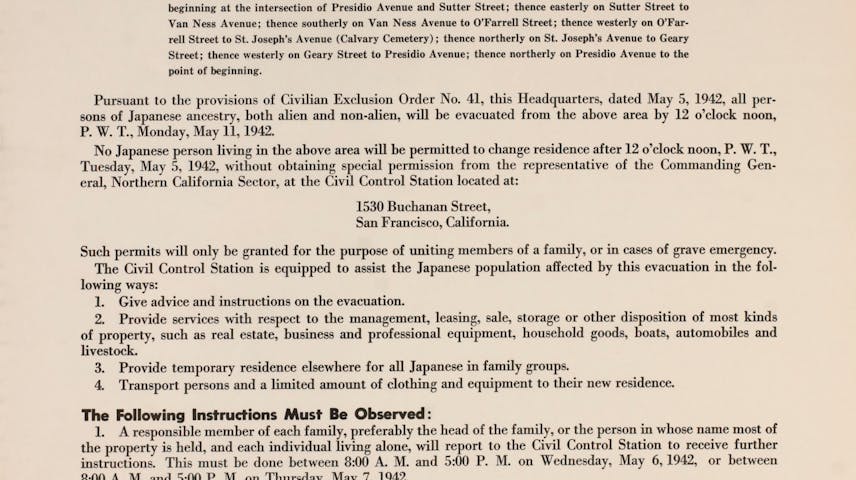
Take the time to read the document "Instructions to All Persons of Japanese Ancestry" on p. 13 or the similar document from May 5, 1942.
Seen and Unseen
Elizabeth Partridge & Lauren Tamaki
Instructions to All Persons of Japanese Ancestry and Glossary of Terms
National Parks Service