Loading course navigation
Loading lesson
50 min
Student Lesson
Lesson 14: Seen and Unseen: Part 8
Content
Students will analyze how the concept of bearing witness helps readers evaluate Ansel Adams’s photographs of Manzanar.
Language
Students will explain how Adams emphasizes, frames, and omits aspects of life at Manzanar using interpretive verbs, cause-and-effect connectors, and evidence-based explanations from an article excerpt and photographs.
Foundational Skills
Students will analyze the morphemes in resettlement to determine meaning and explain how the word shapes interpretation.
How do historical records (texts, images, and testimony) shape what is remembered about the past?
Knowledge-Building:
In the previous lesson, students compared how Dorothea Lange and Toyo Miyatake documented Manzanar. In this lesson, they add the concept of bearing witness before evaluating Adams’s work.
Enduring Understanding:
Historical records do more than show events; they shape what viewers notice, what they feel responsible for, and what may still remain hidden.
Future Lessons:
In the next lesson, students will trace how the back matter of Seen and Unseen reveals limits in the historical record and helps readers question what photographs do and do not show.
Unit Performance Task:
Today’s work helps students build claims about how records shape public memory of Japanese American incarceration and what those records reveal about the people who lived through it.
| Lesson Flow | Purpose of Learning Experience |
|---|---|
Launch5 Minutes | Students will activate prior learning from Lange and Miyatake and be introduced to the need for a new lens—bearing witness—for evaluating Adams’s photographs. |
Literacy Lab10 Minutes | Students will learn the morphology and connotation of resettlement so they can notice how word choice shapes historical memory. |
Learning in Action30 Minutes | Part A: Defining Bearing Witness (RI.7.6) Students will discuss a short article excerpt to define bearing witness and explain how images can create moral responsibility. Part B: Evaluating Adams Through a Witness Lens (RI.7.6, RI.7.9, W.7.9.b) Students will analyze Adams’s photographs and accompanying text to evaluate what his images reveal, what they conceal, and what they teach viewers about the incarcerated community. |
Material List
Student copies of Seen and Unseen by Elizabeth Partridge and Lauren Tamaki
Unit 2 Lesson 14 Student Edition
Routines
Think-Pair-Share
Introduce New Words Using Morphology
Think-Pair-Write-Share
Quick Write
Teacher Tip |
|---|
This lesson references harmful government labels that appear in the source text. Clarify for students that these labels were created by the government, not by the incarcerated community. In your own lesson language, use precise contemporary phrasing, such as “incarcerated Japanese Americans,” “prison camp,” “forced removal,” and “people labeled ‘disloyal’ by the government.” |
Teacher Guidance: Have students take out their homework on remaining questions about the loyalty questionnaire and their writing from the previous lesson.
Pair students to discuss their writing from the previous lesson regarding the loyalty questionnaire and the article about it.
Ask: In the previous lesson, we considered the loyalty questionnaire and its effects both at the time and for decades after. What questions do you still have?
I am still unsure why Japanese Americans were even expected to answer those questions. If the government already thought that Japanese Americans weren’t trustworthy just because of their ancestry, why would they even ask this? It is difficult to understand something like that at this distance. It’s easier to understand the painful effects that it had but harder to understand why it would have been done.
Say these Directions: Today, we are completing our study of the images of Manzanar by looking at the photography of Ansel Adams. We’re adding one more idea—bearing witness—to study Adams’s photographs with a stronger lens. This matters because your final performance task asks you to explain how records shape what people remember about Japanese American incarceration.
Ask: Thinking back to our study of Lange’s and Miyatake’s photographs, what patterns did you notice in what was included in these historical records? Whose experiences were included, and whose were left out? How did each photographer’s relationship to the incarcerated community—whether they visited from outside or were themselves imprisoned—influence what they were able or chose to show?
I noticed that both Lange and Miyatake show daily life at Manzanar, but each one highlights different parts of that life. Lange’s photographs often show the larger setting and the pressure of removal and incarceration, while Miyatake’s photos show more community life inside the camp. The photographers’ different relationships to the community shaped what they could see and what people trusted them to photograph. Some experiences are still missing, such as private fear, anger, or what people felt when the camera was gone. That means that the photographic record is useful, but it is not complete.
Connection to Today’s Learning
Say: We have already compared photographers. Next, we will build a concept that helps us evaluate what any image asks a viewer to see, remember, and respond to.
Teacher Guidance: Use this routine to help students determine the meaning of resettlement and notice how word choice can soften harm.
Say these Directions: We are going to study the word resettlement because it helps us notice how language can shape the way history is remembered. When we are trying to formulate ideas about a text or a historical event, it helps to study the precise meanings of words and their connotations.
Read aloud the sentence on p. 84 that uses the word resettlement to describe people leaving Manzanar.
Target Sentence Block:
President Roosevelt promised to encourage further resettlement.
Write resettlement on the board.
Ask: What word parts do you see in resettlement? What smaller base word do you see?
I see the word settle, with re- at the beginning and -ment at the end.
On the board, circle the prefix and suffix and underline settle.
Ask: The prefix re- can mean “again.” What does settle mean? What do they mean together?
Settle means to stay in a place. Sometimes people say “settle down” when they mean to quiet down and stop moving, and sometimes they say it when they mean finding a home and staying there. With the prefix, it could mean settling again; if you move from one town to another, you might be resettling.
On the board, add the word relocation, again circling the prefix and suffix and underlining the base (loc, “place”), adding the full word relocate below.
Ask: What other words do you know with this base word? What does locate mean? What does it mean with the prefix re-?
I know the word location, which means a place. Locate probably means to go to a place or find a place. With the prefix, it means to locate again in a different place.
Ask: What does resettlement mean on this page? How do you know?
It means people moving to a new place or being made to move to a new place. But it says that they had to move to the middle of the country, and the document shows that they had restrictions. So they were going back to their homes or even the cities or towns where they had lived before.
Ask: What does relocation mean in the name War Relocation Authority (WRA)? Remember that the WRA was the U.S. government agency that had been created to imprison Japanese Americans earlier in the war.
The WRA was responsible for moving people for government purposes. They moved people into the prison camps earlier in the war, and then they moved people out once it was considered less risky.
On the board, add the word removal, circling the prefix and writing remove below. Guide students to recall the headline “Mass Removal of Aliens and Citizens Likely” from earlier in Seen and Unseen (p. 15), as well as early notes about how removal was called evacuation.
Ask: What does removal have in common with resettlement and relocation in its word parts? What is different?
It has the same prefix, and it’s about moving, but it doesn’t say that you’re going somewhere else. It might mean “move again,” but it doesn’t have a part about a new place or settlement.
Ask: How do these three words relate in the context of Japanese American imprisonment and the events shown in Seen and Unseen?
Removal is the harshest-sounding term. They didn’t want people to think that what was happening was that bad, so they used words that sounded more comfortable and less harsh. That was when people were taken from their cities and towns to prisons. Resettlement was when people were allowed to leave, but only in some cases, and not to go home. Relocation includes both of these.
Remove the word from display, and have students write resettlement in their Personal Dictionaries from memory, adding their own definition.
Verify Meaning: Prompt students to use a dictionary, glossary, or other reference material to confirm the meaning of settlement that they inferred.
Say these Directions: Check your spelling and definition using a dictionary or other reference material. Revise your definition as needed.
Say: Circle the prefix and suffix, and underline the base word.
Ask: Which part of the word helped you remember how to spell it?
The base word settle helped me most because it is the biggest familiar part in the middle of the word.
Teacher Tip |
|---|
In Lesson 7, students discussed the use of passive voice in government documents. As time allows, you may wish to elicit that these words are all noun forms based on verbs. This tends to mask both who is doing the action and who is experiencing the action. |
Check for Understanding (L.7.4.b) | |
|---|---|
Add resettlement to your Personal Dictionary. Underline settle, circle re- and -ment, and write one sentence explaining how the word can soften the reality of forced removal. | |
Modeling: | |
If needed, prompt students to start with “The word sounds ___, but the reality was ___.” |
Connection to Today’s Learning
Say: We will keep noticing how words frame history. Next, we will learn a concept—bearing witness—that will help us evaluate what photographs ask viewers to see and feel.
Teacher Guidance: Students will read two paragraphs from a longer article that provide explanations of the idea of bearing witness.
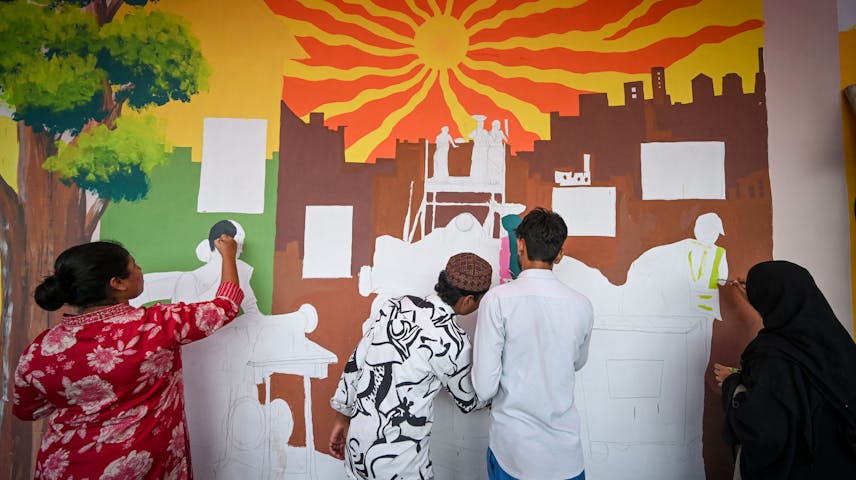
Say: I’m going to read part of an article that relates to Seen and Unseen and what we’ve been discussing. This article is about public art, meaning art that is in public spaces like the street. But it’s also about the idea of bearing witness and how different kinds of art can bear witness. What does that mean?
Say these Directions: As I read this short excerpt aloud, listen for words or ideas that tell you what bearing witness means. Jot down one idea you hear, then talk with your partner about what responsibility the article assigns to viewers of art that bears witness.
First, read section I (Bearing Witness), paragraph 3, from “For the most part” to “accountability and responsibility.” This paragraph defines how art can bear witness. Provide, or substitute as you read, synonyms for some of the most challenging vocabulary in the excerpt, including disseminating (sharing or spreading) and embodied (physical, bodily).
Have students jot notes in their journals using a three-column format: What the Author Says, What It Means, and How It Connects to _Seen and Unseen_. After the reading, have students discuss the questions with partners and then share their ideas with the class.
Then, as students continue to take notes, read section VI (Conclusion), paragraph 2, beginning with “Bearing witness.” This paragraph summarizes how art that bears witness gives its viewers a responsibility. Provide, or substitute as you read, synonyms for some of the most challenging vocabulary in the excerpt, including aesthetic (artistic), disseminate (to share or spread), and epistemic (knowledge-giving).
Ask: According to the excerpt, what does it mean to bear witness?
According to the article, art can bear witness to events and situations by sharing information and what people experienced, and when we view the art, we have a responsibility to become witnesses ourselves, not just viewers.
Ask: How can an image create moral responsibility for a viewer?
An image can create moral responsibility when it makes viewers feel that they should remember, question, or respond to what happened. It can push people to think about whether the image tells the truth fully or only partly.
Ask: Does the idea of bearing witness and viewer responsibility change the way we approach Adams’s photographs? If so, how, and if not, why not?
The idea of bearing witness changes my approach because I am not only asking what Adams photographed. I am also asking whether his images bear witness accurately or fully, to help me understand imprisonment clearly, or whether they leave out details that matter.
Check for Understanding (RI.7.6) | |
|---|---|
In one or two sentences, explain what bearing witness means and name one responsibility it creates for a viewer. | |
Modeling: | |
If needed, prompt students to complete the frame Bearing witness means ___, so a viewer should ___ |
Connection to Today’s Learning
Say: Now that we have a lens, we are ready to ask a sharper question about Adams’s photographs: Do these images help viewers bear witness to imprisonment, or do their choices make some truths harder to see?
Teacher Guidance: Have students turn to pp. 84–95 of Seen and Unseen. Ask them to keep open one Adams portrait on p. 92, the landscape image on p. 88, and a previously studied Lange or Miyatake image from earlier lessons for side-by-side comparison.
Teacher Tip |
|---|
Guide students away from a simple true-or-false judgment about Adams. The goal is to evaluate how his choices shape what viewers can witness. His photographs may honor people’s dignity while also limiting what viewers understand about prison life. |
Say these Directions: Revisit the Adams section with the idea of bearing witness in mind. As you discuss, use the words emphasizes, frames, and omits, and support your ideas with details from the text and the photographs. After talking with your partner, choose one question to answer in writing, and be ready to share your thinking with the class.
Say: We have talked about how art, including photographs, can bear witness to events. On p. 92, I notice that the family is posed carefully on the porch, and that gives the image dignity and order. Is this bearing witness accurately? Ansel Adams may be trying to show viewers that this family deserves respect and acceptance. But the same choice also controls what I can witness: I do not see confinement, fear, or pressure outside the frame. So my claim cannot be just “This photo is positive” or “This photo is false.” A stronger claim is that Adams emphasizes dignity while omitting parts of imprisonment, which makes the photo both meaningful and limited as a record.
Ask: Look at the Adams portrait on page 91: Mrs. Nakamura and her two daughters posed on the porch. Adams arranged them, chose the angle, and waited for the right light. Now compare this to any Lange photograph of families from earlier in the book. What is different about how the people appear? What does posing do to a portrait that a candid shot does not—and what information about the subject’s real experience is lost when someone is posed?
In Adams’s portrait, the family looks neat, composed, and dignified. In Lange’s candid photos, people look uncertain, tired, or caught in the middle of something. Posing gives Adams control over the image. He can make the family look like any American family on a porch. But posing may not let the photo bear witness to the real situation. Most importantly, you can’t see that the people are prisoners. A candid photo might show discomfort, exhaustion, or anger that a posed photo conceals.
Ask: When you place Adams’s porch portrait beside a Miyatake community photo and a Lange documentary photo, what choices in posing, lighting, angle, and background stand out? What do those choices tell you?
Adams uses careful posing, balanced light, and a clean angle to make the family look stable and dignified. Miyatake’s community photos often feel as if we are inside a real moment with people who know the photographer. Lange’s documentary photos often include harsher backgrounds or wider views that remind viewers of the camp setting. These choices communicate different purposes: Adams shapes a respectful public image, Miyatake records community life from within, and Lange documents conditions more directly.
Ask: Partridge writes that Adams photographed Manzanar with the Sierra Nevada mountains visible in the background (p. 88), calling it a place of “acrid splendor.” Acrid can mean “bitter” or “hurtful.” Adams was already famous for photographing dramatic landscapes. Why might Adams have included the mountains in his camp photographs? What message does a beautiful landscape send when the people in the foreground are imprisoned?
The mountains make Manzanar look like a beautiful place, which is complicated because it was a prison. Adams may have included the landscape to show that Japanese Americans were living in a dramatic, impressive setting—to make viewers feel that they had, and were worthy of, good conditions. But the beauty risks making the imprisonment look less harsh than it was. If all you saw was the mountains and the smiling faces, you might not realize that these people were locked up.
Ask: Partridge writes that the prisoners smiled for Ansel’s camera because “they were under enormous pressure to prove they were ‘good citizens’” (p. 96). What does this mean? How does the author’s statement change the way you read these portraits by Ansel Adams?
It means that the smiles may show pressure and strategy, not simple happiness. People knew that they were being judged, so smiling could be a way to perform loyalty for the camera and for the country. Knowing that changes how I read the portraits because I stop treating facial expressions as clear proof of comfort or approval. The photos still show dignity, but they also reveal how much pressure incarcerated people were under to look acceptable and patriotic.
Pulse Check (RI.7.6) |
|---|
Which statement best evaluates Ansel Adams’s Manzanar photographs through the lens of bearing witness? |
A. Adams’s photographs fully bear witness because they show every major part of prison life, including punishment, protest, and resistance.
B. Adams’s photographs cannot count as bearing witness because only people who were incarcerated can create meaningful records of Manzanar.
C. Adams’s photographs can partially bear witness by showing people’s dignity, but posing and omissions can limit what viewers understand about imprisonment.
D. Adams secretly photographed private moments from inside camp life, so his work reveals truths that other photographers could not capture.
|
Teacher Guidance: Students should synthesize across multiple lessons and redirect attention from photographers back to the incarcerated community.
Use the following writing model as a reference if needed for support and guidance:
Across the three photographers, I learned that the incarcerated community at Manzanar was living with both pressure and resilience. Adams’s posed portraits and the smiles on p. 96 show how people were expected to appear loyal and composed. Earlier images by Lange and Miyatake also show uncertainty, work, celebration, and care for one another. Together, these records help me understand that people at Manzanar were not only suffering under imprisonment; they were also protecting dignity and building community inside unjust conditions.
Say these Directions: Write three or four sentences to synthesize what you have learned and discussed about patterns and differences among photographs by Lange, Miyatake, and Adams. Use at least one specific detail from photographs or text across these lessons. State the pattern and at least one specific omission or limitation, and use at least one interpretive verb such as emphasizes, frames, or omits.
A pattern across the photographs is that all three photographers show daily life, but they do not show it in the same way. Lange more often emphasizes conditions and uncertainty. Miyatake records life from within, such as with his secret photograph of the communal bathrooms (p. 59), which was not allowed. Adams frames people in positive, dignified ways. Important experiences are still left out, like private fear, conflict, or what happened outside the frame. Their different relationships to the prison shaped what people trusted them to see and what each photographer wanted viewers to remember.
Say: As part of your homework, think about one thing that you understand about the incarcerated community’s experience thanks to your analysis of how the three photographers’ work bears witness.
Optional Sentence Starter:
Across these photographs, I noticed ___, but I now understand that ___.
Write a brief response to this question: After studying these three photographers’ work across multiple lessons, what is one thing you now understand about the incarcerated community’s experience that you didn’t understand before? Not about the photographers—about the people in the photographs.
Then, read pp. 96–105 of Seen and Unseen. In your Journal, note one place where the text helps you understand something about the incarcerated community that a photograph alone might not show.
Seen and Unseen
Elizabeth Partridge & Lauren Tamaki
Bearing Witness and Creative Activism
Sondra Bacharach, The Journal of Aesthetics and Art Criticism