Loading course navigation
Loading lesson
50 min
Student Lesson
Lesson 17: : Seen and Unseen, Explanatory Writing, Part 2
Content
Students will write explanatory paragraphs that synthesize information from a shared model primary source, individually researched primary sources, and Seen and Unseen to learn about Japanese American incarceration.
Language
Students will synthesize what multiple sources reveal and omit about Japanese American incarceration by writing an explanatory paragraph that uses a claim–evidence–explanation structure, synthesis language, and academic nouns while accurately introducing evidence and explaining its relevance to the Essential Question.
Foundational Skills
Students will practice writing explanatory paragraphs that cogently organize details in support of a clearly stated main idea.
How do historical records (texts, images, and testimony) shape what is remembered about the past?
Knowledge-Building:
Students’ sources will vary in the details they present, but they all will provide concrete facts about Japanese American incarceration that reinforce or extend information in Seen and Unseen.
Enduring Understanding:
Primary sources have their own perspectives and limitations. Thus, consulting a variety of such sources is helpful in understanding the wider story.
Future Lessons:
The next lesson concludes this investigation by having students discuss Seen and Unseen along with the sources they have gathered. Subsequent flex days provide opportunities for review and formative assessment.
Unit Performance Task:
Synthesizing information from primary and secondary sources will be essential to success in the Performance Task. In this lesson, students gain practice with these skills in a smaller-scale setting.
| Lesson Flow | Purpose of Learning Experience |
|---|---|
Launch5 Minutes | Students will provide brief factual descriptions of their primary sources to a peer and prepare to analyze a shared model source before drafting. |
Literacy Lab10 Minutes | Students will practice expanding kernel sentences to provide details about the “who, where, and why” of events described in their sources. |
Learning in Action30 Minutes | Part A: Analyze a Shared Model Primary Source + Compare Sources (RI.7.9) Students will analyze Mary Tsukamoto’s letter as a shared model, then compare sources in terms of what they include, omit, and reveal, using a three-column chart to organize their thinking. Part B: Write an Explanatory Paragraph (RI.7.9, W.7.2.a-f) Students will write an explanatory paragraph that builds on the shared analysis and their own source review to make a broader claim about documenting Japanese American incarceration. |
Material List
Student copies of Seen and Unseen by Elizabeth Partridge and Lauren Tamaki
Unit 2 Lesson 17 Student Edition
3-Column Chart graphic organizer
Routines
Turn-and-Talk
Launch the class with a discussion of the roles of primary and secondary sources.
Say: Historians use multiple kinds of evidence to understand events and experiences from the past: letters, photographs, oral histories, and narrative accounts. These are all primary sources. Historians may analyze and synthesize information from primary sources to create a secondary source. Each primary source can reveal something important, but none shows the full picture. Today, we’ll first analyze a letter by Mary Tsukamoto to her son, as an example of using a primary source closely, and then you’ll craft a short explanatory paragraph that combines evidence from that letter, your own source research, and Seen and Unseen to explain what we can and cannot learn about daily life during incarceration.
Have students use the Turn-and-Talk routine to describe primary sources to a peer.
Say these Directions: Turn and talk to your classmate about a primary source. Explain:
Who created the source
For what purpose the source was created
The author’s point of view
How the sources relate to one another and to the text of Seen and Unseen
Ask: What can one kind of source show clearly, and what might it leave out?
A letter can show feelings and relationships clearly, because the writer is speaking in a personal voice. A photograph can show setting and physical details right away. But each one leaves something out, so we need more than one source to understand daily life during incarceration.
Review the Essential Question with students: How do historical records—texts, images, and testimony—shape what is remembered about the past?
Say: A concluding statement is more than a final sentence. It must do two things: it must follow from the information, meaning it grows out of the evidence without introducing new claims, and it must support the information, meaning it helps the reader understand why the evidence matters. A conclusion that only restates the opening does the first job but not the second.
Say these Directions: Review the following three concluding sentences from a paragraph about how primary sources shape what is remembered about Japanese American incarceration. Label each one: Weak (just restates the topic), Basic (follows from the information), or Strong (follows from AND supports by naming why it matters).
Mentor Conclusion 1: “Taken together, the letter, the oral history, and Seen and Unseen show that daily life at Manzanar was difficult and closely controlled.”
Basic: Follows from the evidence; synthesizes sources but stops at restatement.
Mentor Conclusion 2: “Ultimately, the sources we keep shape what future generations can know: because the WRA controlled which images were preserved, much of the daily fear and indignity of incarceration remained invisible to the public and might have remained invisible to history.”
Strong: Follows from AND supports: names why it matters and connects to the Essential Question.
Mentor Conclusion 3: “In conclusion, this paragraph has discussed how primary sources describe Japanese American incarceration.”
Weak: Restates the topic only; tells the reader nothing new about the evidence.
Ask: What does the strong conclusion do that the other two do not? What phrasing signals the “support” move?
Say: As you draft your paragraph today, aim for a strong conclusion. Use one of these reflection openers instead of In conclusion:
Ultimately,
What this evidence reveals is
Taken together
Then finish with a statement that names why the evidence matters or what it means for whose stories get remembered.
Teacher Tip |
|---|
Students who use different varieties of English may pronounce or structure words differently in speech. When this happens, model the standard academic English form alongside the student’s phrasing without correction or judgment. For example, restate the word clearly (“ultimately”) and draw attention to the morphemes (ultimate + -ly) to anchor spelling and meaning. Emphasize that pronunciation can vary across contexts, but academic writing requires consistent spelling patterns and standard forms. |
Say: As you write your explanatory paragraphs, make your last sentence do real work. It should grow out of your evidence and show your reader why your explanation matters.
Have students gather and review the sources analyzed so far:
The letter from Mary Tsukamoto to her son Richard, used as a shared model primary source
Their own researched primary sources, including at least one oral history excerpt, letter, or photograph
Relevant pages from Seen and Unseen
Provide students with a 3-Column Chart graphic organizer to use in organizing their review of their sources.
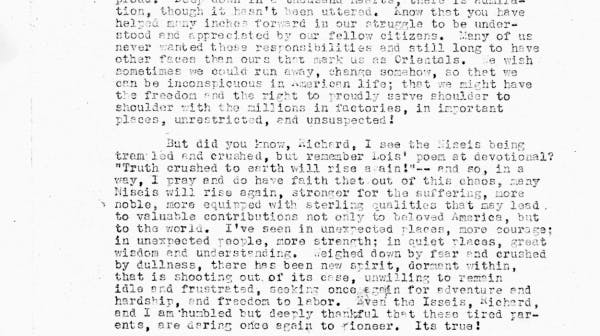
Say: We are going to study one primary source together to practice close source analysis before you draft your own analyses. As we examine Mary Tsukamoto’s letter, add notes about what the source reveals, what it leaves out, and how it connects to daily life during incarceration. Then you will use the same thinking process with your own sources.
Conduct a shared read-aloud of the first three paragraphs with the class, inviting a volunteer to read each paragraph. Have students read the last section of the letter on their own.
Teacher Tip |
|---|
The second part of the letter is directed toward the writer’s understanding of God. Students read it to learn about this individual’s perspective on the situations she and her family faced. |
Say: To analyze this primary source, we need to consider who is writing and what that person’s perspective is. This letter is a personal letter from a mother to a son, with a prayer and a description of how that individual felt.
Show a three-column chart on the board, and guide students through discussion, adding notes to the chart. Then have partners discuss and answer the questions.
Completed Sample Chart Entry: Mary Tsukamoto Letter
What This Source Reveals | Something This Source Leaves Out | How This Connects to Daily Life |
|---|---|---|
The letter reveals a mother’s worry, faith, and hope while her family is incarcerated and Japanese American soldiers are serving in the war, including her son. | It does not provide a full picture of prison routines, the views of every family member, or what the recipient is experiencing or writes back. | It shows that daily life included separation, uncertainty, prayer, and the effort to hold a family together. |
Ask: Who wrote this letter, and what source information helps us place it in time and audience?
Mary Tsukamoto wrote the letter. The source information shows that it comes from the wartime period and that it was written for a specific audience, which matters because it helps us read it as a personal primary source instead of a later summary.
Ask: What is the writer’s relationship to the events being described?
The writer is not just observing these events from far away. She is connected to them personally because her family is living through incarceration, so her letter gives the perspective of someone directly affected.
Ask: What perspective does the letter show? Whose voice is being centered?
The letter centers the voice of a Japanese American woman whose family was harmed by government incarceration. It gives us an incarcerated person’s perspective rather than the point of view of a photographer or outside observer.
Ask: What might be missing from this source that you would still want to know?
I would still want to know more about daily routines, conditions in the prison, and how other family members responded. One letter gives an important voice, but it cannot show every part of the experience.
Say these Directions: As you review your other sources, take notes in the same chart with the same headings. Remember that strong explanatory writing focuses on clarifying and illustrating ideas with evidence.
Clarify, if needed, that for most sources, daily life will mean daily life during incarceration in the prisons, but it could also mean daily life at the beginning of the war or daily life as people tried to return to society after incarceration.
Teacher Tip |
|---|
After students complete at least one row with the shared model source, invite them to extend the same chart with color-coding or brief annotations to show overlap among sources. This keeps the organizer consistent while helping students notice patterns they may want to use in their writing. |
Provide students with a confidence continuum (i.e., 1–5). As needed, model how to demonstrate a level of confidence using the continuum.
Reflection |
|---|
Reflect on your ability to write a strong explanatory paragraph using Mary Tsukamoto’s letter, the sources you have collected, and the thinking you have done about them using the Reflection routine. |
Students will write an explanatory paragraph that synthesizes information from Seen and Unseen, Mary Tsukamoto’s letter, and at least one of the other primary sources they have studied.
Guide students to make notes about one or two of their selected primary sources, using the same structure as the class model in Part A. Allow students to work on their notes independently for five minutes. Then instruct them to write a paragraph based on the question.
Say these Directions: Use your notes from Part A to write a five- to seven-sentence explanatory paragraph that makes and supports a general claim about how Mary Tsukamoto’s letter, at least one additional primary source, and Seen and Unseen portray Japanese American incarceration.
Your paragraph should include:
Details from Mary Tsukamoto’s letter and at least one other primary source
A comparison of how the different sources present information
At least one text detail from Seen and Unseen
A clear explanation
Provide optional sentence frames that support structure without scripting students’ thinking:
Topic Sentence: Mary Tsukamoto’s letter, [my other source], and Seen and Unseen reveal some important truths about daily life during Japanese American incarceration, but they also leave out key parts of the experience.
Evidence Sentences:
For example, Mary Tsukamoto’s letter reveals ___.
In [my other primary source], ___ shows ___.
In Seen and Unseen, the authors show that ___.
Synthesis/Explanation Sentences:
Together, these sources show that daily life included ___, but we still do not see ___.
Comparing these sources helps reveal ___, yet they also fail to show ___.
The source ___ shows ___, while the source ___ shows ___.
Concluding Sentence: This matters because it affects whose stories are remembered and whose are not.
While students are working, circulate to review students’ writing, and use prompts as needed:
Does the claim sentence make a clear and specific statement that is relevant to Mary Tsukamoto’s letter, the selected additional source, and Seen and Unseen?
Is the evidence described concisely but in enough detail that the reader can understand its relevance?
Do the sentences in the middle of the paragraph show the connections between the evidence and the claim rather than just listing facts?
Does the conclusion not only sum up what has been said but also leave the reader with an impression of its wider significance?
Reconvene the class, and invite students to share the topic sentences they have written, along with a brief oral summary of two pieces of evidence they used to support their topic sentence.
Checklist (W.7.2.a, W.7.2.b, W.7.2.f) |
|---|
You will turn in your draft explanatory paragraph. After you have finished your draft, check that you:
|
Lesson 17 Writing Rubric: Explanatory Paragraph — Strong Conclusions
Writing prompt: Write an explanatory paragraph synthesizing information from a primary source text about Japanese American incarceration. Include a concluding sentence that goes beyond restating your topic sentence to offer an insight about why this story matters today.
Criteria | 1 — Beginning | 2 — Developing | 3 — Proficient |
|---|---|---|---|
Thesis & Topic Sentence (W.7.2.a) Clear Topic Sentence + Context | The paragraph does not include a clear topic sentence. There is no context for the source or its significance. | The paragraph includes a topic sentence, but it is vague or does not fully set up the analysis of why this primary source matters. | The paragraph opens with a focused topic sentence that identifies the primary source and establishes what aspect of the Japanese American incarceration story it reveals. |
Evidence & Analysis (W.7.2.b) Synthesize the Source | Evidence from the primary source is absent or copied without paraphrase or analysis. | Evidence from the primary source is present, but the analysis is brief or does not fully explain what the source reveals. | Evidence from the primary source is accurately integrated — quoted or paraphrased — and analyzed. The explanation shows what specific details reveal about the experience of incarceration. |
Conclusion (W.7.2.f) Conclude with Why It Matters | The paragraph does not include a conclusion or simply repeats the topic sentence. | The conclusion restates the topic sentence but does not add an insight about why this story matters today. | The conclusion goes beyond restating the topic sentence to offer a specific insight about why this story — or the act of telling it — matters today. The closing sentence does real work. |
Have students revise their final sentence to directly connect to the Essential Question. Students should rewrite only the concluding sentence to ensure that it addresses the following prompt.
Ask: How does comparing Mary Tsukamoto’s letter with other sources help us decide what is remembered about the past?
Comparing Mary Tsukamoto’s letter with other sources helps us decide what is remembered because each source makes some parts of history visible and leaves other parts out. The letter centers one family’s fear and hope, while other sources can add setting, routine, or broader context.
Collect the revised sentences as formative data on understanding and writing clarity.
Have students review their notes, questions, observations, and annotations so they are prepared to have a class discussion in the subsequent lesson. Instruct them to take notes in their Journal on the following prompt:
What facts about your chosen sources and Mary Tsukamoto’s letter do you most want to share with the rest of the class? How do those sources connect to texts that we have all read, such as Seen and Unseen?
Reconvene the class and invite students to share the topic sentences they have written, along with a brief oral summary of two pieces of evidence they used to support their topic sentence.
Seen and Unseen
Elizabeth Partridge & Lauren Tamaki

Letter from Mary Tsukamoto to “Richard,” Soldier in the 442nd Regimental Combat Team, October 21, 1943
California State University