Loading course navigation
Loading lesson
50 min
Student Lesson
Lesson 34: Seen and Unseen, Research, Part 3
Content
Students will select a preliminary topic and research question for their “Witness to History” multimedia presentation and then combine evidence from Seen and Unseen and an external source to support the presentation.
Language
Students will synthesize evidence from multiple sources to generate a focused research question and explain its relevance using cohesive transitions and evidence-based reasoning language.
How can readers evaluate words and images for accuracy, perspective, and ethical use?
Knowledge-Building:
Students will learn how to narrow down a broad research topic into a focused topic and question suitable for a class research project.
Enduring Understanding:
Major historic events can be researched from many angles and are often documented in numerous primary and secondary sources. A focused topic and research question allow us to understand specific aspects of those events.
Future Lessons:
In future lessons, students will continue locating and assessing additional external sources and evaluating those sources for accuracy, perspective, and ethical use.
Unit Performance Task:
This lesson introduces the Performance Task directly, including its requirements, purpose, and evaluation criteria. It then provides students a chance to identify task-relevant items in their past reading and research from this unit.
| Lesson Flow | Purpose of Learning Experience |
|---|---|
Launch5 Minutes | Students will engage in a Turn-and-Talk discussion to help generate research ideas based on Seen and Unseen and external sources. |
Literacy Lab10 Minutes | Students will observe as the teacher models how to narrow a broad topic to a focused topic and a related research question. |
Learning in Action30 Minutes | Part A: Model Synthesizing Evidence (RI.7.3, W.7.7, W.7.9.b) Students will observe as the teacher models the process of synthesizing evidence from Seen and Unseen and text set sources, evaluating it in light of the research question, and identifying further research directions. Part B: Select a Research Topic (RI.7.3, W.7.7, W.7.9.b) Students will determine a topic and research question for their multimedia presentations and will begin evaluating available sources in light of their topic and question |
Material List
Unit 2 Lesson 34 Student Edition
3-Column Chart graphic organizer
Performance Task Handout
Seen and Unseen by Elizabeth Partridge and Lauren Tamaki
Routines
Turn and Talk
Display the Showcase Performance Task prompt and Essential Question for Investigation 2.
Performance Task: Interpreting History Through Images and Testimony
What You’ll Do: Curate a short digital exhibit or podcast segment that responsibly interprets and evaluates a hidden or overlooked story from the Japanese American incarceration experience. Choose two or three photographs or illustrations (from the text or an approved archive), and pair them with a quotation, letter excerpt, or oral history testimony that helps reveal the story behind the images.
Why It Matters: Studying historical photographs and testimony helps us understand how evidence, perspective, and media choices influence what we know about the past. Careful analysis supports us in interpreting history accurately and sharing it responsibly.
Criteria for Success: The presentation must clearly explain the historical context and lived experience of the survivors. It must accurately use evidence from one external research source and offer insight into how texts and images document and interpret historical experience. An effective multimodal presentation will incorporate captions, visuals, and narration as necessary to make its point. The presenter will actively participate in peer feedback and reflection.
Essential Question: Investigation 2
How can readers evaluate words and images for accuracy, perspective, and ethical use?
Remind students that they have already conducted some research to find external sources that may help in creating their presentations, and they will have the opportunity to continue researching as they decide on a focus for their presentation. Then transition students into partnerships to engage in the Turn-and-Talk routine.
Turn-and-Talk
Say these Directions: Discuss your response to the following question with a partner.
Ask: What aspect of life during incarceration are you interested in learning more about?
I’m interested in learning more about how families handled daily life in prison, especially how they dealt with cramped barracks, dust, and lack of privacy. In Seen and Unseen, I noticed that people kept trying to create routines and make their rooms feel more livable. I want to know what people did to cope with those conditions and how photographs, letters, and testimony show that side of incarceration.
Invite volunteers to share their ideas with the whole class as time permits.
Say: Today, we are going to take stock of the reading and research we’ve done so far and decide on a direction for our research projects. We will identify researchable questions about survivor testimony from Japanese American incarceration and determine what evidence we need to answer our research questions.
Model how to move from a broad topic to a focused topic for the “Witness to History” presentation. This focused topic can be turned into a question that students can research using the following steps.
Say: There are many ways we could continue to research Japanese American incarceration, but it is much too broad a topic to cover in a single research project. We need to choose a more focused topic to guide our writing and research process and to help us identify relevant evidence. Here’s how we can narrow a topic step-by-step until we have a focused topic and a related research question that matches our purpose.
Say: How to Narrow a Research Topic:
Narrow down your broad topic, identifying an event, a group of people, or another specific aspect.
My broad topic is Japanese American incarceration. I’m going to focus on daily life at Manzanar and how people coped with harsh living conditions. We already have some resources for learning about Manzanar specifically, and daily routines are one specific part of life in prison.
Name the specific topic you want to investigate. Then add focus words to guide your exploration.
Now that I have decided to investigate daily life at Manzanar, I can focus on different aspects, such as what the barracks were like, how families handled dust and weather, how people created routines, or how they tried to make their living spaces feel more normal.
I’m going to use focus words like how, why, to what extent, in what ways, impact, cope, or adapt. These words push me to analyze and explain, not just list facts.
Tie the topic and question to the purpose.
My purpose is to show how reading and listening to survivor testimony can help us be better witnesses to history by more responsibly interpreting and evaluating past events. So my question should help me find evidence from Manzanar survivors that explains parts of history we might otherwise overlook or misunderstand.
Make sure the topic question is answerable with sources.
Now I ask: Can I answer this by using Seen and Unseen plus at least one credible source? Can I find concrete evidence like quotes, descriptions, dates, photographs, and records? If yes, it’s researchable.
Draft your research question and evaluate it.
Here is my model research question: How did Japanese American families at Manzanar cope with harsh daily living conditions and create routines that made prison life more livable?
Now I check it. It’s focused on one aspect of incarceration: daily life and coping with conditions. It connects to our purpose: learning from survivor testimony. And it tells me exactly what to look for in sources: descriptions of the barracks, letters about daily routines, photographs of living spaces, and accounts of how families adapted.
If my question still feels too big, I can narrow it one more time by adding a place, a time period, or an even more specific area of focus. For example, I could focus on barracks life or on the ways families made shared spaces feel more personal.
Connection to Today’s Learning
Say: Today, you’ll practice narrowing a broad topic into a focused topic and related research question. This will help you identify useful information in existing sources and find additional evidence to support your multimedia presentation.
Say these Directions: To answer your research question, you will gather evidence from Seen and Unseen and at least one credible external source. As you do, think not only about the factual content of the sources but also their:
Visual or structural choices
Perspective and/or potential bias
Tone
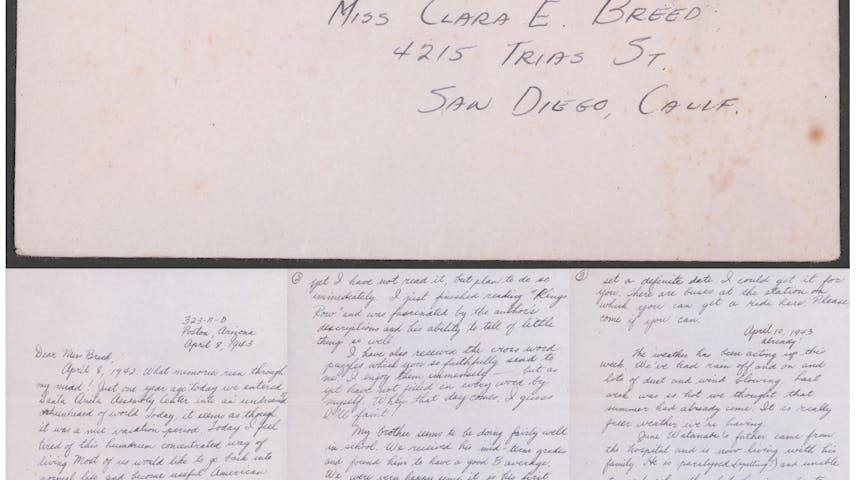
Model, in general terms, how you would locate a source about daily life and coping with conditions by using broad keywords first and then narrowing to source types that fit your question. The model below is based on the provided sources “Letter to Clara Breed from Fusa Tsumagari, Poston, Arizona, October 9, 1942” and “Surviving Poston’s Desert Heat: Cellars, Fans, Ponds, and Gardens.”
Project a 3-Column Chart graphic organizer with filled examples of:
Details, perspective, and tone from the survivor sequence (Seen and Unseen)
New or corroborating information from “Letter to Clara Breed” (Tsumagari letter) and “Surviving Poston’s Desert Heat” (Kakuda account), such as that shown below
Information can be written in complete sentences or in note phrases at this stage.
Connections between the sources
The following sample responses draw on “Letter to Clara Breed” and “Surviving Poston’s Desert Heat.”
Details from Seen and Unseen | New Details & Perspectives from Other Sources | Connections |
|---|---|---|
Seen and Unseen shows that daily life in prison was uncomfortable and controlled. The words and images emphasize crowded barracks, dust, and the struggle to make temporary spaces feel livable. | In the Tsumagari letter, the writer describes harsh daily conditions and the work of adjusting to them. The Kakuda photo essay adds visual details that show people creating routines and trying to make their surroundings feel more human and manageable. | Together, these sources show that daily life in prison was shaped by both hardship and coping. People dealt with discomfort, but they also built routines, cared for family members, and found ways to make the space feel more livable. This gives me a research direction about how ordinary routines helped people survive incarceration. |
Continue to use the example topic and question from the Literacy Lab as you examine these sources and identify opportunities for further research.
Say: My starting point in answering my research question is Seen and Unseen, along with Fusa Tsumagari’s letter and the essay by Roy Kakuda. Looking at my chart, I can see that I already know some things about daily life and coping with conditions:
The barracks were uncomfortable and didn’t have privacy.
Daily routines helped people create structure.
Images and testimony together show both hardship and the ways people coped.
Say: I can see also that there are some things I still want to find out:
What daily routines helped families make prison life more manageable?
How did people change their living spaces to cope with dust, heat, or crowding?
How do different kinds of sources—such as photographs, letters, and testimony—show emotions differently?
Say: I will also want to find photographs or other visual media that can support my multimedia presentation.
Say: Now that I see what my current sources offer me, I can continue looking for other sources. I want to collect several primary and secondary sources in multiple media forms (news articles, archival photos, short videos, speeches, etc.).
Reflection (RI.7.3) |
|---|
Reflect on your ability to synthesize sources using the Reflection routine. |
Say these Directions: Select a specific event or aspect of camp life during Japanese American incarceration that is connected to survivor stories presented in Seen and Unseen. Follow the steps modeled during the Literacy Lab, and begin a 3-Column Chart graphic organizer. Use Seen and Unseen plus one external source.
Say: Follow these steps to develop your research question:
Choose one specific aspect of your broad topic.
Name the specific topic you want to investigate, and add focus words.
Tie the topic and research question to the purpose.
Make sure the topic question is answerable with sources.
Draft the research question and evaluate it.
Say: As you select photographs and illustrations for your digital exhibit or podcast, think about this: You are now the designer. You are making compositional choices—which images to include, how to pair them with text, what to put first.
Ask: What is one design principle you’ve learned from studying Partridge and Tamaki’s choices that you will apply to your own exhibit or podcast?
One design principle I’ve learned is that the size and placement of an image relative to text affect what the reader experiences first—feeling or information. In my exhibit, I plan to lead with a large photograph before the explanatory text, the way Partridge and Tamaki do on pp. 28–29, because I want my audience to have an emotional response before they start analyzing.
Teacher Tip |
|---|
Students may find, as they work on their graphic organizers, that the external sources they have accessed so far do not have much to say about the research topic that now interests them. Reassure them that they will have more opportunities to identify additional sources both in and outside of class before their project is due. For now, consider having them focus on next steps:
|
Checklist |
|---|
As you select your Research Topic, make sure you:
|
Students complete a brief Turn-and-Talk to summarize insights from conducting research.
Turn-and-Talk
Say these Directions: Use the Turn-and-Talk routine to discuss the following question with a partner.
Ask: What is one insight about your research topic that you have gained from Seen and Unseen or an external source? What is one question that will require further research?
Say: Be specific—name the source, and explain what it revealed.
One insight I had is that school plays a bigger role in kids’ lives than just studying academic subjects. It’s also a place where kids have a lot of their social life and where they learn ways to express themselves through art. One question I have is what the science classes were like and whether they had the equipment to do biology and chemistry labs.
Instruct students to complete the graphic organizer and address the following:
If you find that your external sources do not closely match your chosen research topic, identify one promising external source using the resources discussed in past classes (Densho, NPS, National Archives, etc.), and note identifying information and a brief description in your Journal.
Seen and Unseen
Elizabeth Partridge & Lauren Tamaki
Letter to Clara Breed from Fusa Tsumagari, Poston, Arizona, October 9, 1942
Japanese American National Museum
Surviving Poston’s Desert Heat: Cellars, Fans, Ponds and Gardens
Roy Kakuda, Discover Nikkei