Loading course navigation
Loading lesson
50 min
Student Lesson
Lesson 32: Seen and Unseen, Research, Part 2
Content
Students will select, analyze, and corroborate credible external sources that confirm and complement the information in the survivor stories from Seen and Unseen.
Language
Students will relate survivor testimony to other sources by using evaluation verbs (confirms, challenges, complicates), source attribution language (“According to . . . ,” “The interview states . . .”), contrastive connectors (however, in contrast), and academic nouns (credibility, evidence, perspective).
How can readers evaluate words and images for accuracy, perspective, and ethical use?
Knowledge-Building:
Students will learn how to locate and analyze sources that can support research into Japanese American incarceration.
Enduring Understanding:
Researching additional sources can help us read the testimonies of survivors with greater understanding of their context and perspective.
Future Lessons:
In future lessons, students will practice the craft of writing effective synthesis and then determine topics and research questions for their multimedia presentations.
Unit Performance Task:
This lesson offers students an opportunity to collect and analyze the external sources they will need to complete the Performance Task.
| Lesson Flow | Purpose of Learning Experience |
|---|---|
Launch5 Minutes | Students will engage in a Turn-and-Talk discussion to help identify external sources that could enrich their understanding of survivor narratives. |
Literacy Lab10 Minutes | Students will observe and practice the acknowledgment of sources through quotation and paraphrase. |
Learning in Action30 Minutes | Part A: Model Source Research (RI.7.1, RI.7.6, W.7.7) Students will observe as the teacher models the process of locating and examining an external source and connecting it to information from the anchor text. Part B: Research External Sources (RI.7.1, RI.7.6, W.7.7) Students will select and analyze an external source that confirms or contextualizes survivor narratives from Seen and Unseen. |
Material List
Unit 2 Lesson 32 Student Edition
Central Idea and Details Organizer
Seen and Unseen by Elizabeth Partridge and Lauren Tamaki
Routines
Turn and Talk
Display the Essential Question:
How can readers evaluate words and images for accuracy, perspective, and ethical use?
Students will use a Turn-and-Talk routine to discuss examples of sources they might consult, such as government documents, oral histories, and news articles. Invite volunteers to share their ideas with the whole class as time permits.
Say these Directions: Read the question, and take a moment to think about some ideas. Then use the Turn-and-Talk routine to discuss your ideas with a partner before sharing with the class.
Ask: Why might it be important to compare survivor testimonies and photos with other historical sources?
Other historical sources can give us context that provides a more complete picture of an event or situation. Seeing multiple perspectives can help us understand the specific perspectives from which individual survivors wrote, spoke, and photographed. In cases where photos were taken for official purposes, outside sources can also help us assess any bias or omissions in the photographic record.
Say: Today, we are going to research sources that will help us put survivor stories in context. In doing so, we will consider how those sources can help us interpret history in an informed and responsible way.
Display the following sentence from Seen and Unseen: “‘I have to record everything,’ he said to Archie. ‘This kind of thing should never happen again’” (p. 53). Explain the difference between quoting and paraphrasing, then model an example of both.
Say these Directions: Today, we will practice quoting and paraphrasing sources. Follow along as I explain and model. Then you will practice your own paraphrasing, using Archie Miyatake’s complaint about the pervasive sandstorms on p. 44.
Say: When we use the words of a source directly, we put them in quotation marks to ensure that readers recognize they are taken right from that source. We do not need quotation marks when we paraphrase or put the contents of a source in our own words, but we still need to acknowledge the source.
Say: To use Toyo Miyatake’s exact words here, we need to use quotation marks:
Exact Quotation: Toyo Miyatake wanted to “record everything” about Manzanar so that an injustice like the one he was experiencing would “never happen again.”
Say: We can paraphrase if we want to express the idea of Toyo Miyatake’s statement without using his exact words, but we still need to mention that it was Miyatake’s idea:
Paraphrasing: Toyo Miyatake believed that an injustice like the mass incarceration of Japanese Americans should not be repeated. He set out to capture all aspects of camp life using his camera.
Say: This paraphrase keeps the main ideas: “record everything” and “should never happen again.” But I changed the wording because my goal was to explain what Miyatake wanted to record and what he wanted to prevent. Someone who has not read Seen and Unseen might not have that context.
Say: Now, practice paraphrasing from the Archie Miyatake quote on p. 44.
Archie Miyatake noted that the sand was a major nuisance for the prisoners at Manzanar.
According to Archie Miyatake, the sandstorms at Manzanar were a source of constant discomfort and frustration.
Ask: When would you choose to quote, and when would you choose to paraphrase?
I would quote some of Archie Miyatake’s words, because his details about the sand on the mattress and in his teeth are more powerful than just saying that it was uncomfortable.
Say: You might use a quote when the exact words of a source are very powerful or meaningful. You might paraphrase when you want to briefly summarize a large chunk of text from a source.
Connection to Today’s Learning
Say: As you engage with external sources today, you may find phrases and sentences that stand out as clear and memorable that you want to use in your own research-based writing. Correctly quoting and paraphrasing is both an ethical way of acknowledging your sources and a help to your readers if they want to learn more.
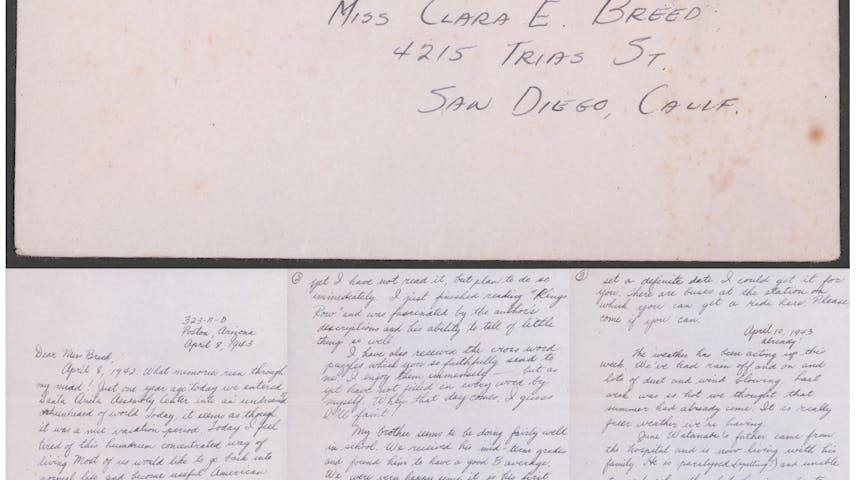
Project an excerpt from a survivor sequence in Seen and Unseen. Provide a list of possible research sources, such as the examples listed below. Model locating a source generically, then say: For our modeling today, we’ll use a source from our collection: 'Letter to Clara Breed from Fusa Tsumagari, Poston, Arizona, October 9, 1942.”
Say these Directions: When you conduct research, you need to draw evidence from many sources in order to present the full picture. The list below provides a good start for where you can access credible sources.
For oral histories of camp survivors:
Densho
Japanese American National Museum
Manzanar National Historic Site (NPS)
For orders, notices, and other official documents:
National Archives
Library of Congress
Display the Tsumagari letter excerpt, and model how to collect evidence using the Central Idea and Details graphic organizer. Focus on details such as her daily work in the construction office, the electrical storm, school starting, the hay mattresses, and the comparisons she makes between different prison sites.
Say these Directions: As I read this letter, I am looking for details that help me understand daily life, perspective, and conditions. I am also asking how this source connects to what we have already learned in Seen and Unseen.
Briefly discuss connections, perspectives, and differences between Tsumagari’s letter and what students have studied in Seen and Unseen.
Ask: What connections can you make between this source and Seen and Unseen?
Fusa Tsumagari’s letter corroborates aspects of Seen and Unseen while adding a personal perspective because it shows people trying to keep daily life going inside the incarceration camp. She writes about working in the construction office and about school starting, which matches the book’s examples of people building routines even when they have been treated unfairly. However, the letter focuses on one person’s experience, while the book shows many perspectives.
Ask: What new details or perspectives does this source provide?
This letter gives small details that make the experience feel more real. Fusa mentions an electrical storm, hay mattresses, and comparisons between prison sites. Those details help me picture what daily life felt like and what people noticed right away.
Ask: What differences do you see between this source and Seen and Unseen?
The letter is one person writing in the moment, so it feels direct and personal. In contrast, Seen and Unseen brings together many voices, photos, and explanations from the authors. The book gives a broader view, but the letter lets me hear one person’s daily experience more closely.
Say: Now you will work independently. Use this same process to find and analyze your own external source.
Teacher Tip |
|---|
From this lesson onward, students will gradually be exercising greater independence in selecting and interpreting sources. As they get underway, consider offering a brief refresher on the differences between primary and secondary sources:
|
Provide students with a confidence continuum (i.e., 1–5). As needed, model how to demonstrate a level of confidence using the continuum.
Reflection (RI.7.1, RI.7.6) |
|---|
Reflect on your ability to analyze historical sources using the Reflection routine. |
Say these Directions: Now, you will investigate additional research on your own. Find evidence from additional credible sources, and analyze them using the Central Idea and Details graphic organizer. Think about how those sources compare with survivor sequences from Seen and Unseen. Get started using the list of credible external resources below.
For oral histories of camp survivors:
Densho
Japanese American National Museum
Manzanar National Historic Site (NPS)
For orders, notices, and other official documents:
National Archives
Library of Congress
Potential topics to consider:
Education
Health
Family life
Art
Food
Social activities
Say: As you review survivor sequences and external sources, think like a historian: What question is each source helping you answer? What additional questions emerge as you compare sources?
Provide students with time to:
Annotate their survivor sequences for key details, emotional tone, and perspective
Read the external source, noting its perspective, key details, and tone
Fill in the Central Idea and Details graphic organizer as shown in Part A
Say: Before we discuss, write one sentence that explains how your source corroborates, challenges, or adds to the survivor account.
Once students have had a chance to read, annotate, and record, lead a whole-class discussion.
Ask: What patterns or differences did you notice between the survivor testimony in Seen and Unseen and the other source you examined?
Among the survivors whose stories I heard or read, I noticed broad agreement about the camp’s poor accommodations: the food, the housing, the bedding, the medical care. Yet they coped with these problems in widely varied ways and expressed different attitudes about their circumstances.
Ask: The external source you found was also designed— someone made choices about what photographs to include, how to frame quotations, and what to emphasize. Describe one design choice in your external source, and compare it to a design choice Partridge and Tamaki made in Seen and Unseen when covering the same topic. What does the comparison reveal about how design shapes historical understanding?
In the interview I found, the survivor speaks directly to the camera. There are no illustrations, music, or visual effects. It doesn't have another voice or any pictures of where they were imprisoned. That focuses the attention on just that person and what they experienced. In Seen and Unseen, testimony is surrounded by writing, illustrations, and historical photographs. The authors are interpreting and giving context for the testimony.
Ask: How does combining sources help you understand the experience of Japanese Americans?
I find that comparing sources lets me fill in the gaps. For example, all the sources I have read or heard, including Seen and Unseen, agree that food was very basic. But different survivors emphasize different details. One woman made fun of how the mess hall served foods they didn’t necessarily know how to prepare, while another interviewee pointed out that the food was often the same. He expressed gratitude for the farmers at Manzanar who, once the harvests began to come in, ensured that there was fresh produce.
Teacher Tip |
|---|
As students identify and analyze sources, check if they:
|
Students complete a brief Turn-and-Talk to summarize insights from conducting research.
Say these Directions: Form pairs, and share one insight gained by comparing a survivor sequence with an external source. Use an evaluation verb (confirms, challenges, or complicates) when you share your insight.
Instruct students to complete the following:
Review your notes and annotations from your external sources.
Write down one question in your Journal that you have after conducting your research.
Seen and Unseen
Elizabeth Partridge & Lauren Tamaki
Letter to Clara Breed from Fusa Tsumagari, Poston, Arizona, October 9, 1942
Japanese American National Museum