Loading course navigation
Loading lesson
50 min
Student Lesson
Lesson 12: Seen and Unseen, Part 7
Content
Students will analyze how Elizabeth Partridge and Lauren Tamaki present the Manzanar protest, the shooting, and the loyalty questionnaire.
Language
Students will explain how sequence, visual design, and contrastive connectors shape a comparison of perspectives and purposes.
Foundational Skills
Students will read long, complex questions fluently by chunking punctuation and phrasing units.
How do historical records (texts, images, and testimony) shape what is remembered about the past?
Knowledge-Building:
Students examine the protest and shooting at Manzanar, the absence of photographic evidence, and the loyalty questionnaire, a public document that created impossible choices for families.
Enduring Understanding:
Historical records always include gaps, and readers must notice both what was preserved and what was left unseen.
Future Lessons:
Students will continue comparing how different photographers documented Japanese American incarceration and how those differences shape public memory.
Unit Performance Task:
Today’s work prepares students to analyze how texts and images build, limit, and complicate the historical record in their final performance task.
| Lesson Flow | Purpose of Learning Experience |
|---|---|
Launch5 Minutes | Students will activate prior knowledge from Lesson 11 and frame today’s focus on what Miyatake could record and what remained unseen. |
Literacy Lab10 Minutes | Students will use a Language Study routine to examine the actual wording of Questions 27 and 28 on the loyalty questionnaire and analyze how sentence structure intensifies the pressure of the choice. |
Learning in Action30 Minutes | Part A: Reading What Was Left Unseen Students will close-read pp. 60–65 to analyze Partridge’s sequencing and Tamaki’s illustration choices during the protest and shooting. Part B: Impossible Choices Students will analyze the loyalty questionnaire on pp. 66–74 in terms of design, language, and impact and consider how Partridge and Tamaki frame their presentation of this public document.. |
Material List
Unit 2 Lesson 12 Student Edition
Student copies of Seen and Unseen by Elizabeth Partridge and Lauren Tamaki
Routines
Annotation Spot-Check
Language Study
Turn and Talk
Quick Write
Have students take out their annotations from Lesson 11 and open to pp. 60–74 of Seen and Unseen.
Teacher Guidance: Use this routine to reactivate the previous lesson’s thinking and bridge to today’s focus on gaps in the historical record. Students work with a partner and briefly reference their notes from pp. 54–59.
Partners sit side by side with annotations open.
Say these Directions: In the previous lesson, we tracked how Miyatake tried to record everyday life at Manzanar. Today, we are taking that a step further by studying a moment when the historical record is incomplete and asking how writers and artists help us understand what was left unseen.
Have student pairs discuss the question for one to two minutes and then share with the class.
Ask: What is one thing Miyatake helped readers see, and what is one kind of event that might have been harder for him to record?
In the last lesson, Miyatake helped readers see ordinary life at Manzanar, including portraits and community moments. It was probably harder for him to record sudden or dangerous events, because he worked secretly and did not always have enough light, time, or safety.
Connection to Today’s Learning
Say: Today, we move from what Miyatake captured to what he could not capture, and we will study how Partridge and Tamaki make that absence meaningful for readers.
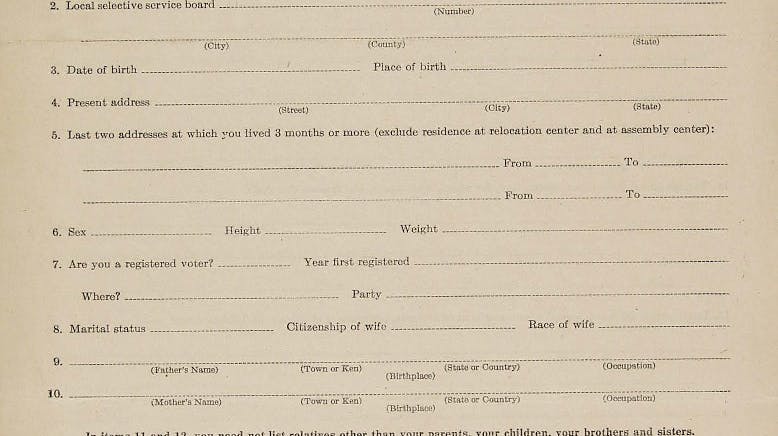
Direct students to p. 67, where the loyalty questionnaire is reproduced, and explain that today, they will study the government’s actual wording, not only the paraphrase in the book.
Teacher Guidance: Use this routine to show students how long, formal sentences can sound official while also hiding pressure and assumptions. This study unlocks Learning in Action Part B, where students will analyze why the questionnaire created impossible choices for families.
Say these Directions: We are going to slow down and study the actual wording of the loyalty questionnaire because the exact language matters. When we chunk a long sentence into smaller parts, we can see what the government is really asking people to promise.
Target Sentence Block:
27. Are you willing to serve in the armed forces of the United States on combat duty, wherever ordered?
28. Will you swear unqualified allegiance to the United States of America and faithfully defend the United States from any or all attack by foreign or domestic forces, and forswear any form of allegiance or obedience to the Japanese emperor, or any other foreign government, power, or organization?
Remind students of some of the reactions Partridge explains, such as when she writes on p. 69, “Families argued over what to answer” and “Archie reluctantly agreed to answer yes to question 28.” Then help students break the questions into chunks with their meanings, compiling the results in a table on the board.
Chunk | Meaning | Function |
|---|---|---|
willing to serve in the armed forces | ready to join the military | introduces a high-stakes demand |
on combat duty, wherever ordered | in fighting situations, in any place the government chooses | removes control over where and how a person serves |
swear unqualified allegiance | promise complete loyalty with no conditions | demands total commitment |
forswear any form of allegiance or obedience | reject any possible loyalty to another government | assumes that the person may already have another loyalty; cuts some people off from the country where they are citizens |
Ask: Which phrase in Question 27 makes the choice feel especially pressured or unfair? Explain what that phrase adds.
The phrase “wherever ordered” makes the question feel especially pressured because it asks a person to agree to combat duty without knowing where they would go or what would happen. It makes the choice feel less like a real choice.
Ask: Why might Question 28 have been especially frightening to those expected to answer it, especially if they were not US citizens?
They were asked to “forswear any form of allegiance” to any other country. If they weren’t US citizens at the time, to answer “yes,” they had to make themselves not loyal citizens of any country, which could have left them without any home to return to if the US didn’t accept them as citizens later.
Check for Understanding (L.7.1.a) | |
|---|---|
Choose one phrase from Question 27 or 28. Write one or two sentences explaining what that phrase means in everyday language and how it changes the pressure of the question. | |
Modeling: | |
If needed, guide students to first rewrite the phrase in everyday language, then add one sentence beginning with “This increases the pressure because ___.” |
Connection to Today’s Learning
Say: Now that we have studied the government’s actual wording, we are ready to see how that language affected real families in the text.
Teacher Tip |
|---|
Pages 60–65 describe protest, tear gas, gunfire, and a death. Before students begin, briefly name that this section includes state violence against imprisoned people. Remind students they may respond in general terms, through the text, or through a hypothetical if a personal connection feels too private. |
Teacher Guidance: Use this routine to help students move from summary to analysis. The focus is not only on what happened but also on how Partridge’s sequencing and Tamaki’s design choices shape the reader’s experience.
Students work in pairs and keep their books open to pp. 60–65.
Say these Directions: Read the section about the protest and shooting, beginning when tension grows around the jail and ending with Jim Kanagawa’s death five days later. As you read, mark one place where Partridge’s words shape the feeling of the scene and one place where Tamaki’s illustration choices shape what readers can understand.
Guide student pairs to read and discuss the questions one at a time, writing notes or full answers as they go. Remind them to cite the text in each answer and to analyze, not summarize, the impact of the writer’s and illustrator’s choices. For the last five minutes, have volunteers share their answers with the class.
Ask: In the section where Partridge describes the protest and shooting at Manzanar (pp. 60–65), why does she write, “There would be no photographic record of what followed” before the description of tear gas and gunfire? What effect does that sequence have on the reader?
By telling us first that there are no photos, Partridge forces us to read the description without images to anchor it. We have to visualize it ourselves. If she had told us afterward, we might be waiting for photos or wondering why there were no photos. This connects to the book’s theme because this is one of the moments that was deliberately unseen, and Partridge is making us see it through words alone.
Ask: Look at Tamaki’s illustrations for the protest and shooting on pp. 62–63. They use shadows, blurred brushstrokes, and no clear faces. She could have drawn a detailed, realistic scene. Why might Tamaki have made these choices? What do these choices do that a realistic illustration would not?
A realistic drawing would try to show exactly what happened, but Tamaki was not there, and there are no photographs. The brushstrokes look fast and full of fear or anger. They show how it might have felt to be there—scary and chaotic with everything happening so fast. They show feeling rather than a precise record of the event. The style also reminds readers that we cannot know every detail when records are missing.
Ask: Whose perspective is centered in these pages, and what is still missing from the record? Consider how Miyatake's position — photographing from inside the community — shaped what he was able to capture and what remained beyond his reach.
These pages are centered on the protesters and the other people living through the protest. What is still missing is a full visual record of exactly what happened in the moment of violence. Even though Miyatake was part of the community, he could not photograph sudden, dangerous events.
Check for Understanding (RI.7.6) | |
|---|---|
In two sentences, explain one writing choice Partridge makes and one illustration choice Tamaki makes to help readers understand the protest even though no photographs exist. | |
Modeling: | |
If students retell only the event, prompt them to add the words choice and effect: “What choice did the creator make, and what effect did it have on you as a reader?” |
Teacher Guidance: Students now analyze part of the loyalty questionnaire as a public document, connecting its language and design to the real decisions faced by Americans of Japanese ancestry. Students should look closely at both the wording of Questions 27 and 28 and the visual and structural features of the document as reproduced on p. 67. Keep the conversation grounded in the text, and allow students to answer the witness-response question through personal reflection, a hypothetical example, or an observation about human experience.
Students remain with partners and turn to pp. 66–74.
Say these Directions: Reread the pages where the questionnaire is shown and the family argues over what to answer. As you talk with your partner, use the actual wording of Questions 27 and 28, Partridge’s description of Archie’s anger, and the images of Miyatake’s work to explain why this section feels so difficult and human. Discuss each question, and then answer using specific details and evidence from the text.
Say: A strong analysis of a public document notices both what the words say and how the document is designed. Features like headings, text style, seals, signature lines, and legal notices are not decoration. They show who has authority and what is at stake for the person being asked to sign.
Guide student pairs to discuss each question and write answers. For the second question, keep an eye on students in case of any traumatic triggering, do not press students to use personal examples, and avoid letting any answer be labeled “wrong,” especially if it includes direct experience.
Ask: How does the actual wording of Questions 27 and 28 help explain why families argued over what to answer?
The actual wording makes the questions feel much harsher than a short summary does. Question 27 asks about doing combat duty wherever ordered, and Question 28 asks for unqualified allegiance and forswearing any other loyalty. That language could make families worry about safety, separation, and what the government already assumed about them.
Ask: Families argued over what to answer. Archie wanted to say no because he was angry, but Toyo and Hiro feared that if he said no, he would be taken away from the family. Think about another situation you have experienced or heard about when a choice was needed but every option felt wrong. How does it feel when there is no good answer—and someone else controls what happens either way?
It can feel frustrating and unfair because you are being forced to choose, but none of the choices really protect you. You might feel angry, trapped, or scared because the result is still controlled by someone else.
Even if my exact situation was different, I know what it feels like to be pressured into picking the least bad option. It makes a person feel powerless because the system is bigger than their own decision.
Ask: Look at the questionnaire on p. 67. What do the features you can see, such as the official seal, the all-caps header, the dotted signature and date lines, and the note at the bottom, show you about the document's purpose?
The official seal and all-caps header signal that this is a government document with legal authority. The dotted signature and especially the note at the bottom make it a heavy, official commitment. It’s more like a demand. And if the person’s answers aren’t judged accurate, the person could be fined or imprisoned for ten years.
Ask: Look at how the authors show the document on the page and what else they include on the page. How do the author’s choices affect what you notice about the document? What may have been their purpose?
The authors show just part of the form, like a stack of paper, and show pencil and pen marks on it. They also describe Archie’s and others’ reactions underneath the document on the same page. They may be trying to show that real people had to sign this document and give them the last word.
Pulse Check (RI.7.6, RI.7.9) |
|---|
Which detail best explains why the loyalty questionnaire created impossible choices for many families? A. It asked about hobbies and entertainment, so families worried that the questions were too personal.
B. It used broad official language that demanded combat service and complete allegiance, and families feared separation no matter how they answered.
C. It gave families enough room to explain their answers in detail, which made the decision harder.
D. It was difficult mainly because Miyatake was unable to photograph the form clearly.
|
Teacher Guidance: This Quick Write is the lesson’s written synthesis. Students should cite at least two specific details from today’s reading, and one of those details should come from either the protest/shooting sequence or the loyalty questionnaire wording.
Say these Directions: Today, we studied a moment that wasn’t photographed and a document with impact far beyond the page. In your Quick Write, explain how Partridge and Tamaki help readers bear witness anyway.
Guide students to write three or four sentences, citing at least two specific details from pp. 60–74, including one from the protest section and one from the questionnaire section.
Ask: How do Partridge and Tamaki help readers bear witness to events that were not fully photographed or publicly shown? Use at least two specific details from pages 60–74, including one from the protest section and one from the questionnaire section, in your 3–4 sentence response.
Partridge and Tamaki help readers bear witness by showing both what was recorded and what was left unseen. In the section about the protest, Partridge says there would be no photographic record before describing tear gas and shooting, so the missing images become part of the story. Tamaki’s blurred, shadowy illustration on pp. 62–63 makes the scene feel chaotic without pretending to show exact details that were never preserved. Later, the actual wording of Questions 27 and 28 helps me understand why families argued, because the government asked for combat duty wherever ordered and for unqualified allegiance, which made the choice feel impossible.
Say: This same skill matters for your performance task because you will need to explain not only what a source shows but also what its limits are. When you notice what was preserved, what was omitted, and how creators respond to those gaps, your final analysis becomes stronger and more honest.
Ask: Which phrase, question, or tool helped you most today as a reader?
Studying the actual wording of the questionnaire helped me most because the phrase “unqualified allegiance” showed me why the questions felt so loaded and unfair.
Read pp. 70–81 of Seen and Unseen. As you read, focus on how Miyatake’s photographs differ from Dorothea Lange’s photographs. In your Journal, jot down at least two differences and a possible reason for each.
Seen and Unseen
Elizabeth Partridge & Lauren Tamaki
Statement of United States Citizen of Japanese Ancestry
Densho