Loading course navigation
Loading lesson
50 min
Student Lesson
Lesson 1: Building Background Knowledge: Before Pearl Harbor
Content
Students will engage with an article and photo collection that provide context for the wartime experiences of Japanese Americans and people on the home front generally. The photos also provide a way to introduce Dorothea Lange, one of three photographers whose work at Manzanar is covered in Seen and Unseen.
Language
Students will build historical context by describing and interpreting details from an informational article and a photo collection, using observation and interpretation verbs (depicts, represents, suggests) and the sentence starters “I notice…”/“I wonder...” to explain how perspective and bias shape what gets remembered about Japanese American life before World War II.
Foundational Skills
Students will learn the meanings of perspective and bias, two words fundamental to understanding both the anchor text and the history of Japanese American internment.
How do historical records (texts, images, and testimony) shape what is remembered about the past?
How can readers evaluate words and images for accuracy, perspective, and ethical use?
Knowledge-Building:
The items in this lesson’s Resource Set describe the communities that were destroyed by the internment policy and, in many cases, never rebuilt.
Enduring Understanding:
The stories of the Japanese Americans affected by Executive Order 9066 did not begin at Pearl Harbor. Japanese immigrants and their descendants had a long history in the United States prior to the war.
Future Lessons:
Lessons 2 and 3 continue building context by introducing documents directly related to Japanese American internment and wartime propaganda.
Unit Performance Task:
To interpret primary documents in this unit’s research project, students will need both a contextual understanding of the internment policy and the ability to consider a source’s perspective and purpose.
| Lesson Flow | Purpose of Learning Experience |
|---|---|
Launch15 Minutes | Students will read a newspaper article describing Japanese American communities in Los Angeles before World War II and reflect on the struggles and opportunities these communities encountered. |
Learning in Action30 Minutes | Part A: Compare Media: Life on the Homefront (RI.7.6, RI.7.7) Students will build background knowledge about the war by examining photographs from the American home front and will continue to discuss the situation of Japanese Americans on the eve of the war. Part B: Preview Themes (RI.7.6) Students will discuss the meaning of key thematic terms for this unit such as perspective and bias and will relate them to the work of documentary photographers. |
Look Back5 Minutes | Students will use a 3–2–1 Summary to consolidate what they have learned from the article and photo set. |
Material List
Key Terms and Topics graphic organizer
3-Column Chart graphic organizer
Routines
Turn-and-Talk
3–2–1 Summary
Collaborative Idea Board
Launch by introducing the unit topic, and build curiosity by having students analyze visual and informational texts depicting Japanese American life before World War II.
Say these Directions: You will examine historical photos and read a text from before the events of the book. Begin reading “Before Pearl Harbor, L.A. Was Home to Thriving Japanese Communities. Here's What They Were Like” by Patt Morrison. Start at the beginning of the article and pause when you reach the line, “How that idyll ended, I’ll get to presently.” You may read independently or follow along as classmates read aloud.
When you reach the line “How that idyll ended, I’ll get to presently,” pause your reading. As needed, review the meaning of the word idyll. Then, respond to the questions that follow to check your understanding and guide your discussion.
Ask: What traditions did Japanese people bring with them when they came to the West Coast? What American traditions did they adopt?
Japanese immigrants brought food traditions such as mochi, religious traditions including Buddhism, and traditional sports such as sumo. Many adopted American foods like ice cream and pastimes such as baseball, and some enrolled their sons in the Boy Scouts.
Continue reading the article. Pause again when you reach the sentence, “And then, beginning Dec. 7, 1941, it was all swept away.” Be ready to stop and discuss your understanding at that point.
Ask: What challenges did Japanese and Japanese American people face as they built communities in Los Angeles and other cities?
Japanese people who were not U.S. citizens could not own land in California because of a discriminatory law. They had to lease land to farm or buy it in the name of their American-born children who were citizens. They also faced discrimination in hospitals and other institutions, so they built their own despite legal challenges along the way.
Read the rest of the article, or assign the wartime and postwar portions for homework as needed.
Say these Directions: Take out the Key Terms and Topics graphic organizer. Add the terms perspective and bias to your organizer. As you add each term, write its definition so you can use it to support your understanding of the text.
Say: Today, we are building our understanding of Japanese Americans’ experiences in the United States before World War II. In the rest of the unit, we will be focusing on what happened during the war, so we must understand the situation at the war’s start.
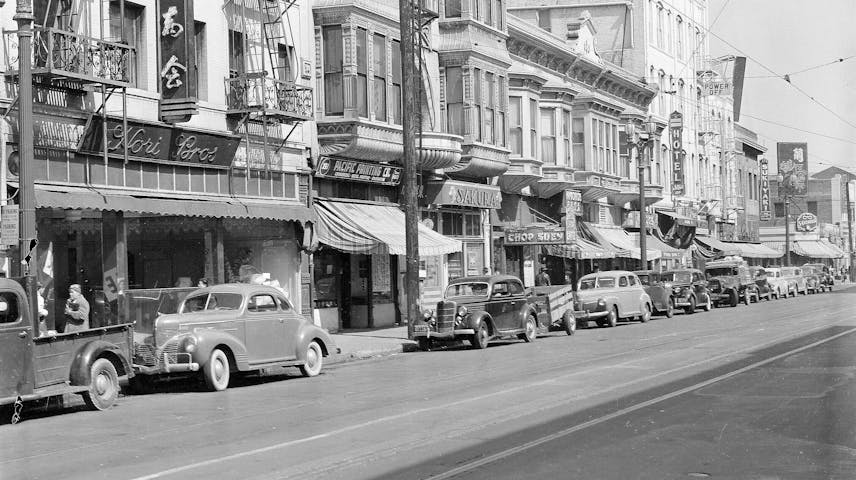
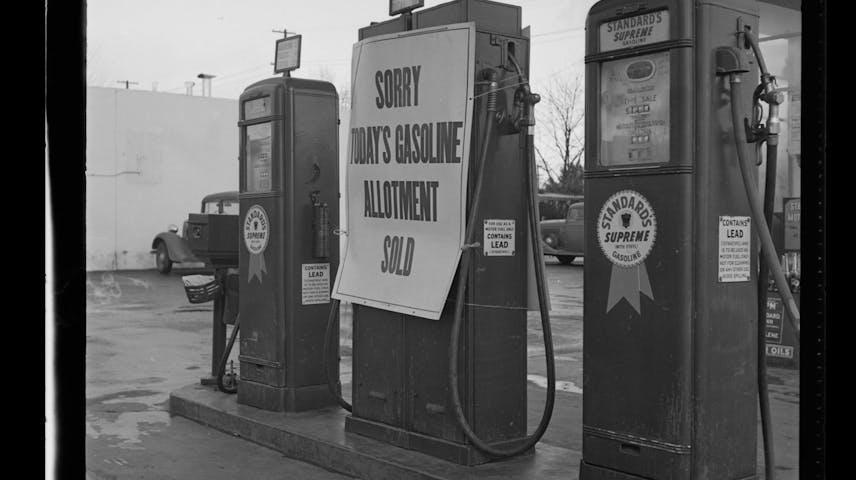
Display or circulate the photos from “Daily Life on the Homefront” (Spark Resource Set #1). Lead discussion of the photos and provide needed background knowledge specific to each photo, such as:
“Wartime Gas Rationing,” “Horse Meat”: Rationing was a big part of the wartime economy. Households were limited in how much of certain foods and other essentials they could buy, even if they had the money. People made do with substitutes that were not rationed.
“Let’s Get It Over”: To support the war effort, Americans lent money to the government through a program called War Bonds. Like today’s savings bonds, these gained interest and could be turned in for cash when they matured.
“Work for All”: Dorothea Lange was optimistic in saying that “everyone was welcome,” but it was true that the war economy opened opportunities to groups that historically had faced severe discrimination in the workforce.
With many men deployed overseas, women took on new roles, including blue-collar jobs that had been previously deemed “men’s work.” The famous “Rosie the Riveter” poster shows the government’s encouragement of this trend.
Many Black workers found employment in factories and shipyards, sometimes with the support of anti-discrimination directives to keep wartime production levels high. Some Black civic and business leaders urged cooperation with the war effort as an opportunity to fight both the Nazi threat abroad and racism at home.
These trends obviously contrast with the intensified discrimination against Japanese Americans.
Say these Directions: Analyze the photos from “Daily Life on the Homefront.” As you look closely, listen for important background information about each image. Then, turn and talk with a partner to compare how the article and the photos present the lives of Japanese and Japanese American communities in the United States, including their cultural life. As you discuss, think about what each source shows, emphasizes, or leaves out, and how that shapes your understanding of the time period:
Ask: What do you understand from the article about Japanese and Japanese American communities? What do you want to learn more about?
I understand that these communities were in some ways isolated, with their own newspapers and hospitals and law firms. But in other ways, places like Little Tokyo were strongly connected to the culture and economy of the rest of the city and country. What I want to understand is how and why non-Japanese people suddenly decided that their Japanese neighbors were spies. Did the government promote this view because of the war?
Ask: In what ways was the response to Pearl Harbor a break with past treatment of Japanese Americans? In what ways was it a continuation?
Japanese Americans had faced significant discrimination, including under the law, well before Pearl Harbor. In one sense, the forced relocation and internment of Japanese Americans were an extension of this discrimination. [Toward the end of the article, museum director Kristen Hayashi describes “a long arc of discrimination” extending well before Pearl Harbor.] However, despite the discrimination, Japanese Americans had been able to “put down roots” in places like Los Angeles, establishing schools and businesses and places of worship. Wartime relocation and imprisonment tore up these roots in a way that seems unprecedented.
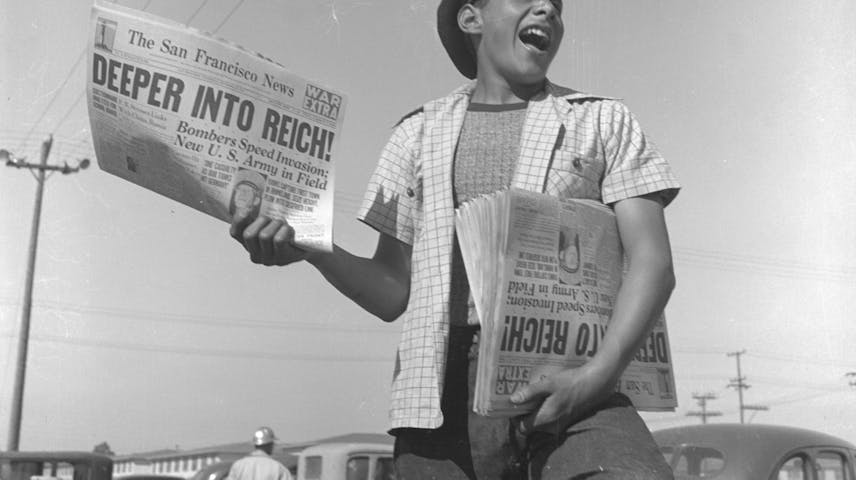
Once you have observed the photos and answered the questions, you will use your Key Terms and Topics graphic organizer to record important historical events, policies, and key details that help you build context for what you are learning.
Teacher Tip |
|---|
To help students deepen background knowledge, encourage them to briefly research the United States’ policy toward involvement in the war before Pearl Harbor and its conflicts with Japan leading up to the declaration of war. Set the stage by explaining that isolationism—opposition to getting involved in World War II—was a popular view in the U.S. right up until the attack on Pearl Harbor. |
Check for Understanding (RI.7.6, RI.7.7) |
|---|
Write 1-2 sentences explaining how the article and photos present life before Pearl Harbor. In your response, be sure to:
|
Remind students that in this unit, they will be reading a text titled Seen and Unseen. Discuss what it means to be “seen and unseen” in both literal and figurative senses.
Say these Directions: Think about the ideas of perspective and purpose. As we discuss, consider bias, representation, and what gets remembered, and why. Share your ideas as we record them on a Collaborative Idea Board, and connect your thinking to how photographs shape what people understand and remember.
Ask: Is it possible for a photographer to be biased, or do photos—assuming they are not heavily edited—merely present neutral facts?
I think it is possible for a photographer to be biased because photographers choose what subjects to photograph and which photos to develop or publish. Even when there is not a political issue at play, photographers pick and choose what to show: a wedding photographer picks the photos that show the couple looking happy and elegant. Individual photos may present facts by showing that a specific thing happened in front of the camera at a specific time. But if you only show the “good facts” or the “bad facts” about something, you are presenting a biased perspective.
Ask: How does a photographer’s perspective come through in their work?
A photographer’s perspective shows up in their work in the people, things, and moments they choose to photograph. We can learn what a photographer considers important by noticing what they include and what they leave out. For instance, two photographers might visit a national park and photograph it from different points of view. One might be focused on the natural beauty of the place and take lots of photos that show the landscape but have few or no people in them. Another might want to show how people enjoy and experience the park and include hikers, campers, etc. in their photographs.
Review the Essential Questions that will guide your thinking and learning throughout this unit.
How do historical records—texts, images, and testimony—shape what is remembered about the past?
How can readers evaluate words and images for accuracy, perspective, and ethical use?
As time permits, identify and preview key terms from these questions, such as testimony.
Provide students with a confidence continuum (i.e., 1–5). As needed, model how to demonstrate a level of confidence using the continuum.
Reflection (RI. 7.6) |
|---|
Reflect on your ability to analyze how a photographer’s perspective and purpose influence what is shown, what is left out, and how events are understood using the Reflection routine.
|
Transition students into the Lesson Look Back by providing them with the 3-Column Chart graphic organizer.
Say these Directions: Create a 3–2–1 summary focused on the phrase “Thriving Japanese Communities.” Think about what it means for a community to thrive as you complete your summary.
3 important words/phrases
2 key details or Ideas
1 sentence explaining what the text is mostly about (gist sentence)
3 Important Words/Phrases | 2 Key Details or Ideas | 1 Sentence Explaining What the Text Is Mostly About |
|---|---|---|
1. Little Tokyo/Japantown 2. Fish Harbor 3. Mochi ice cream | 1. Japanese Americans built their own institutions such as hospitals because they were excluded from mainstream ones. 2. Japanese and Japanese American workers were hugely important to the agriculture and fishing industries. | Japanese immigrants and their descendants formed strong, close-knit communities within Los Angeles and other West Coast cities, but these communities were uprooted soon after war broke out between the United States and Japan. |
Students read their independent reading book for 20 minutes and complete a reading log entry.
Read your independent reading book for 20 minutes. In your reading log, record the date and pages you read, write 1–2 sentences about what happened or what you learned, and respond to this week’s prompt using evidence from the text.