Loading course navigation
Loading lesson
50 min
Student Lesson
Lesson 6: Seen and Unseen, Part 2
Foundational Skills
Students will use Latin roots and affixes to support acquisition of a domain-specific vocabulary word.
Content
Students will read an official government document enacting the policy of Japanese American incarceration.
Language
Students will summarize and interpret a government document by citing text evidence, using contrastive language to name omissions, and using evaluative verbs to explain how official documents show point of view.
How do historical records (texts, images, and testimony) shape what is remembered about the past?
Knowledge-Building:
Students will engage with the language of a primary source document detailing how the incarceration policy would be implemented in one area.
Enduring Understanding:
Official documents express a perspective; they are not necessarily neutral and objective.
Future Lessons:
In Lesson 7, students will conduct a mini-analysis of another primary source. Then, in Lesson 8, students will read about and examine the photographs of Dorothea Lange, one of three photographers whose work is detailed in Seen and Unseen.
Unit Performance Task:
Official documents reflect one influential, but limited and biased, perspective on how and why Japanese American incarceration took place.
| Lesson Flow | Purpose of Learning Experience |
|---|---|
Launch5 Minutes | Students will use a turn-and-talk discussion to activate their homework reading of Seen and Unseen pp. 8–15 and compare it to their knowledge of the word forced removal. |
Literacy Lab10 Minutes | Students will be introduced to the morphology and etymology of the vocabulary word incarceration. |
Learning in Action30 Minutes | Analyzing Perspectives of “Instructions to All Persons of Japanese Ancestry” (RI.7.6) Students will summarize and identify key ideas of a local order implementing incarceration, identify its point of view based on text evidence, and consider its likely effects on Japanese Americans. |
Material List
Unit 2 Lesson 6 Student Edition
Seen and Unseen by Elizabeth Partridge and Lauren Tamaki, pp. 8–15
Routines
Turn-and-Talk
Morphology & Vocabulary
Check for Understanding
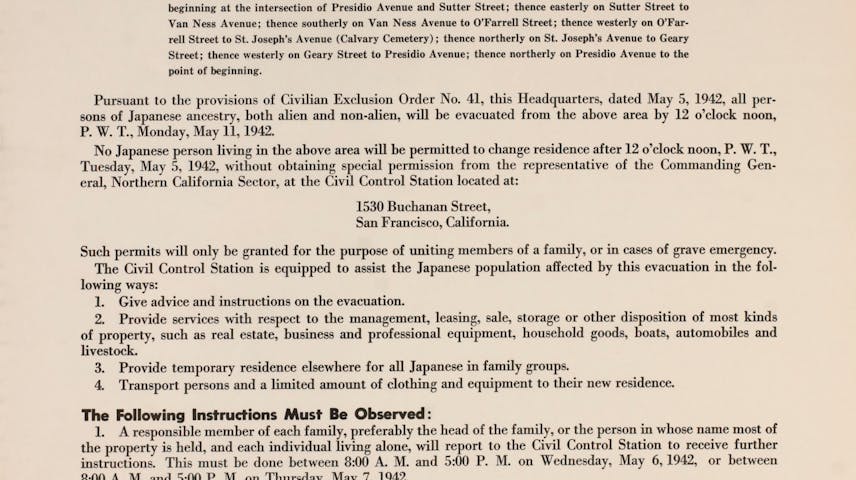
Have students take out their annotations of “Instructions to Persons of Japanese Ancestry,” the document shown on Seen and Unseen p. 13.
Lesson 5 homework: Students were to continue reading Seen and Unseen through p. 15 and read the document, "Instructions to All Persons of Japanese Ancestry" on p. 13, annotating anything they may want to use for the Performance Task at the end of the unit.
Say these Directions: Look at the phrase forced removal and its definition from your reading yesterday, then share your responses with your partner.
Ask: Does this phrase have a positive or a negative feeling to you? Why?
Negative, because it means something dangerous is happening, like a fire or storm.
Positive, because it means getting away from danger.
Ask: Look at the layout of the “Instructions to All Persons of Japanese Ancestry” notice on page 13. It uses numbered steps and official language. How does the design of this document make the phrase forced removal sound routine? What would be different if the same information were written as a personal letter to each family?
With your partner, think back to pages 8–15 of Seen and Unseen and discuss whether the definition of forced removal matches what you read. As you talk, consider the following:
Ask: Were the Japanese Americans in danger?
No, the government claimed that Japanese Americans were themselves dangerous.
Ask: Were they taken to a place of safety?
No, the camps were likely no safer for the people living there than their homes would have been.
Ask: Does the use of the phrase forced removal match other ways that you have used it?
No. Usually, when people are evacuated, it is because of a sudden nearby danger like a wildfire or a flood, not to round them up as prisoners in camps.
Teacher Tip |
|---|
Students may have had varying experiences with forced removal. If appropriate, allow time for students to bring in these experiences briefly, while guiding students to the idea of going from danger to safety. |
Connection to Today’s Learning
Say: Today, you’ll read the text of a notice telling Japanese Americans to report to camps such as Manzanar. You will examine the language that the U.S. government used to explain this action and will think critically about the point of view and central ideas of the notice. We will consider together how words like forced removal can shape understanding of events.
Teacher Tip |
|---|
Provide students with “Instructions to All Persons of Japanese Ancestry and Glossary of Terms.” They will use the Glossary in this activity. The version of the Instructions provided in this document is very similar to the one reproduced in Seen and Unseen on p. 13, but is from May 5, 1942, and applied to San Francisco. |
Say these Directions: Today, we are going to study one word closely: incarceration. We will break it into meaningful parts, make a smart first guess, and then use a glossary or dictionary to verify exactly what the word means in this lesson.
Say: When I see a long word like incarceration, I do not try to memorize it all at once. I look for parts that carry meaning. I notice the ending -ation, and that ending often tells me the word names an act, process, or result. In the middle, I see carcer, a Latin root connected to prison.
Ask: What does the suffix -ation tell you about the word incarceration?
The suffix -ation shows that the word names an act or process, so incarceration is the process of imprisoning or confining people.
Ask: Based on the root and suffix, what is your best first guess about the meaning of incarceration?
My first guess is that incarceration means putting people into prison or keeping them confined.
Say these Directions: In your Personal Dictionary, write incarceration. Circle in-, underline carcer, and circle -ation. Then write a first-guess definition in your own words.
Say these Directions: Now consult the glossary in the text set or a digital or print dictionary to check the pronunciation, part of speech, and precise meaning of incarceration. Revise your definition if the reference material gives you a more exact meaning.
Ask: After checking a reference material, how would you define incarceration in this lesson?
In this lesson, incarceration means imprisoning Japanese Americans without criminal charges, so it is more specific than just saying they moved or left.
Prompt students to use a dictionary, glossary, or other reference material to confirm the meaning they inferred.
Say these Directions: Check your definition using a dictionary, glossary, or other reference material. Does the definition match what we figured out? Revise as needed.
Erase/Hide: Stop displaying the word.
Directions: Write the word incarceration from memory in your Personal Dictionary.
Say: Display the word and check or correct your spelling.
Say: Circle the prefix, underline the root, and circle the suffix.
Ask: Which part of the word helped you remember how to spell it?
The ending -ation helped me because I know that spelling pattern from other long words, and it reminded me how the word ends.
🎯 PURPOSE Support students in using morphology and reference materials to determine and verify a precise meaning of incarceration. Language Focus: Prefix, root, and suffix language Definition and revision language Verification language using glossary and dictionary terms |
|---|
🗣️ SAY / ASK Prompt students to say a first-guess definition before they consult a reference so they can compare how their thinking changes. Revoice student ideas with precise academic language, especially words like confine, imprison, process, and verify. _"You said 'it means being stuck somewhere' — we can explain that by saying 'it means being confined or imprisoned.'"_ _"You said 'the ending makes it a thing' — we can say 'the suffix -ation shows that the word names an act or process.'"_ My first guess is that incarceration means ___ because I notice ___. The suffix -ation helps me think the word means the act or process of ___. After checking the glossary or dictionary, I want to revise my definition to ___. |
👁️ WATCH FOR / SUPPORT IF NEEDED Invite students to connect incarceration to related words or cognates they know in another language and discuss how that prior knowledge supports meaning-making. Allow students to rehearse their revised definition with a partner before writing it in their Personal Dictionary. If students identify -ation but cannot explain how it helps with meaning → _Prompt:_ "What kind of words end in -ation? Do those words name an action, a process, or a person?" If students copy the glossary definition without revising in their own words → _Prompt:_ "Say it in your own words now. What did the reference material help you confirm or change?" Student names a meaningful word part and uses it to state a reasonable first-guess definition. Student revises the first guess after consulting a glossary or dictionary and explains what new detail made the definition more precise. |
Check for Understanding (L.7.4.c, L.7.4.d) | |
|---|---|
In your Personal Dictionary, write incarceration, label its parts, and write a revised definition that shows what you learned from a glossary or dictionary. Add one sentence explaining how the reference material confirmed or changed your first guess. | |
Teacher Tip: If students only copy the definition, prompt: Which part was your first clue, and what detail from the glossary made your definition more precise? |
Say: Understanding incarceration will help you notice how word choice shapes meaning when you read the government notice. As you read, pay attention to how official language can make imprisonment sound orderly or ordinary.
Teacher Tip |
|---|
Note that 'evacuation' was the government's term. In our discussions, we use 'incarceration' because it more accurately describes what happened — Japanese Americans were imprisoned without trial or due process. This morphology lesson uses 'incarceration' because we are analyzing the word itself, not endorsing it. |
Say these Directions: Use the guiding questions to support your annotations and summaries to the following sections:
Group A will read and summarize the section “. . . Living in the Following Area,”
Group B will read and summarize “The Following Instructions Must Be Observed.”
After 10–12 minutes, the groups switch passages.
Group A Questions
Ask: Who is being addressed?
The document addresses “persons of Japanese ancestry,” including “alien and non-alien” persons—meaning Japanese immigrants who had not become citizens as well as Japanese American citizens.
Ask: What geographic areas are included?
The document describes a precise area that spans parts of Los Angeles County, including the City of Los Angeles and Santa Monica.
Ask: Based on this section, who has to follow the instructions?
Anyone in that area who had Japanese ancestry, regardless of legal status in the United States, age, gender, or job.
Group B Questions
Ask: What specific rules were imposed?
Japanese Americans had to pack up their personal supplies and report to a station within two days.
Ask: What restrictions are emphasized?
Large furniture and pets were not allowed. People could not take their own cars to the reception center.
Ask: How do you think this would affect people who had to go to the camps?
People had to rapidly store, sell, or otherwise dispose of goods they could not carry. They had to make arrangements very quickly for any businesses they might have owned and for anyone or anything they were responsible for caring for—pets, gardens, relatives outside the designated area.
Use the following questions to help you summarize your section.
Ask: Who is in charge, and how do you know?
The government, by listing an order, by saying what “will” happen; because it is signed by a person with a military title.
Ask: What does the writer want you to think the government is doing for the people who have to leave?
Helping them, giving advice, being clear.
Ask: Whose perspective is this document from?
This is telling the government’s point of view, and it makes the process sound very orderly and organized.
Ask: What does the writer want readers to think and feel about the order?
That it is fair and helpful; that it must be followed.
Ask: What does the document NOT tell us about the people affected?
The document does not tell us about the upheaval the forced removal caused in the lives of Japanese Americans, when they could go home, or what happened to the homes and belongings that they left.
When groups are done with their summaries, have the groups report to the class.
Help students reconnect to the Essential Question:
Say: What we see in this document is one version of the story. However, it doesn’t show much about the lives of the people who were living in that area, either before or after they had to go to the camps. This is where our Essential Question becomes important: How do we decide whose stories are remembered? How can we learn about the stories that were left out? Today we are beginning to uncover the stories behind the document.
Reflection (RI.7.6) |
|---|
Reflect on your ability to analyze perspective and language in informational texts using the Reflection routine.
|
Have students write a brief response analyzing perspective and missing voices using text evidence. Use responses to assess understanding of the point of view and the Essential Question.
Say these Directions: Write a brief response explaining whose perspective is shown in the Instructions notice and whose perspective is missing. Use at least two details from the text to support your thinking, and explain how this connects to the Essential Question.
Ask: Whose perspective is conveyed in the Instructions notice? Give two details that show how you know. Based on what you have read in Seen and Unseen, whose point of view is missing? How does this help us think about our Essential Question?
The Army heading and saying what will and won’t “be permitted” shows that this document is from the point of view of the government. The perspective of the Japanese Americans who had to follow the orders is missing. This relates to the Essential Question because if we only had these kinds of documents to learn about World War II, we would miss a big part of what happened.
Instruct students to take notes in their Journal on the following prompt:
Review what you have read so far in Seen and Unseen. In your Journal, make notes about topics you may want to explore in the next lesson, which is the first writing lesson of the unit. There, you will write a mini-analysis of a primary source related to Japanese American incarceration.
Seen and Unseen
Elizabeth Partridge & Lauren Tamaki

Instructions to All Persons of Japanese Ancestry and Glossary of Terms
National Parks Service